
Calm Music for Stress: How to Choose Music That Actually Calms You, and a 10-Minute Music Break
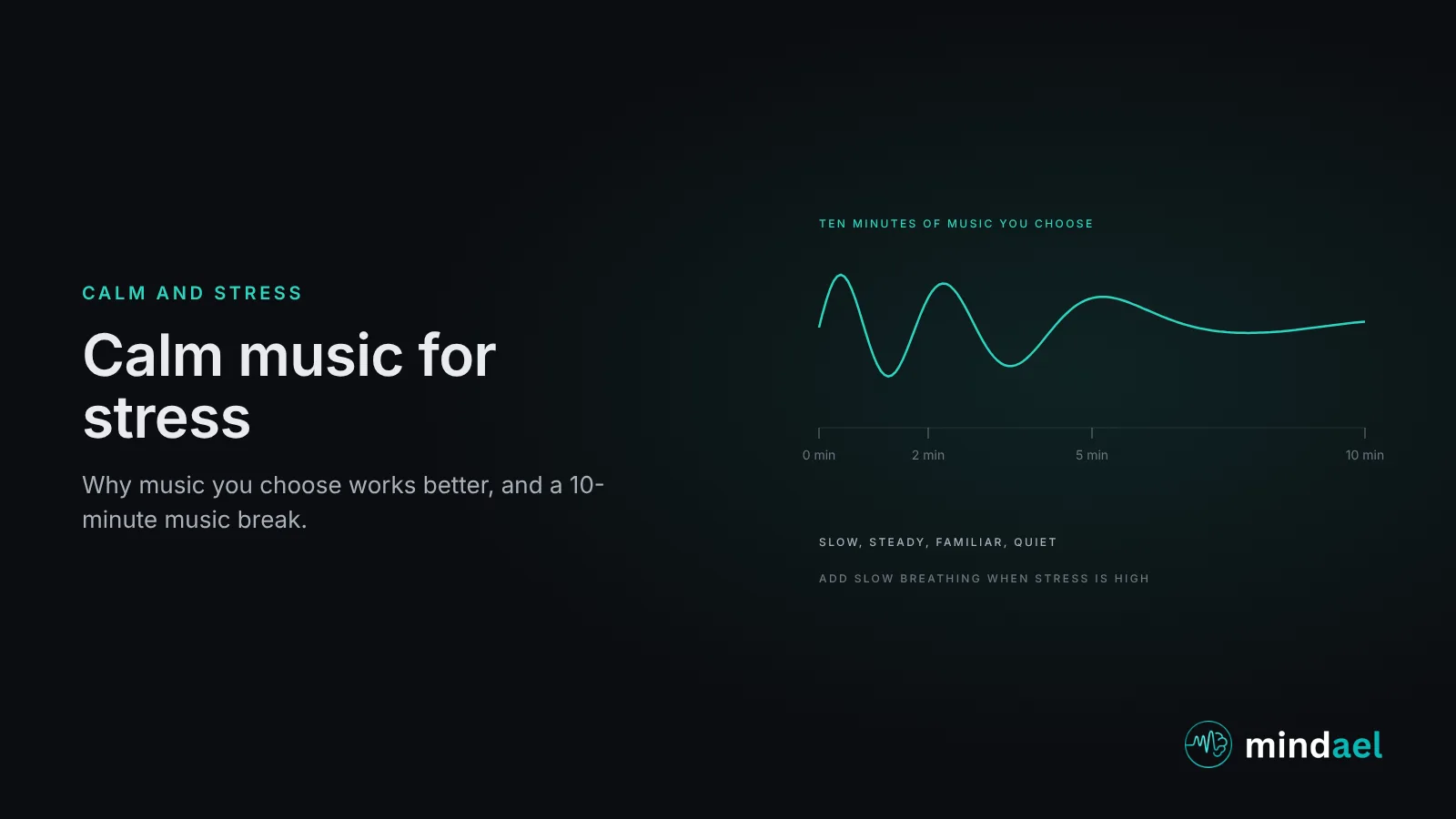
Calm music can take the edge off stress, but which music you play matters more than the label on the playlist. In a study that stressed people with a speech task and mental arithmetic, ten minutes of music they chose themselves reduced negative feelings more than listening to a radio documentary, in younger and older adults alike. A meta-analysis of 104 trials found music had a small to medium effect on stress markers such as heart rate and cortisol, and a medium effect on how stressed people felt, though a later meta-analysis of short-term stress recovery in healthy people found no clear overall effect, with results depending on genre, tempo and who chose the music. So treat calm music as a modest, safe tool: pick slow, steady, familiar tracks you already find soothing, give it about ten minutes, keep the volume low, and pair it with slow breathing when stress is high.
Calm music for stress is one of the simplest things you can reach for in a tense day. It works best when you choose it well and use it on purpose. This guide covers what the research honestly shows, why your own choice of music matters, and a ten-minute music break you can take anywhere. We make Mindael, a sound app with calm sounds for stressful moments, free to download on the App Store.
What the research shows
The broad picture is positive but modest. A meta-analysis of 104 randomised trials found that music had a small to medium effect on physical stress markers such as heart rate, blood pressure and cortisol, and a medium effect on how stressed people felt (de Witte et al., 2020).
Short-term recovery is less clear. A later meta-analysis of experiments in healthy people, looking at how fast they recovered after a stressor, found no clear overall effect. Results varied with genre, tempo and whether people chose the music themselves (Adiasto et al., 2022). Calm music is a useful tool, not a guaranteed fix.
Your own choice matters
One detail keeps coming up: who picks the music. In a study where people were stressed with a speech task and mental arithmetic, ten minutes of music they chose themselves reduced negative feelings more than ten minutes of a radio documentary, in both younger and older adults (Groarke and Hogan, 2019).
A playlist called “calm” only helps if it calms you. Good signs that a track will:
- Slow and steady, with no sudden drops or swells.
- Familiar, so you are not following it to see what comes next.
- Mostly instrumental, so words do not start a new train of thought.
- Soothing to you, even if it is not on anyone else’s list.
A 10-minute music break
- Pick one track or sound you already find calming.
- Turn the volume low, just above the room.
- Breathe out longer than you breathe in for the first two minutes. Our calm breathing guide shows how.
- Let attention rest on the sound. When thoughts pull you away, come back to it.
- Stop after ten minutes and notice how you feel before you go back to the task.
If melody keeps your mind busy, try steady sounds instead: soft rain or ocean waves work like slow music without a tune to follow.
What kind of calm music works for which kind of stress
Stress is not one thing, and the music that helps depends on how it shows up.
| How the stress feels | What tends to help |
|---|---|
| Wired, heart racing, cannot sit still | Slow, steady music or a sound with no beat: soft drones, ocean, slow piano |
| Mind looping on a problem | Instrumental music with a gentle melody to follow, so attention has somewhere else to go |
| Flat, drained, low after a hard day | Warm, familiar music you love, even if it is not slow |
| Tense in a noisy place | A steady sound that covers the room, such as brown noise or rain |
The first row is where most “calm music” playlists aim. The others matter just as much. If you are drained rather than wired, the slowest ambient track may do less for you than an old favourite.
Calm music at work, in the evening and before sleep
At work. Keep it instrumental and quiet, so it does not compete with reading or writing. Ten minutes between meetings does more than a whole day of background music you have stopped hearing. If you need to concentrate afterwards, switch to a steady sound; our guide to listening to music while studying explains why words get in the way.
In the evening. This is the best time for a longer session. Twenty to thirty minutes of calm music while you cook, stretch or sit marks the end of the working day. Dim the lights and put the phone face down, so the music is not a soundtrack to scrolling.
Before sleep. Choose something slower and softer still, with no vocals, and let it stop on its own after you fall asleep. Our calm music for sleep guide covers what to play, and our sleep music for anxiety guide is for nights when worry is the problem.
Common mistakes
- Playing it too loud. Loud music raises arousal, whatever the genre. Just above the room is enough.
- Using it as background all day. Music you no longer notice is not doing much. Short, deliberate breaks work better.
- Following someone else’s playlist. If a track irritates you, it is not calm music for you. Swap it.
- Choosing songs with strong memories. A song tied to a hard time can pull you back there. Pick neutral or happy associations.
- Expecting it to fix the cause. Music changes how you feel for a while. It does not answer the email or have the conversation.
When music is not enough
If your body is still tense after ten minutes, add something physical: slow breathing, a short walk, or the techniques in how to calm down. A stress meditation is a good next step if you want a daily practice. And if stress is there most days for weeks, treat that as a reason to talk to a doctor, not a reason for a better playlist.
The short version
Calm music lowers stress modestly, and music you choose yourself works best. Pick slow, steady, familiar tracks, give it about ten minutes, keep it quiet and add slow breathing when stress is high. For deeper reading, see our relax music for stress guide. For calm sounds you can play anywhere, Mindael is free to download on the App Store, and our anxiety sounds guide has more.
Ten calm minutes, whenever you need them.
Mindael has soft drones made in our studio, rain and ocean recorded without loops and brown noise generated to spec, two at a time, to play quietly through a stressful afternoon. Free to download, no account, works offline.
- Soft drones, rain, ocean and brown noise
- Two sounds at once, each with its own level
- Free to download, no account, works offline
 Free · No account needed · Works offline
Frequently asked questions
Does calm music really help with stress?
Modestly. A meta-analysis of 104 trials found music lowered stress markers and how stressed people felt. A later review of short-term recovery found mixed results, so it works best as one tool among several.
What is the best calm music for stress relief?
Music you choose yourself and already find soothing: slow, steady, familiar and mostly instrumental. In one study, self-chosen music reduced negative feelings after a stressful task better than a radio documentary.
How long should I listen to calm music for stress?
About ten minutes is a good start; that is what helped in the self-chosen music study. Longer is fine if it keeps helping.
Is nature sound as good as calm music?
For some people, yes. Rain or ocean waves work like slow, steady music without a melody to follow. Try both and keep the one that settles you.
Should calm music be loud?
No. Keep it low, so it fills the background rather than demanding attention.
Can music replace treatment for stress or anxiety?
No. If stress is constant or affecting sleep, work or mood, talk to a doctor or therapist. Music is a support, not a treatment.
Sources
- Groarke JM, Hogan MJ. Listening to self-chosen music regulates induced negative affect for both younger and older adults. PLoS ONE, 2019.
- de Witte M, et al. Effects of music interventions on stress-related outcomes: a systematic review and two meta-analyses. Health Psychology Review, 2020.
- Adiasto K, et al. Music listening and stress recovery in healthy individuals: a systematic review with meta-analysis of experimental studies. PLoS ONE, 2022.
This article is for general information and is not medical advice. If stress or anxiety is constant or affecting your daily life, please talk to a doctor or therapist.
This article is part of our anxiety, stress and panic guide. Hear the sounds in this article in the Mindael sound library, or see our app comparison checklists.