

White Noise for Babies: How to Use It Safely for Newborns, Toddlers and Older Kids
White noise is the oldest trick in the newborn book, and one of the few with a study behind it: in 1990, four out of five newborns fell asleep within five minutes with white noise playing, against one in four without. The whole question for parents is not whether it works but how to use it safely, and that is what this page is about. Every sound here is in Mindael, free to download on the App Store, with a timer that fades so the sound does not run all night by default.
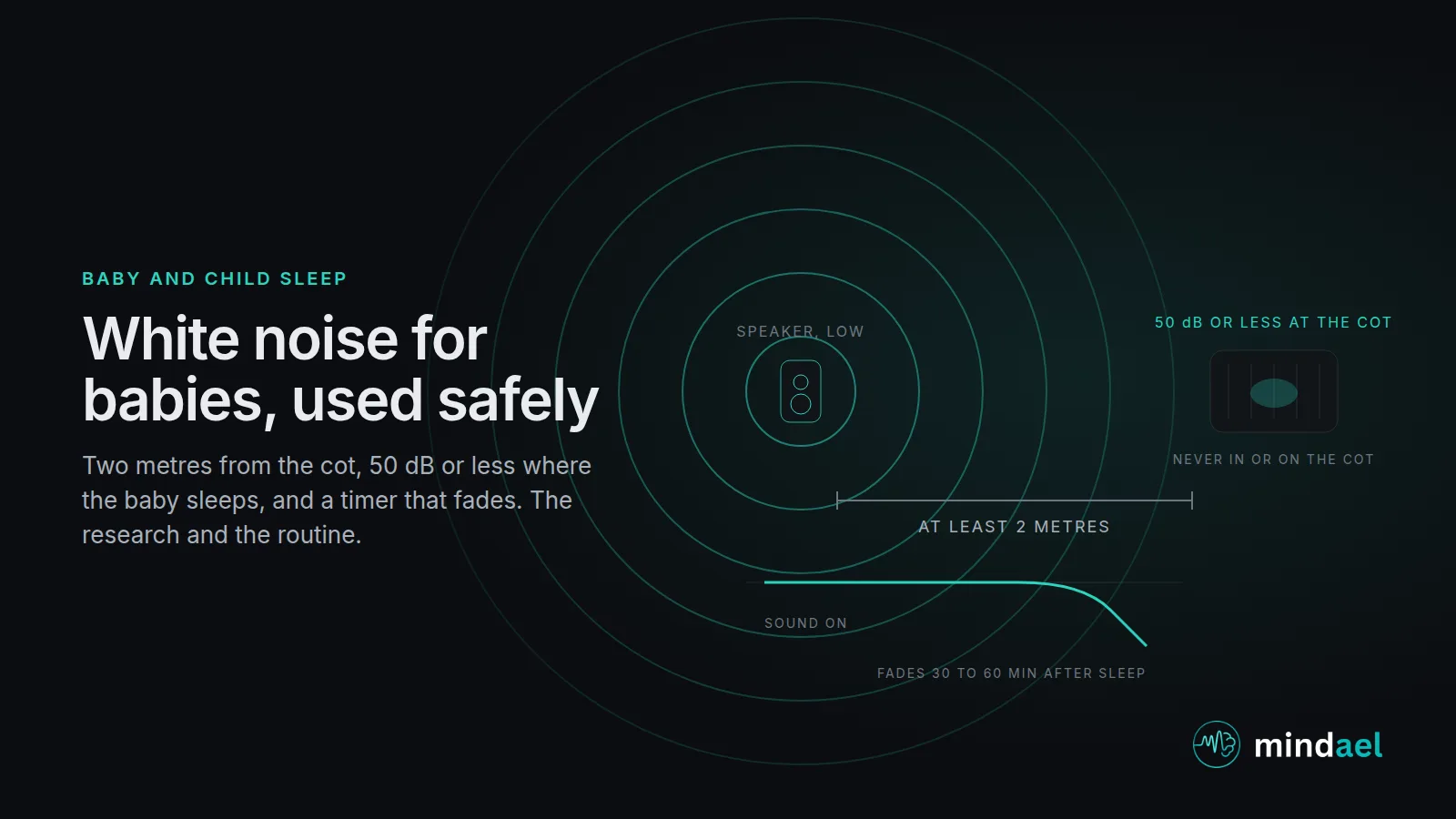
White noise helps most babies settle because it covers the sudden household sounds that wake them and resembles the constant noise of the womb. Use it safely: no louder than 50 dB measured at the cot, which is a quiet conversation; speaker at least two metres from the baby and never in or on the cot; a timer that fades after the baby is asleep rather than all-night play; and lower, softer pink noise as the child grows. It is a sleep aid, not a safe-sleep measure: back to sleep, on a flat firm surface, in the parents' room, comes first.
Sounds that work, and why
White noise
The sound used in the newborn study and the strongest masker for sudden sounds: a door, a sibling, the street. Keep it low; newborns need less than you think.
Pink noise
Softer at the top end, closer to steady rain. The better choice from around six months on, and for any child who finds white noise harsh.
Rain
For toddlers and older children who want something that sounds like weather rather than a machine. Recorded, not looped, so there is no seam to notice.
Brown noise
For teenagers with a loud house or a racing mind at bedtime. Deep and featureless, and the color most adults end up with too.
Why white noise works for babies
A newborn has spent nine months inside a body: a constant rush of blood flow and digestion, louder than a vacuum cleaner by some estimates, with no silence at all. Then they arrive in a quiet room where every sound is sudden. White noise does two things at once. It gives back a steady background, and it covers the sudden sounds, a closing door, a sibling, a dog, that pull a light sleeper out of a sleep cycle.
The study everyone cites is small but clear. In 1990, 40 newborns were tested at a London hospital: with white noise playing, 80 percent were asleep within five minutes; without it, 25 percent (Spencer et al., 1990). Adult research says the same thing in slower motion: steady broadband sound shortened the time to fall asleep by about 38 percent in a 2017 lab study (Messineo et al., 2017). Our white noise page covers how the sound itself works.
The safety rules, and where they come from
Level: 50 dB at the cot. In 2014, researchers measured 14 infant sleep machines and found that at maximum volume several exceeded 50 dB, the level recommended for hospital nurseries, at a typical cot distance, and some exceeded it even at two metres (Hugh et al., 2014). Fifty decibels is a quiet conversation. Measure where the baby’s head is, not at the speaker; a sound-meter app is accurate enough for the purpose.
Distance: two metres, never in the cot. Sound pressure falls with distance, so the same speaker across the room is a fraction of the level it is on the cot rail. The 2014 authors’ first recommendation was simply to move the machine as far from the baby as possible. Nothing goes in or on the cot in any case, which is the safe-sleep rule below.
Duration: a fading timer, not all night by default. The reason for caution here is animal research: continuous moderate noise delayed the development of the auditory cortex in rat pups (Chang and Merzenich, 2003). That is rats, at continuous exposure, and it has not been shown in babies. But it is enough that we would use a 30 to 60 minute fade for most nights and reserve all-night play, kept very low, for genuinely loud homes.
Safe sleep comes first. White noise does not reduce the risk of sudden infant death and nothing on this page replaces the basics: back to sleep, a flat firm surface with nothing in it, in the parents’ room for the first six months, no overheating (Moon et al., 2022). The sound is a settling aid on top of that, not a substitute for any of it.
The routine that works
Start the sound before the last feed or story, at the level you measured, from the same place every night. Babies learn cues faster than anything else, and within a couple of weeks the sound starting is the signal that sleep is coming. Keep it running through the settling, set the fade, and leave the room before it ends. If the baby wakes between sleep cycles and the sound is still there, they often settle without you; if it has faded, the same quiet background you leave them in is what they wake to, which is the point of the fade.
For night wakes, restart the sound rather than turning the lights on. Same level, same fade.
Newborn to teenager: what changes
0 to 6 months. White noise at 50 dB or less, two metres away, fading timer. This is the window the research covers.
6 months to 2 years. Move to pink noise, which has less energy in the high frequencies and sounds like steady rain rather than a hiss. Lower the level a notch at the same time. Babies this age are more sensitive to the top end of white noise and no longer need the womb-like density.
Toddlers and preschool. Rain, ocean, or pink noise at a low level, started as part of the bedtime story. Many children stop needing it here; if yours sleeps through without it on holiday, let it go.
School age and teenagers. The adult setup: brown noise or rain, a fading timer, speaker across the room, and the phone out of the bedroom. Our sleep sounds guide has the full version, and the breathing guide has a slow-breathing pattern older children can use for the minutes before sleep.
Stopping
Taper rather than stop. Lower the volume by a step every few nights for a week or two, then shorten the timer, then skip it on a night the child is already tired. If sleep gets worse, go back one step and hold for a week. There is no age by which white noise must be gone; there is only the child in front of you.
Choosing the app
The same low-volume logic applies to the other sensitive ears in the house: our music for dogs guide covers what the kennel research found and how loud is safe for a dog.
Any sound app can play white noise. The things that matter for a baby are a volume control fine enough to set 50 dB and leave it, a timer that fades rather than cuts, true pink and brown noise for the later stages, and no stream that drops at 3 a.m. Our best white noise app checklist goes through each one.
How to set it up tonight
- Put the speaker across the room, not in the cotAt least two metres from the baby, pointing away. Never in, on or clipped to the cot. Distance is the simplest volume control you have.
- Set the level at the cot, not at the speakerStand where the baby's head will be. It should sound like a quiet conversation, 50 dB or less. A free sound-meter app on your phone is accurate enough for this.
- Start it as part of the wind-downSame sound, same level, every night, started before the last feed or story. The sound becomes the cue, and cues are what make bedtime shorter over time.
- Use a timer that fadesSet it to fade out 30 to 60 minutes after lights out. The baby needs help falling asleep, not a machine running eight hours at the ear.
- Review it every few monthsNewborn white noise becomes pink noise at six months, rain by toddlerhood, and nothing at all for many children by school age. Lower the level each time you review.
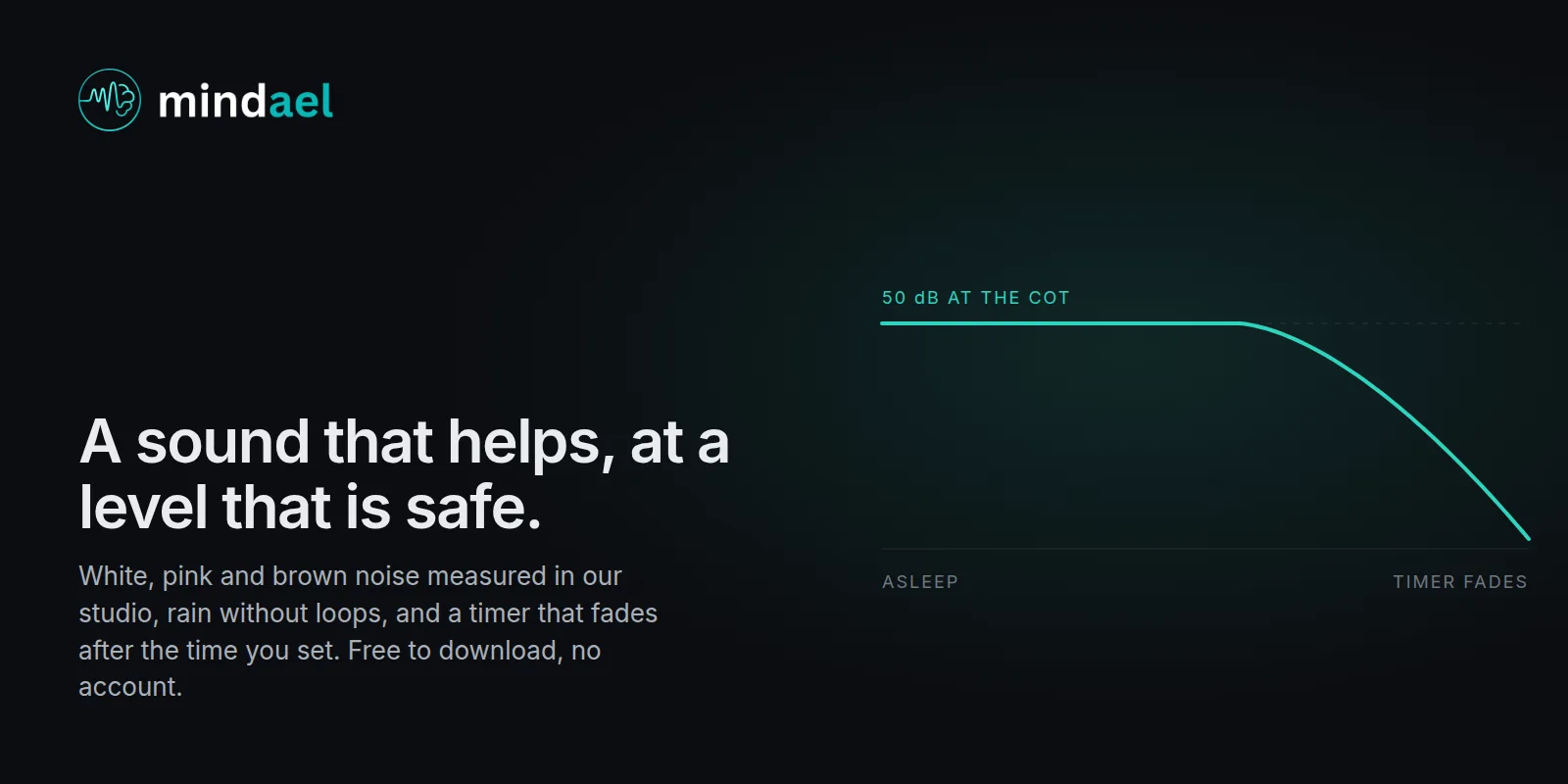
A sound that helps, at a level that is safe.
Mindael has white, pink and brown noise measured in our studio, rain and ocean recorded without loops, and a timer that fades after the time you set. Put the phone across the room, set the level at the cot, and let the fade do the rest. Free to download, no account, works offline.
- White, pink and brown noise, measured; rain and ocean, no loops
- Timer that fades after 30 to 60 minutes
- Free to download, no account, works offline
 Free · No account needed · Works offline
 Frequently asked questions
Is white noise safe for babies?
At a low level and a distance, yes. The caution in the research is about volume: a 2014 study found several infant sleep machines could exceed recommended limits at maximum volume, so keep the speaker across the room and the level at or below 50 dB where the baby sleeps. It is a sleep aid and never replaces safe-sleep basics.
How loud should white noise be for a baby?
No louder than 50 dB measured at the cot, which sounds like a quiet conversation or a soft shower in the next room. The limit comes from hospital nursery guidance and the 2014 Pediatrics study. If you have to raise your voice over it, it is far too loud.
Where should I put the white noise machine?
At least two metres from the cot and never inside or attached to it. Doubling the distance from the speaker roughly halves the sound pressure, so distance does most of the safety work for you.
Should white noise play all night for a baby?
We recommend a timer that fades 30 to 60 minutes after sleep for most babies, with all-night use reserved for genuinely loud homes and kept very low. Animal research on continuous noise and auditory development is the reason to be cautious about eight hours at a time, even though it has not been shown in babies.
When should I stop using white noise for my baby?
There is no hard date. Many families move to softer pink noise around six months, to rain or nothing for toddlers, and drop it when the child no longer notices it is gone. Taper the volume rather than stopping suddenly, over a week or two.
Does white noise help toddlers and older children sleep?
Yes, in the same way it helps adults: it covers the household sounds that wake light sleepers. For toddlers, rain or pink noise at a low level; for older children and teenagers with a loud house, brown noise and a fading timer, the same setup in our sleep sounds guide.
Sources
- Spencer JA, Moran DJ, Lee A, Talbert D. White noise and sleep induction. Archives of Disease in Childhood, 1990.
- Hugh SC, et al. Infant sleep machines and hazardous sound pressure levels. Pediatrics, 2014.
- Moon RY, et al. Sleep-related infant deaths: updated 2022 recommendations for reducing infant deaths in the sleep environment. Pediatrics, 2022.
- Chang EF, Merzenich MM. Environmental noise retards auditory cortical development. Science, 2003.
- Messineo L, et al. Broadband sound administration improves sleep onset latency in healthy subjects in a model of transient insomnia. Frontiers in Neurology, 2017.
This page is for general information and is not medical advice. Follow your paediatrician's and national safe-sleep guidance; white noise is a sleep aid, not a safety measure.