

Breathing Exercises for Anxiety, Sleep and Focus: The Ones That Work
Slow breathing is the fastest way we know to change how you feel, because it is the one part of the stress response you can steer by hand. Breathe out longer than you breathe in for a few minutes and your heart rate follows. Every exercise on this page is in Mindael, free on the App Store, as a guided pattern you can run under rain or brown noise, and below we explain which one to pick and why it works.
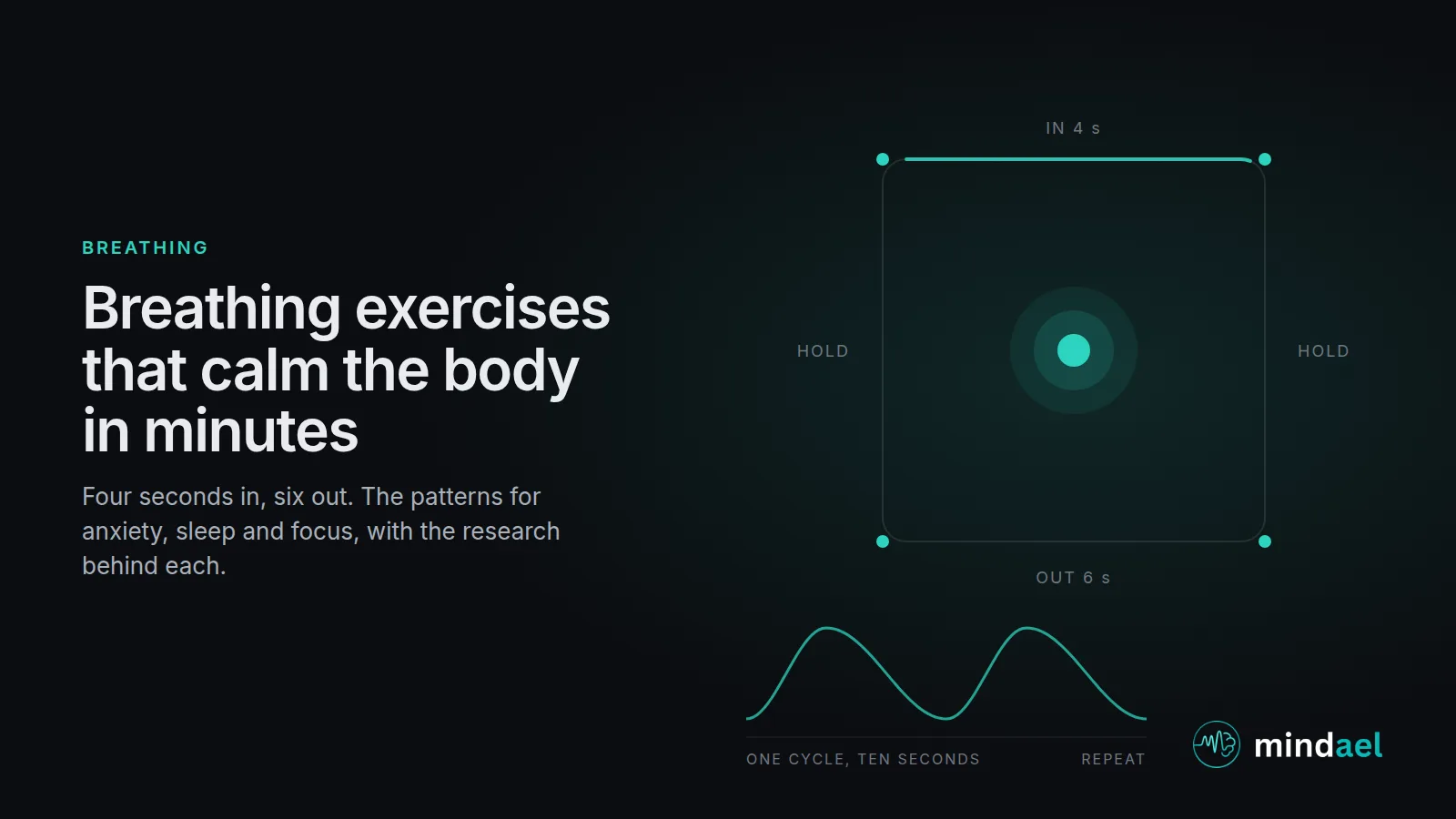
For anxiety right now, do three physiological sighs: two short breaths in through the nose, one long breath out through the mouth. For stress that will not lift, five minutes of slow breathing at around six breaths a minute, exhale longer than inhale. For sleep, 4-7-8 under a steady sound. For focus before work, box breathing, four counts a side. Give any pattern five minutes a day for a week before judging it.
Sounds that work, and why
Guided 4-7-8 breathing
A voice-free visual guide that counts the pattern for you, so you can close your eyes and follow the sound instead of counting.
Rain
The steady patter gives your attention somewhere to rest between breaths. Our listeners pair it with 4-7-8 at night more than any other sound.
Brown noise
Deep and featureless, which is what you want under box breathing before work. Nothing in it to follow, so the count stays in front.
Alpha waves
An 8 to 12 Hz binaural beat that sits in the same relaxed-alert band slow breathing moves you toward. Earbuds needed, fifteen minutes is enough.
Why breathing is the lever
Most of what your body does under stress is automatic. Your heart speeds up, your muscles tense, your attention narrows, and none of it asks permission. Breathing is the exception. It runs on its own when you ignore it, but it also answers to you the moment you take over, and it is wired into the same system that controls the rest. Slow the breath, and especially lengthen the exhale, and the heart slows with it. That is not a metaphor. Each exhale nudges the vagus nerve, the brake on the stress response, and a long exhale holds the brake down a little longer.
A 2018 systematic review in Frontiers in Human Neuroscience pulled together the studies on slow breathing, meaning roughly six breaths a minute, and found a consistent picture: higher heart rate variability, more alpha activity in the brain, and lower reported anxiety and better mood (Zaccaro et al., 2018). A 2023 meta-analysis of randomised trials found breathwork lowered stress compared with no treatment, with similar gains for anxiety and depressive symptoms (Fincham et al., 2023). The effect sizes were modest, which is honest. Breathing will not fix a bad week. It will change the next ten minutes, reliably, and that is usually what you need.
The four patterns, and which one to use
Physiological sigh: for a spike of anxiety
Two short breaths in through the nose, the second one topping up the first, then one long slow breath out through the mouth. Repeat two or three times. This is the pattern your body uses on its own when you sob or when you are about to fall asleep, and it is the fastest way to reinflate the small air sacs in the lungs and dump carbon dioxide.
In a 2023 study at Stanford, 108 people were randomised to five minutes a day of either cyclic sighing, box breathing, cyclic hyperventilation or mindfulness meditation for a month. Cyclic sighing produced the largest improvement in daily positive mood and the biggest drop in resting breathing rate, and it beat meditation on both (Balban et al., 2023). If you only learn one pattern from this page, learn this one. It works standing in a queue.
Slow breathing: for a stressful day
Breathe in for about four seconds and out for about six, through the nose, so you land near six breaths a minute. No holds. That rate is where heart rate variability peaks for most adults, because the breath rhythm lines up with the natural swing in blood pressure, and it is the rate used in most of the biofeedback research (Lehrer and Gevirtz, 2014).
A 2017 trial trained healthy adults in diaphragmatic breathing for eight weeks and measured a drop in cortisol and an improvement in sustained attention compared with the control group (Ma et al., 2017). This is the pattern for the afternoon when everything is slightly too much. Ten minutes under brown noise or an alpha beat and the day usually looks different.
4-7-8: for bed
In through the nose for four counts, hold for seven, out through the mouth for eight with a soft whoosh. Four rounds to start. The long hold and longer exhale push the breath rate well under six a minute, and the audible exhale gives you something to listen to. It is the pattern we built the guided breathing screen in Mindael around, because it is the one our listeners asked for most at night.
The research on 4-7-8 specifically is thin, so we will not claim more than the mechanism it shares with every other slow-exhale pattern. What we can say is that it is a slow-breathing pattern with a long exhale, that slow breathing with a long exhale is what the reviews above support, and that in practice most people do not reach the fourth round before the counting blurs. Run it under rain with a 30 minute fade and let the sound carry on where the counting stops. Our sleep sounds guide covers the volume and timer settings.
Box breathing: before focused work
Inhale four, hold four, exhale four, hold four. The holds keep the rate low without tipping you toward sleep, which is why it is taught in high-pressure jobs and why it was one of the arms in the Stanford study, where it also improved mood, just less than the sigh did. Use it for five minutes before a work block, then start the block with the same sound still playing. Our focus sounds guide explains how to run the block.
The settings that make it work
Posture. Sit upright or lie down. Put one hand on your belly and one on your chest. The belly hand should move first and most. Chest-only breathing is faster and shallower, and it is the pattern anxiety already has you in.
Nose in. Every pattern here starts through the nose. It slows the inhale, warms the air and makes the breath quieter, which matters when you are listening to a sound underneath.
Exhale longer. If you remember nothing else, make the out-breath longer than the in-breath. Four in, six out is enough. The ratio does more than the total length.
A steady sound underneath. Counting seconds is work, and work is the opposite of what you are after. A sound with a rhythm, like rain, or none at all, like brown noise, gives your attention somewhere to sit so the count becomes a feeling rather than a task. Keep it low, around the level of a quiet conversation. In Mindael, the guided breathing screen runs on top of whichever sound you choose, so you can watch the count or close your eyes and follow the sound.
Five minutes, daily. The Stanford protocol was five minutes a day for 28 days, and the benefits grew over the month rather than arriving on day one. A short daily session beats a long occasional one, every time.
When to pick which
The honest summary: anxiety spike, physiological sigh, right now, anywhere. Stress that lingers, slow breathing at four in and six out, ten minutes under brown noise. Bed, 4-7-8 under rain with a timer. Work, box breathing for five minutes and then start. People with ADHD tell us box breathing before a task is the step that gets them over the starting line; our sounds for ADHD page has more on that. And if the problem is a mind that will not stop rather than a body that will not settle, our guide to how to calm down fast pairs breathing with the other things that work in minutes. If you are choosing an app to keep the count, our best breathing app checklist lists what it needs.
How to set it up tonight
- Pick one pattern for one jobPhysiological sigh for a spike of anxiety, slow breathing for a stressful day, 4-7-8 for bed, box breathing before focused work. Do not rotate through all four.
- Sit or lie so your belly can moveHand on the stomach, hand on the chest. The lower hand should rise first. If only the chest moves, slow down and breathe lower.
- Make the exhale longer than the inhaleThis is the part that lowers heart rate. In through the nose, out through pursed lips or the nose, and let the out-breath take its time.
- Put a steady sound under itRain, brown noise or an alpha beat at a low volume. The sound holds your attention so you stop counting seconds and start feeling the rhythm.
- Five minutes a day, every dayThe 2023 Stanford study used five minutes daily for a month. The effect grows with practice, so the schedule matters more than the length.
Your next five minutes are already counted.
You know the pattern and the count. Mindael guides 4-7-8 and slow breathing on screen, runs rain or brown noise underneath at the volume you set, and fades out when the timer ends. Download it, pick a sound, and breathe out for longer than you breathe in.
- Guided breathing patterns with a visual count
- Rain, brown noise and alpha beats to run underneath
- Free, no account, works offline
 Free · No account needed · Works offline
 Frequently asked questions
What is the best breathing exercise for anxiety?
For a sudden spike, the physiological sigh: two inhales through the nose, one long exhale through the mouth, repeated two or three times. In a 2023 randomised study, five minutes a day of this pattern improved mood and lowered breathing rate more than mindfulness meditation did over a month.
How does deep breathing calm you down?
A slow exhale activates the vagus nerve, which slows the heart. A 2018 systematic review found that breathing at around six breaths a minute raises heart rate variability and is linked to lower anxiety and better mood across the studies reviewed.
Does 4-7-8 breathing help you sleep?
It is a slow-breathing pattern with a long exhale, which is the feature the research supports for settling the nervous system. Most of our listeners use it for the first ten minutes in bed under rain, then let the sound take over.
What is box breathing?
Inhale four counts, hold four, exhale four, hold four. It is the pattern used in tactical and performance training because it steadies breathing without making you drowsy, which makes it the right choice before work rather than before sleep.
How long should I do breathing exercises?
Five minutes is enough to measure a change, and five minutes daily for four weeks is what the strongest recent study used. Longer sessions are fine, but consistency does more than length.
Should I breathe through my nose or mouth?
In through the nose for every pattern here. Out through the nose for slow breathing and box breathing, out through the mouth for the physiological sigh and 4-7-8, where the audible exhale is part of the effect.
Sources
- Balban MY, et al. Brief structured respiration practices enhance mood and reduce physiological arousal. Cell Reports Medicine, 2023.
- Zaccaro A, et al. How breath-control can change your life: a systematic review on psycho-physiological correlates of slow breathing. Frontiers in Human Neuroscience, 2018.
- Ma X, et al. The effect of diaphragmatic breathing on attention, negative affect and stress in healthy adults. Frontiers in Psychology, 2017.
- Fincham GW, et al. Effect of breathwork on stress and mental health: a meta-analysis of randomised-controlled trials. Scientific Reports, 2023.
- Lehrer PM, Gevirtz R. Heart rate variability biofeedback: how and why does it work? Frontiers in Psychology, 2014.
This page is for general information and is not medical advice. If you have a breathing or heart condition, or anxiety that interferes with daily life, talk to a doctor before starting a breathing practice.