

The Best Breathing App for iPhone: What It Needs and How to Choose
A breathing app has one job: to keep the count so you do not have to. The good ones do that with a pacer you can follow with your eyes closed, the patterns the research actually tested, and a sound underneath so the minutes feel like rest rather than arithmetic. Mindael's guided breathing was built that way, on top of rain and brown noise made in our studio, and it is free to download on the App Store. Here is the checklist we would use for any breathing app, and how this one measures up.
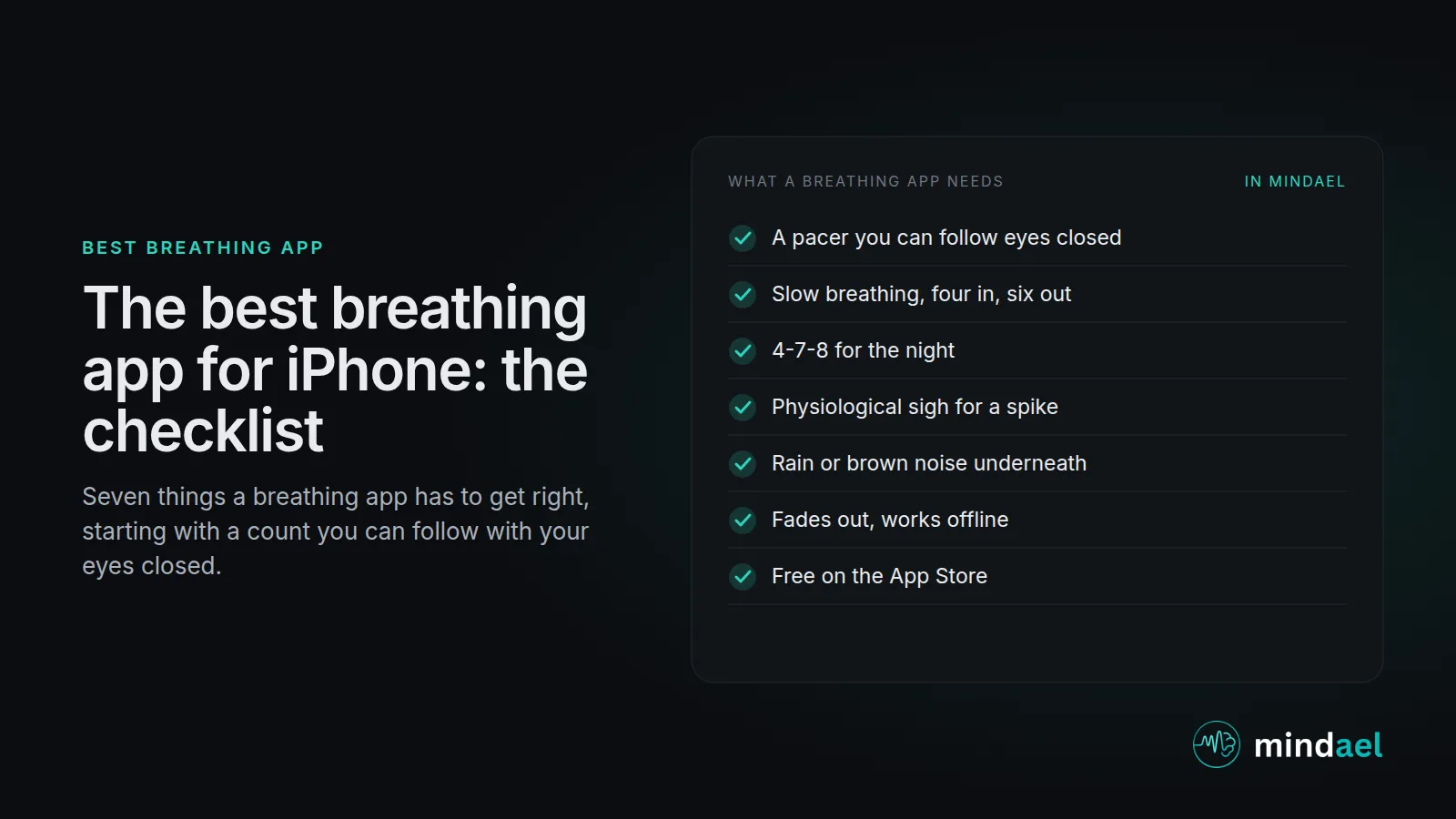
The best breathing app has a clear visual pacer with an audio cue so you can close your eyes, the slow-breathing patterns the research used (a long exhale, about six breaths a minute, 4-7-8 for sleep, the physiological sigh for a spike of anxiety), a steady sound underneath, a session that ends with a fade, offline play and no account. Mindael covers that list, with the research on each pattern on our breathing guide, and is free to download.
What to look for, and how Mindael covers it
| What you need | In Mindael |
|---|---|
| A pacer you can follow with your eyes closed | A visual count on screen with the sound carrying the rhythm, so you watch it or close your eyes |
| Slow breathing with a long exhale | Four in, six out, about six breaths a minute, the rate the heart rate variability research used |
| 4-7-8 for the night | Guided on screen under rain, with the timer fading when the rounds are done |
| The physiological sigh for a spike | Two inhales through the nose, one long exhale; the pattern that beat meditation in a 2023 trial |
| A sound underneath | Rain, brown noise or an alpha beat at the balance you choose, made in our studio |
| A session that fades, not an alarm | The sound fades at the end so a bedtime session ends in sleep, not in a chime |
| Works offline | Every sound and pattern is on the phone; nothing streams |
| No account, no tracking | Open it and breathe |
| Price | Free to download on the App Store |
What a breathing app usually gets wrong
Most breathing apps are a circle that grows and shrinks, with a count you have to watch. That means eyes open, screen bright, and attention on a shape instead of on the breath, which is the opposite of the state you were after. The second common problem is the pattern: an animation at whatever rhythm the designer liked, rather than the rhythms that were tested. The third is silence, or a music loop, where a steady sound would have done the work of making the minutes feel like rest.
The checklist, explained
A pacer for closed eyes. The visual count is for the first round, while the rhythm settles into the body. After that the sound should carry it. In Mindael the guided breathing runs on top of the sound you chose, so you can watch the count or close your eyes and follow the rain; our breathing guide explains each pattern.
The patterns the research used. A 2018 systematic review of slow breathing, meaning roughly six breaths a minute, found consistently higher heart rate variability, more alpha activity and lower anxiety across studies (Zaccaro et al., 2018). The rate is not arbitrary: around six breaths a minute is where heart rate variability peaks for most adults, and it is the rate used in most of the biofeedback work (Lehrer and Gevirtz, 2014). For a spike of anxiety, the physiological sigh, two inhales through the nose and one long exhale, produced the largest improvement in daily mood of four five-minute practices in a 2023 randomised trial, ahead of box breathing and meditation (Balban et al., 2023). An app that only animates one pretty rhythm has skipped all of this.
A sound underneath. Counting is work. A sound with a rhythm, like rain, or none at all, like brown noise, gives attention somewhere to sit so the count becomes a feeling. Keep it at the level of a quiet conversation.
A fade. A bedtime 4-7-8 session should end in sleep. A chime at the end undoes it. The sound should fade out and, for bed, keep running after the counting stops; the sleep sounds guide has the timer settings.
Offline, no account. The moment you need the physiological sigh is rarely a moment with good signal or patience for a sign-up screen.
Who this suits
Anyone who has been told to “just breathe” and wanted to know how, which pattern, and for how long. People with anxiety that arrives in spikes, where the sigh is the tool. People who cannot fall asleep, for whom 4-7-8 under rain is the night routine; our guide to how to calm down fast pairs it with the other things that work in minutes. And people with ADHD who use box breathing to get over the starting line, which the sounds for ADHD guide covers. The evidence for all of it is modest and real: a 2023 meta-analysis of randomised trials found breathwork lowered stress, anxiety and depressive symptoms compared with no treatment (Fincham et al., 2023). The app’s job is to make the ten minutes easy enough that you actually do them.
How to switch in five minutes
- Download Mindael and open the breathing guideFree on the App Store, no account. The guided patterns sit on top of whichever sound is playing.
- Pick the pattern for the momentAnxious right now: the physiological sigh, five times. Stressed and tight: four in, six out for ten minutes. Bed: 4-7-8 under rain. Before work: box breathing, then start.
- Choose a sound underneathRain for the night, brown noise for the afternoon, an alpha beat with earbuds for a reset. Keep it at the level of a quiet conversation.
- Follow the pacer, then close your eyesWatch the count for the first round so the rhythm is in your body, then let the sound carry it.
- Let it fadeA ten minute session that fades out ends gently. For bed, set it longer than you need and let the sound run on after the counting stops.
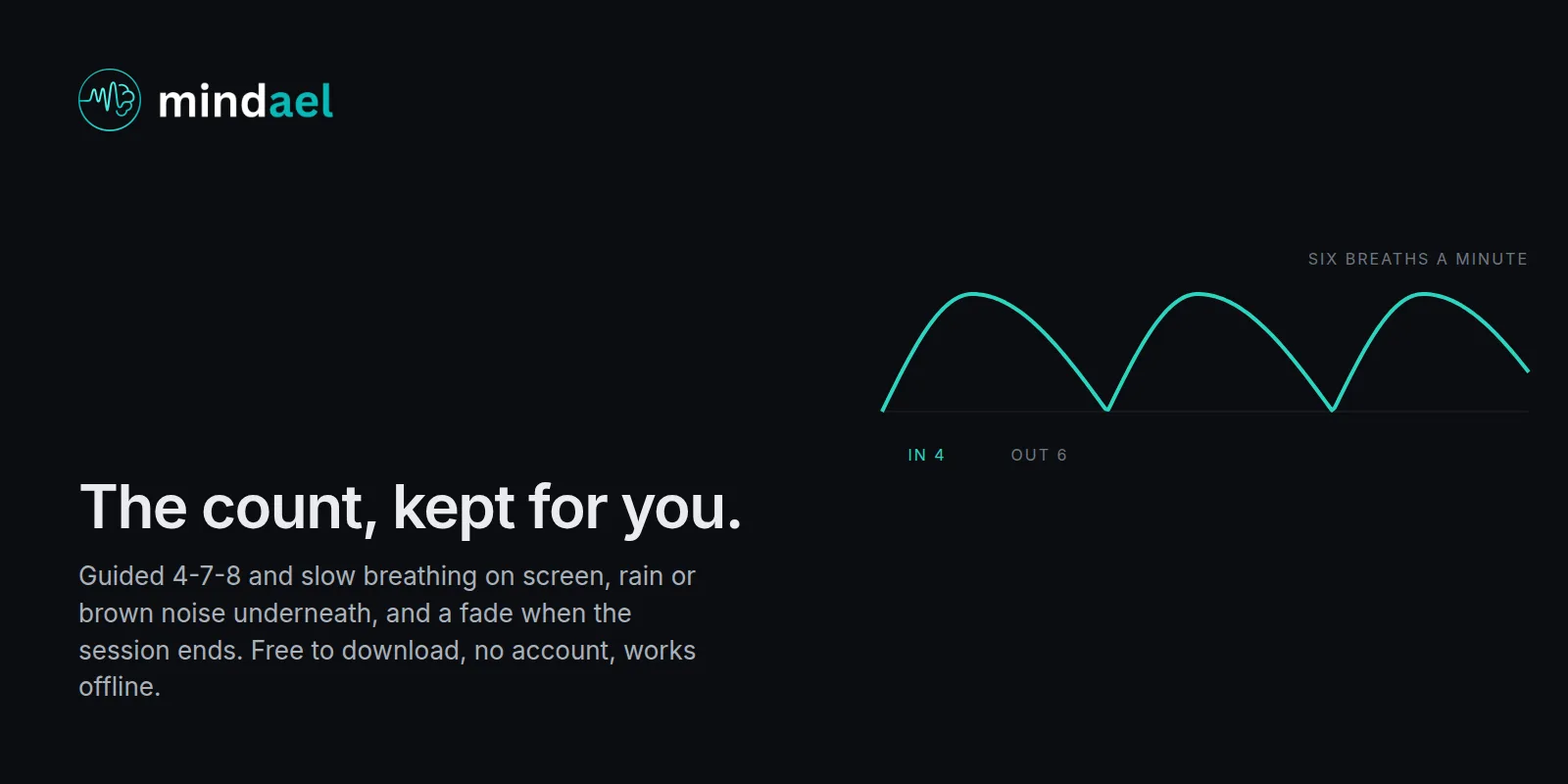
The count, kept for you.
Mindael guides 4-7-8 and slow breathing on screen, runs rain or brown noise underneath at the volume you set, and fades out when the session ends. Free to download, no account, works offline. Pick a pattern and breathe out for longer than you breathe in.
- Guided breathing patterns with a visual count and a sound underneath
- Rain, brown noise and alpha beats made in our studio
- Free to download, no account, works offline
 Free · No account needed · Works offline
 Frequently asked questions
What is the best breathing app?
The one whose pacer you can follow with your eyes closed, that guides the slow-exhale patterns the research tested, runs a sound underneath, fades out at the end and works offline. Mindael does that and is free to download on iPhone.
Is there a free breathing app for iPhone?
Yes. Mindael is free to download on the App Store, needs no account, and has guided breathing on top of rain, brown noise and the rest of the library.
What breathing pattern should the app guide?
Slow breathing at about six breaths a minute with a longer exhale is the pattern with the most evidence, from a 2018 systematic review and the heart rate variability research. 4-7-8 is the night version. For a spike of anxiety, the physiological sigh, which produced the biggest mood improvement in a 2023 randomised trial of daily five minute practices.
Does a breathing app actually help with anxiety?
The breathing does, if you do it. A 2023 meta-analysis of randomised trials found breathwork lowered stress, anxiety and depressive symptoms compared with no treatment, with modest effect sizes. The app's job is to make the ten minutes easy enough that you do them.
Box breathing app or 4-7-8?
Box breathing (four in, four hold, four out, four hold) suits the start of a work block; it is even and alerting. 4-7-8 suits bed, because the long exhale and hold push the breath rate down and the whoosh gives you something to listen to. A good app lets you use either; our breathing guide explains when.
Can I use a breathing app with sleep sounds?
That is the point of putting the two in one app. In Mindael the breathing guide runs on top of whichever sound is playing, so 4-7-8 under rain with a fade is one screen, and when the counting stops the rain carries on.
Sources
- Zaccaro A, et al. How breath-control can change your life: a systematic review on psycho-physiological correlates of slow breathing. Frontiers in Human Neuroscience, 2018.
- Balban MY, et al. Brief structured respiration practices enhance mood and reduce physiological arousal. Cell Reports Medicine, 2023.
- Lehrer PM, Gevirtz R. Heart rate variability biofeedback: how and why does it work? Frontiers in Psychology, 2014.
- Fincham GW, et al. Effect of breathwork on stress and mental health: a meta-analysis of randomised-controlled trials. Scientific Reports, 2023.