

Focus Sounds for Deep Work: What to Play When You Need to Concentrate
A good focus sound does one job: it stops the room from interrupting you. Not music with lyrics, not a playlist that changes every three minutes, but a steady bed that lets the task fill your attention. The sounds below are the ones our listeners work to most, all of them in Mindael, free on the App Store, and the research behind each is cited.
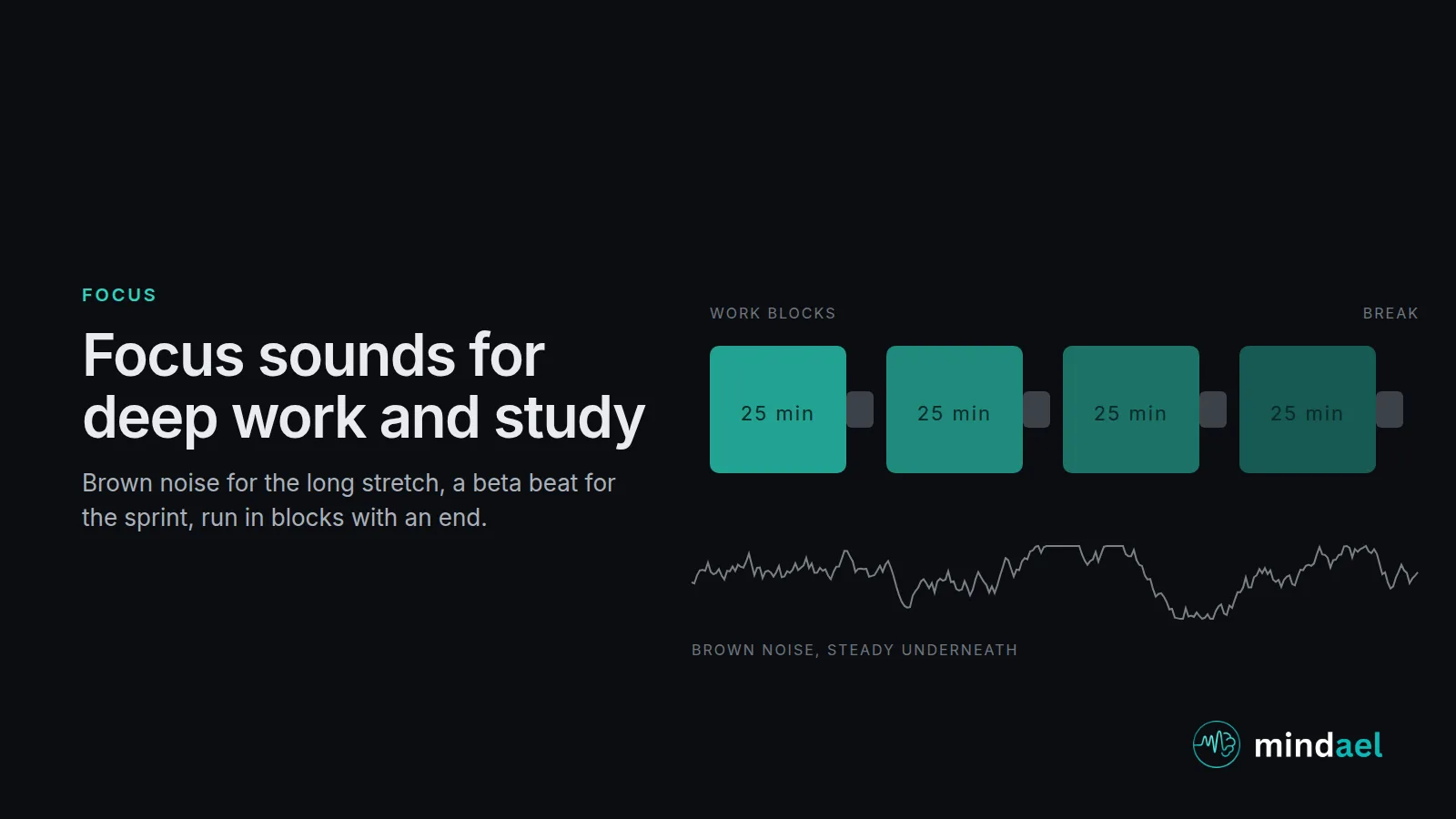
For most people, brown noise at a low volume is the best all-day focus sound. For a sharp, time-boxed push, a beta binaural beat with earbuds. For creative work, a moderate coffee-shop-level ambience rather than silence. Whatever you pick, keep it steady, keep it quiet, and run it in 25 to 50 minute blocks.
Sounds that work, and why
Brown noise
Deep and steady, with no hiss to tire your ears over a long afternoon. The sound more of our listeners work to than any other.
Beta binaural beats
A 13 to 30 Hz pulse that matches an alert working brain. Earbuds required. Best in 25 to 45 minute sessions for tasks that need vigilance.
Gamma 40 Hz
The fastest band, used for hard problem solving and fast recall. Layer it under brown noise so the tone sits in the background.
Rain, café and ambient
A moderate ambience that gives your brain a stable backdrop. The choice for writing and design, where silence makes every thought too loud.
Why silence is not the answer
Open-plan offices taught a generation of workers that the problem is noise. It is only half true. The problem is change. A room at a steady 55 dB is easy to work in; a silent room where someone laughs every four minutes is not. Your attention is tuned to detect new sounds, and every new sound costs you a few seconds of re-entry into the task. Over an afternoon that adds up to the feeling of having worked all day and done nothing.
A focus sound fixes the contrast, not the volume. It fills the gaps so the laugh, the door and the notification arrive against a background instead of against silence. The room is the same. Your brain simply stops filing each sound as news.
What the research shows
The most practical finding comes from a creativity study that compared quiet, moderate and loud ambient noise. Moderate noise, around 70 dB, the level of a busy café, improved performance on creative tasks; loud noise at 85 dB made it worse (Mehta et al., 2012). That is the strongest argument we know for an ambient bed when the work is writing or design, and for keeping it moderate.
For vigilance, the kind of attention that catches errors in a spreadsheet or a line of code, a 1998 controlled study had participants do a 30 minute attention task while listening to binaural beats hidden in pink noise. Beta beats produced more correct detections and fewer misses than theta and delta beats, and better mood ratings (Lane et al., 1998). A 2019 meta-analysis of 22 studies found a reliable medium-sized effect of binaural beats on attention and memory, larger with longer sessions (Garcia-Argibay et al., 2019).
Plain noise has its own evidence, mostly from attention research. Children with attention problems performed better on a memory task with white noise playing, while children without those problems did slightly worse (Söderlund et al., 2007). The lesson for the rest of us is that noise helps most when your attention is hardest to hold, which is exactly when people reach for it. We cover that in depth on the sounds for ADHD page.
Matching the sound to the work
For study specifically, reading, memorising and exam practice, the classical music and studying guide goes through what the research says task by task.
Reading, coding, numbers. Brown noise, low. These tasks need a long, even stretch of attention, and brown noise is the sound people can forget for three hours straight.
A deadline push. A beta beat under brown noise, earbuds in, 25 to 45 minutes, then off. The beat is a tool for a session, not a sound for a whole day.
Writing, design, planning. Rain or a café ambience at a moderate level. These tasks need a little looseness, and the creativity research points to a moderate ambience rather than silence.
Hard problems and recall. Gamma at 40 Hz, layered quietly under brown noise, for the one hour where you need to hold a lot in your head at once.
If you have never used a focus sound, start with brown noise for a week before trying anything else. It is the easiest to live with, and our guide to what brown noise is explains why.
How to set it up tonight
- Choose by taskReading, coding and spreadsheets: brown noise. A deadline sprint: beta beat under brown noise. Writing or design: rain or ambient.
- Set the volume below your inner voiceYou should be able to think in words over it. If you notice the sound, it is too loud.
- Work in blocks25 or 50 minutes with the sound on, then a 5 to 10 minute break with it off. The switch itself becomes a start signal.
- Keep the same mix for a weekThe focus effect grows with habit. Changing sounds every session resets it.
- Earbuds only when you need themBinaural beats require them. For everything else a small speaker is more comfortable for a whole day.
Start the next block with the right sound.
You know what to play and how long to run it. Mindael has brown noise made in our studio and measured to spec, beta and gamma beats with a clean carrier tone, and rain and café ambience to put under them. Set a 25 minute timer, press play, and the room disappears.
- Brown, pink and white noise, measured to spec
- Beta, gamma and alpha beats to layer under noise
- Timer for work blocks, works offline
 Free · No account needed · Works offline
 Frequently asked questions
What is the best sound for focus?
For long, steady work, brown noise. It covers voices and ventilation without getting sharp. For a short, intense push, a beta binaural beat with earbuds is the sound with the clearest research behind it for alertness.
Is music or noise better for concentration?
Steady noise, for most tasks. Music with lyrics competes with the language parts of your brain, and even instrumental music changes every few seconds, which pulls attention. Noise does not change, so your attention stays on the work.
Do binaural beats really improve focus?
A controlled study in 1998 found that beta binaural beats improved vigilance and mood compared with theta and delta beats during a 30 minute attention task. A 2019 meta-analysis of 22 studies found a reliable effect on attention and memory tasks. Headphones are essential.
How loud should focus sounds be?
Just loud enough to blur the room. A 2012 study found that moderate ambient noise around 70 dB helped creative thinking, while loud noise at 85 dB hurt it. For plain noise we suggest lower still, 40 to 55 dB.
Can I use focus sounds for studying?
Yes, and this is the most common way our listeners use them. Brown noise for memorising and problem sets, a beta beat for exam-style practice, and a timer so each block has an end.
Sources
- Lane JD, Kasian SJ, Owens JE, Marsh GR. Binaural auditory beats affect vigilance performance and mood. Physiology & Behavior, 1998.
- Garcia-Argibay M, Santed MA, Reales JM. Efficacy of binaural auditory beats in cognition, anxiety, and pain perception: a meta-analysis. Psychological Research, 2019.
- Mehta R, Zhu R, Cheema A. Is noise always bad? Exploring the effects of ambient noise on creative cognition. Journal of Consumer Research, 2012.
- Söderlund G, Sikström S, Smart A. Listen to the noise: noise is beneficial for cognitive performance in ADHD. Journal of Child Psychology and Psychiatry, 2007.
This page is for general information and is not medical advice.