

How to Concentrate Better: 7 Techniques for the Moment You Keep Drifting Off
Concentration is attention held on one thing while something else pulls at it, and it is trained, not inherited. In the moment: notice the drift, return without comment, and give the mind an anchor to return to. Around it: one task at a time, a steady sound to cover the room, sprints of 20 to 25 minutes, and the phone out of sight. A few minutes of daily attention practice makes all of it easier within two weeks.
How to concentrate better is a slightly different question from how to focus better, and the difference matters. Focus is the setup: what you remove, what you add, how you plan the day; our focus guide covers that. Concentration is what happens in the next ninety seconds, when you are on the page and the mind slides off it. This article is about that moment, and the seven techniques that shorten each slide. The sound side is what we built Mindael for, free on the App Store, and it appears in two of the seven.
1. Give attention an anchor
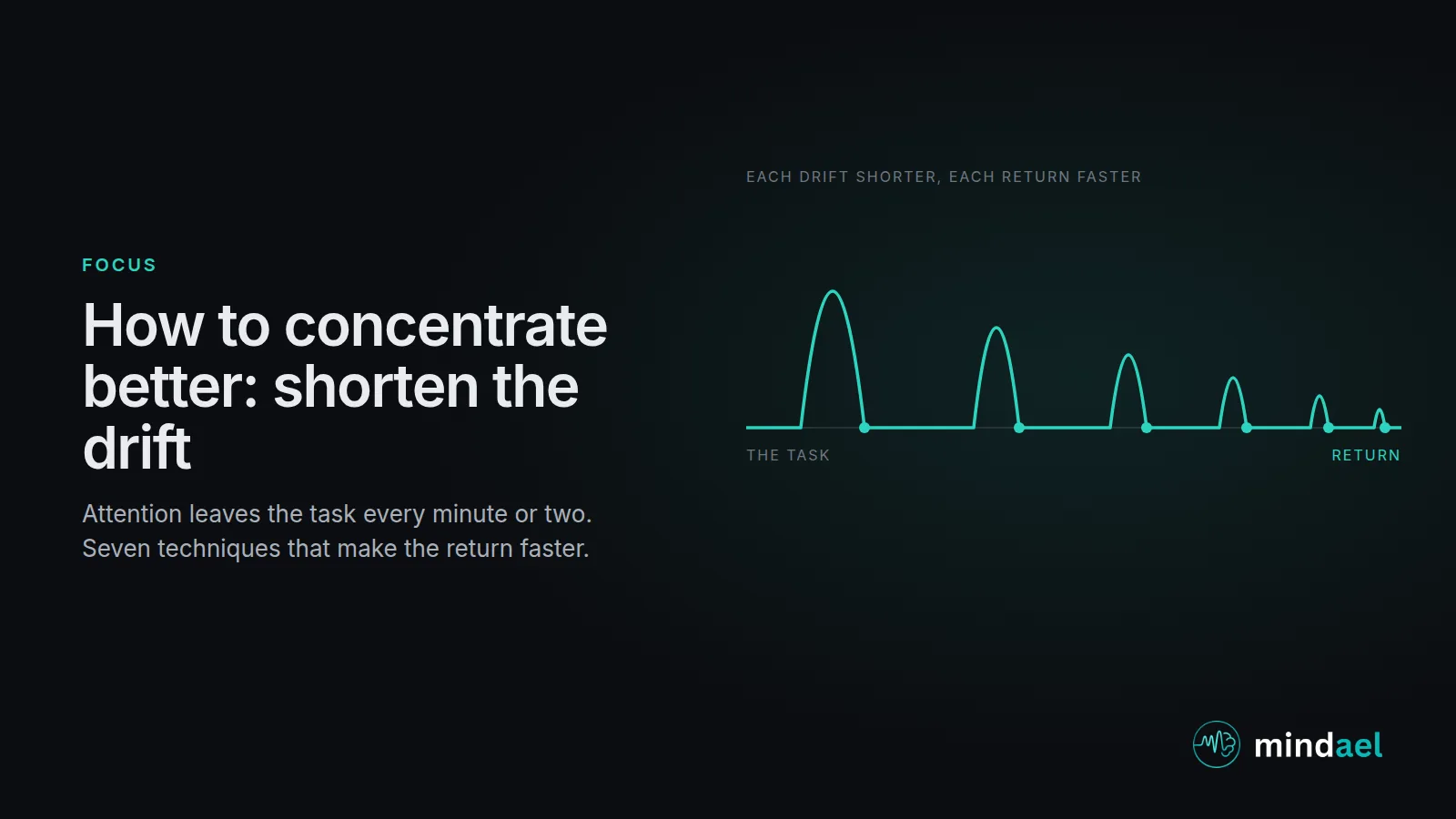
Concentration is not a steady beam. It is a series of returns. The mind leaves the task every minute or two, whether you are an expert or a beginner, and the difference between people who concentrate well and people who do not is how fast they notice and how cleanly they come back. An anchor makes both faster: a fixed thing you return to. For reading, the tip of a pen under the line. For listening, the speaker’s voice. For writing, the next sentence, said silently first. When you notice you have gone, you do not finish the thought you left for; you go to the anchor.
This is the mechanism mindfulness training works on, and the research is specific. In a 2013 study, two weeks of practice at noticing and returning improved students’ reading comprehension scores and working memory and reduced mind-wandering during the test (Mrazek et al., 2013). An earlier study found measurable gains in sustained attention after four 20 minute sessions (Zeidan et al., 2010). Our meditation guide has a sound-based version of the practice.
2. The re-entry rule
When you catch yourself drifting, the temptation is to finish the drift first: reply to the thought, look up the thing, then come back. Do not. Write the thought in three words on paper and return. A 2009 study found that attention stays partly with an unfinished task after you switch, and performance on the new task suffers for as long as the residue lasts (Leroy, 2009). Every drift you complete is a switch; every drift you cut short is a return. The paper note is what makes cutting it short feel safe.
3. One thing on the desk, one thing on the screen
Concentration fails in proportion to what is available to drift to. The phone is the worst of it: in a 2017 series of experiments, people’s attention and working memory were worse when their own silent phone was on the desk than in their bag, and worse in the bag than in another room (Ward et al., 2017). The same logic applies to the second monitor, the open tabs, and the book you are not reading. One task visible, everything else out of sight. It feels drastic for an hour and normal by the third day.
4. Cover the room with a steady sound
The ear cannot be closed, and speech in particular pulls attention whether you want it to or not. A steady sound without words gives the mind less to drift to and makes the return shorter. Brown noise is what most of our listeners use for long work; rain for reading; a beta or gamma beat with earbuds for the hardest hour. For people who find concentration hard in general, the evidence is stronger: white noise improved attention and memory in children with ADHD in a 2007 study, while it hindered those without (Söderlund et al., 2007). The settings are in our focus sounds guide. Keep the level at a quiet conversation, and use the same sound each time so it becomes the cue to begin.
5. Sprint, then stop
Attention on one task fades after about 20 to 40 minutes, and the fade is not fixed by effort. In a 2011 experiment, people doing a 50 minute vigilance task declined steadily unless they got two brief breaks, in which case they held level to the end (Ariga and Lleras, 2011). So concentrate in sprints: 20 to 25 minutes with a written goal, a timer that fades rather than rings, a break away from the screen, then again. The Pomodoro guide is the full method; four sprints is a very good morning.
6. Read with a pen, write before you type
For reading, the pen under the line is both anchor and pace. For listening, notes by hand: typing invites the browser and transcribes without understanding, while handwriting forces you to choose what matters, which is concentration by another name. For writing, say the sentence before you type it. Each of these converts a passive task, where the mind drifts freely, into an active one, where it has a job.
7. Check the body first
A surprising share of “I can’t concentrate” is physical. Mild dehydration measurably worsens attention and mood (Masento et al., 2014); so does a skipped meal, a bad night, or an hour in a stuffy room. Before concluding that the problem is your mind, drink a glass of water, open a window, and take a two minute walk. If the problem is sleep, no technique on this page will hold until that is fixed; our sleep sounds guide is where to start. Two minutes of slow breathing from the breathing guide lowers the noise in your own head before a hard block.
Concentrating in class and in the library
If the question is what to play while you study, our study sounds guide answers it task by task, including why music with lyrics costs you on reading.
Class: front row, phone in the bag, pen in hand, the teacher’s voice as the anchor. Library: one subject per sprint, a written goal for the sprint, brown noise or rain in earbuds at a low level, the phone face down in the bag rather than on the desk. In both, the re-entry rule is the one that pays: notice the drift, three-word note, back to the anchor.
The practice that makes the rest easier
Ten minutes a day of noticing and returning, whether you call it meditation or not, is what the 2013 study used, and two weeks was enough to measure. Pick a sound, set a ten minute fade, follow the breath, and every time you notice you have gone, come back without comment. It is the same movement you make a hundred times during a day’s work, practised where nothing is at stake.

Something steady to come back to.
An anchor works better when the room is covered. Mindael's brown noise and binaural beats are made in our studio, the timer runs 20 minute sprints and fades at the end, and nothing streams or needs an account. Download it, start the sound, and return to the line.
- Brown noise, beta and gamma beats, rain, studio-made
- Timer that fades at the end of each sprint
- Free to download, no account, works offline
 Free · No account needed · Works offline
 Frequently asked questions
How can I concentrate better right now?
Close everything that is not the task, put the phone out of sight, start a steady sound at a low volume, and set a 20 minute timer. When you notice you have drifted, return to the task without finishing the drift. That is the whole technique; the rest of this article is why it works.
How do I concentrate better while studying?
Study one subject per sprint with a written goal for the sprint, such as 'summarise chapter 4'. Read with a pen, which forces the mind to stay on the line. Use steady sound to cover the library or the house, and take the break away from the screen.
How do I concentrate better in class?
Sit at the front, phone in the bag, notes by hand. Pick an anchor for the lesson, such as the teacher's voice or your pen, and return to it each time you notice you have gone. Slow breathing for two minutes before class lowers the background noise in your own head.
Why can't I concentrate?
Usually sleep, a phone within reach, or a task too vague to hold. Less often, hunger or dehydration. If concentration has been poor for months in every setting, that is worth raising with a doctor; our sounds for ADHD guide covers one common cause.
Does white noise help you concentrate?
For many people, yes. A 2007 study found white noise improved memory and attention in children with ADHD, and for most adults a steady sound covers the room so there is less to drift to. Brown noise is the usual choice for long work; keep it at a quiet conversation.
How long does it take to improve concentration?
Two weeks of daily practice shows measurable change: a 2013 study found two weeks of mindfulness training improved reading comprehension scores and working memory and reduced mind-wandering in students.
Sources
- Mrazek MD, et al. Mindfulness training improves working memory capacity and GRE performance while reducing mind wandering. Psychological Science, 2013.
- Zeidan F, et al. Mindfulness meditation improves cognition: evidence of brief mental training. Consciousness and Cognition, 2010.
- Leroy S. Why is it so hard to do my work? The challenge of attention residue when switching between work tasks. Organizational Behavior and Human Decision Processes, 2009.
- Ward AF, et al. Brain drain: the mere presence of one's own smartphone reduces available cognitive capacity. Journal of the Association for Consumer Research, 2017.
- Söderlund G, Sikström S, Smart A. Listen to the noise: noise is beneficial for cognitive performance in ADHD. Journal of Child Psychology and Psychiatry, 2007.
- Ariga A, Lleras A. Brief and rare mental "breaks" keep you focused. Cognition, 2011.
- Masento NA, et al. Effects of hydration status on cognitive performance and mood. British Journal of Nutrition, 2014.
This article is for general information and is not medical advice. If trouble concentrating is persistent and affects your work or studies across settings, please talk to a doctor.
This article is part of our focus guide. Hear the sounds in this article in the Mindael sound library, or see our app comparison checklists.