

Pomodoro Timer and Technique: How to Use It So the Work Actually Gets Done
A Pomodoro is 25 minutes of one task, then a five minute break, four times, then a longer rest. The idea is old and simple, and it survives because it fixes the two things that kill focus: not starting, and not stopping. Mindael has a Pomodoro timer built around sound, so each block starts with brown noise or a beat and ends with a fade instead of an alarm, and it is free to download on the App Store. This page covers the method, the evidence, and the settings we recommend.
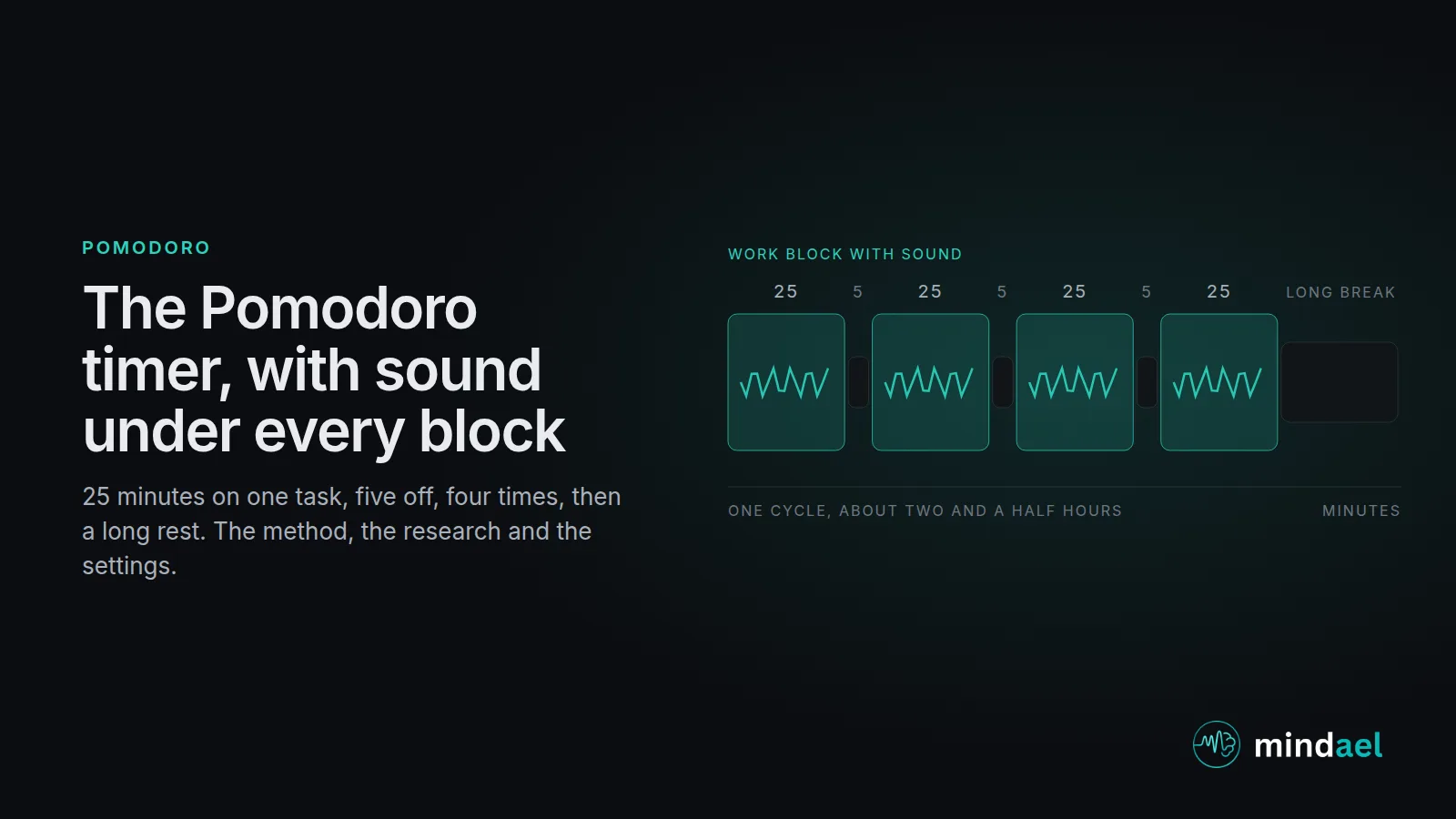
Work for 25 minutes on one task, break for five, repeat four times, then rest for 20 to 30 minutes. The timer is the point: a fixed end makes starting easy, and a scheduled break stops the slow drift in attention that research measures after about 40 minutes of continuous work. Run a steady sound under each block, keep the phone out of reach, and track completed blocks rather than hours.
Sounds that work, and why
Brown noise
The sound most of our listeners run under a Pomodoro. Deep, steady and without detail, so a 25 minute block has nothing in it to follow but the work.
Beta binaural beats
A 14 to 20 Hz beat for the blocks where you need to be sharp rather than calm. Earbuds required; one block is enough to feel the difference.
Gamma 40 Hz
For the hardest block of the day, usually the first. A 40 Hz beat under brown noise is the combination we hear about most for problem solving.
Rain
For reading and writing, where brown noise can feel heavy. Rain at a low volume covers an open office without pulling attention.
Why a timer beats willpower
Most lost afternoons are not lost to laziness. They are lost to a task that never quite started and a break that never quite ended. The Pomodoro technique attacks both with the same tool: a visible end. Twenty-five minutes is easy to begin because it is small, and a five minute break is easy to end because it is scheduled.
The research behind this is about attention, not tomatoes. In a 2011 experiment, people doing a 50 minute vigilance task got steadily worse, as everyone does, unless they were given two brief breaks, in which case their performance held flat to the end (Ariga and Lleras, 2011). Attention is not a tank that empties; it is a goal that fades, and a short break re-sets it. A 2022 meta-analysis of 22 studies on micro-breaks of under ten minutes found consistent gains in energy and drops in fatigue, with performance gains for simpler tasks (Albulescu et al., 2022).
And the fixed schedule matters. A 2023 study gave one group of students Pomodoro-style breaks and let another choose their own. The self-regulated group took fewer breaks, later, and reported more fatigue and less concentration, while getting no more done (Biwer et al., 2023). People are bad at noticing when they need a break. A timer is not.
The method, exactly
- Choose one task and write it down.
- Set a timer for 25 minutes and work only on that task.
- When it rings, mark the block done and break for five minutes.
- After four blocks, take a long break of 20 to 30 minutes.
- Anything that interrupts, a thought, a message, a colleague, is noted and dealt with in the break.
That is the whole technique. Everything else is tuning.
Settings that suit different work
The classic 25/5 is a starting point. Writing and admin suit it well. Deep technical work, code, mathematics, a long draft, often needs longer to get into, and a block that ends just as you arrive is worse than no block. For that work we recommend 50 minutes on, ten off, which keeps the same ratio. Anything beyond 90 minutes stops being a Pomodoro and becomes an afternoon.
Count blocks, not hours. Eight clean blocks is a very good day; it is only four hours of focused work, and that is roughly what most people have in them. Knowing that makes the ninth block easier to skip without guilt.
Sound under the block
The reason we built a Pomodoro timer into a sound app is that the two solve each other’s problems. A steady sound gives the block a start cue and a wall against the room; the timer gives the sound an end. Our listeners mostly run brown noise under their blocks: deep, steady, nothing in it to follow. For sharper work, a beta or gamma 40 Hz binaural beat with earbuds. For reading, rain at a low volume. The focus sounds guide goes through the research on each, and the sounds for ADHD guide covers why steady noise helps attention when it is hard to hold.
Keep the volume at the level of a quiet conversation and use the same sound for every block. Within a week, pressing play is the thing that starts the work.
What breaks the method
Interruptions. A 2008 study found that interrupted workers finish the task in about the same time, but at the cost of higher stress, frustration and effort, because they speed up to compensate (Mark et al., 2008). The Pomodoro’s rule, that the block is never paused, is what protects you from that. The phone goes in another room, not face down on the desk; notifications are off for 25 minutes; the door is closed if there is one.
Breaks spent on the screen. Five minutes of news or messages is a different task, not a rest, and attention carries part of it into the next block. Stand up instead. The micro-break research is clear that movement and real detachment are what produce the recovery.
Skipping the long break. Four blocks without a real rest, then four more, is how the technique gets blamed for burnout it was designed to prevent.
Pomodoro for study and for ADHD
Which sound to run under a study block depends on the task; our study sounds guide sorts reading, memorising and problem sets by what the research says helps each. Students were the subjects in the 2023 trial, and the fixed-break group’s advantage was in how they felt by the end of the session: less tired, more able to concentrate. For revision, 25/5 with a written one-line goal per block (“chapter 4 summary”, not “biology”) is the version we would use. For people with ADHD, the fixed block answers the hardest part, starting, and the sound answers the second hardest, staying. Steady noise has been shown to improve cognitive performance in children with ADHD, where it hinders those without (Söderlund et al., 2007), which is why brown noise under a Pomodoro is the setup we point to first. If you are choosing an app for it, our best Pomodoro app checklist lists what to look for.
How to set it up tonight
- Write the one task before you start the timerA Pomodoro protects a single task. Write it in one line, then start. If the line has an 'and' in it, split it.
- Set 25 minutes and press play on a soundThe sound marks the start of the block the way a kettle marks tea. Same sound each time, so the brain learns the cue.
- Do not stop the timer for anythingA thought that is not the task goes on a scrap of paper. The block is not paused for messages, and the phone is in another room.
- Take the five minutes away from the screenStand, water, window. Reading news is not a break for attention; it is a different task. The research on micro-breaks rewards movement and detachment.
- After four blocks, rest for 20 to 30 minutesThis is where the method earns its name. Long rests are what let the fifth and sixth block of the day be as good as the first.
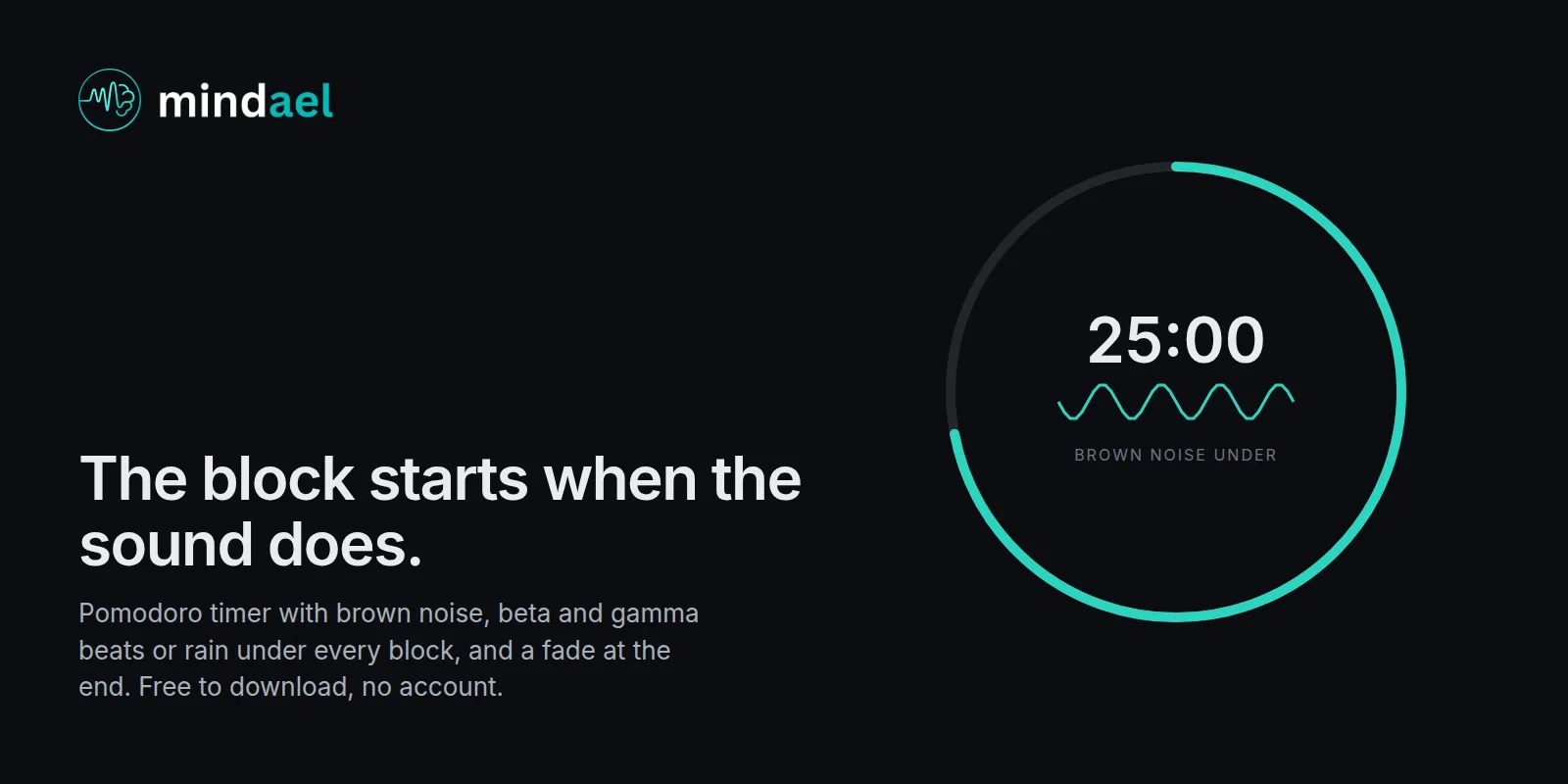
The timer, the sound and the fade, in one place.
Mindael's Pomodoro mode starts each 25 minute block with the sound you chose, counts the breaks for you, and ends every block with a fade rather than a bell. Brown noise, beta and gamma beats and rain are all made and measured in our studio. Download it, write today's one task, and start the first block.
- Pomodoro timer with work, short break and long break
- Brown noise, beta and gamma beats, rain, studio-made
- Free to download, no account, works offline
 Free · No account needed · Works offline
 Frequently asked questions
What is the Pomodoro technique?
A time management method from the late 1980s: choose a task, work on it for 25 minutes, take a five minute break, and after four of these take a longer break of 20 to 30 minutes. Each 25 minute block is a 'pomodoro', Italian for tomato, after the kitchen timer its inventor used.
Does the Pomodoro technique actually work?
The parts it is built from do. Attention measurably drops during long continuous tasks and recovers after a brief break, a 2011 study found. A 2022 meta-analysis of 22 studies found micro-breaks raise vigour and lower fatigue. A 2023 trial comparing fixed Pomodoro breaks with self-chosen breaks found the Pomodoro group felt less fatigue and more concentration, with the same amount of work done.
Why 25 minutes?
It is short enough to start without dread and long enough to get somewhere. There is nothing magic about it: the trial that compared break schedules used 25 minute blocks, but deep technical work often suits 50 minutes with a ten minute break. Start at 25 and lengthen only when you keep wishing the timer had not rung.
What should I do during the five minute break?
Leave the screen. Stand up, get water, look out of a window, stretch. The 2022 meta-analysis found breaks help most when they involve physical movement or real detachment from the task. Checking messages makes the next block start slower, because attention stays partly on the message.
What sound should I use with a Pomodoro timer?
Something steady and without words. Brown noise is the usual choice; a beta or gamma binaural beat for blocks that need sharpness; rain for reading. Keep it at a low volume and use the same sound every block so it becomes the start cue.
Is a Pomodoro timer good for ADHD?
Many people with ADHD find the fixed, short block makes starting easier and the scheduled break stops the crash. Pairing it with brown noise helps further; steady noise has been shown to improve attention in people with ADHD symptoms. See our sounds for ADHD guide for the research.
Sources
- Ariga A, Lleras A. Brief and rare mental "breaks" keep you focused: deactivation and reactivation of task goals preempt vigilance decrements. Cognition, 2011.
- Albulescu P, et al. "Give me a break!" A systematic review and meta-analysis on the efficacy of micro-breaks for increasing well-being and performance. PLOS ONE, 2022.
- Biwer F, et al. Understanding effort regulation: comparing "Pomodoro" breaks and self-regulated breaks. British Journal of Educational Psychology, 2023.
- Mark G, Gudith D, Klocke U. The cost of interrupted work: more speed and stress. CHI 2008.
- Söderlund G, Sikström S, Smart A. Listen to the noise: noise is beneficial for cognitive performance in ADHD. Journal of Child Psychology and Psychiatry, 2007.