

Classical Music and Studying: What the Research Actually Says, and What to Play Instead When It Does Not Help
"Classical music for studying" is one of the most searched phrases in the whole sound-and-focus world, and the honest answer is more useful than the myth. Classical music does not make you smarter; the Mozart effect did not survive replication. But the right kind of background sound does help some kinds of study and hurts others, and the research is clear enough to say which. This page covers what the studies found, which tasks suit music, which suit steady noise, and which suit silence, and how to set up a study session that does not fight the sound. The sounds are in Mindael, free to download on the App Store.
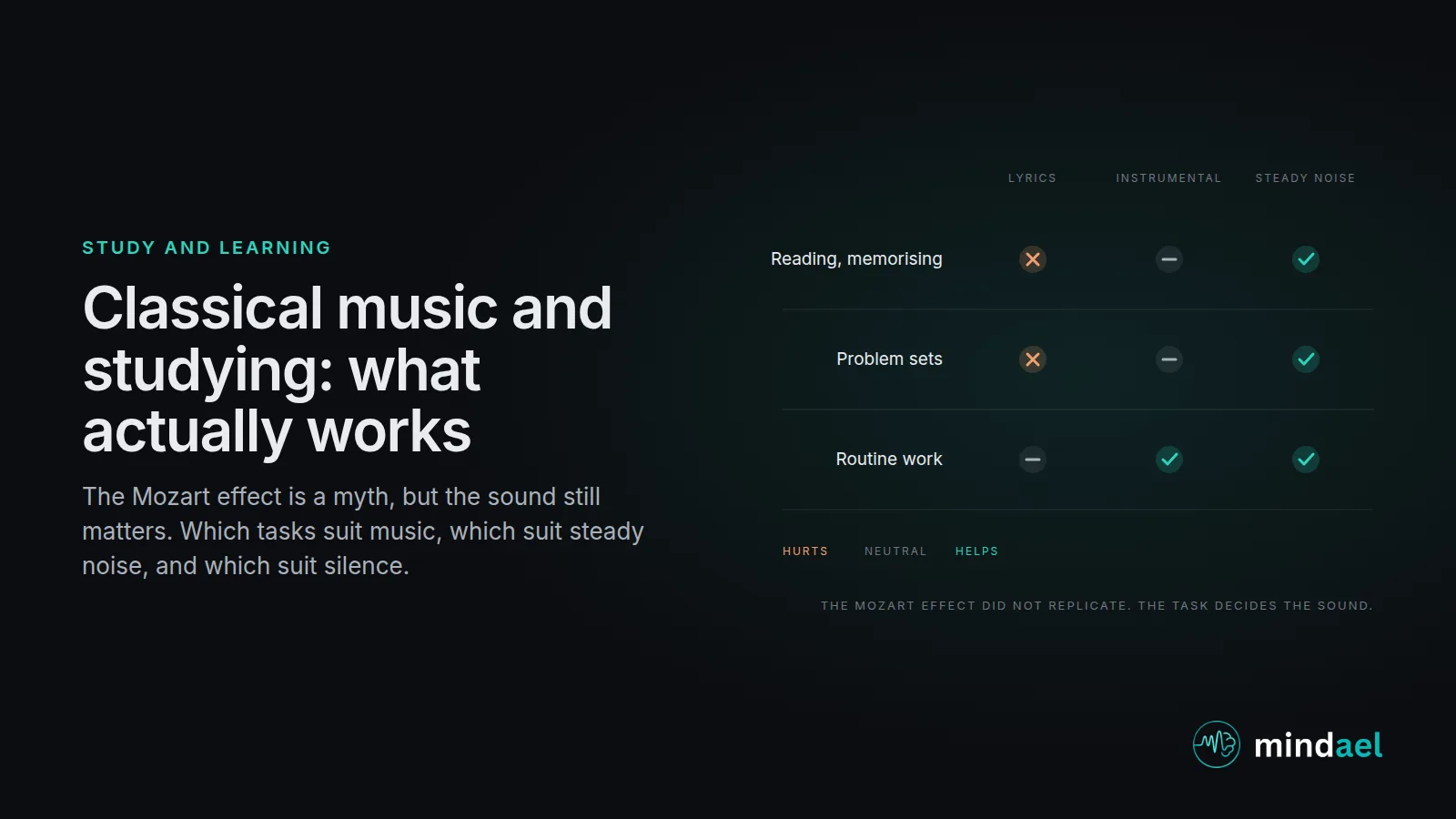
Classical music and studying: the Mozart effect is a myth, confirmed by a 2010 meta-analysis of nearly 40 studies, but background sound still matters. Music with lyrics or a familiar melody hurts reading comprehension and memorising, because language and melody compete with the words you are trying to learn; a 2011 meta-analysis found background music slightly harms reading and memory tasks overall. Slow, unfamiliar, instrumental music is roughly neutral and improves mood and persistence on long or dull work. Steady noise, brown or pink, helps most for reading and problem sets in a noisy room, and in people with ADHD it can improve performance outright. The rule: music for the routine parts, steady noise for the hard parts, silence or noise for memorising.
Sounds that work, and why
Brown noise
The reading sound. Deep and featureless, it covers the library, the flatmate and the street without adding anything the language parts of the brain want to process.
Pink noise
Lighter than brown, for people who find it too heavy, and for long problem sets where you want a floor rather than a blanket.
Rain
For note-taking, drafting and the routine parts of a session, when a flat noise feels too clinical. Natural, varied, no melody to follow.
Alpha waves
A 10 Hz beat for reading and review, with earbuds. Relaxed and awake, which is the state in which long reading goes best.
Beta waves
A faster beat for practice problems, past papers and checking work, the parts of study that reward alertness rather than calm.
The Mozart effect, briefly
In 1993 a short paper reported that college students did slightly better on a spatial reasoning task for about ten minutes after listening to a Mozart sonata. It became “Mozart makes you smarter”, a governor handed out classical CDs to newborns, and a generation of students put on Bach to revise. A 2010 meta-analysis of nearly 40 studies settled it: the effect was small, was matched by listening to anything pleasant or arousing, did not transfer to intelligence or grades, and was largest in the labs connected to the original authors (Pietschnig et al., 2010). Classical music is wonderful. It does not make you cleverer.
What survives is more modest and more useful: background sound changes how you feel while studying and, depending on the task, how well you do. The research on that is consistent enough to act on.
What background sound does to study
Music with words hurts verbal work. Reading, memorising, learning vocabulary, writing prose: all of these run through the language system, and lyrics run through the same system at the same time. A 2011 meta-analysis of background music studies found a small overall negative effect on reading and memory, with the harm concentrated in music with lyrics and in faster, louder music (Kämpfe et al., 2011). A later experiment found that fast, loud background music disrupted reading comprehension where slow, quiet music did not (Thompson et al., 2012). And liking the music does not rescue it: students reading with their own preferred music, which usually had lyrics, did worse on comprehension than those in silence (Perham & Currie, 2014).
Slow instrumental music is roughly neutral, and good for mood. When the music has no words, a steady tempo and no big surprises, the same reviews find little effect on performance either way, and a reliable improvement in how people feel and how long they stick with dull work. That is the honest case for classical music and studying: it does not make the reading go in faster, but it can make the third hour of it bearable.
Steady noise helps where the room is the problem, and helps some brains more. Brown and pink noise carry no language and no melody, so they cover a noisy room without competing for the verbal system. For people with ADHD the finding is stronger: moderate background noise improved memory and attention performance in children with attention difficulties while slightly worsening it in attentive children, probably because it lifts arousal to a useful level in a brain that runs low (Söderlund et al., 2007; Söderlund et al., 2010). Our ADHD guide goes into that in full.
Which sound for which study task
Reading a textbook, memorising, vocabulary, writing an essay. Silence in a quiet room; brown noise or pink noise in a loud one. No lyrics, no familiar melody. If you want something less flat than noise, rain. A 10 Hz alpha beat in earbuds suits long reading for many of our listeners; keep it low.
Problem sets, past papers, checking work. Steady noise or a faster beta beat. These tasks reward alertness more than calm, and they are less disrupted by sound than reading is.
Note-taking, writing up, flashcard review, tidying notes. The routine parts. This is where quiet instrumental music earns its place: unfamiliar, slow, no words. Baroque, ambient and film scores are the usual picks, and the genre matters less than the absence of lyrics and surprises.
The last hour before an exam. Nothing new. Whatever sound you studied with, if any, at the same low level. The how to concentrate article has the rest of the exam-week setup.
Setting up the session
Sound under a timed block, off in the break. Twenty-five minutes with the sound on, five minutes of silence, four rounds, then a longer break: the Pomodoro guide explains the method and why the fixed breaks matter. Keep the volume low enough that you forget the sound within a minute; if you can hear detail in the music, it is loud enough to cost attention. Headphones in the library, a speaker at home. And test it on yourself: a week of reading with noise and a week with music, same kind of material, and compare what stayed. The studies are about averages, and you are not one.
For the broader question of which sound suits which kind of work, not only study, our focus sounds guide is the companion to this page, and the how to focus better article covers the habits around the sound.
How to set it up tonight
- Decide what kind of work the next block isReading and memorising use the language and memory systems that music competes with. Problem sets, writing up, flashcard review and routine tasks leave more room. Match the sound to the block, not to your mood.
- Reading, memorising, anything verbal: steady noise or silenceBrown or pink noise at a quiet-conversation level, in headphones if the room is loud. No lyrics, no familiar melody, no podcast. In a quiet room, silence is fine; the noise is for covering a room that is not.
- Routine and long work: slow instrumental music, unfamiliar, lowIf you want music, choose instrumental pieces you do not know well, at a steady tempo and volume, played quietly. Baroque, ambient and film scores are common picks; the genre matters less than the absence of words and surprises.
- Twenty-five minutes, then offRun the sound under a Pomodoro block and turn it off in the break. The silence in the break is part of what makes the sound work when it comes back on.
- Volume: lower than you thinkLoud sound of any kind costs attention. If you can hear the detail in the music, it is too loud for study; it should be a floor you forget about within a minute.
- Test yourself, not your playlistThe research is about averages. Study the same kind of material for a week with noise and a week with music and compare how much you retain. People differ, and the only study that matters is yours.
The floor under the reading.
Mindael has brown and pink noise generated to spec, rain recorded without loops, and alpha and beta beats made in our studio for the different parts of a study session. Free to download, no account, works offline. Set it low, set the block, and forget it is there.
- Brown and pink noise, rain, alpha and beta beats, studio-made
- Works offline in the library
- Free to download, no account
 Free · No account needed · Works offline
 Frequently asked questions
Does classical music help you study?
Not the way the myth says. Listening to classical music does not raise intelligence or test scores; a 2010 meta-analysis found the Mozart effect was tiny and mostly disappeared in independent labs. As background sound, slow instrumental classical is roughly neutral for most study tasks, can improve mood on long or dull work, and is better than music with lyrics, which measurably hurts reading and memorising.
Is it better to study with music or in silence?
For reading, memorising and anything verbal, silence or steady noise beats music, because words and melodies compete with the words you are learning. For routine tasks, writing up and long problem sets, quiet instrumental music is fine and can help you persist. In a noisy room, steady noise usually beats both silence and music.
What is the best music for studying?
Instrumental, unfamiliar, slow and steady, played quietly: baroque and classical without big dynamic swings, ambient, film scores, lo-fi without vocal samples. What matters is no lyrics, no melody you will sing along to, no sudden changes in volume. For hard reading, swap it for brown noise.
Does the Mozart effect work?
No, not as popularly understood. The original 1993 finding was a short-lived improvement on one spatial task after listening to a Mozart sonata. A 2010 meta-analysis of almost 40 studies found the effect was small, was matched by any pleasant stimulus, and was largest in the labs connected to the original researchers. Listening to Mozart does not make you or your child smarter.
Is white noise good for studying?
For covering a noisy room while reading, yes, and brown or pink noise is more comfortable than white for long sessions. In people with ADHD, moderate background noise has improved performance on memory and attention tasks in several studies, probably by raising arousal to a useful level. In a quiet room, for someone without attention difficulties, it adds little.
Can I study with lo-fi?
For routine work, yes, if it has no vocal samples and you keep it low. For reading and memorising, treat it like any other music and swap it for steady noise. The appeal of lo-fi is that it is steady and unfamiliar, which is exactly the profile the research favours.
Sources
- Pietschnig J, et al. Mozart effect, Shmozart effect: a meta-analysis. Intelligence, 2010.
- Kämpfe J, et al. The impact of background music on adult listeners: a meta-analysis. Psychology of Music, 2011.
- Thompson WF, et al. Fast and loud background music disrupts reading comprehension. Psychology of Music, 2012.
- Perham N, Currie H. Does listening to preferred music improve reading comprehension performance? Applied Cognitive Psychology, 2014.
- Söderlund G, et al. Listen to the noise: noise is beneficial for cognitive performance in ADHD. Journal of Child Psychology and Psychiatry, 2007.
- Söderlund G, et al. The effects of background white noise on memory performance in inattentive school children. Behavioral and Brain Functions, 2010.