

Pink Noise: The Balanced Sound Sleep Labs Have Studied Most
Random noise, energy falls 3 dB per octave
15 second sample of the pink noise in Mindael, measured to fall 3 dB per octave.
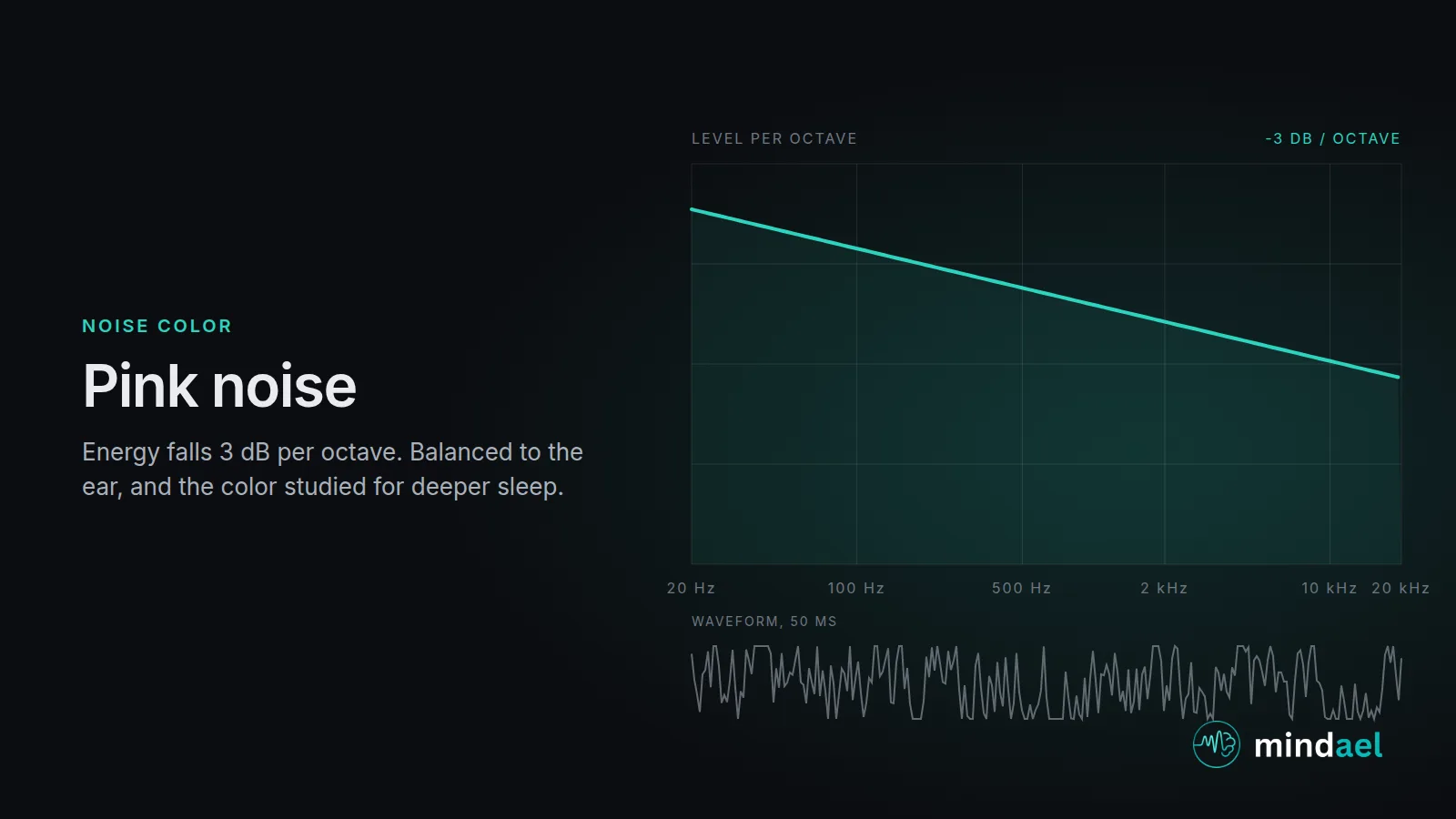
Pink noise sits between white and brown: softer than static, brighter than a rumble, like steady rain. Sleep labs have studied it more than any other color, and for most people it is the easiest noise to fall asleep to in a room that is not quite quiet.
Choosing an app? See what the best brown noise app needs, or browse the full sound library.
What pink noise is
Pink noise loses 3 dB of energy with every octave, which means each octave of pitch carries the same total energy. Since the ear hears in octaves, that balance is why pink noise sounds natural where white noise sounds harsh. Rain, surf and wind in leaves all sit close to a pink spectrum, which is also why people describe those sounds as restful. The track in Mindael is generated and measured in our studio to hold that slope from end to end.
When to use it
Sleep. This is the color sleep researchers reach for. When soft pink noise pulses were timed to a sleeper’s slow brain waves, deep sleep got deeper and memory the next morning improved, first in young adults (Ngo et al., 2013) and then in older adults (Papalambros et al., 2017). Those experiments used monitoring to time the pulses, which an app does not do; what carries over is that pink noise is the sound the brain tolerates well all night.
Attention. The 2024 meta-analysis of noise in young people with ADHD symptoms pooled pink with white and found small, consistent gains in task performance (Nigg et al., 2024). Many of our listeners who find brown too heavy for the desk land on pink.
How to listen
Quietly, on a speaker across the room for sleep. If you share a bed with someone who hates static, pink is usually the color they can live with. Add ocean waves for movement or a little brown noise for depth, and set the timer.
The three colors are compared side by side, with a one-line rule for choosing, in brown noise vs white noise vs pink noise.
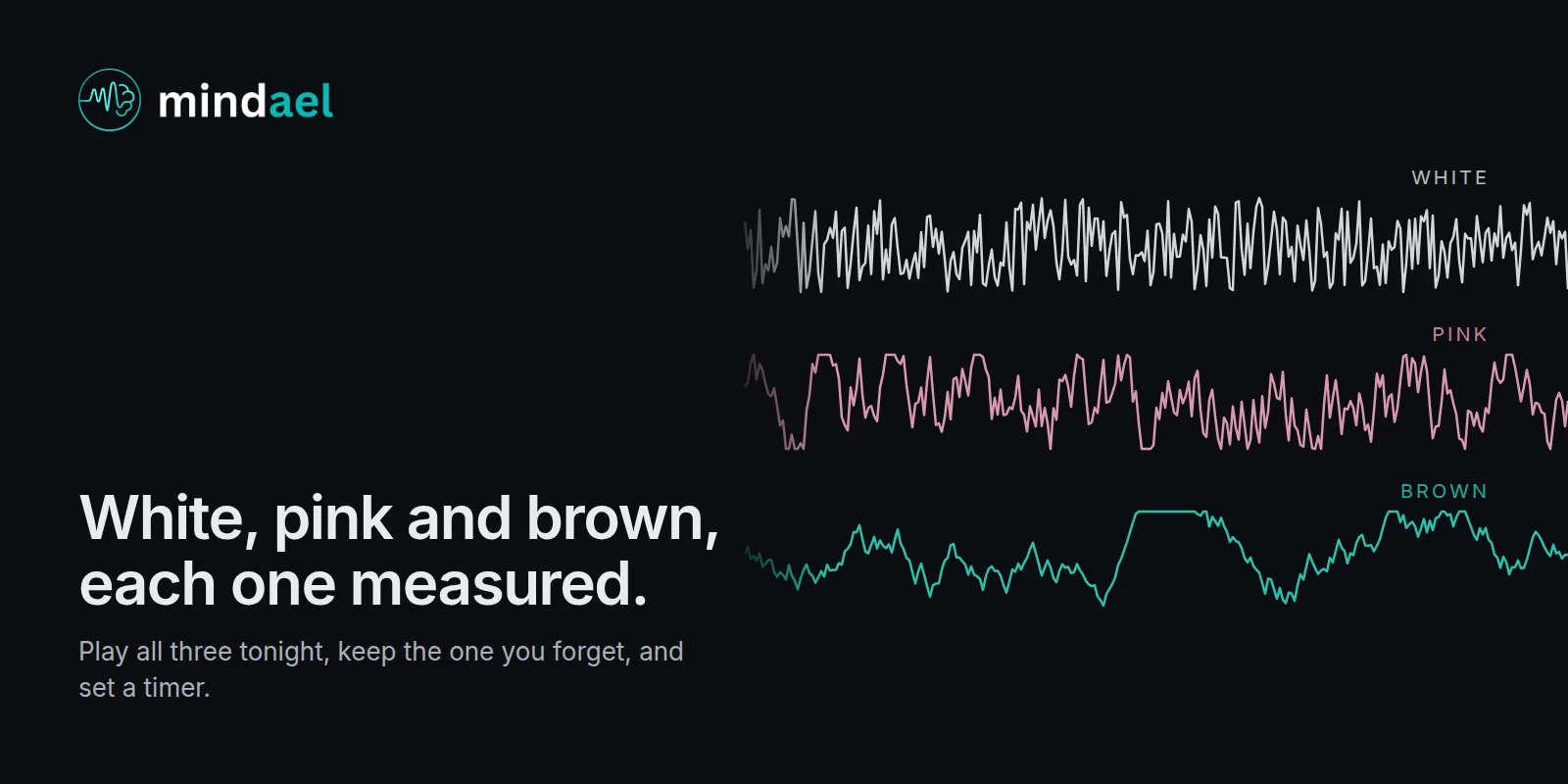
The color sleep science keeps coming back to.
If one noise color deserves a three-night test, it is this one. Mindael's pink noise is generated in our studio and measured to fall 3 dB per octave, so the balance you hear in the sample is the balance you sleep to. Download it, play it low, and set a 60 minute fade.
- Pink, brown and white noise, measured to spec
- Layer pink with ocean or a delta beat
- Sleep timer with a gentle fade, works offline
 Free · No account needed · Works offline
 Frequently asked questions
What is pink noise?
Random noise whose energy falls 3 dB with every octave, so each octave carries the same total energy. To the ear that sounds balanced and natural, like steady rain or wind through trees.
Is pink noise good for deep sleep?
Sleep-lab studies played soft pink noise pulses timed to the sleeper's slow brain waves and found deeper slow-wave sleep and better next-morning memory, in young adults in 2013 and in older adults in 2017. Those used brain monitoring to time the pulses; a steady track is simpler, but it is the same sound.
Pink noise vs white noise?
White is brighter and masks sharp sounds better. Pink is softer and easier to sleep with for a whole night. Most people who try both for sleep keep pink.
Can I use pink noise for studying?
Yes. It is a comfortable background for reading and writing, less heavy than brown and less sharp than white. Keep it low and run it in 25 to 50 minute blocks.
Sources
- Ngo HV, Martinetz T, Born J, Mölle M. Auditory closed-loop stimulation of the sleep slow oscillation enhances memory. Neuron, 2013.
- Papalambros NA, et al. Acoustic enhancement of sleep slow oscillations and concomitant memory improvement in older adults. Frontiers in Human Neuroscience, 2017.
- Nigg JT, et al. Systematic review and meta-analysis: do white noise or pink noise help with task performance in youth with ADHD or with elevated attention problems? Journal of the American Academy of Child and Adolescent Psychiatry, 2024.
This page is for general information and is not medical advice.