

Ocean Wave Sounds: The Slow Rhythm That Sets the Pace for Breathing and Sleep
Natural broadband sound with a slow 8 to 12 second rhythm
15 second sample of a real three-layer mix from Mindael: Ocean waves with a Theta 7.5 Hz beat and a 285 Hz tone.
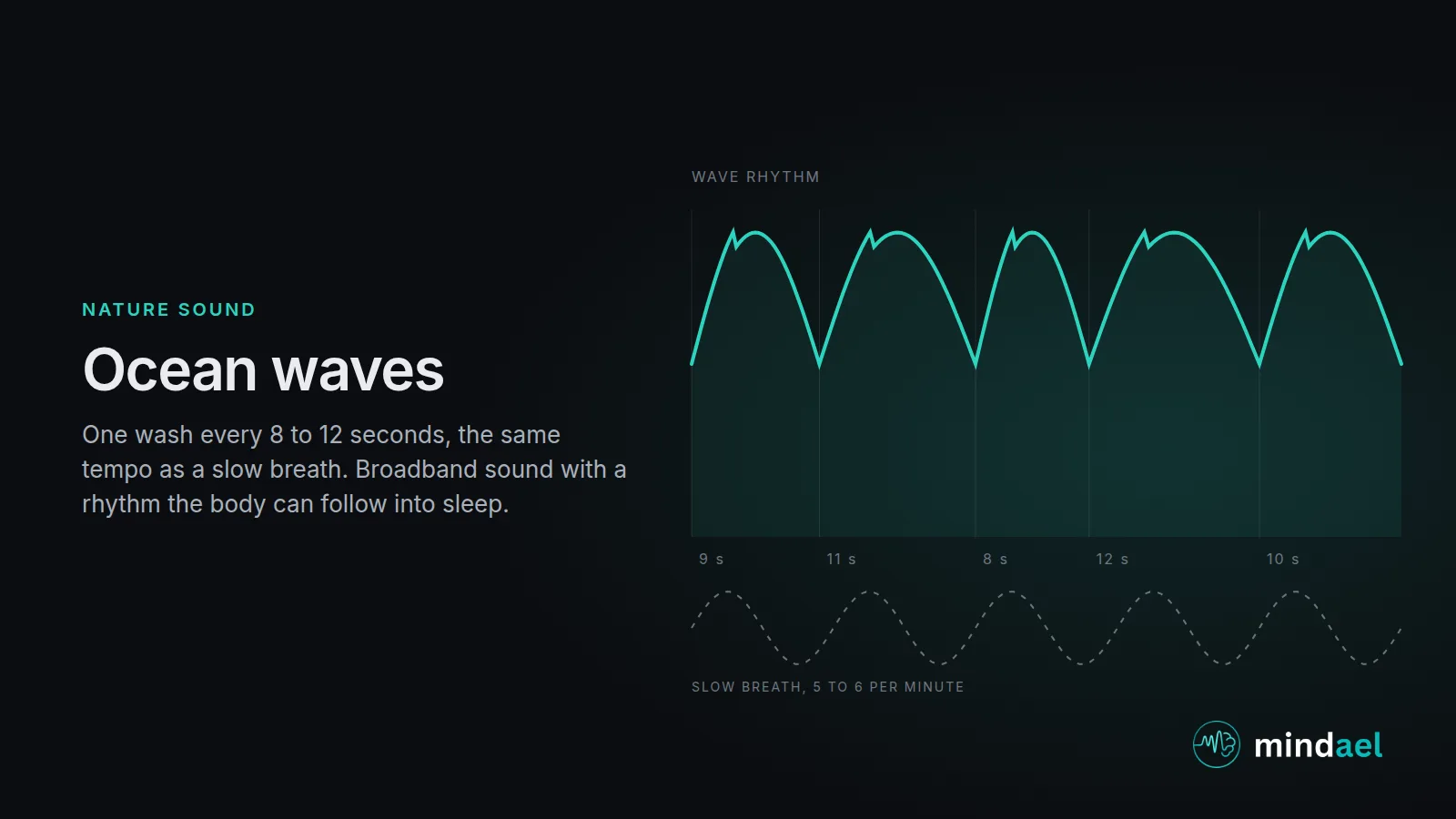
Ocean waves are rain with a rhythm. Each wave is a soft wash of broadband sound, and the gap between waves, roughly eight to twelve seconds, is close to a slow breathing cycle. That is why ocean is the natural sound people reach for when they want to calm down rather than just mask a room.
Choosing an app? See what the best sleep sounds app needs, or browse the full sound library.
What makes ocean different from rain
Both are natural broadband sounds with a pink-like balance. The difference is time. Rain is continuous; the ocean arrives in slow waves, one wash every eight to twelve seconds, with a quiet trough between. That trough is the useful part. Slow breathing, four seconds in and six out, fits one wave almost exactly, so the ocean does the counting for you. The recordings in Mindael are made by us and chosen for a calm, even rhythm rather than dramatic surf.
When to use it
Winding down. This is where ocean earns its place. Put it on, let the exhale lengthen to match the waves, and give it ten minutes. If you want more, add a theta beat with earbuds; a 6 Hz beat raised theta brain activity within about ten minutes in a 2017 study (Jirakittayakorn and Wongsawat, 2017), and ocean is the most natural thing to put over it.
Sleep. Ocean on a speaker, low, with a timer. Steady broadband sound shortened time to fall asleep in a noisy setting (Messineo et al., 2017), and ocean is that sound with a rhythm attached. Choose a calm sea rather than crashing surf if you wake easily.
Meditation. A lying-down session with ocean, a soft drone and nothing else is one of the three sessions on our meditation sounds page.
How to listen
Speaker for ocean alone, earbuds if you add a beat. Keep the ocean at about half the volume you first set; it is more effective when it sits under your attention. The sample above is a real three-layer mix from the app, Ocean with Theta 7.5 Hz and 285 Hz, which is a good first evening mix to save.
The evening mix you heard in the sample, ready to save.
Ocean under a theta beat and a soft tone is the most saved evening mix among our listeners. In Mindael you build it once, set the levels, and press play every night. The ocean is recorded by us, the beat uses a clean carrier, and the timer fades it out when you are done.
- Ocean waves, calm sea and shoreline recordings
- Save a mix of up to eight sounds
- Timer with a gentle fade, works offline
 Free · No account needed · Works offline
 Frequently asked questions
Why are ocean sounds relaxing?
Each wave is a soft, broadband wash close to pink noise, and the slow rhythm between waves gives the breath something to follow. A longer exhale is the most reliable way into the rest state, and ocean sets that pace without any counting.
Are ocean waves good for sleep?
Yes, especially for people who find plain noise too flat. The rhythm fades into the background within minutes. If you wake easily, choose a calm ocean rather than surf with big crashes.
Ocean waves or rain?
Rain is steadier; ocean has rhythm. For masking a loud room, rain or heavy rain. For calming down, ocean. Many of our listeners use ocean in the evening and switch to rain at bedtime.
What is in the sample?
A real three-layer mix from the app: Ocean waves, a Theta 7.5 Hz binaural beat and a 285 Hz solfeggio tone. It is the kind of mix you can save and reuse every evening.
Sources
- Messineo L, et al. Broadband sound administration improves sleep onset latency in healthy subjects in a model of transient insomnia. Frontiers in Neurology, 2017.
- Jirakittayakorn N, Wongsawat Y. Brain responses to a 6-Hz binaural beat: effects on general theta rhythm and frontal midline theta activity. Frontiers in Neuroscience, 2017.
This page is for general information and is not medical advice.