

Binaural Beats: How They Work and What the Science Actually Says
A binaural beat is a slow pulse your brain creates when each ear hears a slightly different tone. Studies link it with lower anxiety, steadier attention and easier sleep, and the effect depends on three things: headphones, a frequency that matches your goal, and a session of 15 to 30 minutes.
Binaural beats are the part of Mindael people ask us about most, usually in two forms: “how can a sound that is not even there do anything?” and “which frequency should I use?” Both have clear answers. You can try every band, from delta to gamma, for free in Mindael on the App Store, and the guide below explains what you are hearing, what the research found, and how to listen so a session actually works.
What are binaural beats?
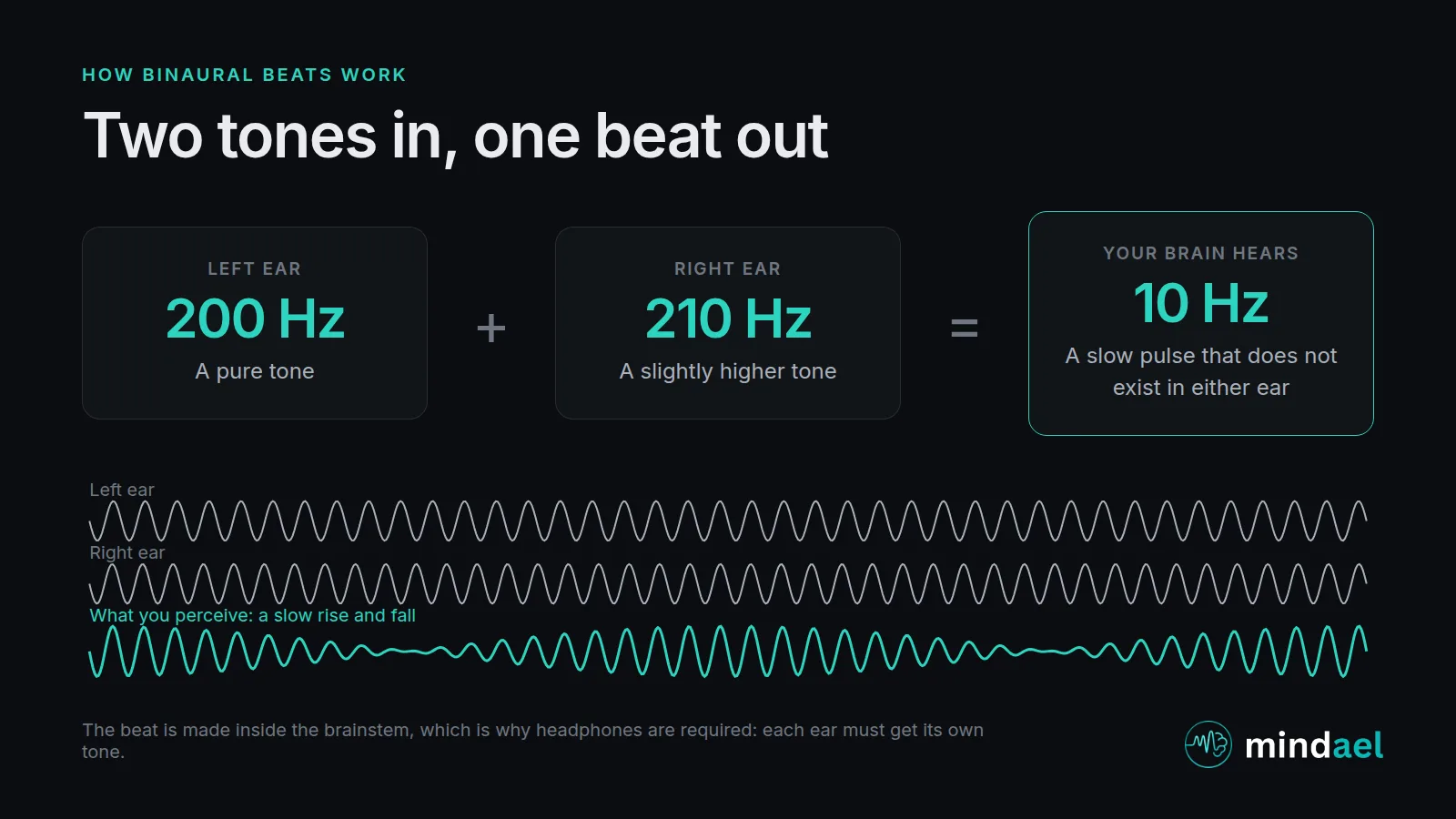
A binaural beat is not a sound in the room. It is something your brain assembles. When the left ear hears a steady tone at one frequency and the right ear hears a tone at a slightly different frequency, the auditory system reconciles the difference and you perceive a third, much slower pulse that exists in neither signal.
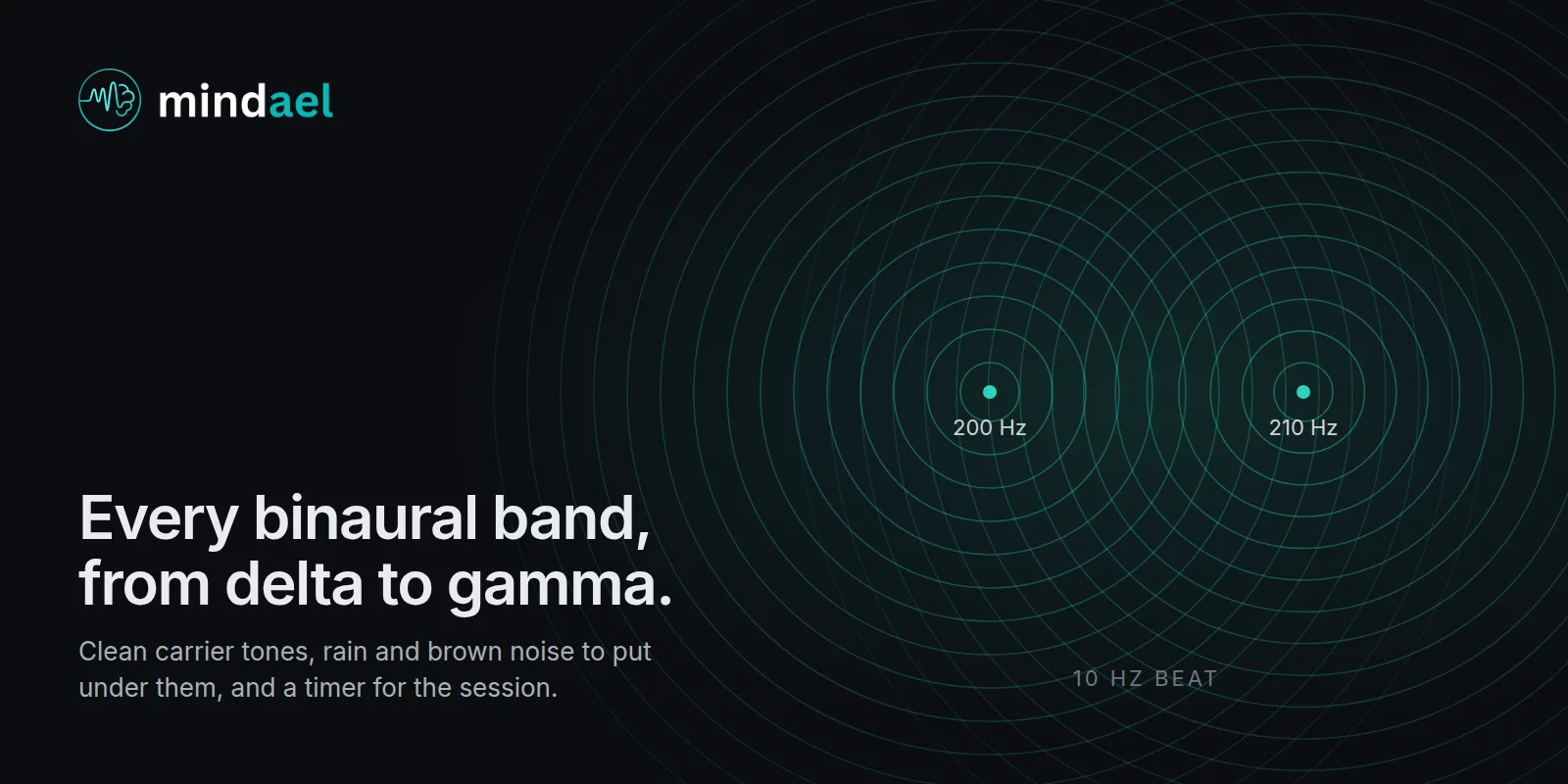
Play 200 Hz in the left ear and 210 Hz in the right, and you hear a 10 Hz beat. That beat is created in the brainstem, where the signals from the two ears first meet, which is why headphones are not optional. A speaker mixes the two tones in the air and the effect disappears.
The phenomenon was described in detail by Gerald Oster in a 1973 Scientific American article that is still the standard reference (Oster, 1973). What made it interesting to researchers is what happens next: with a beat playing, measurable brain activity tends to drift toward the same frequency. This is called the frequency-following response, and it is what people mean by brainwave entrainment. Feed the brain a slow pulse and it leans toward a slower state; feed it a fast one and it leans toward alertness.
How strong that pull is varies with the person, the frequency and the setting. We cover the evidence below. The mechanism itself is what separates binaural beats from background sounds like brown or pink noise, which work by masking rather than by nudging brain rhythm.
The five brainwave bands
Choosing a beat starts with the five frequency bands the brain cycles through every day. Each one is linked with a mental state, and each matches a range of beat frequencies.
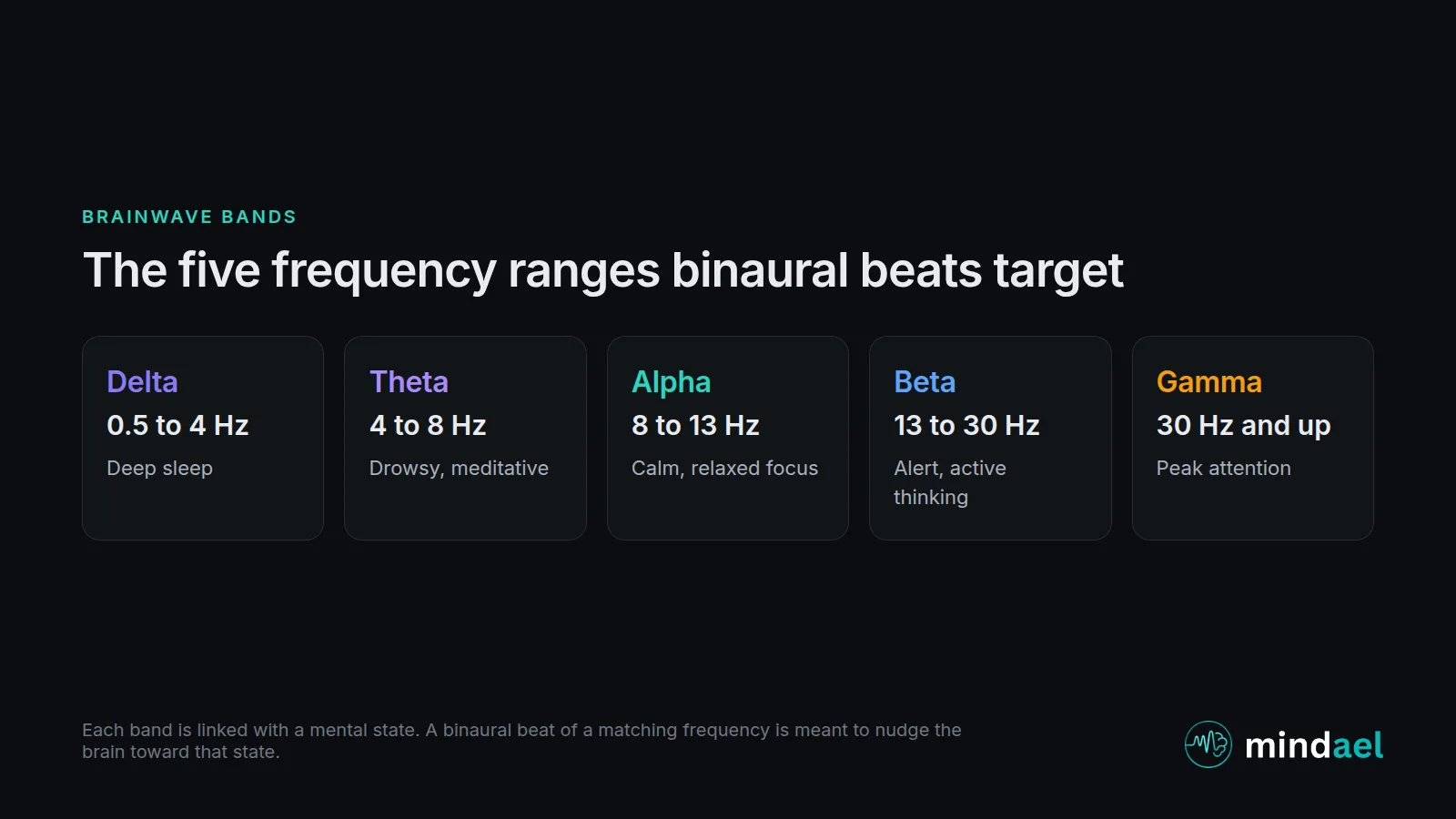
- Delta (0.5 to 4 Hz). The slowest waves, dominant in deep, restorative sleep. Delta beats are paired with sleep audio.
- Theta (4 to 8 Hz). Light sleep, deep meditation, daydreaming. The usual choice for winding down.
- Alpha (8 to 13 Hz). Calm, relaxed and awake, eyes closed. What most people want when they need to take the edge off without dozing.
- Beta (13 to 30 Hz). Alert, engaged, actively thinking. The everyday working brain.
- Gamma (30 Hz and up). Fast activity tied to memory, learning and problem solving.
You do not need the numbers. The short version: the slower the beat, the more relaxed the target; the faster the beat, the more activated.
Binaural beats for sleep
Sleep is the most popular use and one of the better studied. Delta waves dominate deep sleep, so a delta beat of 1 to 4 Hz is meant to tilt a tired but restless brain in that direction.
In a 2018 sleep-lab study, a 3 Hz binaural beat played during the night increased the time participants spent in deep (N3) sleep and reduced lighter N2 sleep compared with a control night (Jirakittayakorn and Wongsawat, 2018). An earlier field study followed young elite soccer players who listened to a delta beat over several weeks at bedtime; they reported better sleep quality and felt more awake the next day than the control group (Abeln et al., 2014). The effects are modest, and they add up over a routine rather than appearing in one night.
Theta beats, around 6 Hz, are typically used in the half hour before bed rather than during sleep. In a 30-minute EEG study, a 6 Hz beat raised theta activity across the brain within the first ten minutes and produced the pattern associated with a meditative state, with listeners reporting less worry afterwards (Jirakittayakorn and Wongsawat, 2017). The goal there is to slow thinking down enough that falling asleep becomes the easy part.
A few practical notes. Start the audio fifteen to thirty minutes before you want to be asleep. Keep the volume low, just enough to hear through earbuds or a soft sleep headband. And give it more than one night; sleep responds to routines.
Binaural beats for focus
For work, the target moves up the spectrum. Beta beats of 13 to 30 Hz match the alert state most people want when studying, writing or coding. In one of the first controlled experiments, people doing a 30-minute vigilance task with beta beats detected more targets and reported better mood than with theta or delta beats (Lane et al., 1998). Gamma beats, around 40 Hz, are the choice for tasks that need fast recall or hard reasoning, and alpha beats suit calmer, longer stretches like reading.
If you want to try this, start the beat a few minutes before you need to focus and run it for twenty to thirty minutes. Layer it over brown noise or rain so it does not feel like a test tone in your ear; nearly everyone finds that easier for a long session.
Binaural beats for anxiety
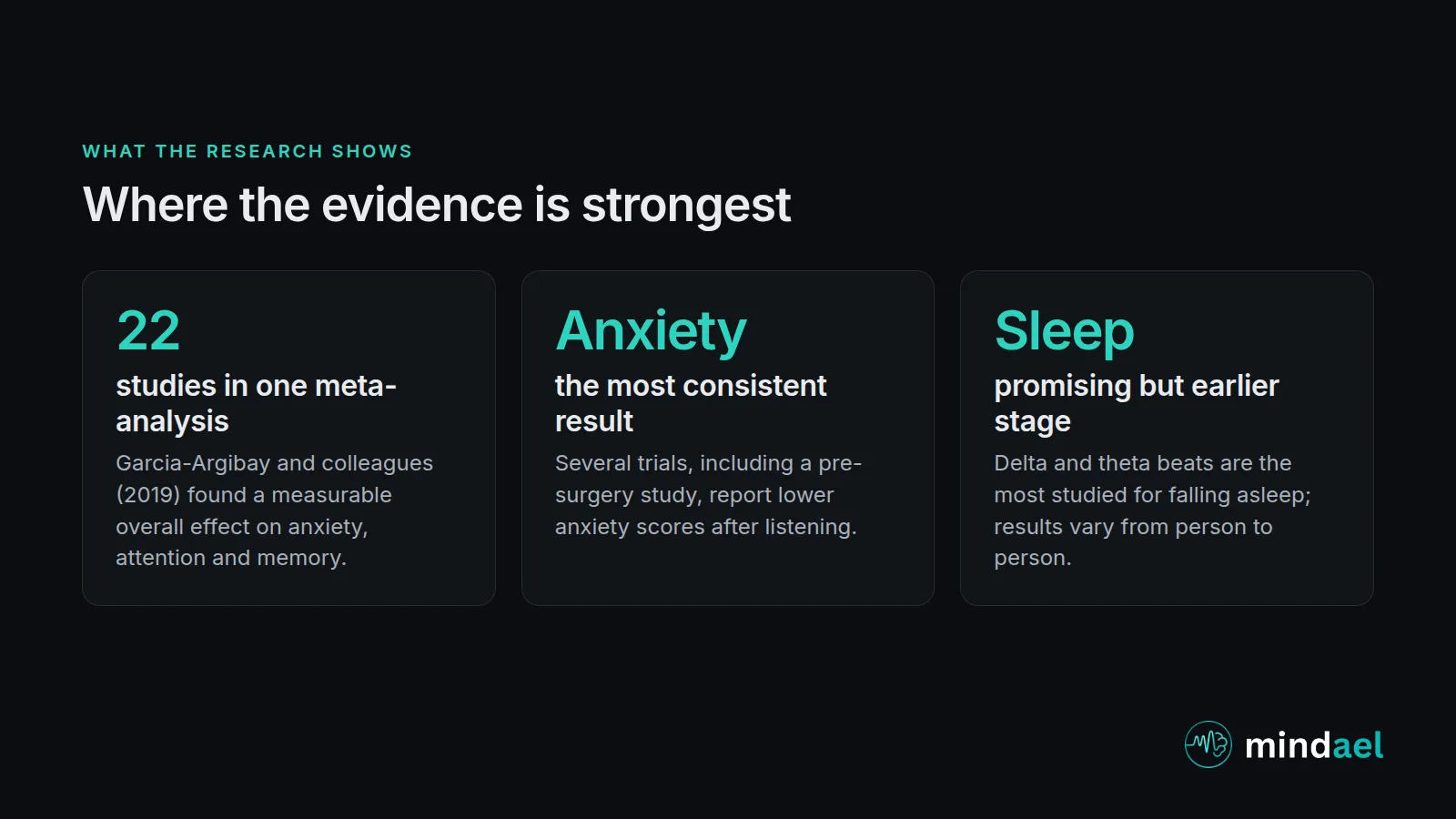
Anxiety is where the evidence is most consistent. In a hospital trial, patients waiting for day surgery who listened to binaural beats had a markedly smaller rise in anxiety than those who listened to the same music without the beat or to nothing (Padmanabhan et al., 2005). A larger emergency-department trial with 291 patients found that sound compositions built around binaural beats reduced anxiety during the wait compared with usual care (Weiland et al., 2011).
For everyday stress, the protocol most people settle on is simple. Put on a theta or alpha session for fifteen to twenty minutes, sit somewhere quiet, close your eyes, and let your breathing slow on its own. As a daily reset, it costs nothing and takes less time than a coffee break.
What the research shows overall
The frequency-following response is real and the effects are measurable. The clearest summary is a 2019 meta-analysis that pooled 22 studies and found an overall effect of binaural beats on anxiety, attention, memory and pain, with larger effects when the beat was played for longer and without masking noise over it (Garcia-Argibay et al., 2019).
Two things help when reading this research. First, the effect sizes are small to moderate; binaural beats are a nudge, not a switch. Second, responses vary. Some people feel a clear shift in their first session, others need a couple of weeks of daily use before they notice anything. Expectation plays a part too, which is fine: sitting down with headphones and the intention to settle is itself a useful habit.
Binaural beats appear to be safe for healthy adults at a sensible volume. Do not use them while driving. If you have epilepsy, check with your doctor first, because rhythmic stimulation can in rare cases be a trigger.
How to use binaural beats effectively
If you want to get something out of binaural beats rather than add another tab to the pile, these habits do the work.
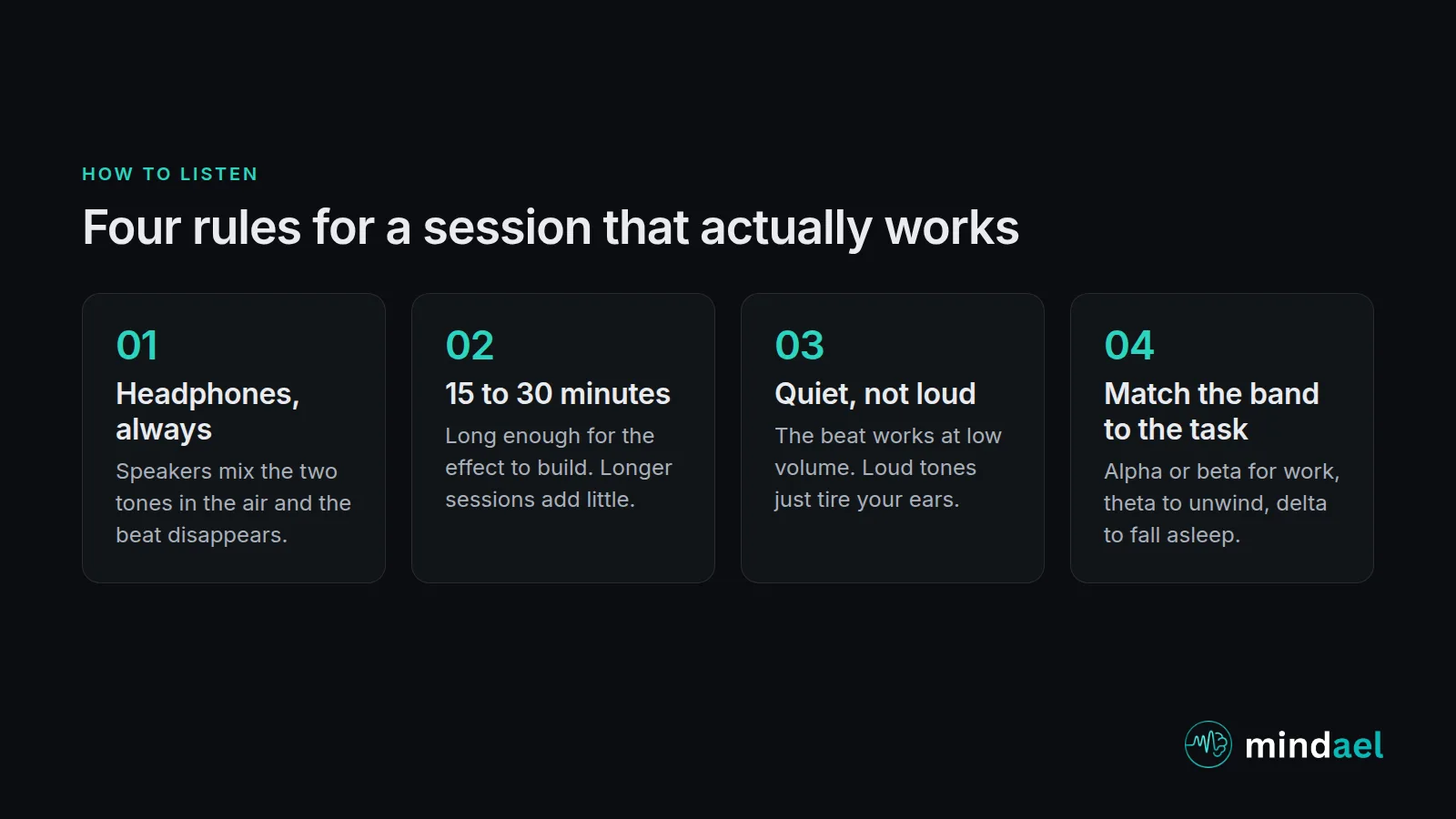
- Stereo headphones or earbuds, always. Speakers do not produce the beat.
- Match the band to the goal. Delta for sleep, theta for winding down, alpha for calm focus, beta for active work, gamma for hard problems.
- Fifteen to thirty minutes. Long enough for the effect to build. Longer rarely adds anything and can leave you flat.
- Keep it quiet. The beat should sit in the background. Loud tones just tire your ears.
- Layer it with something pleasant. Rain, ocean, brown noise or a soft ambient pad make long sessions far easier than a raw tone.
- Be consistent. Like meditation or exercise, the effect builds with daily use over a couple of weeks.
Treat them as a tool. Pair them with the basics that are known to work, real sleep, real breaks and real movement, and they become a reliable nudge in the direction you want.
Your first session is one tap away.
You know the band you need and how long to listen. Mindael has every beat from delta to gamma, generated with a clean carrier tone, plus the rain and brown noise to put under it. Earbuds in, pick the band for tonight, and give it fifteen minutes.
- Delta, theta, alpha, beta and gamma beats
- Layer a beat under rain, ocean or brown noise
- Timer that fades out, works offline
 Free · No account needed · Works offline
 Frequently asked questions
Do I need headphones for binaural beats?
Yes. The beat only exists when each ear receives its own tone. A speaker mixes the two tones in the air and the effect disappears. Any stereo earbuds or headphones will do.
How long should I listen to binaural beats?
Fifteen to thirty minutes is the range most studies used, and it is what we recommend. The meta-analysis of 22 studies found that longer sessions produced larger effects than very short ones, so give it at least ten minutes.
Which binaural beat frequency is best for sleep?
Delta, between 1 and 4 Hz, matches the brain's deep-sleep rhythm and is the most studied for sleep. Theta, around 4 to 8 Hz, is the usual choice for the wind-down before bed.
Which frequency is best for focus?
Beta, 13 to 30 Hz, matches an alert working brain and improved vigilance in a controlled study. Alpha, 8 to 13 Hz, suits calmer tasks like reading. Gamma, around 40 Hz, is used for demanding problem solving.
Are binaural beats safe?
For healthy adults, yes, at a sensible volume. Do not use them while driving. If you have epilepsy, check with your doctor first, since rhythmic stimulation can in rare cases be a trigger.
Can I combine binaural beats with other sounds?
Yes, and we recommend it. A raw tone gets tiring. Layer the beat under rain, brown noise or an ambient pad so it sits in the background for the whole session.
Sources
- Oster G. Auditory beats in the brain. Scientific American, 1973.
- Garcia-Argibay M, Santed MA, Reales JM. Efficacy of binaural auditory beats in cognition, anxiety, and pain perception: a meta-analysis. Psychological Research, 2019.
- Padmanabhan R, Hildreth AJ, Laws D. A prospective, randomised, controlled study examining binaural beat audio and pre-operative anxiety in patients undergoing general anaesthesia for day case surgery. Anaesthesia, 2005.
- Weiland TJ, et al. Original sound compositions reduce anxiety in emergency department patients: a randomised controlled trial. Medical Journal of Australia, 2011.
- Jirakittayakorn N, Wongsawat Y. A novel insight of effects of a 3-Hz binaural beat on sleep stages during sleep. Frontiers in Human Neuroscience, 2018.
- Jirakittayakorn N, Wongsawat Y. Brain responses to a 6-Hz binaural beat: effects on general theta rhythm and frontal midline theta activity. Frontiers in Neuroscience, 2017.
- Abeln V, Kleinert J, Strüder HK, Schneider S. Brainwave entrainment for better sleep and post-sleep state of young elite soccer players. European Journal of Sport Science, 2014.
- Lane JD, Kasian SJ, Owens JE, Marsh GR. Binaural auditory beats affect vigilance performance and mood. Physiology & Behavior, 1998.
This article is for general information and is not medical advice.
Hear the sounds in this article in the Mindael sound library, or see our app comparison checklists.