

Sounds for ADHD: Brown Noise, White Noise and What Actually Helps You Start
If you have ADHD, you probably already know the feeling: the task is not hard, starting it is. A steady low sound gives an under-stimulated brain the constant input it is looking for, so the first minute of work stops feeling like a wall. Brown noise, the sound most of our ADHD listeners use, is in Mindael, free on the App Store, and this page explains why it works and how to set it up.
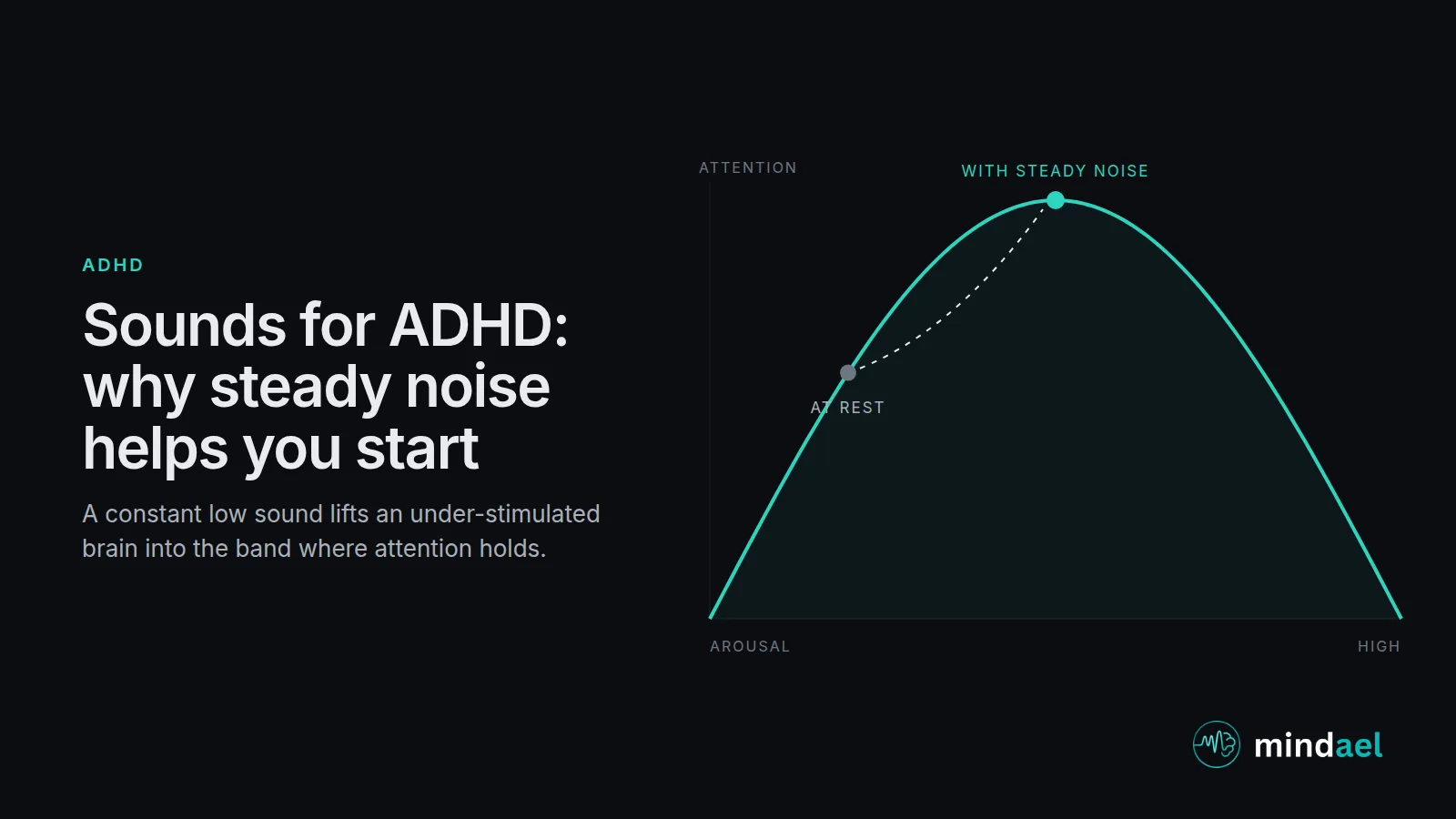
Steady broadband noise, white, pink or brown, gives measurable gains in attention and memory for people with ADHD symptoms, and the effect is strongest in those who struggle most. Brown noise is the gentlest version. Keep it low, start it before you sit down, and pair it with a timer so each block has an end.
Sounds that work, and why
Brown noise
Deep and soft. The gentlest of the noise colors, which is why it is the one people with ADHD can keep on for hours without it getting sharp.
White noise
The color most of the ADHD research used. Brighter than brown; better in a loud room, harder to live with for a full day.
Pink noise
The middle ground. The 2024 meta-analysis pooled pink with white, and many of our listeners find it the easiest to start with.
Beta beat under brown noise
For short, sharp blocks when you need vigilance rather than calm. Earbuds required, 25 minutes, then off.
Why steady noise helps an ADHD brain
The explanation researchers use is called the moderate brain arousal model. Attention works best in a middle band of arousal. An ADHD brain tends to sit a little below that band at rest, which is why boring tasks feel physically hard to start and why fidgeting, music and a second screen are so tempting: they are all attempts to add input. Steady noise adds that input in a form that does not compete with the task. It brings arousal up to where attention works and then stays out of the way.
That model also explains the pattern people notice in themselves. The same brown noise that helps you start a report may feel heavy on a day when you are already keyed up. On those days, lower the volume or switch to rain. The goal is the middle band, not more sound.
What the research shows
The foundational experiments came from Sweden. Children with attention problems remembered more words from a list when white noise played, while children without those problems did slightly worse under the same noise (Söderlund et al., 2007). A follow-up in ordinary classrooms found the same split: inattentive children improved with white noise, attentive children did not (Söderlund et al., 2010).
In 2024, a systematic review and meta-analysis pooled the studies on white and pink noise in young people with ADHD or elevated attention problems and found small but consistent improvements in attention and task performance, strongest in those with more severe symptoms (Nigg et al., 2024). The authors describe noise as a low-cost support worth trying alongside, not instead of, standard care, which is how we would put it too.
Those studies used white and pink noise. Brown noise rides on the same mechanism with the sharp end removed, which is why it is the color most adults with ADHD end up keeping on. Our guide to what brown noise is goes into the spectrum and the settings in more detail.
The setup that works for our ADHD listeners
We hear from a lot of people with ADHD, and the ones who stick with sound share a few habits.
They start the sound before the task. The noise becomes the first step, and it is a step you cannot fail. By the time you open the document, you are already working.
They remove the choice. One sound, brown noise, for two weeks. Browsing a sound library is a lovely way to not start a task, so pick once and leave it.
They use a timer. An ADHD brain handles a 25 minute block far better than an afternoon. The timer gives the block a shape, and the break with the sound off makes the next block’s start signal stronger.
They keep it quieter than feels right. The research effect came from moderate noise. If you can hear it clearly over your own thoughts, turn it down.
For short bursts that need sharp attention rather than calm, a beta binaural beat under brown noise is the sound with the clearest research for vigilance (Lane et al., 1998), and our focus sounds page shows how to run those blocks.
How to set it up tonight
- Press play before you sit downThe sound is a start signal. Starting it first turns the hardest part of the task into a habit you already did.
- Keep it lower than you wantAround 40 to 50 dB. The research effect comes from steady input, not loud input.
- One block, one timer25 minutes on, 5 off. The end point matters as much as the sound; an open-ended task is the one that never starts.
- Same sound every timePick brown noise and stay with it for two weeks. Novelty is exactly what an ADHD brain will chase, so remove the choice.
- Add a layer only when it is boringIf brown noise fades into the background after a week, that is it working. Add rain if you want texture, not because you are restless.
Make starting the easy part.
The hardest minute of any task is the first one. Mindael's brown noise is made in our studio, measured to fall exactly 6 dB per octave, and ready in one tap, with a timer that ends the block for you. Download it, press play before you open the work, and see how different the first minute feels.
- Studio-made brown, pink and white noise
- Timer for 25 minute blocks and breaks
- Layer rain or a beta beat in two taps, works offline
 Free · No account needed · Works offline
 Frequently asked questions
Does brown noise help with ADHD?
Many people with ADHD say it does, and the published research on white and pink noise points the same way: small but consistent gains in attention and task performance, strongest in people with more severe symptoms. Brown noise is the same kind of steady sound with the high frequencies rolled off, which makes it easier to keep on.
Why does noise help an ADHD brain but distract other people?
The leading explanation is the moderate brain arousal model. An ADHD brain sits slightly below its ideal arousal level, and a constant mild input brings it up to where attention works. A brain already at that level gets pushed past it, which is why the same noise made non-ADHD children in the Swedish studies perform slightly worse.
Is white noise or brown noise better for ADHD?
The studies used white and pink. In practice, brown noise is what most people can tolerate for a full day, so it is where we suggest starting. If your room is loud, try white.
How long should I listen?
For the length of a work block, 25 to 50 minutes, then a break with the sound off. Hours of low sound are fine; the break is for your attention, not your ears.
Can children with ADHD use these sounds for homework?
The research was done mostly with school-age children, and it found the benefit there. Keep the volume low, around a quiet conversation, and use a speaker rather than headphones.
Sources
- Söderlund G, Sikström S, Smart A. Listen to the noise: noise is beneficial for cognitive performance in ADHD. Journal of Child Psychology and Psychiatry, 2007.
- Söderlund GBW, Sikström S, Loftesnes JM, Sonuga-Barke EJ. The effects of background white noise on memory performance in inattentive school children. Behavioral and Brain Functions, 2010.
- Nigg JT, et al. Systematic review and meta-analysis: do white noise or pink noise help with task performance in youth with ADHD or with elevated attention problems? Journal of the American Academy of Child and Adolescent Psychiatry, 2024.
- Lane JD, Kasian SJ, Owens JE, Marsh GR. Binaural auditory beats affect vigilance performance and mood. Physiology & Behavior, 1998.
This page is for general information and is not medical advice. Sound is a support, not a treatment; if you have ADHD, keep working with your clinician.