

Music for Dogs: What Sounds Actually Calm a Dog, What the Research Found, and How to Use Them at Home
Dogs do respond to sound, and not in the way the "dog music" playlists suggest. The research, most of it done in rescue kennels where stress is easy to measure, finds that slow, steady, mid-volume sound lowers barking, pacing and heart rate, that dogs get used to the same genre within days, and that the biggest practical use is not relaxation but masking: covering the fireworks, thunder and doorbells that frighten them. This page covers what the studies found, which sounds to use for which problem, how loud is safe for ears far more sensitive than ours, and the signs that a dog needs a vet rather than a playlist. The sounds are in Mindael, free to download on the App Store.
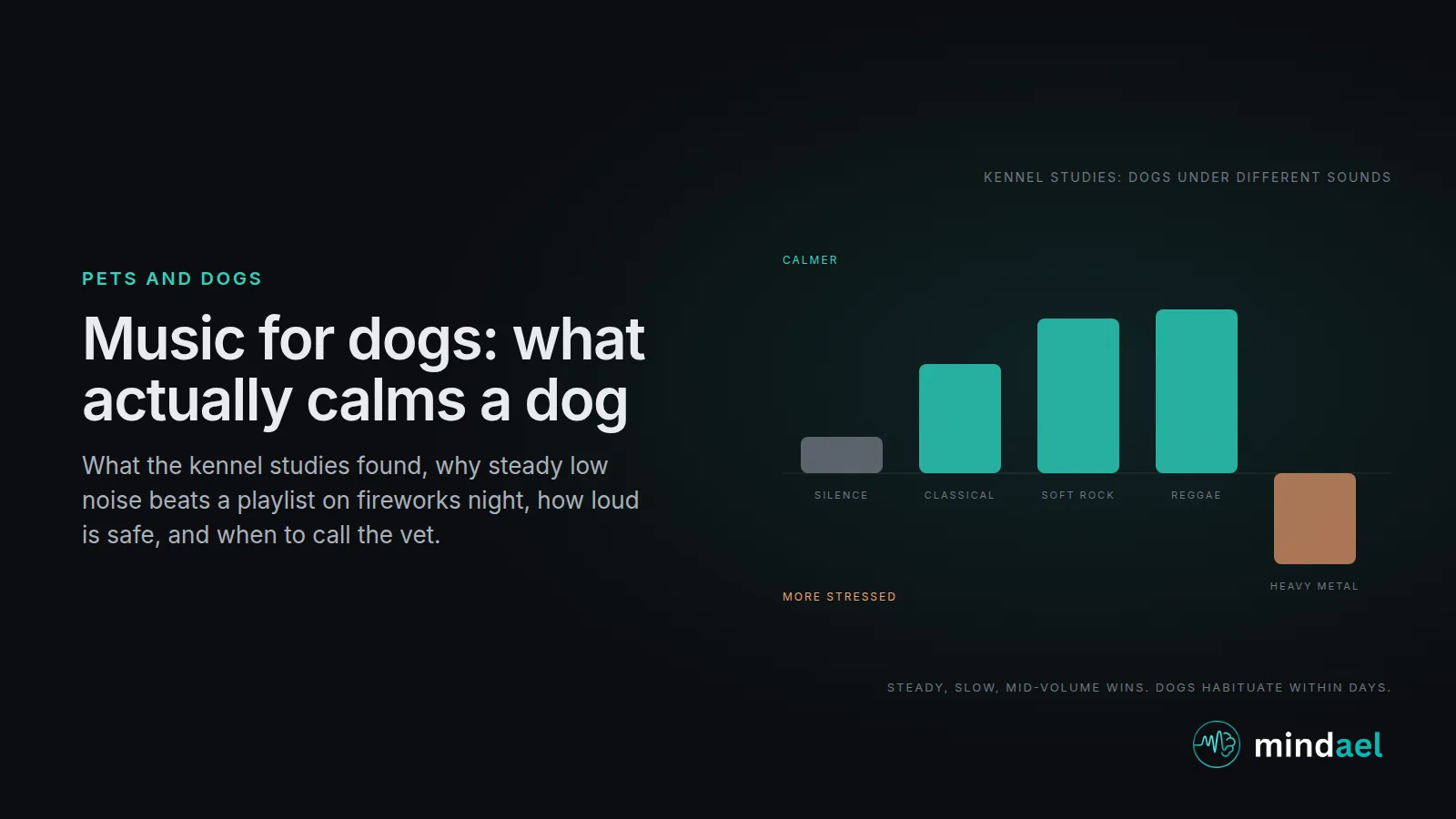
In kennel studies, classical music lowered barking and standing and raised time lying down and sleeping; heavy metal increased shaking; soft rock and reggae lowered stress markers the most in a 2017 study that also found dogs habituate to any one genre within a few days. For a dog that fears fireworks or thunder, the most useful sound is a steady low noise, brown or pink, started before the noise begins and kept at the level of a quiet conversation where the dog lies. Rotate the sound, never play it loud, pair it with a safe place, and for a dog that panics, drools or tries to escape, see a vet: sound helps mild cases and is not a treatment for noise phobia.
Sounds that work, and why
Brown noise
The fireworks and thunder sound. Its energy sits in the same low frequencies as bangs and rumbles, so at a modest level it covers them rather than competing. Start it before dark on fireworks nights.
Pink noise
Lighter than brown, for everyday masking: the hallway, the neighbour's door, the delivery van. The one to leave on when the dog is home alone.
Rain
Soft and varied. For the evening, for a dog that is unsettled rather than frightened, and for dogs who find a flat noise strange at first.
Ocean waves
Slow and rhythmic. Several of our listeners use it as the settle-down sound after walks; the rhythm is around six waves a minute, which is calm for people too.
Green noise
Mid-frequency, like a steady breeze. A change from pink or brown when a dog has habituated to one of them, which the research says happens within days.
What the kennel studies found
Most of what is known about music for dogs comes from rescue kennels, where stress is high, behaviour is easy to observe and the same dogs can be watched under different sounds. The findings are consistent and modest.
In a 2012 study of 117 kennelled dogs, classical music increased the time dogs spent sleeping and reduced barking, while heavy metal increased body shaking, a sign of anxiety; a commercial “dog relaxation” album did no better than silence (Kogan et al., 2012). In a 2015 study, a week of classical music at a Scottish rescue centre lowered stress behaviours and raised heart rate variability, the marker of a calmer nervous system, compared with silent control days, but the effect faded over the week (Bowman et al., 2015). The same group then compared five genres in 2017 and found all of them reduced stress compared with silence, with soft rock and reggae showing the largest changes in heart rate variability, and again found dogs habituating to any one genre within days (Bowman et al., 2017).
Two more pieces matter. A 2016 study found audiobooks settled kennelled dogs better than music did, with more resting and less barking and standing, which suggests that a steady, unhurried human voice is reassuring in itself (Brayley & Montrose, 2016). And a 2017 trial in a veterinary hospital found that classical music during stays reduced some stress behaviours but not others, with owners rating the hospital better either way (Engler & Bain, 2017).
What the calming sounds have in common: slow or no tempo, no sudden changes in volume, mid-range pitch, steadiness. That is also a description of rain, ocean and low noise, which have the advantage that there is no genre for the dog to get used to and nothing in them that resembles a bang.
Masking: the use that matters most
Roughly half of pet dogs show some fear of loud noises, fireworks and thunder above all, and most owners never seek help for it (Blackwell et al., 2013). For those dogs the most useful thing a sound can do is not soothe but cover. A firework is a sharp low bang arriving out of silence. A steady brown noise already filling the room, at a quiet-conversation level, takes the edge off every bang by raising the floor it has to climb over; the dog still hears it, but it is no longer the loudest and most sudden thing in the world. Start it before dark, close the curtains, open the dog’s den. The noise colours article explains why brown rather than white for this job: white has a hiss in the high frequencies that dogs, who hear far higher than we do, find more intrusive.
For everyday noise, the hallway, the street, the delivery van that sets off barking at three in the afternoon, pink noise or rain at a low level is enough, and it is the sound to leave on when the dog is home alone.
How loud, and how to tell
Dogs hear up to around 45 kHz, against our 20, and detect quieter sounds than we do. A level that sounds modest to you standing by the speaker is louder to a dog lying next to it, so set the volume at the dog’s bed, not yours, and keep it to a quiet conversation. The same rule we give for a baby’s room applies, and for the same reason: the sound is there to blur the outside, not to be heard. If the dog gets up and moves away from the speaker, that is the answer; turn it down or change the sound.
Which sound for which dog
The anxious-when-alone dog. Pink noise or rain, low, from an hour before you leave so it is not a departure cue, with a radio talk station as an alternative given the audiobook finding.
The fireworks and thunder dog. Brown noise, started before dark, with a den. For a dog that panics anyway, this is a vet conversation, and often a medication conversation, well before the season.
The unsettled evening dog. Rain or ocean, the same one each evening, as a wind-down cue. After a couple of weeks it becomes a signal that the day is over, for the dog and for you; our relaxing sounds guide is the human version of the same idea.
The dog who has stopped responding. Habituation. Change the sound: green noise for a week, then back. Rotation is what the research says keeps the effect.
When sound is not the answer
A dog that pants, drools, trembles, hides for hours, soils, or tries to break through doors during noise has a noise phobia, which is a clinical anxiety disorder, not a preference problem. Sound can be part of a plan for those dogs, alongside a safe place, gradual desensitisation and, for the worst nights, medication from a vet. It is not the plan on its own, and the kindest thing an owner can do is get help before the next fireworks night rather than after it.
How to set it up tonight
- Measure the volume where the dog liesDogs hear quieter sounds than we do and higher ones. Set the level by standing at the dog's bed: it should be a quiet conversation, never louder. If the dog moves away from the speaker, it is too loud or too strange; turn it down.
- Introduce it when the dog is calmPlay the sound during ordinary, relaxed time for a few days before you need it: after a walk, at dinner, in the evening. A sound that first appears during a thunderstorm becomes part of the storm.
- Start before the noise, not duringOn fireworks night or when a storm is forecast, start brown noise an hour before dark, close the curtains, and leave the dog's safe place open. The masking only works if the dog is already settled under the sound when the first bang comes.
- Rotate the soundA 2017 study found dogs' stress markers returned toward baseline within a few days of hearing the same genre. Alternate rain, pink, brown and green through the week rather than one sound forever.
- Pair it with a safe placeA crate with the door open, a bed in an internal room, a blanket over part of it. The sound covers the outside; the den gives the dog somewhere to go. Together they do far more than either alone.
- Know when it is not enoughPanting, drooling, trembling, hiding for hours, trying to escape, or destroying doors are signs of noise phobia, a clinical problem. Sound helps mild fear; for this, a vet or a qualified behaviourist, and possibly medication for the worst nights.
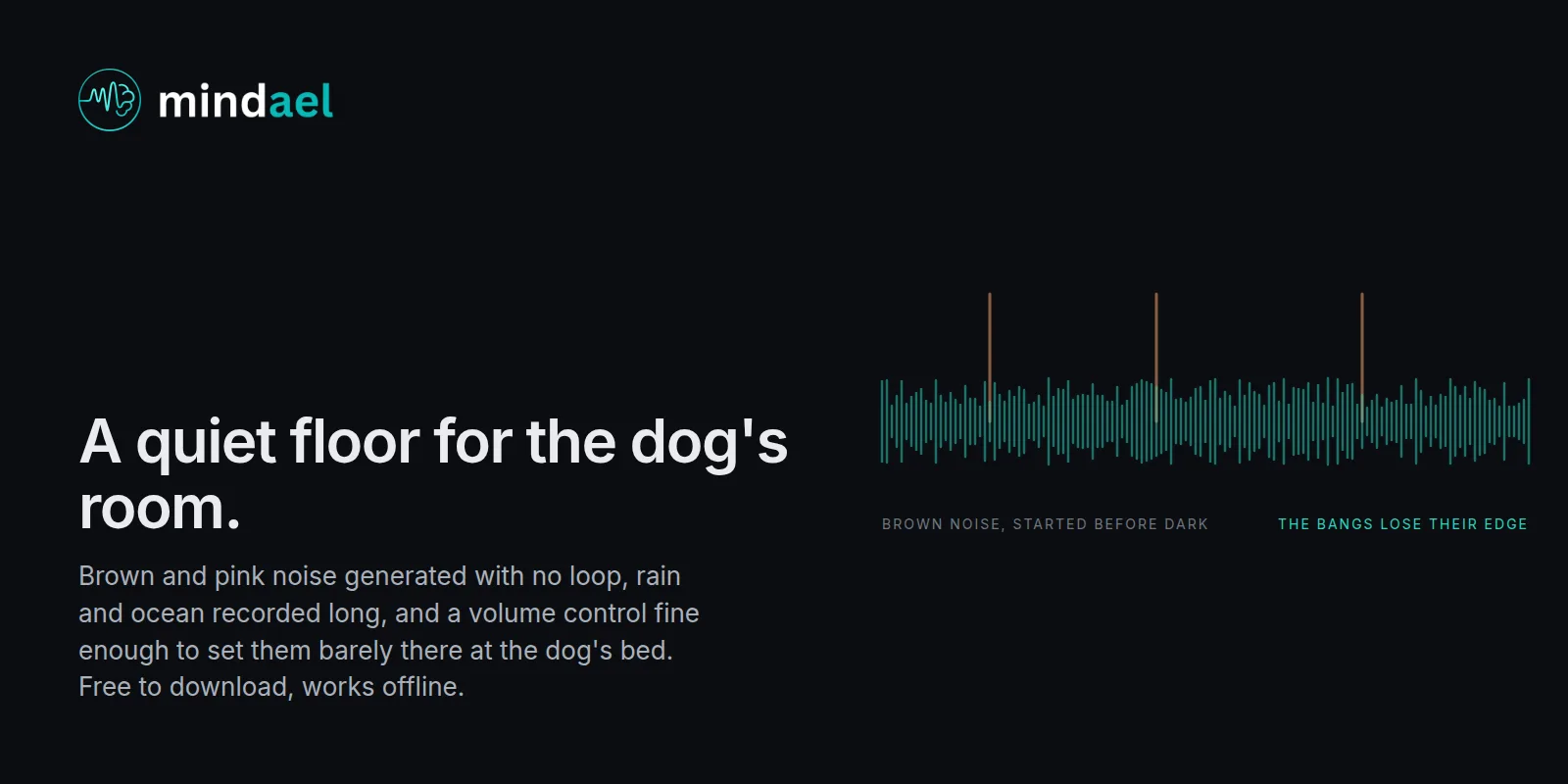
A quiet floor for the dog's room.
Mindael's brown and pink noise are generated continuously with no loop, rain and ocean are long studio recordings, and the volume control is fine enough to set them barely there at the dog's bed. Free to download, no account, works offline. Start it before dark; the dog will tell you if it is too loud.
- Brown, pink and green noise, rain and ocean, studio-made
- Fine volume control for low levels
- Free to download, no account, works offline
 Free · No account needed · Works offline
 Frequently asked questions
Does music really calm dogs down?
In kennel studies, yes, modestly. Classical music increased lying down and sleeping and reduced barking in a 2012 study and lowered stress behaviours and heart rate variability markers in a 2015 study; heavy metal increased body shaking. The effects are real and smaller than the playlists suggest, and dogs habituate to one genre within days.
What is the best music for dogs?
The 2017 kennel study that compared five genres found soft rock and reggae produced the biggest drop in stress markers, with classical, Motown and pop behind them. What the calming genres share is a slow, steady tempo and no sudden changes. Steady natural sound and low noise share the same qualities without a tune for the dog to get used to.
What sounds calm a dog during fireworks?
A steady low noise, brown or pink, started an hour before dark at the level of a quiet conversation where the dog lies, with curtains closed and a safe place open. The noise covers the bangs rather than fighting them. For a dog that panics anyway, talk to your vet before the next fireworks season.
Is white noise bad for dogs?
Not at a low level. The risk is volume: dogs hear quieter and higher sounds than people, and a sound that is comfortable to you at the speaker is louder to a dog lying next to it. Keep it at a quiet conversation measured at the dog's bed, and prefer pink or brown noise, which have less of the high hiss.
Can I leave music on for my dog when I am out?
Yes, at a low level, and it is one of the better uses. Pink noise or rain covers the sounds that set off barking, the hallway, the street, the neighbour's door. A 2016 study found audiobooks did even better than music at settling kennelled dogs, probably because a steady human voice is reassuring; a radio talk station is a reasonable alternative.
Do cats respond to music too?
Cats seem to respond less to human music and more to sounds in their own vocal range; studies with cat-specific music found more interest and relaxation than with classical. For cats the practical use is the same as for dogs, masking and routine, at an even lower volume.
Sources
- Kogan LR, et al. Behavioral effects of auditory stimulation on kenneled dogs. Journal of Veterinary Behavior, 2012.
- Bowman A, et al. 'Four Seasons' in an animal rescue centre; classical music reduces environmental stress in kennelled dogs. Physiology & Behavior, 2015.
- Bowman A, et al. The effect of different genres of music on the stress levels of kennelled dogs. Physiology & Behavior, 2017.
- Brayley C, Montrose VT. The effects of audiobooks on the behaviour of dogs at a rehoming kennels. Applied Animal Behaviour Science, 2016.
- Engler WJ, Bain M. Effect of different types of classical music played at a veterinary hospital on dog behavior and owner satisfaction. Journal of the American Veterinary Medical Association, 2017.
- Blackwell EJ, et al. Fear responses to noises in domestic dogs: prevalence, risk factors and co-occurrence with other fear related behaviour. Applied Animal Behaviour Science, 2013.
This page is for general information and is not veterinary advice. A dog that panics, injures itself, or stops eating during noise needs a vet or a qualified behaviourist; sound can support treatment and does not replace it.