

How to Calm Down Fast: 7 Ways That Work in Minutes, Backed by Research
To calm down fast, change your breathing first: two short breaths in through the nose, one long breath out through the mouth, three times. Then slow to four seconds in, six out, for two minutes, with a steady sound like rain or brown noise playing low. That is the sequence with the most research behind it, and it works in under five minutes, whether the trigger is anxiety, anger or a day that got away from you.
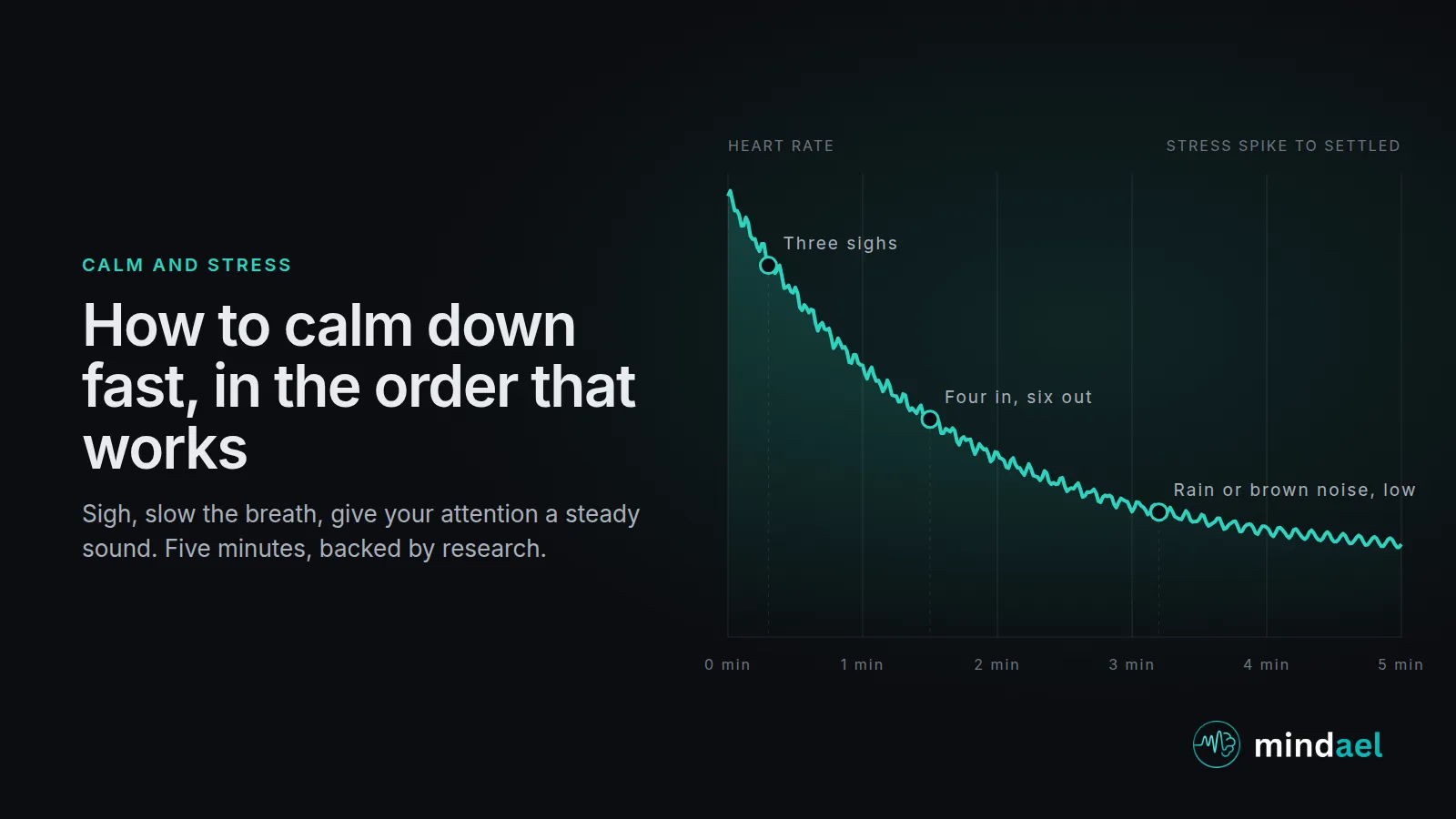
How to calm down is the question we get asked most after “which sound helps me sleep”, and the two are related: the same slow breathing and steady sound that settle a spike at 3 pm settle it at midnight. We built the guided breathing screen in Mindael for exactly this moment, and it is free on the App Store. Below is the sequence we would want you to know by heart, in the order the research supports.
Why the first minute matters
When stress spikes, your body is running a program that was written for danger: faster heart, faster breath, attention locked on the problem. The feeling is loud because the program is loud. The good news is that the program has a manual override, and it is the breath. You cannot decide to slow your heart. You can decide to breathe out slowly, and your heart follows within a minute or two.
So the order below is not random. It starts with the fastest lever, adds the second fastest, and only then moves to the things that take ten minutes or more. Try them in order. Most people do not get past the third.
1. The physiological sigh
Breathe in through your nose. Before you breathe out, take a second, shorter breath in on top of the first, so the lungs fill completely. Then breathe out through the mouth, slowly, until you are empty. Do it three times.
This is the pattern your body uses on its own when you have been crying or when you are drifting off, and it is the fastest known way to offload carbon dioxide and reset the breathing rate. In a 2023 randomised study at Stanford, five minutes a day of this pattern for a month improved mood and lowered resting breathing rate more than box breathing or mindfulness meditation did (Balban et al., 2023). You do not need five minutes in an emergency. Three sighs, thirty seconds, standing wherever you are.
2. Slow down to six breaths a minute
Now settle into a rhythm: about four seconds in through the nose, about six seconds out. No holds, nothing to count precisely. The point is the long exhale. Each slow out-breath presses on the vagus nerve, the brake pedal of the nervous system, and a 2018 review of the research found that this rate raises heart rate variability, increases alpha activity in the brain and lowers reported anxiety across studies (Zaccaro et al., 2018).
Two minutes is enough to feel it. If you want this to work faster next time, practise it when you are already calm: a 2017 trial found eight weeks of daily diaphragmatic breathing lowered cortisol and improved attention (Ma et al., 2017). Our breathing exercises guide has the full set of patterns and when to use each.
3. Give your attention something steady
A spiking mind looks for something to grab, and in a quiet room it grabs the problem. A steady sound gives it something else. In a 2020 meta-analysis of 104 studies, music lowered stress on both physiological measures, heart rate and cortisol among them, and on self-report (de Witte et al., 2020). Natural sounds do the same job: a 2021 synthesis in PNAS found water and bird sounds in particular lowered stress and improved mood across the studies reviewed (Buxton et al., 2021).
What works is steady, slow and without words. Rain, ocean, brown noise, slow instrumental music. Nothing with a chorus you know, because your mind will sing along instead of settling. Keep it at the level of a quiet conversation and let it run under the breathing from step two. This is the combination we hear about most from our listeners, and it is why Mindael’s guided breathing runs on top of whichever sound you choose. Our relaxing sounds guide goes through the options, and the section on calm down music below says what to pick and what to avoid.
4. Change the temperature
Cold water on the face, or a cold glass held in both hands for a minute, gives the body a clear new signal that is not the stressor. It is a blunt tool and the evidence is less tidy than for breathing, so we list it fourth, but it is quick, it is free, and it pairs well with the sigh. Splash, sigh three times, dry your face, carry on.
5. Move the body, briefly
Anger and anxiety both load the muscles for action that never comes. Spend it. Two flights of stairs, a brisk walk to the end of the street, thirty seconds of shaking out the arms. Then come back to slow breathing; it lands more easily when the muscles have done something. If you can make the walk a green one, better: a 2015 study found a 90 minute walk in nature reduced rumination, the looping replay that keeps a spike alive, compared with the same walk on a busy road (Bratman et al., 2015). Ten minutes is not ninety, but the direction holds.
6. Narrow the problem to one sentence
Stress feels like everything at once. Write down, in one sentence, the thing that actually happened. Not the implications, not the history, the event. Then write the one next action, if there is one. Most spikes shrink when they are forced into a sentence, because the sentence is always smaller than the feeling. If there is no next action, that is useful too: it means the job right now is to settle, not to solve.
7. Change the room
If nothing above has moved the needle in ten minutes, change the environment. Different room, outside, a short drive. The brain reads the new setting as the end of the episode, and the steady sound from step three goes with you in your pocket. For a bad evening, the same sequence works at bedtime: sigh, slow breathing, rain, a fading timer. Our sleep sounds guide has the settings.
Calm down music: what to play and what to skip
People search for calm down music more than for any breathing pattern, and the instinct is right, with one correction: the music that calms is rarely the music you love. A song you know pulls attention toward the lyrics and the memory attached to it; the heart rate follows the song, not the breath. What the stress studies used was slow, steady and mostly instrumental, around 60 to 80 beats per minute, without sudden changes in volume (de Witte et al., 2020). Natural sound passes the same test without a tempo at all, which is why rain, ocean and brown noise do so well.
A short playlist for the next spike: rain or ocean at a quiet-conversation level, brown noise if the room is noisy, slow piano or strings with no vocals if you want music, and a low sustained tone like 174 Hz if the stress has settled into the body as a sore jaw or a tight head. For that last case, our stress headache guide covers what else eases it. If what spikes is anxiety rather than anger or overload, the anxiety guide pairs the same sounds with a five-minute routine built for it. Keep whatever you choose on for ten minutes after you feel better; the body takes longer to stand down than the mind.
Calming someone else down
Everything above works in reverse. Lower your voice and slow your own breathing, because people entrain to the person in front of them. Ask one short question and wait. Do not say “calm down”; say “let’s breathe out slowly together” and do it with them. Offer water. Suggest a walk rather than more talk. And if someone is in real danger or talking about harming themselves, the right step is a crisis line or emergency services, not a breathing pattern.
The five-minute version
Sigh three times. Breathe four in, six out, for two minutes. Put on rain or brown noise, low, and keep breathing for two more. Then decide whether there is anything to do. That is the whole method, and it is the one we would want you to have before the next spike rather than during it.
The sound for the next five minutes is already here.
You know the sequence: sigh, slow down, give your attention something steady. Mindael has rain and brown noise recorded and measured in our studio, a guided breathing screen that counts the slow pattern for you, and a timer that fades. Download it now, so the next spike meets a plan instead of a search.
- Rain, ocean and brown noise, studio-made, no loops
- Guided slow breathing over any sound
- Free, no account, works offline
 Free · No account needed · Works offline
 Frequently asked questions
How do I calm down from anxiety right now?
Do three physiological sighs: inhale through the nose, take a second short sip of air on top, then exhale slowly through the mouth. Then breathe four seconds in and six seconds out for two minutes. If you can, put on rain or brown noise at a low volume while you do it.
How do I calm my nervous system down?
Lengthen the exhale. Slow breathing at around six breaths a minute with a longer out-breath raises heart rate variability, which is the measurable sign that the calming branch of the nervous system has taken over. Five minutes a day builds the effect over weeks.
How do I calm down when I am angry?
Same breathing, plus distance. Anger narrows attention, so step away from the trigger for ten minutes, breathe out longer than you breathe in, and let the heart rate drop before you reply. Writing the reply and not sending it also helps.
How do I calm someone else down?
Lower your own voice and slow your own breathing; people match the person in front of them. Ask one simple question, wait for the answer, and do not argue with the feeling. Suggest a slow breath out together rather than telling them to calm down.
Does music really calm you down?
Yes, measurably. A 2020 meta-analysis of 104 studies found music reduced stress on both physiological measures, like heart rate and cortisol, and self-reported ones. Slow, steady, lyric-free sound works best, which is why we point to rain, brown noise and slow instrumental music.
How long does it take to calm down?
Breathing changes heart rate within a minute or two; the feeling usually follows within five. If a spike has not eased after twenty minutes of slow breathing and a change of scene, that is a signal to talk to someone rather than push harder.
Sources
- Balban MY, et al. Brief structured respiration practices enhance mood and reduce physiological arousal. Cell Reports Medicine, 2023.
- Zaccaro A, et al. How breath-control can change your life: a systematic review on psycho-physiological correlates of slow breathing. Frontiers in Human Neuroscience, 2018.
- de Witte M, et al. Effects of music interventions on stress-related outcomes: a systematic review and two meta-analyses. Health Psychology Review, 2020.
- Buxton RT, et al. A synthesis of health benefits of natural sounds and their distribution in national parks. PNAS, 2021.
- Bratman GN, et al. Nature experience reduces rumination and subgenual prefrontal cortex activation. PNAS, 2015.
- Ma X, et al. The effect of diaphragmatic breathing on attention, negative affect and stress in healthy adults. Frontiers in Psychology, 2017.
This article is for general information and is not medical advice. If anxiety or anger is affecting your daily life, or you have thoughts of harming yourself, please talk to a doctor or a crisis line.
This article is part of our relax guide. Hear the sounds in this article in the Mindael sound library, or see our app comparison checklists.