

How to Calm Nerves Before an Exam, an Interview or a Stage: What Actually Works
Nerves before an event are arousal looking for a label. The research says do not try to be calm; take the edge off the body with two physiological sighs and a minute of slow breathing, then tell yourself you are excited rather than trying to relax, write the worry down for ten minutes before an exam, talk to yourself by name, and keep a steady sound in your ears while you wait. The nerves do not disappear; they turn into the energy you were going to need.
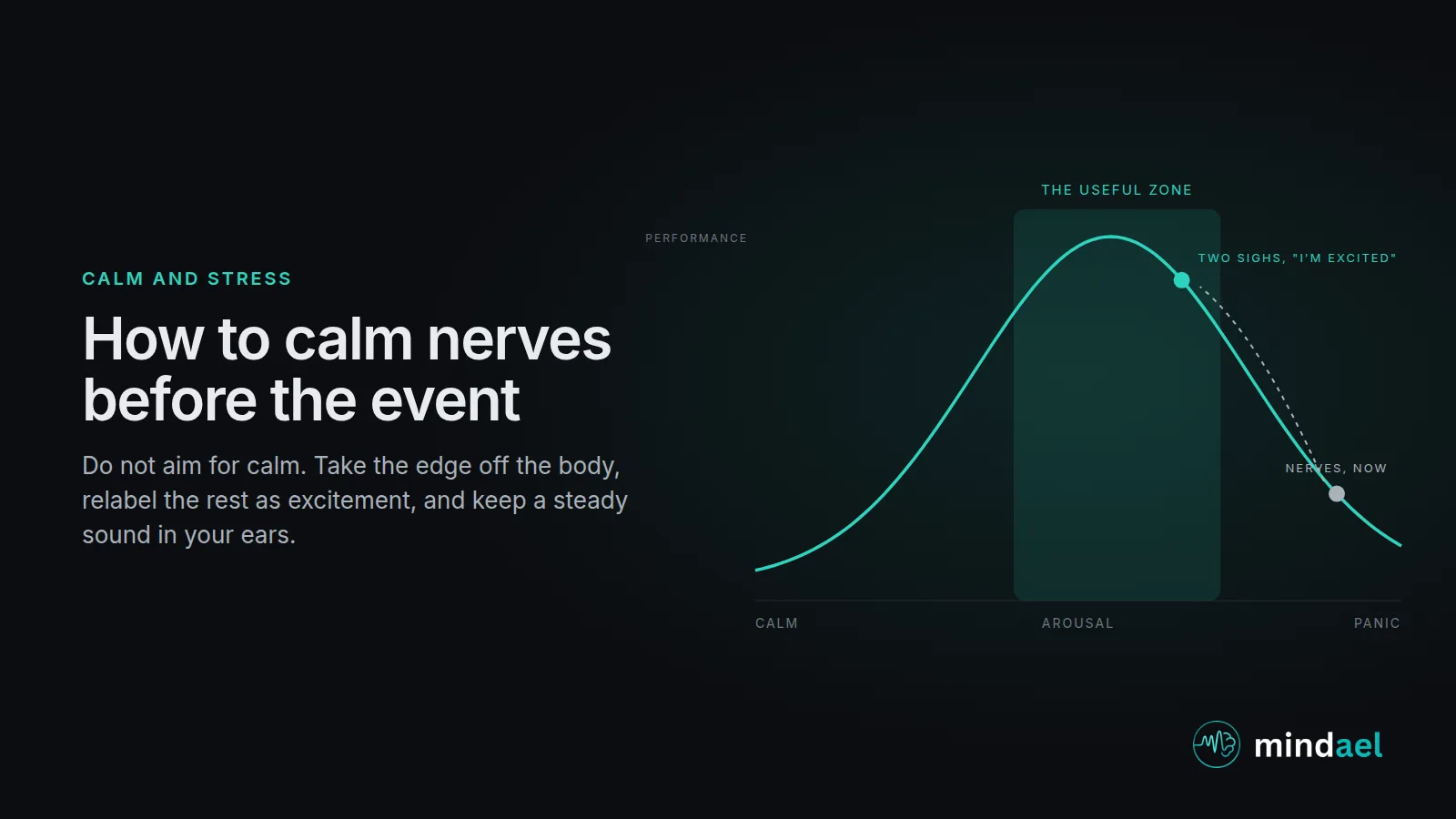
How to calm nerves is the wrong question in one small way, and getting it right is most of the answer. Nerves before an exam, an interview, a speech or a match are the body getting ready: faster heart, quicker breath, sharper attention. The research on performance says the people who do well are not the ones with the least of that. They are the ones who read it as readiness. So the job is not to switch the nerves off; it is to take the edge off the body so you can think, and then put the energy to work. This article gives the tools in the order to use them, with the studies behind each, and the sound side runs in Mindael, free on the App Store. For anxiety that is not tied to an event, our anxiety guide is the place to start.
First, take the edge off the body
Ninety seconds, anywhere, no one will notice. Two physiological sighs: a full breath in through the nose, a second short sip on top, and a long slow exhale through the mouth. In a 2023 randomised trial, five minutes a day of this pattern lowered resting breathing rate and improved mood more than box breathing or mindfulness meditation (Balban et al., 2023); in the moment, two of them visibly slow the heart. Then a minute of four in, six out, through the nose, which lands near the six-breaths-a-minute rate the slow-breathing research links to higher heart rate variability and lower anxiety (Zaccaro et al., 2018). Breathe low, so the belly moves first; our article on abdominal breathing explains why that matters. That is the whole physical reset. Do not try to go further and become calm; the next step needs the energy you have left.
Then say you are excited
This is the counterintuitive one and the best-supported. In a 2014 series of experiments, people about to sing karaoke, give a speech or sit a maths test were told to say either “I am anxious”, “I am excited”, or nothing. The ones who said “I am excited” sang more accurately, were rated as more persuasive and confident speakers, and scored higher on the maths, than the ones who said “I am calm” or “I am anxious” (Brooks, 2014). The reason is that calm is a long way from nervous and excited is next door: both are high arousal, and relabelling only has to move you one step. An earlier study found the same with a harder audience: students told before a practice exam that their arousal would help them performed better on the real exam months later (Jamieson et al., 2010). So, out loud if you can: “I’m excited.” It will feel like a lie the first time. The body does not check.
Write the worry down
For exams and anything with a wait beforehand. In a 2011 classroom study, students who spent ten minutes writing freely about their worries right before a high-stakes exam outperformed students who sat quietly, and the effect was concentrated in the anxious students, who went from scoring below the calm students to scoring with them (Ramirez and Beilock, 2011). Worry occupies working memory, the same memory the exam needs; writing it out offloads it. Pen and paper, ten minutes, no editing, and leave the page behind when you go in.
Talk to yourself by name
“You know this. You have done harder things than this. Slow the first sentence down.” Second person, your own name, as if coaching a friend. In a 2014 series of studies, people who prepared for a public speech using their own name and “you” rather than “I” felt less anxious, were rated as performing better, and ruminated less afterwards (Kross et al., 2014). The small distance is the point: it is hard to be kind to “I” and easy to be kind to someone with a name.
Prepare the first thirty seconds
Nerves peak at the start and fall once you are moving, so the start is the only part that has to be bulletproof. Know the first sentence of the speech, the first answer of the interview, the first question of the exam you will do, the first serve. Rehearse it until it is automatic, and then rehearse the slow version, because the first thing nerves do is speed you up. A deliberately slow first sentence tells the room, and you, who is in charge of the pace.
Sound for the hour before
The hour before is where nerves do their damage, rehearsing every way it could go wrong. A steady sound in the ears stops the rehearsal and lowers the stress response: in a 2013 lab study, people who listened to relaxing music before a stress test recovered from it faster than people who waited in silence (Thoma et al., 2013). Nothing with words and nothing you will follow: brown noise is the usual choice, rain if you want texture, an alpha beat with earbuds if you want to stay sharp rather than sleepy. Keep it at a quiet conversation. Take the earbuds out a few minutes before you start, so your ears are used to the room.
The night before and the morning of
Sleep beats cramming; a short night costs more than an extra hour of revision gains, and our sleep sounds guide has the routine for a night when the mind will not stop. In the morning, eat, drink water, and move for ten minutes, which burns off the first layer of adrenaline. Caffeine as usual, not more. If the nerves have been there for days, the relaxing sounds guide has a fifteen minute evening routine, and our guide to how to calm down fast covers a spike that arrives at the wrong moment.
The short version
Two sighs, a minute of slow breathing. “I’m excited.” Ten minutes writing the worry down if there is a wait. Your own name, as a coach. The first thirty seconds rehearsed slow. Steady sound in the ears until they call you. Then go, nerves and all; they are the part of you that showed up ready.
A steady sound to wait on.
Mindael has rain and brown noise made in our studio for the hour before, and guided slow breathing for the minute before. Put the earbuds in while you wait, breathe out longer than you breathe in, and take them out when they call your name. Free to download, no account, works offline.
- Rain, brown noise and alpha beats, studio-made
- Guided slow breathing on top of the sound
- Free to download, no account, works offline
 Free · No account needed · Works offline
 Frequently asked questions
How do I calm my nerves quickly?
Two physiological sighs, then a minute of breathing four in and six out through the nose. That takes the edge off the body in about ninety seconds. Then stop trying to be calm and say, out loud if you can, 'I'm excited': in a 2014 series of experiments that single reappraisal improved performance in singing, public speaking and maths more than telling yourself to calm down.
How do you calm nerves before an exam?
The night before, sleep. The hour before, a steady sound in your ears and no last-minute cramming. Ten minutes before, write down what you are worried about for ten minutes: in a 2011 classroom study that alone lifted exam scores for anxious students by close to a grade. In the room, two sighs, feet flat, and start with the question you know.
How do you calm nerves before a presentation or interview?
Prepare the first thirty seconds until you could say them asleep, because nerves peak at the start and fall once you are moving. Before you go in: two sighs, a slow breath, 'I'm excited', and address yourself by name: 'You know this material.' Carry water. Once talking, slow the first sentence down deliberately.
Why do I get so nervous before things?
Because the body prepares for anything that matters by raising heart rate, breathing and alertness, and that preparation feels the same whether the thing is a threat or a chance. People who perform well have the same arousal; they read it as readiness. The reappraisal research suggests that reading is learnable.
Does music help calm nerves?
Yes, as a floor to wait on. Steady sound without words, such as rain or brown noise, in the hour before lowers the stress response and stops the mind rehearsing disaster. Take it out a few minutes before you start so your ears adjust to the room.
Is it bad to be nervous before a performance?
No. Moderate arousal improves performance on most tasks; the problem is arousal you interpret as a sign you will fail. The tools here are for keeping it in the useful range and relabelling it, not for removing it.
Sources
- Brooks AW. Get excited: reappraising pre-performance anxiety as excitement. Journal of Experimental Psychology: General, 2014.
- Jamieson JP, Mendes WB, Blackstock E, Schmader T. Turning the knots in your stomach into bows: reappraising arousal improves performance on the GRE. Journal of Experimental Social Psychology, 2010.
- Ramirez G, Beilock SL. Writing about testing worries boosts exam performance in the classroom. Science, 2011.
- Kross E, et al. Self-talk as a regulatory mechanism: how you do it matters. Journal of Personality and Social Psychology, 2014.
- Balban MY, et al. Brief structured respiration practices enhance mood and reduce physiological arousal. Cell Reports Medicine, 2023.
- Zaccaro A, et al. How breath-control can change your life: a systematic review on psycho-physiological correlates of slow breathing. Frontiers in Human Neuroscience, 2018.
- Thoma MV, et al. The effect of music on the human stress response. PLoS ONE, 2013.
This article is for general information and is not medical advice. If nerves regularly stop you from doing things that matter to you, or bring panic attacks, please talk to a doctor; performance anxiety responds well to treatment.
This article is part of our anxiety, stress and panic guide. Hear the sounds in this article in the Mindael sound library, or see our app comparison checklists.