

Abdominal Breathing Benefits: What Diaphragmatic Breathing Does, and How to Do It
Abdominal breathing, also called diaphragmatic breathing, means breathing low and slow so the belly rises before the chest. Its measured benefits: lower cortisol and better sustained attention after eight weeks of practice, higher heart rate variability, lower blood pressure in slow-breathing studies, and faster settling before sleep. The 4-7-8 pattern and slow six-a-minute breathing are both abdominal breathing with a count. Practise lying down with a hand on the belly, ten minutes a day, under a steady sound.
Abdominal breathing benefits are the ones every other breathing exercise is built on. Box breathing, 4-7-8, the physiological sigh, slow breathing at six a minute: all of them assume you are breathing from the diaphragm, low and slow, with the belly moving before the chest. Most adults under stress are not. They breathe high, fast and shallow, from the shoulders, and the pattern itself keeps the stress response running. This article goes through what the research has measured when people learn to breathe low, how to do it, and how it connects to the patterns in our breathing guide. The guided versions run in Mindael, free on the App Store, on top of rain or brown noise.
What abdominal breathing is
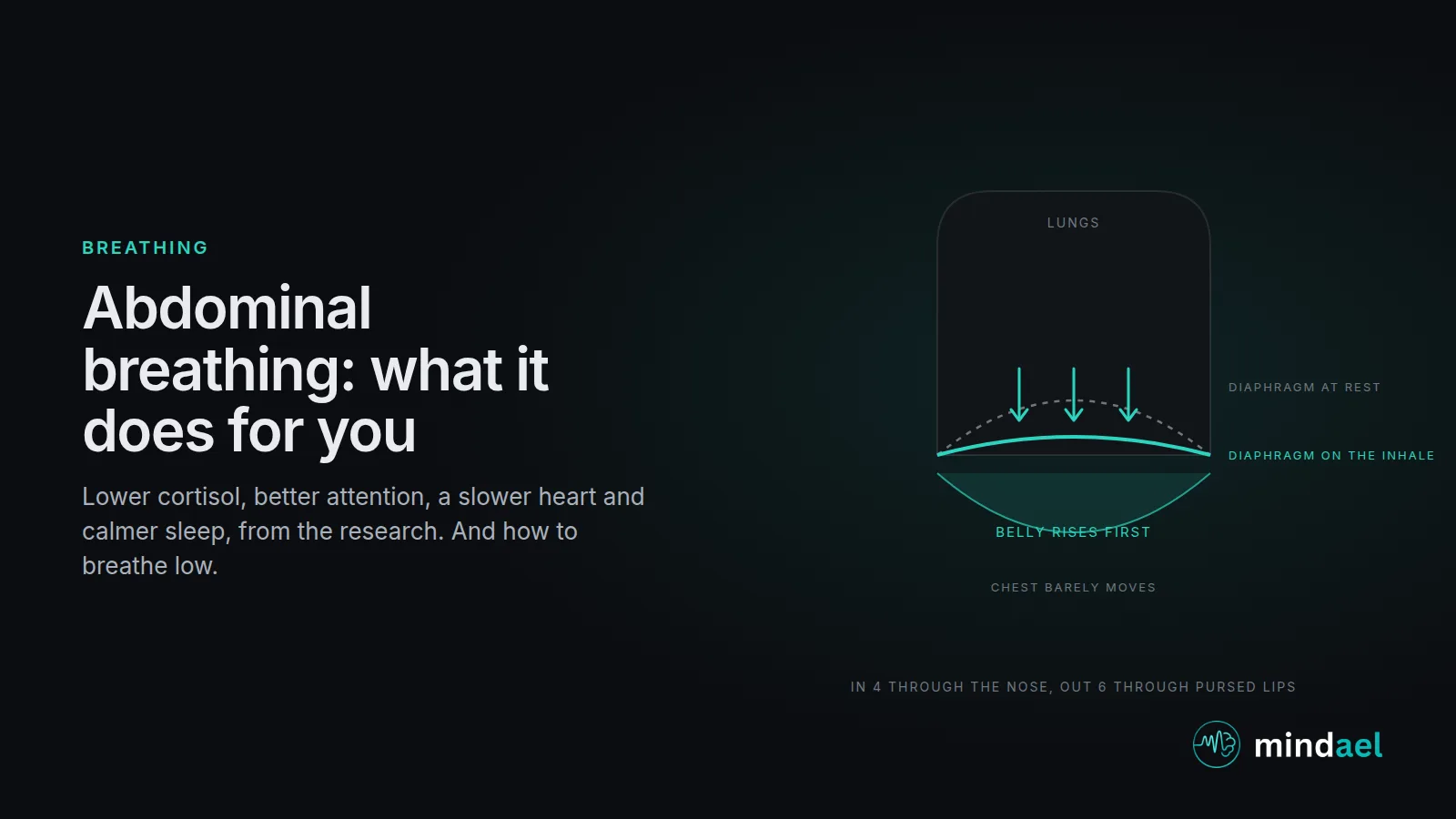
The diaphragm is a dome of muscle under the lungs. When it contracts it flattens and moves down, pulling air into the lower lungs and pushing the belly out. That is a full breath, and it is how babies and sleeping adults breathe. Under stress the pattern shifts upward: the shoulders and neck lift the ribcage, the top of the lungs fills, the belly stays still, and the breath gets faster to make up for being smaller. Abdominal breathing, diaphragmatic breathing and belly breathing are three names for the same correction: let the diaphragm do the work again, so the breath goes low, gets slower, and the exhale gets longer.
The benefits, measured
Lower cortisol, better attention. The cleanest trial is from 2017: 40 healthy adults were randomised to eight weeks of diaphragmatic breathing training, twenty sessions, or to no training. The breathing group ended with significantly lower salivary cortisol and better scores on a sustained attention test than the control group, with less negative mood (Ma et al., 2017). It is the study behind the claim that belly breathing is good for focus, and it is why our focus guide suggests two minutes of it before a work block.
Less stress, across studies. A 2019 systematic review gathered the trials on diaphragmatic breathing for stress and found consistent reductions in physiological markers such as cortisol and respiratory rate and in self-reported stress, while noting the studies were small and the breathing was often combined with other techniques (Hopper et al., 2019). A 2023 meta-analysis of randomised trials of breathwork more broadly found lower stress, anxiety and depressive symptoms than in no-treatment controls, with modest effect sizes (Fincham et al., 2023). Modest is the honest word, and modest, repeatable and free is a good deal.
A slower heart and higher heart rate variability. Breathing low makes breathing slow, and slow breathing is where the physiology gets interesting. A 2017 review in the journal Breathe describes what happens around six breaths a minute: heart rate variability rises, the swing in blood pressure with each breath lines up with the breath itself, and the balance of the nervous system shifts toward rest (Russo et al., 2017). A 2018 systematic review found the same picture across the slow-breathing literature, with more alpha activity in the brain and lower anxiety alongside the heart changes (Zaccaro et al., 2018). Six a minute is not arbitrary: it is the rate at which heart rate variability peaks for most adults, and the rate the biofeedback research trains people toward (Lehrer and Gevirtz, 2014).
Lower blood pressure, at least in the moment. In a 2022 study, healthy young adults who did 4-7-8 breathing, a long-exhale pattern that only works abdominally, showed lower blood pressure and heart rate and higher heart rate variability during and after the session, including after a night of sleep deprivation (Vierra et al., 2022). Acute effects, in healthy people, but the direction is the one you want before bed or before a hard conversation.
Calmer sleep onset. No single trial isolates abdominal breathing for sleep, but the mechanism is the one above: a long slow exhale lowers heart rate and arousal, which is the state falling asleep needs. It is why 4-7-8 is the pattern most people use at night, and why our sleep sounds guide pairs it with rain and a timer.
How to breathe from the diaphragm
Lie on your back, knees bent, one hand on the chest and one on the belly. Breathe in through the nose for about four seconds and aim the air low, so the belly hand rises first and the chest hand barely moves. Breathe out through pursed lips for about six seconds, longer than the inhale, and feel the belly fall. The pursed lips slow the exhale without effort; the longer exhale is where the calming happens. Ten minutes a day, lying down, for a week. Then sitting, with the back supported. Then standing, then walking, then at a desk when an email lands. The goal is that the belly moves first without your thinking about it.
Two mistakes. Pushing the belly out with the abdominal muscles, which is a performance, not a breath: the belly should move because air is arriving, not because you are shoving it. And breathing big: a diaphragmatic breath is not a deep breath in the gym sense. It is a normal-sized breath that goes low. If you feel light-headed, you are taking in too much; breathe smaller and slower.
The patterns that use it
Every pattern on our breathing guide is abdominal breathing with a count. 4-7-8 adds a hold and a long mouth exhale, for sleep. Four in, six out is the plain six-a-minute version, for stress that lingers. Box breathing evens the four sides, for the start of a work block. The physiological sigh, two inhales and one long exhale, is the emergency version for a spike, and it is the first step in our guide to how to calm down fast. The anxiety guide puts the patterns together with sound into a routine for a hard evening, and our article on how to calm nerves covers the minutes before an exam or a stage.
The sound underneath
Counting seconds is work, and the point of this is rest. A steady sound gives attention somewhere to sit so the count becomes a feeling: rain for the evening, ocean if you want a rhythm to breathe with, brown noise when you want nothing at all. Keep it at the level of a quiet conversation. In Mindael the guided breathing runs on top of the sound, so you can watch the count or close your eyes and let the rain keep time.
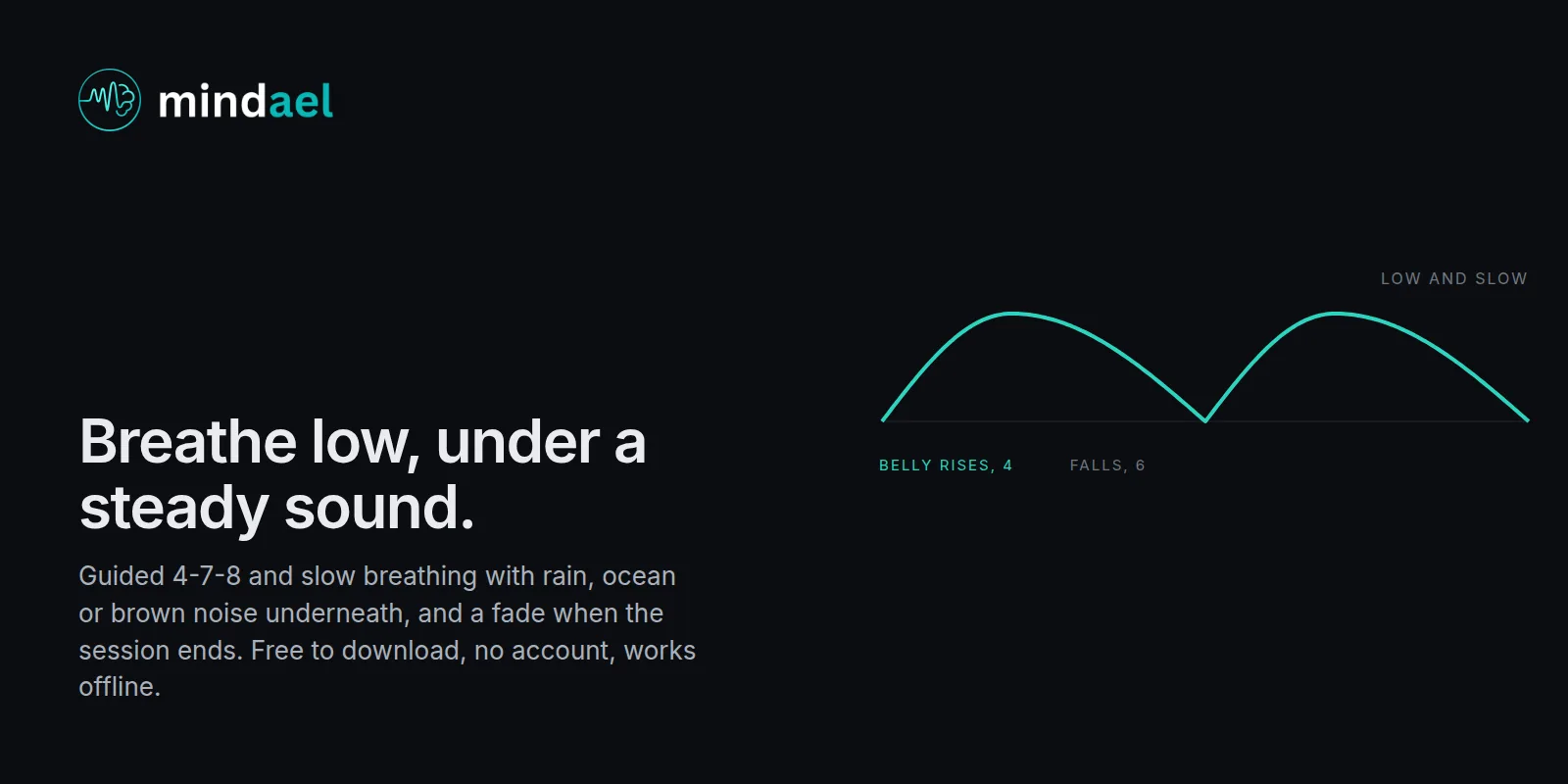
Breathe low, under a steady sound.
Mindael guides 4-7-8 and slow six-a-minute breathing on screen, with rain, ocean or brown noise underneath so the count becomes a feeling, and a timer that fades when the session ends. Free to download, no account, works offline. Lie down, hand on the belly, press play.
- Guided 4-7-8 and slow breathing with a visual count
- Rain, ocean and brown noise made in our studio
- Free to download, no account, works offline
 Free · No account needed · Works offline
 Frequently asked questions
What are the benefits of abdominal breathing?
The ones measured in trials: lower cortisol and better sustained attention after eight weeks of daily practice, higher heart rate variability, lower blood pressure and heart rate during slow breathing, less reported stress and anxiety, and shorter time to fall asleep when used before bed. It also makes every other breathing pattern, from 4-7-8 to box breathing, work better.
What is the difference between abdominal and diaphragmatic breathing?
None; they are two names for the same thing. The diaphragm is the muscle doing the work, the abdomen is where you see it. 'Belly breathing' and 'deep breathing' usually mean the same too.
What are the benefits of 4-7-8 breathing?
4-7-8 is abdominal breathing with a count that forces a long exhale: four in, seven hold, eight out. The long exhale and hold push the breath rate far below six a minute, which is the range the slow-breathing research links to higher heart rate variability and lower anxiety, and a 2022 study found it lowered blood pressure and heart rate acutely in healthy adults. It is the pattern most people use for sleep.
How do I breathe from the diaphragm?
Lie on your back, one hand on the chest and one on the belly. Breathe in slowly through the nose so the belly hand rises first and the chest hand barely moves; breathe out through pursed lips, longer than you breathed in, and feel the belly fall. Ten minutes, then try it sitting, then standing.
How long does abdominal breathing take to work?
Minutes for the immediate effects: a slower heart and a calmer feeling within five to ten minutes of slow breathing. Weeks for the trained effects: the cortisol and attention changes in the research came after eight weeks of practice, twenty sessions in total.
Is it safe to practise abdominal breathing every day?
Yes, for healthy adults it is the normal way to breathe at rest and the goal is to make it automatic. If you have a lung or heart condition, or breathing exercises make you dizzy, go gently and ask your doctor; slow is fine, forcing is not.
Sources
- Ma X, et al. The effect of diaphragmatic breathing on attention, negative affect and stress in healthy adults. Frontiers in Psychology, 2017.
- Hopper SI, et al. Effectiveness of diaphragmatic breathing for reducing physiological and psychological stress in adults: a quantitative systematic review. JBI Database of Systematic Reviews and Implementation Reports, 2019.
- Russo MA, Santarelli DM, O'Rourke D. The physiological effects of slow breathing in the healthy human. Breathe, 2017.
- Zaccaro A, et al. How breath-control can change your life: a systematic review on psycho-physiological correlates of slow breathing. Frontiers in Human Neuroscience, 2018.
- Lehrer PM, Gevirtz R. Heart rate variability biofeedback: how and why does it work? Frontiers in Psychology, 2014.
- Vierra J, et al. Effects of sleep deprivation and 4-7-8 breathing control on heart rate variability, blood pressure, blood glucose, and endothelial function in healthy young adults. Physiological Reports, 2022.
- Fincham GW, et al. Effect of breathwork on stress and mental health: a meta-analysis of randomised-controlled trials. Scientific Reports, 2023.
This article is for general information and is not medical advice. If you have a heart or lung condition, or breathing exercises cause dizziness or distress, please talk to a doctor before practising.
This article is part of our breathing guide. Hear the sounds in this article in the Mindael sound library, or see our app comparison checklists.