

Solfeggio Frequencies: The Nine Tones, What Each One Is Used For, and What Research Says
Solfeggio frequencies are a set of nine pure tones, from 174 Hz to 963 Hz, each paired with a traditional purpose such as calm, change or clarity. 528 Hz is the best known and the one with a published study on stress markers. They are easiest to use as a soft layer under rain or a drone, for 15 to 30 minutes, at a low volume.
Solfeggio frequencies are the tones people ask us about most, usually after hearing a 528 Hz track somewhere and wondering what the number means. The short version: they are nine specific pitches, each with a traditional purpose, and they are at their best as a quiet layer under something steady rather than played alone. Every one of them is in Mindael, free on the App Store, generated at the exact stated pitch, and this guide explains what each tone is for, where the set came from, and what the published studies have found.
What are solfeggio frequencies?
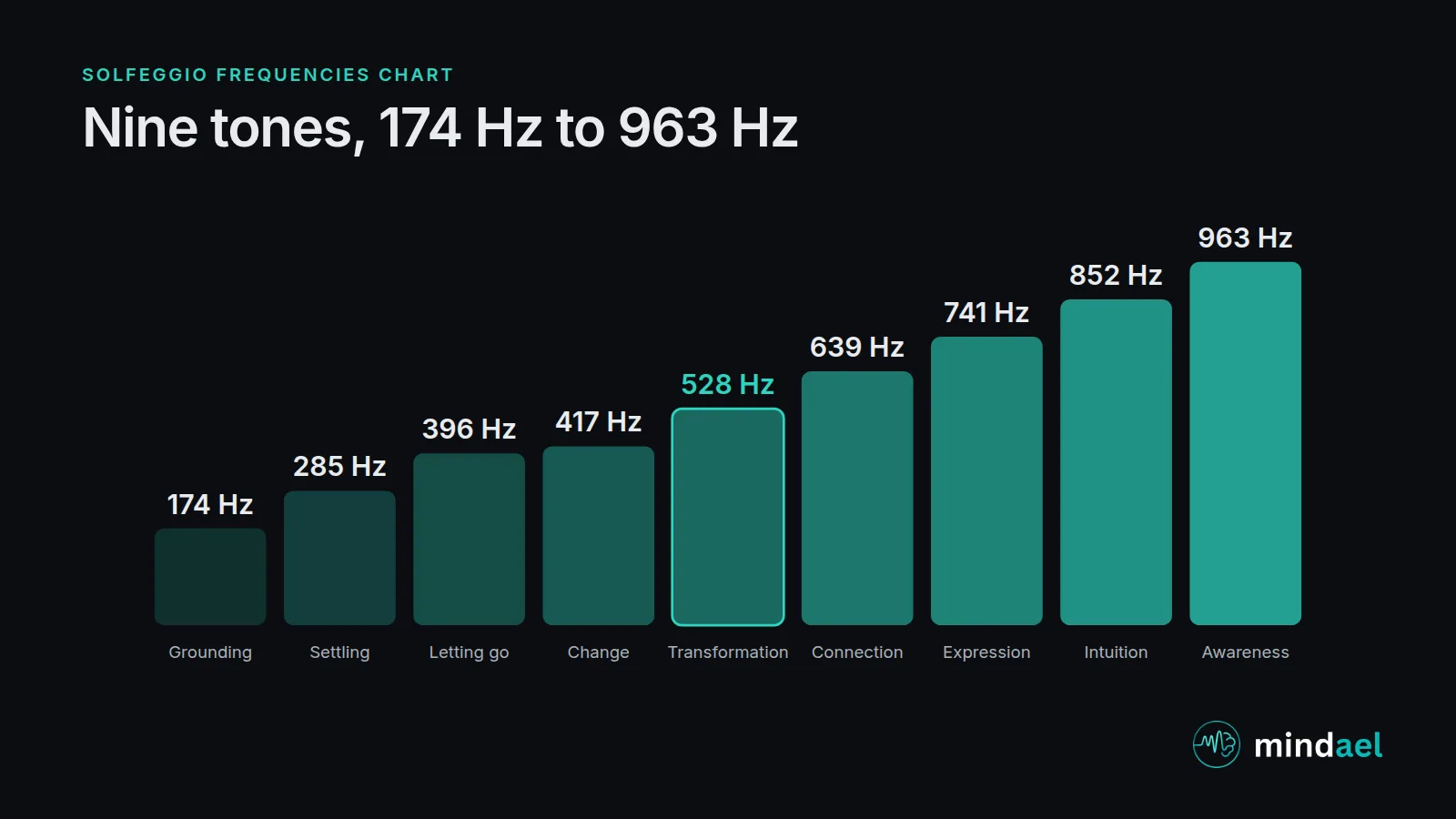
A solfeggio frequency is a single, pure tone at a fixed pitch, measured in hertz (Hz), the number of vibrations per second. The nine frequencies in the set run from 174 Hz, a low hum, to 963 Hz, a high and bright tone. Each is paired with a purpose in the tradition: calm, release, change, connection, clarity, and so on.
The tones are not music in the usual sense. There is no melody and no rhythm. Most people listen to one tone for a while, often with something else underneath it, and describe the effect as a settling or a sense of the room going still. In our experience that is a fair description, and the way the tones work best in practice follows from it.
The nine frequencies and what each is used for
Here is the full set, with the purpose each tone is traditionally paired with and how our listeners actually use it.
| Frequency | Traditional purpose | How people use it |
|---|---|---|
| 174 Hz | Grounding and a sense of safety | The lowest tone, under rain for sleep |
| 285 Hz | Restoration and settling | A low layer for rest after a long day |
| 396 Hz | Letting go of fear and guilt | Under brown noise for an anxious evening |
| 417 Hz | Clearing and making change | A reset tone at the start of a new routine |
| 528 Hz | Transformation; the “love frequency” | The most listened-to tone, for calm and stress |
| 639 Hz | Connection and relationships | A warm background for conversation or reflection |
| 741 Hz | Expression and finding solutions | A clear, bright tone for creative work |
| 852 Hz | Intuition and inner order | Meditation, especially seated practice |
| 963 Hz | Awareness and a sense of oneness | The highest tone, for meditation and quiet mornings |
The purposes are a tradition, not a measurement, and we present them that way. The tones themselves are real and precise, which is why pitch accuracy matters: a 528 Hz tone that is actually 522 Hz is just a different note.
Where the frequencies come from
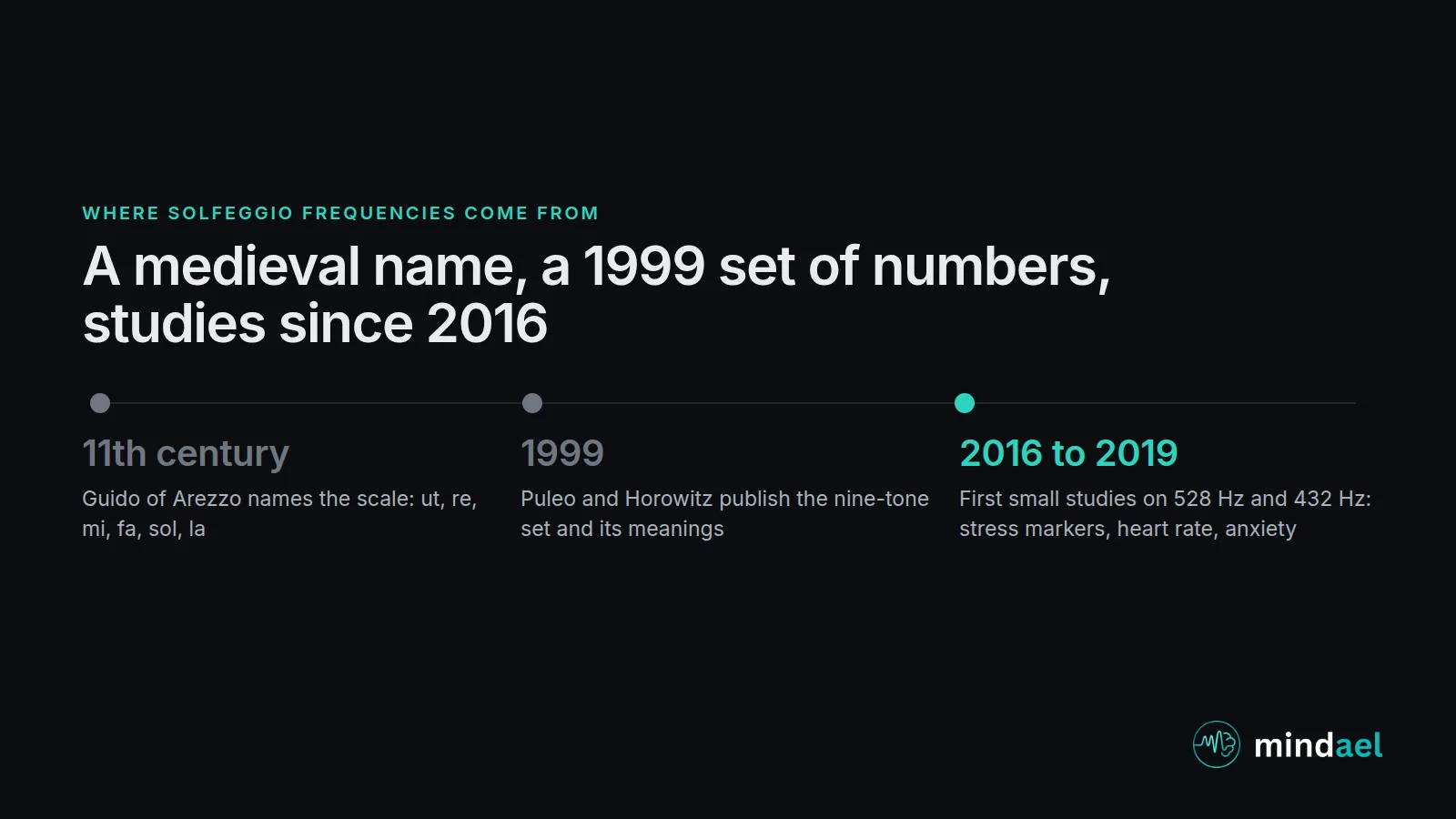
The name reaches back a thousand years. In the 11th century, the monk Guido of Arezzo gave the notes of the scale the syllables ut, re, mi, fa, sol, la, taken from the first syllables of each line of a hymn to St John, “Ut queant laxis”. That system, solmization, became the do-re-mi most of us learned as children. The word “solfeggio” comes from sol and fa.
The nine frequencies are much newer. They were proposed in the 1990s by Joseph Puleo and Leonard Horowitz, who derived the numbers from a pattern in the Book of Numbers and published them in 1999. They attached the six original tones to the six Guidonian syllables and the purposes that still travel with them today. The three outer tones, 174, 285 and 963 Hz, were added afterwards to extend the sequence in both directions.
Knowing the history makes the tones easier to use well. They are a modern framework for listening, with a beautiful old name, and the question that matters is the practical one: what happens when you play them.
What the research shows
The published work is young and the studies are small, but they are real, and they point in one direction.
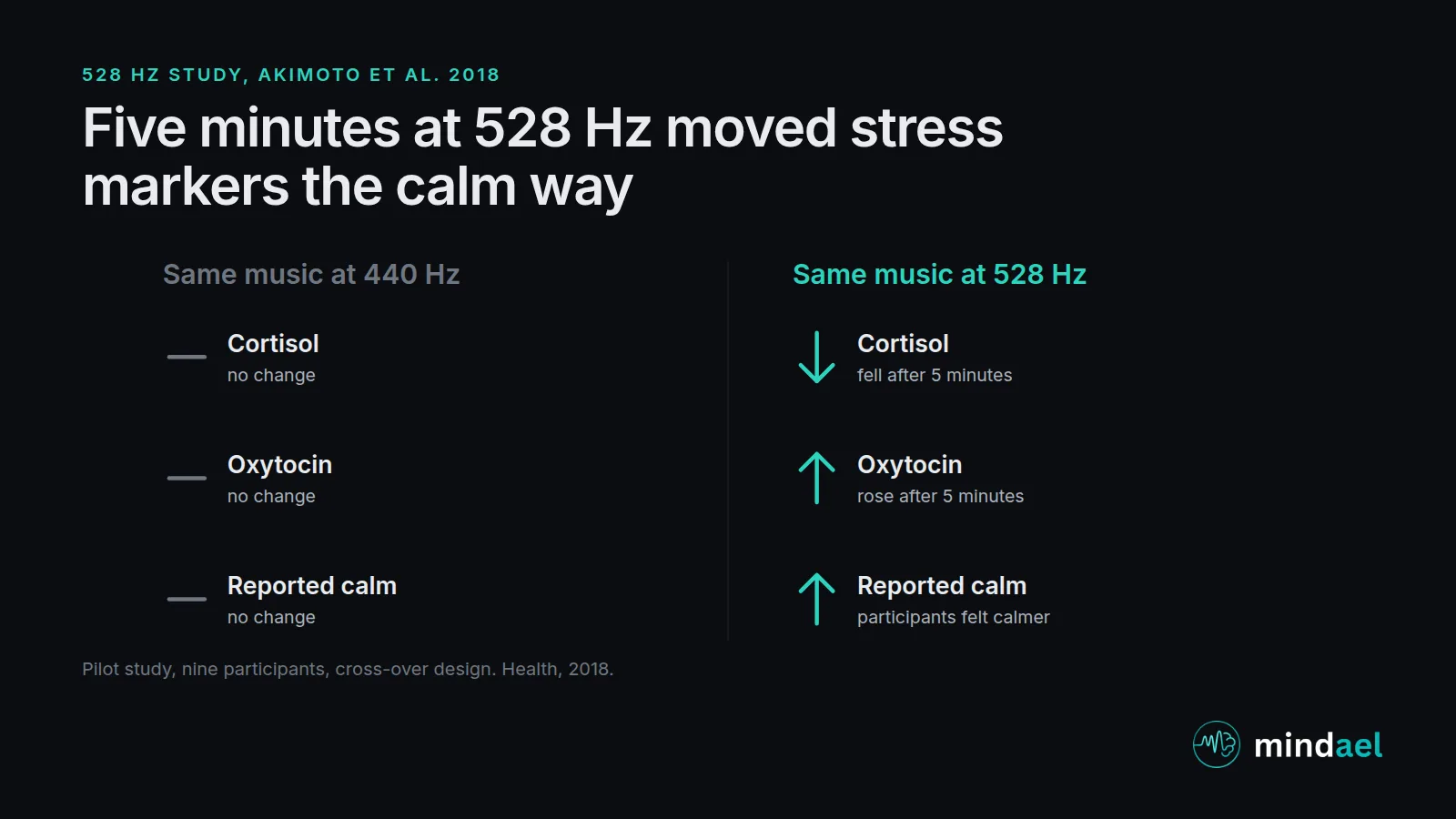
The most cited study played the same piece of music to nine participants twice, once at the standard 440 Hz tuning and once shifted so the music centred on 528 Hz. After five minutes at 528 Hz, levels of the stress hormone cortisol fell and oxytocin rose, with no such change at 440 Hz, and participants reported feeling calmer (Akimoto et al., 2018). Five minutes is a short exposure, which is encouraging for anyone who does not have an hour.
Two further studies looked at 432 Hz, a tuning closely related to the solfeggio tradition and often listened to alongside it. In a double-blind crossover with 33 people, music tuned to 432 Hz was associated with a slightly lower heart rate than the same music at 440 Hz (Calamassi and Pomponi, 2019). In a randomised dental trial, patients who listened to 432 Hz music during root canal treatment reported less anxiety than those treated without music (Di Nasso et al., 2016).
That is the honest state of the evidence: small, consistent, and all in the direction of calm. It is enough for us to recommend the tones for relaxation, sleep and meditation, and to describe them that way rather than any other.
528 Hz, the one everyone asks about
If you only ever try one solfeggio frequency, it will probably be 528 Hz. It has the catchiest name, the love frequency, the one published study, and more listening hours in Mindael than the other eight combined.
In practice it is a warm, mid-range tone, close to the C above middle C. On its own it can feel thin after a minute. Under rain, ocean or a soft drone it becomes a kind of glow in the mix that most people stop hearing and start feeling. That is how we suggest using it: not loud, not alone, and for a set time. Twenty minutes in the evening is the setting our listeners mention most.
For focus, 528 Hz is not the first choice; brown noise and a beta beat do that job better, and we cover them on the focus sounds page. For an anxious evening, it is a reasonable layer under the routine on our relaxing sounds page.
How to listen to solfeggio frequencies
A few settings make the difference between a tone that sounds like a test signal and one that does something.
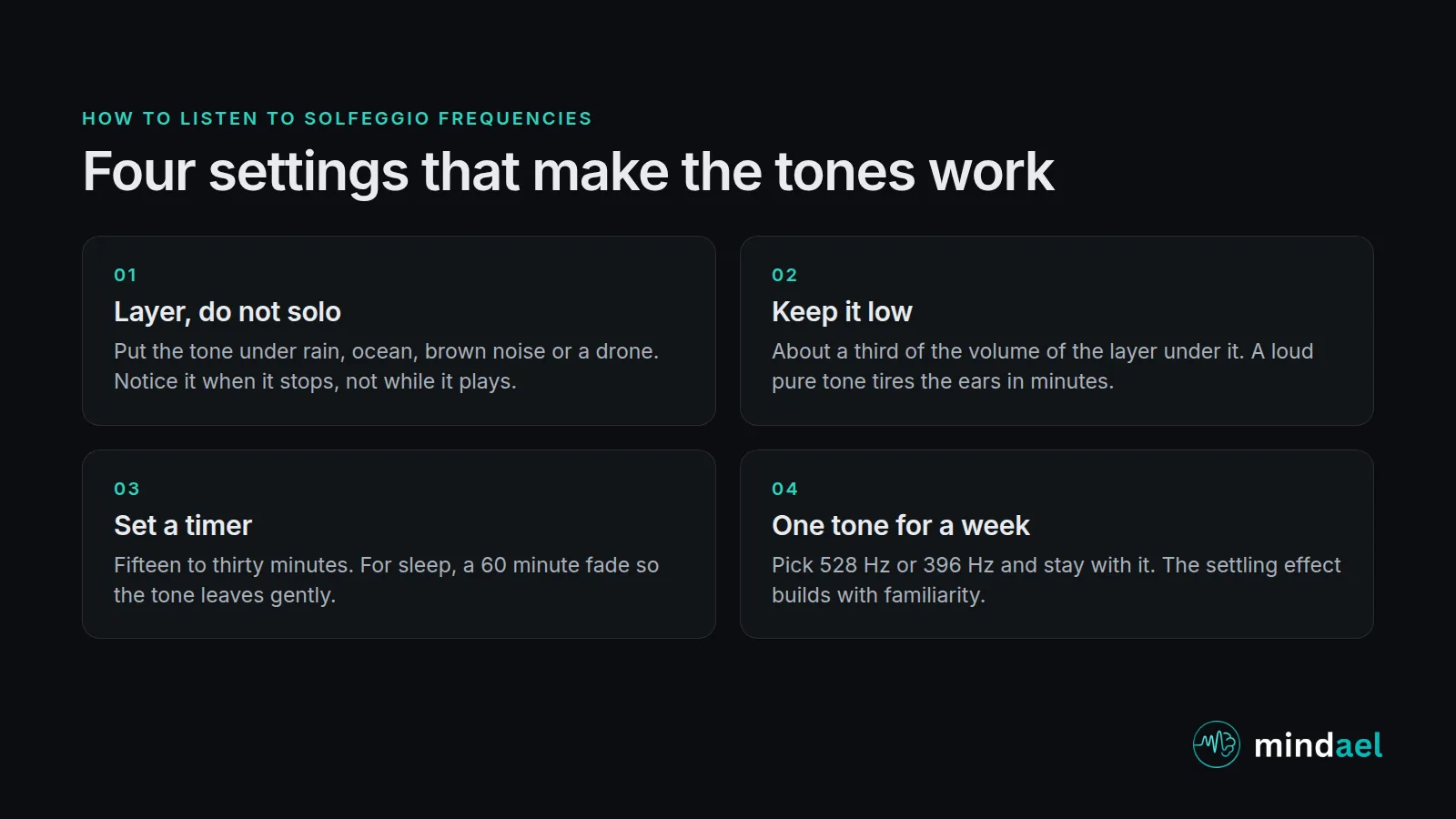
- Layer, do not solo. Put the tone under rain, ocean, brown noise or a drone. The tone should be the thing you notice when it stops, not while it plays.
- Keep it low. A pure tone at high volume is tiring in minutes. Set it at roughly a third of the volume of the layer under it.
- Set a timer. Fifteen to thirty minutes. For sleep, a 60 minute fade so the tone leaves gently.
- One tone for a week. The settling effect builds with familiarity. Switching every night tells you nothing. Pick 528 Hz or 396 Hz, stay with it, then try another.
Headphones are optional. These are single tones, so a speaker works fine. The only time you need earbuds is when you add a binaural beat.
Solfeggio frequencies vs binaural beats
People often confuse the two, and they are different tools.
A solfeggio frequency is one pitch, played the same in both ears. What you hear is the tone itself. A binaural beat is two slightly different pitches, one per ear, and what matters is the difference between them, which the brain turns into a slow pulse. The pulse is the point, and it only exists with headphones.
They combine well. A 6 Hz theta beat for the brain rhythm, a 528 Hz or 396 Hz tone for the character, and rain to hold it together is one of the most popular evening mixes among our listeners. If you want the beats explained in full, with the research for each band, read our guide to binaural beats; the meta-analysis behind that guide pooled 22 studies (Garcia-Argibay et al., 2019).
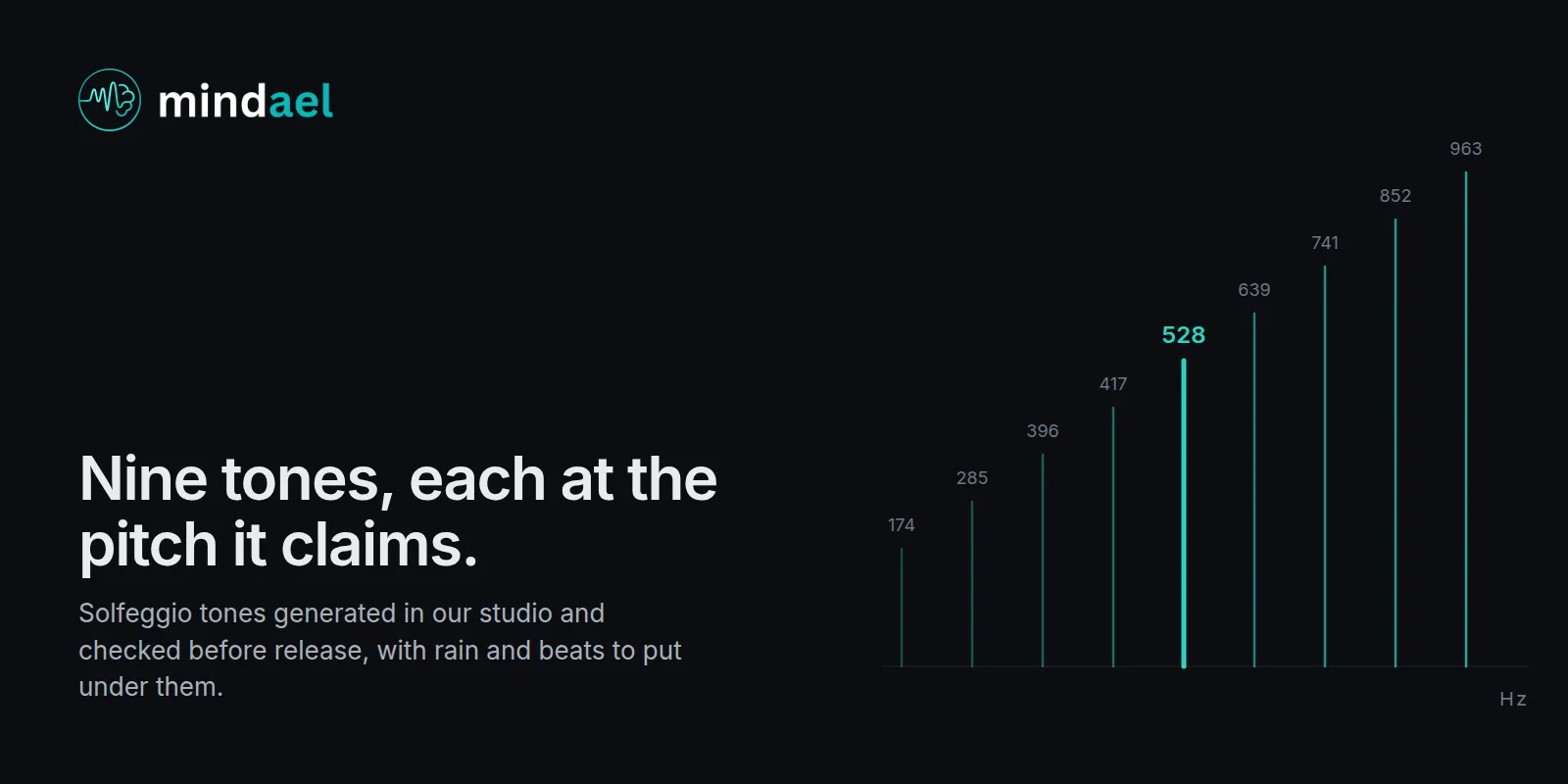
Hear the nine tones as they were meant to sound.
You know the frequencies and what each one is for. Mindael's solfeggio tones are generated in our studio at exactly the stated pitch and checked before release, so 528 Hz is 528 Hz, not a detuned recording. Pick a tone, slide rain or a drone underneath it, set a 20 minute timer, and see which one settles you.
- All nine solfeggio tones, pitch-accurate and studio-made
- Layer any tone under rain, ocean or a binaural beat
- Timer with a gentle fade, works offline
 Free · No account needed · Works offline
 Frequently asked questions
What are the 9 solfeggio frequencies?
174, 285, 396, 417, 528, 639, 741, 852 and 963 Hz. The six in the middle, 396 to 852, are the original set; 174, 285 and 963 were added later to extend the pattern at both ends.
What is 528 Hz good for?
It is traditionally called the love frequency and associated with transformation and calm. A 2018 pilot study found that five minutes of music at 528 Hz lowered stress-related hormone levels compared with the same music at standard 440 Hz tuning. We use it as a soft layer for winding down.
Do solfeggio frequencies work?
The research is early and small, but it points in a consistent direction: music at 528 Hz lowered stress markers in one study, and music tuned to 432 Hz was linked with a slightly lower heart rate and less dental anxiety in two others. Most people notice the effect as a feeling of settling, which is why they are used for relaxation, sleep and meditation.
Which solfeggio frequency is best for sleep?
Our listeners mostly use 174 Hz, 396 Hz or 528 Hz for sleep, layered quietly under rain or brown noise with a timer. The lower tones sit further out of the way; 528 Hz is the one people choose when the issue is stress rather than noise.
Do I need headphones for solfeggio frequencies?
No. They are single tones, not binaural beats, so a speaker works. Headphones are only needed when you combine a solfeggio tone with a binaural beat.
How long should I listen to solfeggio frequencies?
Fifteen to thirty minutes is what most people use, and the 528 Hz study saw a change after five. Keep the volume low enough that the tone sits under the rest of the mix.
Sources
- Akimoto K, Hu A, Yamaguchi T, Kobayashi H. Effect of 528 Hz music on the endocrine system and autonomic nervous system. Health, 2018.
- Calamassi D, Pomponi GP. Music tuned to 440 Hz versus 432 Hz and the health effects: a double-blind cross-over pilot study. Explore, 2019.
- Di Nasso L, Nizzardo A, Pace R, et al. Influences of 432 Hz music on the perception of anxiety during endodontic treatment: a randomized controlled clinical trial. Journal of Endodontics, 2016.
- Garcia-Argibay M, Santed MA, Reales JM. Efficacy of binaural auditory beats in cognition, anxiety, and pain perception: a meta-analysis. Psychological Research, 2019.
This article is for general information and is not medical advice.
Hear the sounds in this article in the Mindael sound library, or see our app comparison checklists.