

Gayatri Mantra With Meaning: The Words, Line by Line, and How to Chant It
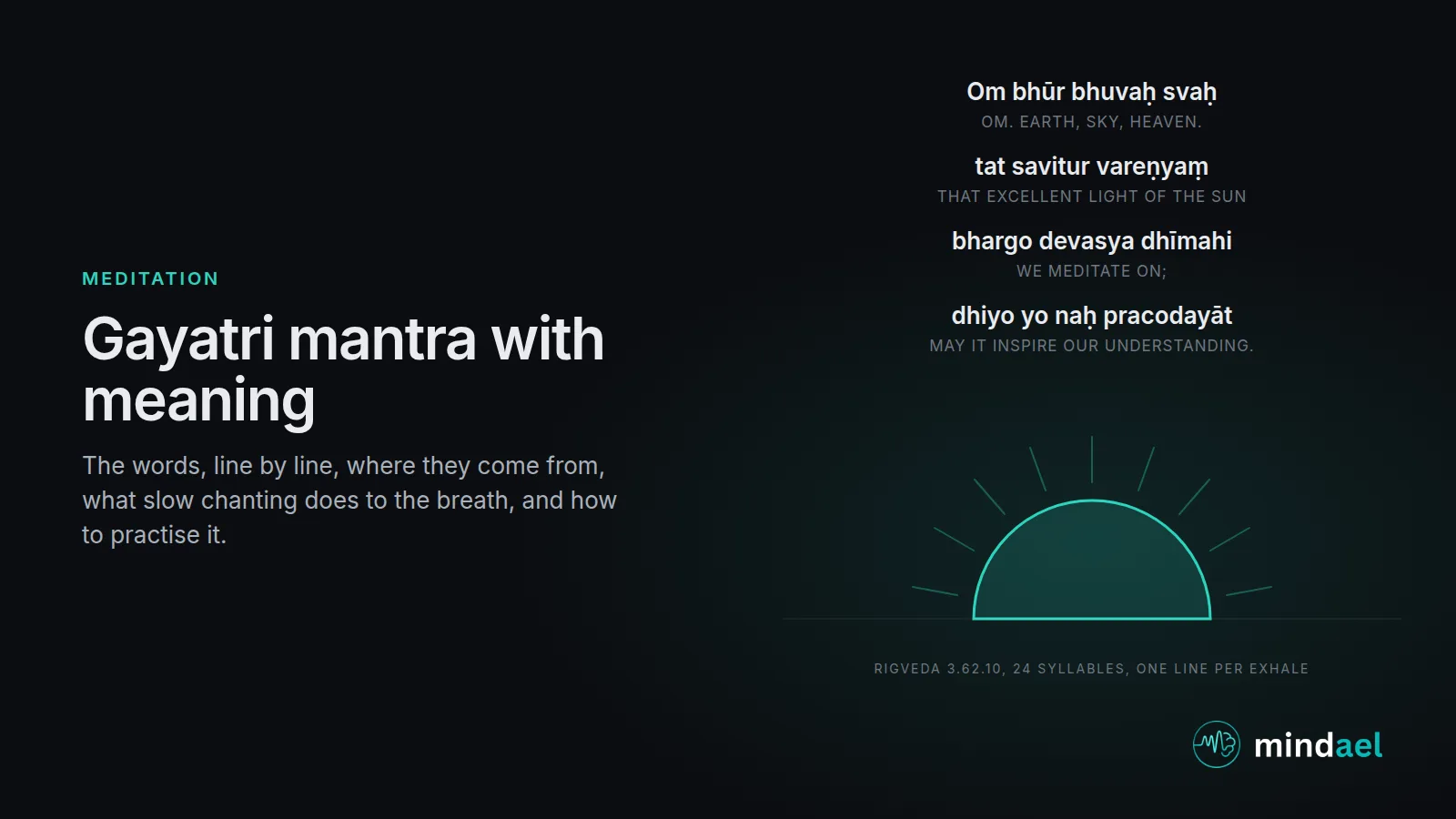
The Gayatri mantra is a 24-syllable verse from the Rigveda (3.62.10) addressed to Savitr, the sun at dawn: Om bhur bhuvah svah, tat savitur varenyam, bhargo devasya dhimahi, dhiyo yo nah prachodayat. Its meaning, line by line: Om, earth, sky and heaven; that excellent light of the radiant sun; we meditate on it; may it inspire our understanding. Chanted slowly, one line per exhale, it brings the breath to about six breaths a minute, the rate the research links with a calmer heart, and gives the mind one thing to hold.
The Gayatri mantra with meaning is what most people are looking for when they search for it: not just the sound, which they may already know from a recording, but what the words say, where they come from, and what chanting them is supposed to do. This article gives all three, with the Sanskrit line by line, a plain English translation, the history in a paragraph, and the research on what slow chanting does to the body. If you want a drone to chant over and a breath guide to pace it, Mindael has both, free to download on the App Store, and our meditation sounds guide explains how to set them up.
The mantra
Om bhūr bhuvaḥ svaḥ tat savitur vareṇyaṃ bhargo devasya dhīmahi dhiyo yo naḥ pracodayāt
In Devanagari: ॐ भूर्भुवः स्वः । तत्सवितुर्वरेण्यं । भर्गो देवस्य धीमहि । धियो यो नः प्रचोदयात् ॥
The verse is Rigveda 3.62.10, which makes it roughly three thousand years old. It is attributed to the sage Vishvamitra and addressed to Savitr, the sun thought of as the power that sets the day, and everything in it, in motion. “Gayatri” is the name of the metre: three lines of eight syllables, 24 in all. The first line, “Om bhur bhuvah svah”, is not part of the Rigveda verse; it is an invocation added in later Vedic ritual, and almost every modern chant includes it.
The meaning, line by line
Om. The seed syllable, chanted before most Vedic verses. It stands for the whole, and in practice it is a long open exhale that settles the voice before the words begin.
Bhūr bhuvaḥ svaḥ. Earth, atmosphere, heaven: the three worlds. Together they say “everything there is”. Some teachers read them as body, mind and spirit, or as the physical, the vital and the mental; the older sense is the three layers of the world.
Tat savitur vareṇyaṃ. “That (tat) of Savitr (savitur), the excellent, the adorable (varenyam).” Savitr is the sun, but specifically the sun as the one who stirs things into life, from the root “su”, to impel. Varenyam means worthy of being chosen, the best.
Bhargo devasya dhīmahi. “The light, the radiance (bhargo) of the shining one (devasya), we meditate on (dhimahi).” This is the heart of the verse and the only verb in the first person: we meditate. Bhargas is light in the sense of brilliance that burns away what is impure.
Dhiyo yo naḥ pracodayāt. “Who (yo) may impel, inspire (prachodayat) our (nah) thoughts, our understanding (dhiyo).” Dhi is intellect, insight, the faculty of seeing clearly. The request is that the same light that moves the world should move the mind.
Put together, in plain English: Om. Earth, sky and heaven. We meditate on the excellent light of the radiant sun; may it inspire our understanding. It is a prayer for clarity, which is why it is traditionally chanted at dawn and why students have chanted it before study for centuries.
What chanting does, measurably
Strip away the meaning for a moment and look at what the body does during a slow chant. Each line is one exhale. Four lines, with the breath in between, takes most people ten to twelve seconds per cycle, which lands near six breaths a minute.
That number matters. In a 2001 study published in the BMJ, Luciano Bernardi’s group had people recite either a yoga mantra or the Ave Maria in Latin and measured their breathing and heart rhythms. Both brought breathing down to almost exactly six per minute, and at that rate heart rate variability and baroreflex sensitivity rose, the markers of a calmer, more responsive cardiovascular system (Bernardi et al., 2001). The mantra was doing what paced breathing does, with the pacing built into the words. A 2018 systematic review of slow breathing studies found the same rate consistently linked to higher heart rate variability and lower reported anxiety (Zaccaro et al., 2018), and our abdominal breathing article explains how to breathe low enough for the chant to carry.
The Om at the start has its own small study: in a pilot fMRI experiment, chanting “Om” produced deactivation in the amygdala and related limbic regions that resembled the pattern seen with vagus nerve stimulation, while a control sound (“sss”) did not (Kalyani et al., 2011). It is one small study, but it fits the breathing data: a long voiced exhale is one of the more reliable ways to lean on the vagus nerve.
On mental health more broadly, a 2018 systematic review of mantra meditation found beneficial effects on anxiety, stress and depression in the general population, with the caveat that many studies were small and poorly controlled (Lynch et al., 2018). A 2022 meta-analysis reached a similar conclusion, with small to moderate effects on anxiety and depression and better evidence needed (Álvarez-Pérez et al., 2022). The honest summary: chanting a mantra regularly is a reasonable calming practice with real physiological effects, mostly through the breath and the single point of attention, and it is not a treatment for anything.
How to chant it
Learn the sound first. Listen to a slow recording a few times and say the lines along with it until the syllables are comfortable. Pronunciation does not need to be perfect for the practice to work; the breath rhythm does most of the physiological work, but the sounds are what give the mind something to hold.
Sit, and put a drone under it. A steady low tone, an Om drone or a tanpura, fills the silence between lines and gives your voice a pitch to rest on. In Mindael, a sustained low tone or the Om drone at a volume just under your own voice works; add the 6 Hz theta beat with earbuds if you like what it does to a sit.
One line per exhale. Breathe in low, into the belly, and chant the line on the way out, letting the last syllable run to the end of the breath. Do not rush the inhale. If you cannot finish the line on one breath, chant more quietly; the volume is not the point.
Count or time it. A mala of 108 beads is traditional; eleven or twenty-one rounds is a common shorter practice. If you would rather not count, set a timer for ten minutes and let the fade at the end tell you to stop. Then sit for a minute in silence before you get up.
Same time each day. Dawn is traditional and also practical: before the phone, before the day gets in. Ten minutes most mornings does more than an hour once a week, which is true of every practice on this site, including the meditation sessions and the breathing patterns.
Who may chant it
The Gayatri was for centuries restricted to initiated men of the “twice-born” castes, given at the thread ceremony and kept from others. That restriction still holds in some orthodox communities. The major Hindu reform movements of the nineteenth and twentieth centuries opened it to everyone, and most teachers today, including those who teach it to Western students, hold that anyone may chant it with respect. If you practise inside a tradition, follow your teacher. If you are chanting on your own for calm and clarity, chant.
The short version
Four lines, one exhale each, over a low drone, ten minutes in the morning. The words ask for a clear mind; the breath pattern gives the body the slow rhythm that research links with a calmer heart. Mindael has the drone, the theta beat and a breath guide that counts the exhale for you, free to download, and the meditation sounds guide has the rest of the setup.
A drone to chant over.
Mindael has sustained low tones and Om-style drones made in our studio, a 6 Hz theta beat to sit under them, and guided slow breathing that runs on top of any sound, so one line per exhale is counted for you. Free to download, no account, works offline.
- Om drones, low tones and theta beats, studio-made
- Guided slow breathing over any sound
- Free to download, no account, works offline
 Free · No account needed · Works offline
 Frequently asked questions
What is the meaning of the Gayatri mantra in English?
A faithful plain translation: 'Om. Earth, atmosphere, heaven. We meditate on the excellent light of the radiant sun; may it inspire our thoughts.' The verse praises the light of Savitr, the sun as the one who sets everything in motion, and asks that the same light brighten the mind of the person chanting. Other translations say 'illuminate our intellect' or 'guide our understanding'; the sense is the same.
What are the words of the Gayatri mantra?
Om bhur bhuvah svah, tat savitur varenyam, bhargo devasya dhimahi, dhiyo yo nah prachodayat. In the Rigveda the verse is the last three lines; the opening 'Om bhur bhuvah svah' was added later as an invocation and is chanted with it today.
How many times should you chant the Gayatri mantra?
Tradition says 108 times, counted on a mala of 108 beads, or 11, 21 or 27 for a shorter practice. For a calming practice the number matters less than the pace: one line per slow exhale, which puts most people near six breaths a minute. Ten minutes is a good daily length.
When is the best time to chant the Gayatri mantra?
The traditional times are dawn, noon and dusk, with dawn considered the most important because the mantra is addressed to the rising sun. Practically, first thing in the morning, before the phone, is when most people manage to keep it up.
Can anyone chant the Gayatri mantra?
Historically it was restricted to initiated men of certain castes, and that restriction is still observed in some traditions. Most modern teachers and the main Hindu reform movements of the last 150 years hold that anyone may chant it. If you are learning within a particular tradition, follow its guidance; if you are chanting on your own for calm and focus, there is nothing stopping you.
Does chanting a mantra actually do anything?
Measurably, yes, and the mechanism is mostly the breath. A 2001 study in the BMJ found that reciting a yoga mantra slowed breathing to about six breaths a minute and increased heart rate variability and the baroreflex, the same effect as paced slow breathing. Reviews of mantra meditation find small to moderate improvements in anxiety and stress, with the quality of the studies still mixed.
Sources
- Bernardi L, et al. Effect of rosary prayer and yoga mantras on autonomic cardiovascular rhythms: comparative study. BMJ, 2001.
- Kalyani BG, et al. Neurohemodynamic correlates of 'OM' chanting: a pilot functional magnetic resonance imaging study. International Journal of Yoga, 2011.
- Lynch J, et al. Mantra meditation for mental health in the general population: a systematic review. European Journal of Integrative Medicine, 2018.
- Álvarez-Pérez Y, et al. Effectiveness of mantra-based meditation on mental health: a systematic review and meta-analysis. International Journal of Environmental Research and Public Health, 2022.
- Zaccaro A, et al. How breath-control can change your life: a systematic review on psycho-physiological correlates of slow breathing. Frontiers in Human Neuroscience, 2018.
This article describes the Gayatri mantra for general interest and as a calming practice. It is not religious instruction, and it is not medical advice; if you are chanting within a tradition, its teachers' guidance comes first.
This article is part of our meditation guide. Hear the sounds in this article in the Mindael sound library, or see our app comparison checklists.