

How to Do Transcendental Meditation: The Technique Explained, and How to Practise a Mantra Meditation at Home
Transcendental meditation (TM) is a mantra meditation practised for 20 minutes twice a day, sitting comfortably with the eyes closed, silently repeating a mantra without effort and letting it fade. The official technique is taught in person by certified teachers, who give each student a mantra; the method itself is simple enough to describe and to practise in a home-grown form with a mantra of your own. Below: what a session looks like step by step, what distinguishes it from mindfulness, and what the research on anxiety and blood pressure actually shows.
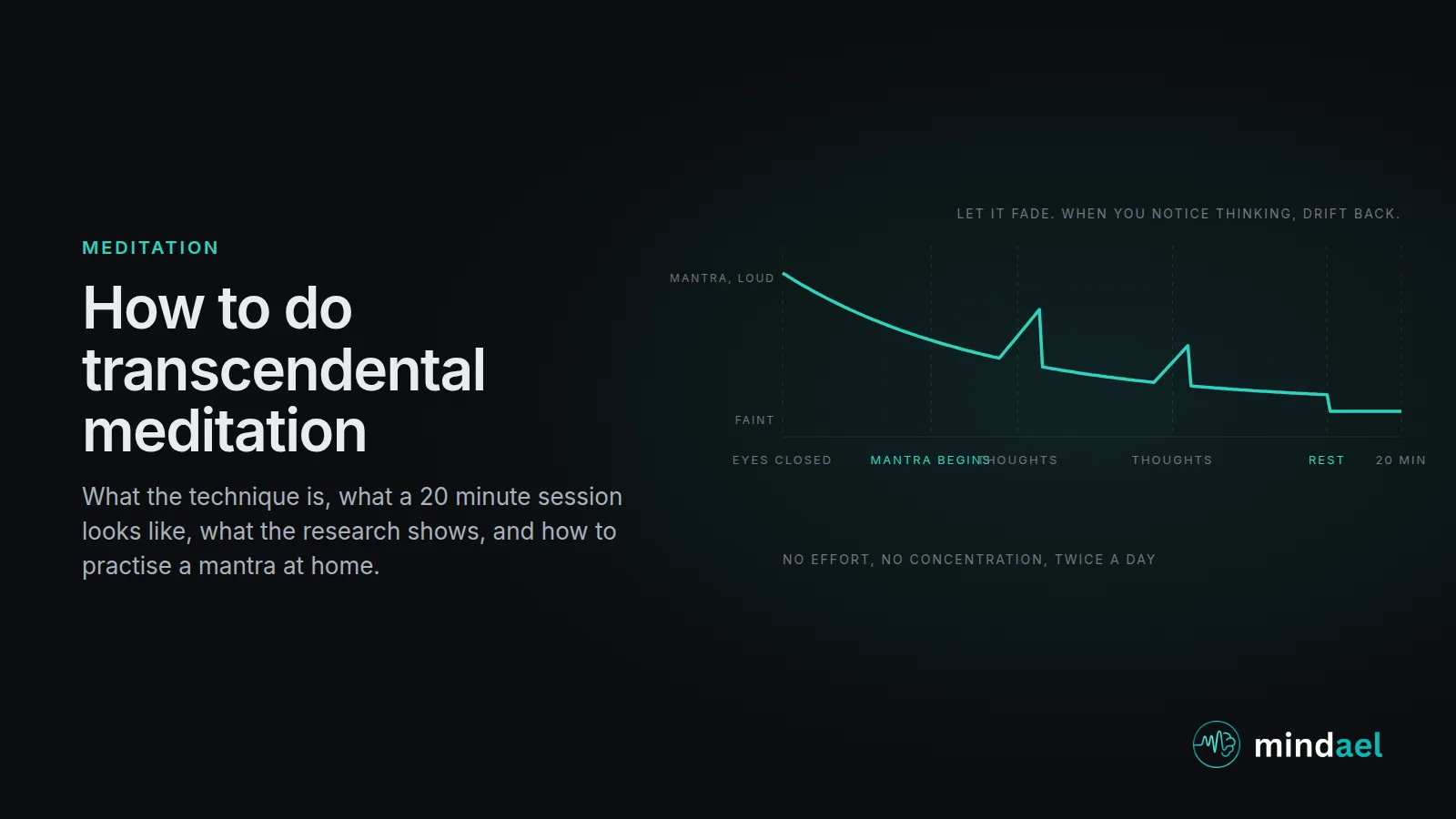
How to do transcendental meditation is a question with two honest answers. The official technique is taught in person, over four sessions, by a certified teacher who gives you a mantra, and that course is the only route to “TM” as the research studied it. The method underneath it, though, is simple and public: sit, close your eyes, let a sound repeat without effort, twice a day for twenty minutes. This article explains both, so that you know what you would be paying for and what you can start this afternoon. For the sound side, a low drone or a 6 Hz theta beat under the practice, Mindael is free to download on the App Store, and our meditation sounds guide covers how to set it up.
What transcendental meditation is
TM was brought to the West by Maharishi Mahesh Yogi in the late 1950s and became the most widely taught single meditation technique in the world. It belongs to the family of mantra meditations: the practitioner silently repeats a sound, and the repetition, rather than any effort to concentrate, is what settles the mind.
What makes it distinctive is how lightly the mantra is held. In mindfulness you train attention, returning to the breath each time you notice you have drifted, and the noticing is the practice. In TM you are told not to concentrate at all. The mantra is “introduced” and allowed to become fainter and vaguer on its own; thoughts are expected and not resisted; when you realise you have been thinking, you ease back toward the sound. Fred Travis and Jonathan Shear, in a paper that organises meditation techniques by what the brain is doing, put TM in a third category, “automatic self-transcending”, separate from focused attention and open monitoring, and reported that TM sessions show more frontal alpha coherence on EEG than either (Travis & Shear, 2010).
The other distinctive thing is the format. Twenty minutes, twice a day, morning and late afternoon, sitting in a chair with eyes closed. No posture requirements, no retreat, no app. Teachers describe it as effortless, and people who struggle with mindfulness because they “cannot stop thinking” often find this is the point: in TM you are not supposed to.
What a session looks like, step by step
This is the structure of a TM-style session. It is what practitioners do; the only part the course adds that you cannot get here is the specific mantra and the in-person checking that you are doing it lightly enough.
1. Sit comfortably, eyes closed, for about thirty seconds. A chair with back support is fine. Hands in your lap. If a sound is on, it should be low: rain or a drone at well below conversation level, or a theta beat in earbuds. Let the body settle and notice the room.
2. Let the mantra begin. Do not say it aloud and do not think it loudly. Let it arise the way a tune comes to mind, softly, in its own time. The pace is whatever is easy; it does not need to match the breath.
3. Let it change. As the mind settles, the mantra may get fainter, slower, less distinct, or disappear for a while. That is the technique working, not failing. Do not sharpen it back up.
4. When you notice thoughts, return without force. You will drift into thinking many times. Each time you realise it, let the mantra come back gently. No judgement, no “again”. Thoughts are part of the process, like dreaming is part of sleep.
5. Twenty minutes. Glance at a clock if you need to; it does not break anything. Or use a timer with a fade at the end rather than an alarm, so the end is a soft cue rather than a jolt.
6. Two or three minutes with eyes still closed. Stop the mantra and simply sit. Coming out slowly is the part people skip and the part that makes the next hour feel different. Then open your eyes and get up.
Twice a day. The second session is late afternoon or early evening, before dinner. Practitioners say it is the one that changes the evening, and it is the one most likely to get dropped, so attach it to something fixed, like arriving home.
Choosing a mantra for a home practice
TM mantras are Sanskrit-derived sounds with no meaning for the person using them, assigned by the teacher and kept private. The secrecy is part of the tradition rather than anything to do with the sound, and the organisation does not publish its lists. For a home-grown practice you need a sound that meets the same functional test: meaningless to you, soft to think, used every time.
Options people use: “Om”, the classic, which has its own small body of research; “so-ham”, breathed in on “so” and out on “ham”; a two-syllable sound you make up with an open vowel and a soft consonant. Avoid a word in your own language, because meaning pulls the mind into thinking about it, and avoid switching once you have begun. If you ever do take the official course you will be given a mantra and can change over then.
For the Gayatri mantra, chanted aloud with a meaning, the practice is different: a voiced, paced chant rather than a silent, effortless one. Both are mantra meditations; they do different things to the breath.
What the research says
TM has more trials than most single techniques, partly because its organisation funded many of them, which reviewers reasonably note. Reading the independent summaries:
Anxiety. A 2014 meta-analysis of 16 randomised trials with 1,295 participants found TM reduced trait anxiety more than control conditions, with the largest effects in people who started with the highest anxiety and most of the improvement within the first two weeks (Orme-Johnson & Barnes, 2014). The authors are TM researchers, which is worth knowing; the effect sizes are in line with other relaxation practices.
Blood pressure. A 2015 systematic review and meta-analysis of 12 studies found TM lowered systolic blood pressure by about 4 mmHg and diastolic by about 2 mmHg compared with controls, with larger effects in older people and those with higher starting pressure (Bai et al., 2015). A five-year randomised trial in 201 African American patients with heart disease found a 48 percent lower rate of death, heart attack and stroke in the TM group than in a health education group (Schneider et al., 2012); it is a single trial and has not been replicated at that scale.
Compared with other meditation. The broadest independent review, in JAMA Internal Medicine in 2014, looked at 47 trials of all meditation programmes and found moderate evidence that mindfulness programmes improved anxiety, depression and pain, and insufficient evidence for mantra programmes including TM, mainly because too few trials met its quality bar (Goyal et al., 2014). A 2022 meta-analysis of mantra-based meditation found small to moderate benefits for anxiety and depression and called for better trials (Álvarez-Pérez et al., 2022).
The fair reading: a twice-daily mantra practice is a reasonable, low-risk way to lower day-to-day anxiety and take a few points off blood pressure for some people, with evidence that is real but not as strong as its advocates say. It is not a treatment, and nobody should stop one for it.
Sound under the practice
TM is traditionally done in silence, and silence is fine. Three reasons people add sound anyway: a noisy household, a mind that cannot settle without a floor, or a preference for the way a theta beat changes the sit. If you add one, keep it low enough that it disappears within a minute. Rain or brown noise covers the room; a low drone gives the mantra a pitch to rest near; a 6 Hz theta beat, in earbuds, raised theta activity within about ten minutes in a 2017 study and is the one with the clearest brain evidence. Our meditation sounds guide has the three setups and how to pick between them. For the evening session, the same sound can run on into the wind-down for sleep.
The short version
Sit, eyes closed, thirty seconds of nothing. Let a meaningless sound repeat softly; let it fade; when you notice thinking, drift back. Twenty minutes, then two minutes of stillness. Morning and late afternoon. If you want the official technique, take the course and get your mantra from a teacher; if you want the practice, start today. Mindael has the drone, the theta beat and a fade at the end, free to download.
A quiet floor for twenty minutes.
Mindael has a 6 Hz theta beat, low drones and rain recorded without loops to sit under a mantra at a volume you barely notice, and a timer that fades out so you are not watching the clock. Free to download, no account, works offline.
- Theta beats, drones and rain, studio-made
- A fade at the end instead of an alarm
- Free to download, no account, works offline
 Free · No account needed · Works offline
 Frequently asked questions
How do you do transcendental meditation?
Sit comfortably with your eyes closed, wait half a minute, then let a mantra, a short meaningless sound, begin silently in the mind. Do not concentrate on it or push thoughts away; when you notice you are thinking, gently return to the mantra. Continue for 20 minutes, then sit with eyes closed for two or three minutes before getting up. Twice a day, morning and late afternoon.
Can I learn transcendental meditation on my own?
You can learn the method on your own: effortless silent repetition of a sound, twice a day, with no attempt to control the mind. The official TM course, taught by certified teachers in person, gives you a personally assigned mantra and several days of guided practice, and the research on 'TM' was done with people trained that way. A self-taught mantra practice is a legitimate meditation; it is just not, strictly, TM.
What mantra is used in transcendental meditation?
TM mantras are Sanskrit-derived sounds without meaning for the person using them, chosen by the teacher and kept private. For a home practice, pick a sound that has no meaning to you and is soft to say: a two-syllable sound with an open vowel, or the classic 'Om' or 'so-ham' if you are comfortable with those. What matters is that you use the same one every time and do not analyse it.
How long should transcendental meditation be?
Twenty minutes, twice a day, is the standard, with a few minutes of rest with eyes closed before standing. Beginners often start with ten and build up. The research effects on anxiety and blood pressure come from the twice-daily routine kept up for months, not from a single long session.
What is the difference between transcendental meditation and mindfulness?
Mindfulness trains attention: you watch the breath or the body and notice when the mind wanders. TM is described as 'automatic self-transcending': you give the mind one easy sound and let it settle on its own, without monitoring. In EEG studies the two show different patterns, with TM producing more frontal alpha coherence. Many people find TM-style practice easier to start because there is nothing to do right.
Does transcendental meditation work?
For anxiety, a 2014 meta-analysis of 16 trials found TM reduced trait anxiety more than controls, with the biggest effects in the most anxious groups. For blood pressure, a 2015 meta-analysis found modest reductions of around 4 mmHg systolic. A broad 2014 review of all meditation programmes in JAMA Internal Medicine found the evidence for mantra meditation thinner than for mindfulness, mostly because fewer good trials existed. It helps some people a lot and is not a cure for anything.
Sources
- Orme-Johnson DW, Barnes VA. Effects of the Transcendental Meditation technique on trait anxiety: a meta-analysis of randomized controlled trials. Journal of Alternative and Complementary Medicine, 2014.
- Bai Z, et al. Investigating the effect of transcendental meditation on blood pressure: a systematic review and meta-analysis. Journal of Human Hypertension, 2015.
- Schneider RH, et al. Stress reduction in the secondary prevention of cardiovascular disease: randomized, controlled trial of transcendental meditation and health education in Blacks. Circulation: Cardiovascular Quality and Outcomes, 2012.
- Goyal M, et al. Meditation programs for psychological stress and well-being: a systematic review and meta-analysis. JAMA Internal Medicine, 2014.
- Travis F, Shear J. Focused attention, open monitoring and automatic self-transcending: categories to organize meditations from Vedic, Buddhist and Chinese traditions. Consciousness and Cognition, 2010.
- Álvarez-Pérez Y, et al. Effectiveness of mantra-based meditation on mental health: a systematic review and meta-analysis. International Journal of Environmental Research and Public Health, 2022.
This article is for general information and is not medical advice. Meditation is not a substitute for treatment of anxiety, depression or high blood pressure; if you are being treated for any of these, keep your treatment and tell your doctor what you are adding. Transcendental Meditation is a trademark of its teaching organisation; this article describes the method and does not offer the official course.
This article is part of our meditation guide. Hear the sounds in this article in the Mindael sound library, or see our app comparison checklists.