

What Is Brown Noise? How It Helps with Focus, Sleep and ADHD
Brown noise is a deep, low-frequency sound that covers the small noises your brain keeps reacting to. People use it to settle into work, fall asleep in noisy places and quiet a busy mind. Kept low and on a timer, it is one of the easiest sounds to live with.
Brown noise went from an audio-engineering term to a household word in the space of a few years, mostly because people with ADHD started describing what it did for them: the inner chatter dropped, and work got easier to start. We hear the same thing from Mindael listeners every week. You can try our studio-made brown noise for free in Mindael on the App Store, and this guide explains what you are actually hearing and how to get the most out of it.
What is brown noise?
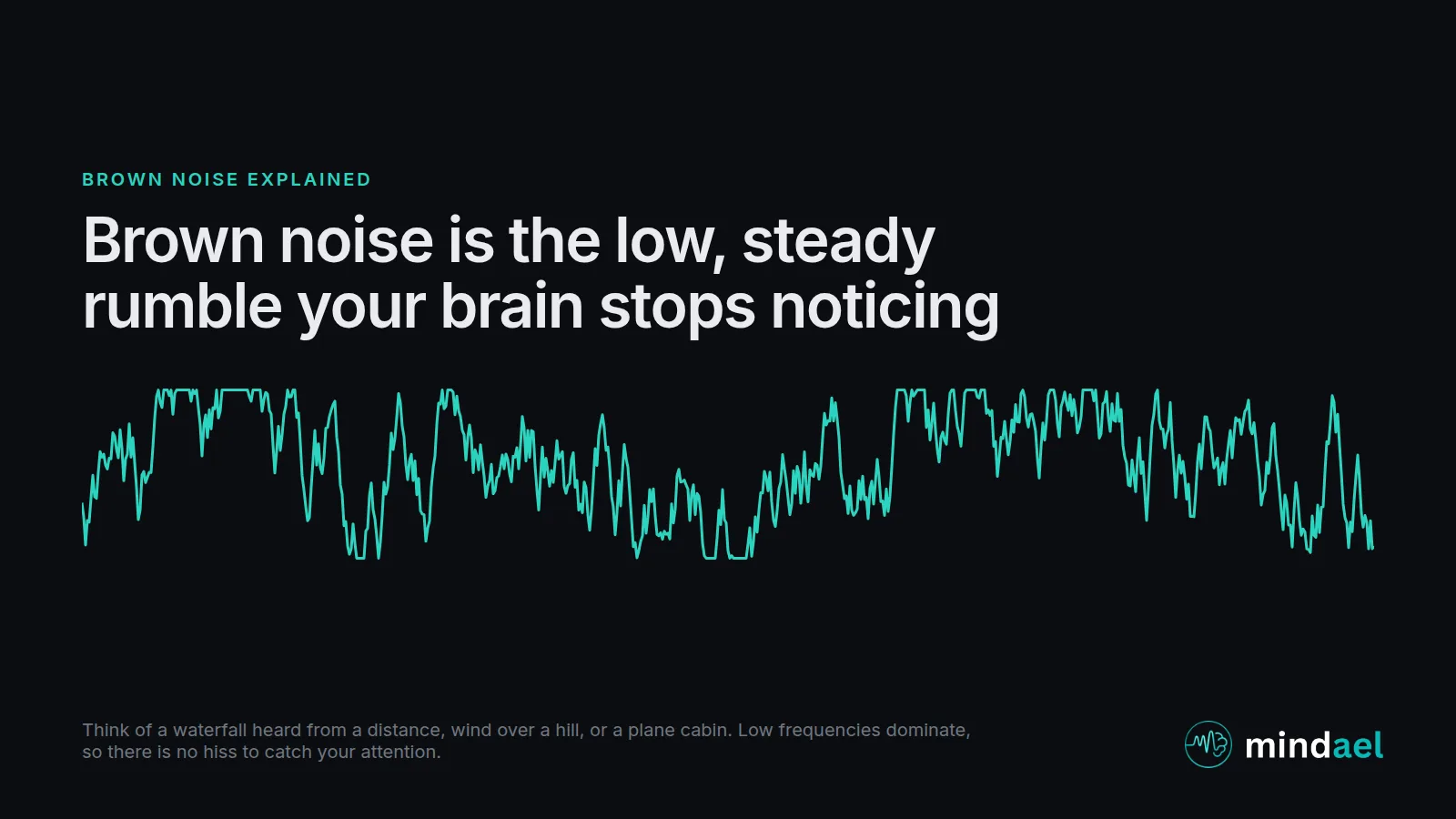
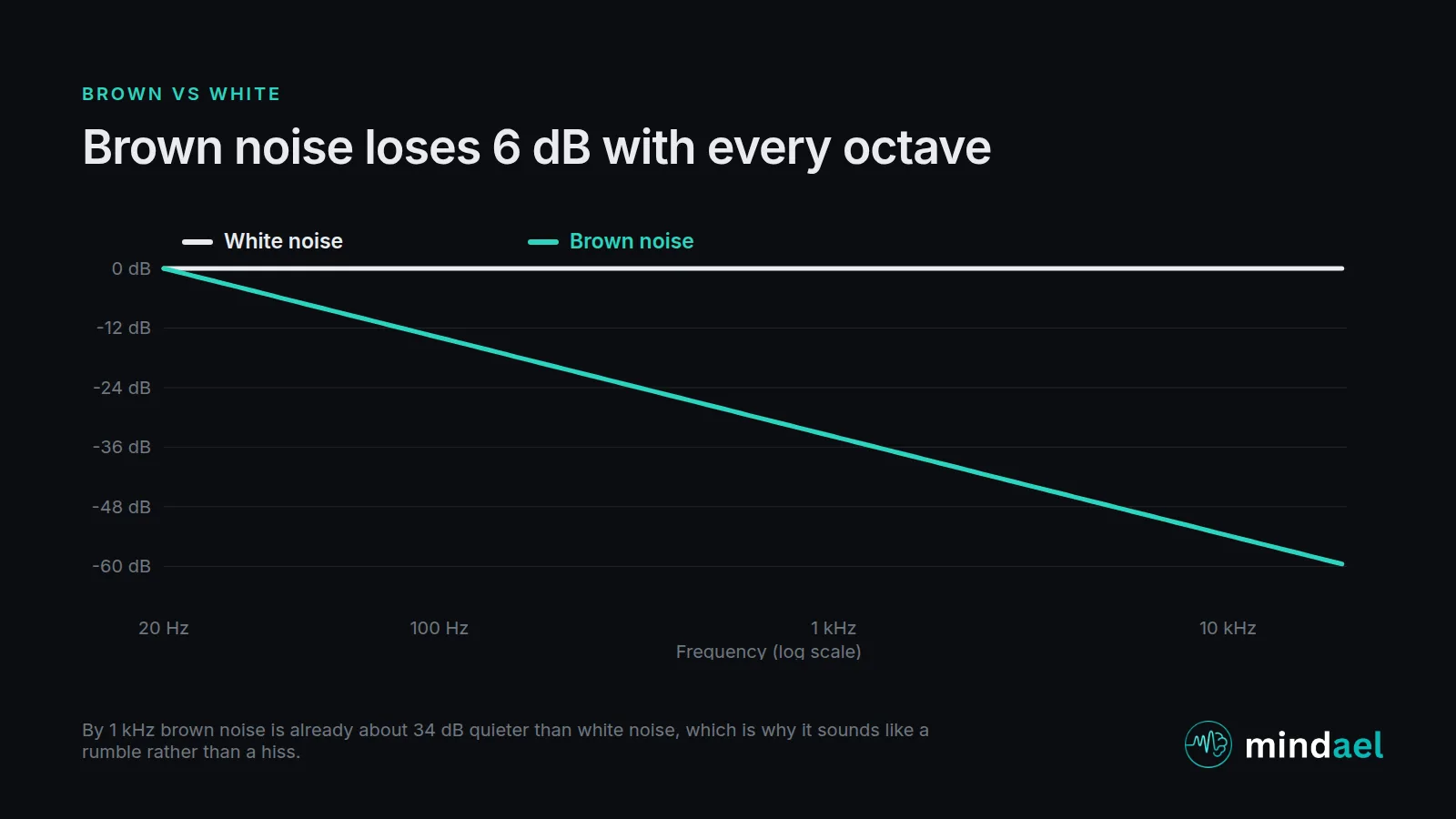
Brown noise is a random sound in which most of the energy sits in the low frequencies. The higher you go up the spectrum, the quieter it gets, by about 6 dB with every octave. The result is a deep, soft rumble that feels closer to a waterfall or heavy surf than to the static hiss most people picture when they hear the word “noise”.
The name has nothing to do with the color. It comes from Robert Brown, the botanist who in 1827 described the random jitter of pollen grains in water. That movement is now called Brownian motion, and the same math produces this sound, which is why you will also see it called red noise or Brownian noise.
If you have stood near a waterfall, listened to wind moving through a canyon, or heard a jet from the far end of a runway, you already have a good picture of it. It is full and warm, almost physical, and it tends to wrap around you instead of sitting at the front of your attention.
How brown noise helps you focus
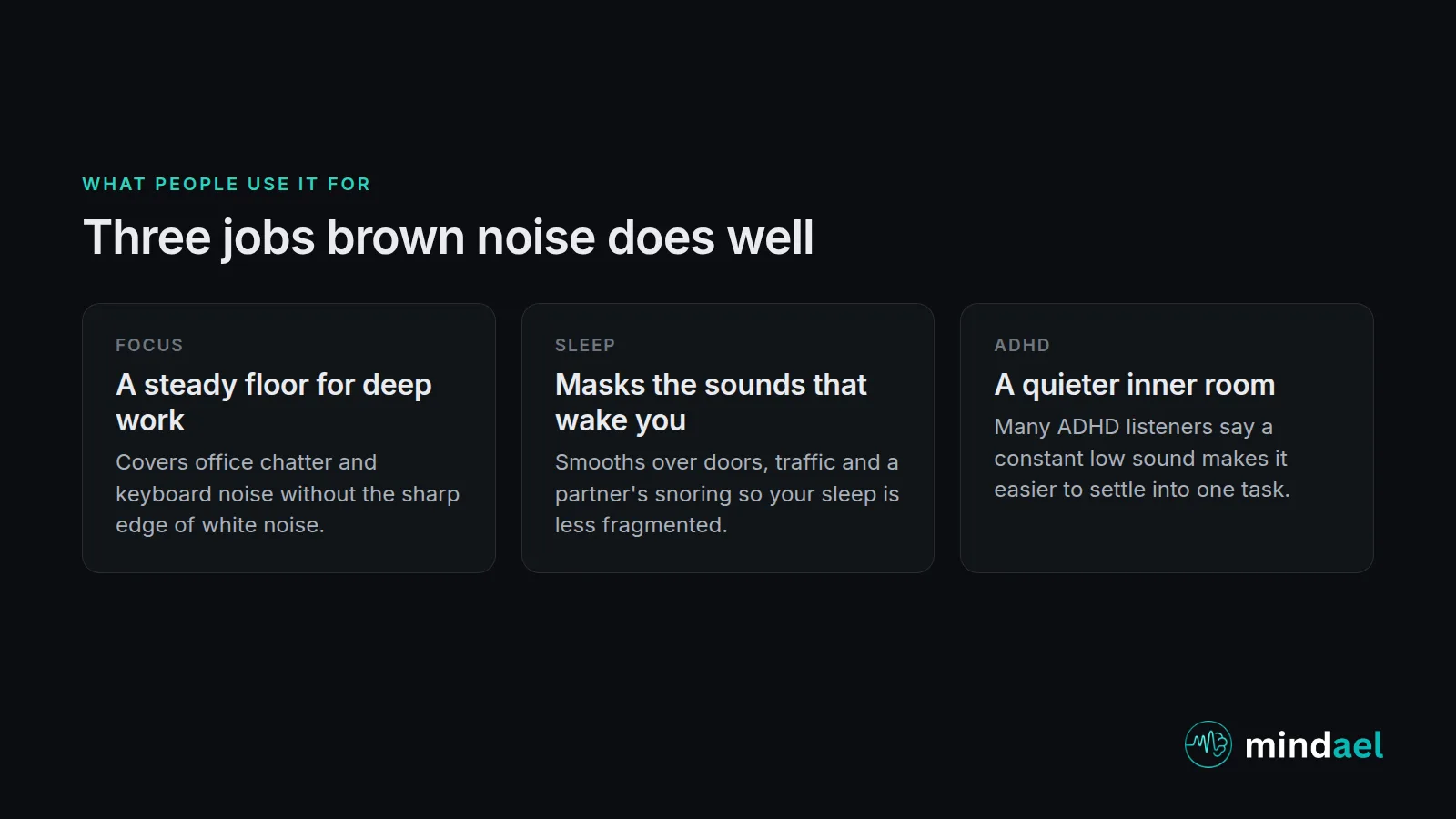
The idea behind any background sound for work is masking. Your brain is built to react to sudden change: a door, a laugh two desks over, a notification. Each one pulls attention away from the task. A steady low sound raises the floor of the room so those spikes have less contrast and stop jumping out. The room does not get quieter; your brain stops tracking it.
Brown noise is especially good at this job because its energy sits where traffic, ventilation and the rumble of voices sit. It also does not get sharp in the ears after an hour the way white noise can, which is the main reason our listeners pick it for long sessions.
For people with ADHD there is a second layer. One well-supported theory, the moderate brain arousal model, holds that an ADHD brain is slightly under-stimulated at rest and performs better with a constant, mild source of input. In a series of experiments, Swedish researchers found that children with attention problems remembered more and performed better on tasks with white noise playing, while children without those problems did slightly worse (Söderlund et al., 2007). A 2024 meta-analysis in the Journal of the American Academy of Child and Adolescent Psychiatry pooled the studies on white and pink noise in young people with ADHD and found small but consistent improvements in attention and task performance, strongest in those with more severe symptoms (Nigg et al., 2024). Those studies used white and pink noise rather than brown, and the gentler color is the one most people find easier to keep on.
In practice, people who work with brown noise keep it quiet, around 40 to 50 dB, roughly a soft conversation in the next room. Loud enough to cover interruptions, soft enough to forget. Headphones work; a small speaker on the desk is usually more comfortable for a whole afternoon.
Brown noise for sleep
Sleep is the other reason people fall for brown noise. The masking that helps you work also helps your brain stop listening for every creak once the lights go out. A constant low sound tells your nervous system that the environment is stable, which makes it easier to let go and stay down.
The sleep research itself mostly used white and pink noise, and it points the same way. In a classic 1990 study, 80% of newborns fell asleep within five minutes with white noise playing, against 25% without it (Spencer et al., 1990). In adults placed in a noisy “transient insomnia” setting, steady broadband noise cut the time to fall asleep by 38% (Messineo et al., 2017). Brown noise is the same kind of sound with the sharp end rolled off, which is why many people who find white noise too bright for bed end up here.
Brown noise sits alongside the basics, not in place of them. A cool, dark room, a regular schedule and less screen light in the last hour will always do more than any sound on its own. As one piece of the routine, though, it takes the edge off an environment you cannot control: a noisy street, a snoring partner, a hotel room.
If you use it overnight, a timer is usually the best setting. Forty-five to ninety minutes carries most people through the first sleep cycle, after which the brain holds its own. Running it until morning is fine too; just keep it low.
Brown noise and the other noise colors
Brown noise is part of a small family of sounds named after the colors of light. Each one has a different balance of highs and lows, and each feels noticeably different in the ears.
- White noise has equal energy at every frequency. Bright and hissy, like radio static or a fan on high. The strongest masker for sharp sounds.
- Pink noise falls 3 dB per octave. Balanced and natural, like steady rain. The color sleep labs have studied most.
- Brown noise falls 6 dB per octave. Deep and warm, like a distant waterfall or a train at night. The easiest to keep on for hours.
- Green noise is a band of mid frequencies with the extremes trimmed, often described as the sound of nature with nothing in particular in it.
- Blue and violet noise tilt the other way, toward the highs. Airy and thin, they are niche sounds used mainly to cover tinnitus.
We compare the three main colors in detail, with a decision guide, in brown noise vs white noise vs pink noise.
What the science says
Most of the published work on noise and attention has used white and pink noise, and brown noise rides on that evidence: the masking is the same mechanism, the sound simply sits lower. The direction of the findings is consistent. Steady broadband noise helps people fall asleep faster in noisy conditions, helps babies settle, and gives a measurable lift to attention in people with ADHD symptoms.
The other thing worth knowing is that responses differ. A sound that lets one person sink into work can feel heavy to another. Some find brown noise perfect for sleep and too thick for a desk; others the reverse. Three nights or three work blocks will tell you more than any review, and switching colors is free.
How to use brown noise effectively
A few settings get you most of the way there.
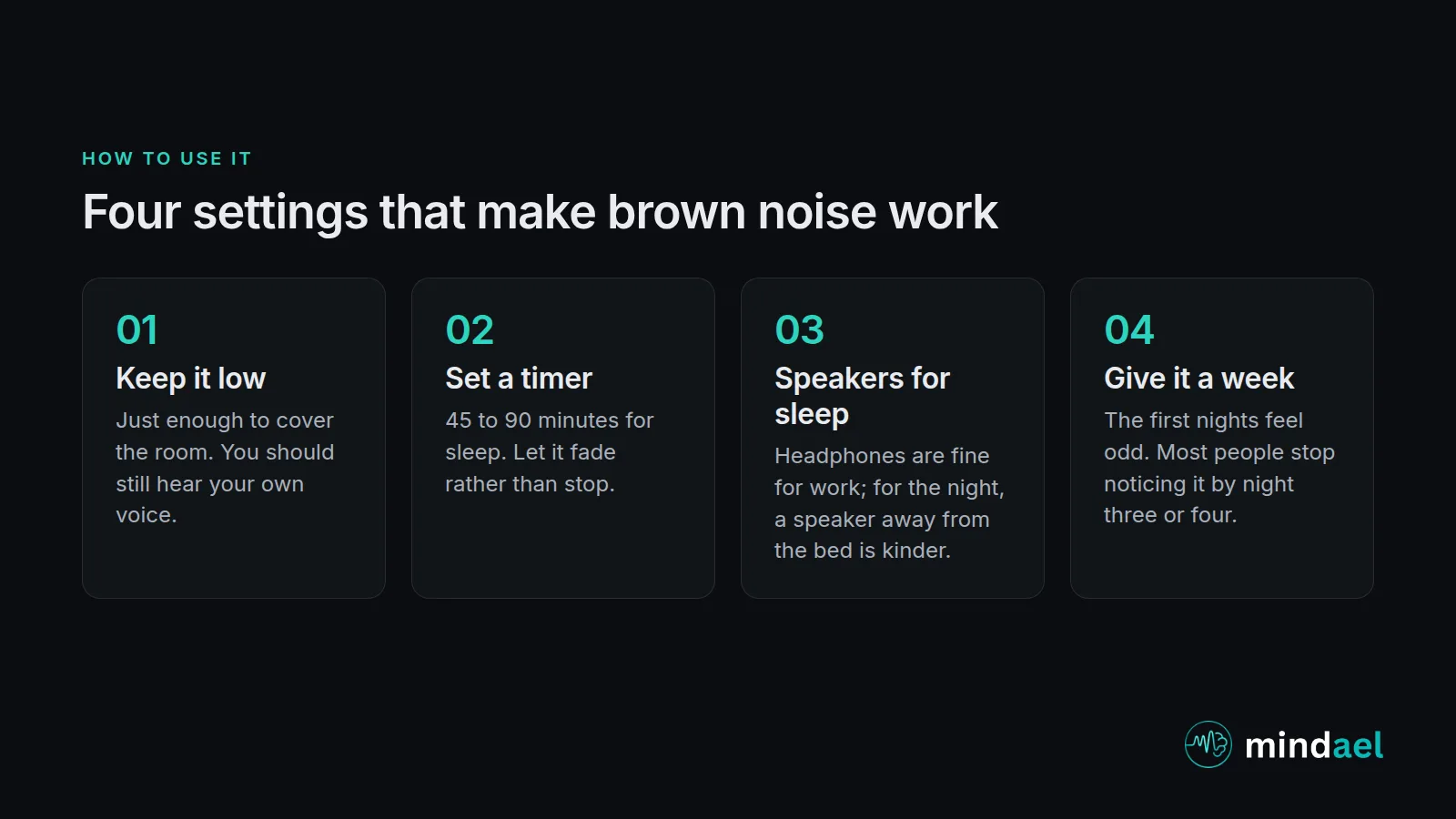
- Keep it low. Around 40 to 50 dB. You should still hear your own voice over it. Loud sound for hours tires your ears, and the masking works at low levels anyway.
- Set a timer for sleep. Forty-five to ninety minutes, with a fade rather than a hard stop, so the silence does not wake you.
- Headphones for work, a speaker for the night. Headphones isolate you in a shared space. For sleep, a speaker across the room is kinder to your ears and lets you turn over freely.
- Give it a week. The first session feels odd. By the third or fourth, most people stop noticing the sound and only notice its absence.
Mixing helps too. Brown noise under light rain is one of the most popular combinations among our listeners; a little pink on top brings back some of the detail without the hiss.
Hear what brown noise is supposed to sound like.
You now know why so many brown noise tracks online drift off spec. The one in Mindael is made in our studio and measured to fall exactly 6 dB per octave, so the depth you just read about is the depth you hear. Turn it on tonight, set a 60-minute fade, and let the room disappear.
- Studio-made, spectrum-measured brown noise
- Layer it with rain, ocean or a delta beat in two taps
- Sleep timer with a gentle fade, works offline
 Free · No account needed · Works offline
 Frequently asked questions
Is brown noise safe to listen to all night?
Yes, at a low volume. Keep it around the level of a quiet conversation, place the speaker away from your head, and use a sleep timer if you only need help falling asleep. Hours of sound are fine; hours of loud sound are not.
Does brown noise help with ADHD?
Many people with ADHD say a steady low sound makes it easier to start and stay on a task. The published studies mostly used white or pink noise, and they found small but real gains in attention, especially in people with stronger symptoms. Brown noise is the gentler-sounding option, so it is a reasonable place to start.
What is the difference between brown noise and white noise?
White noise has equal energy at every frequency and sounds like a hiss. Brown noise loses 6 dB with every octave, so the high frequencies almost disappear and what is left is a deep rumble. White masks sharp sounds better; brown is easier to listen to for hours.
How loud should brown noise be?
Around 40 to 50 dB, which is quieter than normal conversation. A good check: you should still be able to hear someone talk to you while it plays.
Can I use brown noise with headphones?
Yes. Headphones are the better choice in an office or a shared room. For sleep we prefer a speaker across the room so nothing is pressing on your ears all night.
Sources
- Söderlund G, Sikström S, Smart A. Listen to the noise: noise is beneficial for cognitive performance in ADHD. Journal of Child Psychology and Psychiatry, 2007.
- Nigg JT, et al. Systematic review and meta-analysis: do white noise or pink noise help with task performance in youth with ADHD or with elevated attention problems? Journal of the American Academy of Child and Adolescent Psychiatry, 2024.
- Spencer JA, Moran DJ, Lee A, Talbert D. White noise and sleep induction. Archives of Disease in Childhood, 1990.
- Messineo L, et al. Broadband sound administration improves sleep onset latency in healthy subjects in a model of transient insomnia. Frontiers in Neurology, 2017.
This article is for general information and is not medical advice. If you have ongoing sleep or attention problems, talk to a doctor.
Hear the sounds in this article in the Mindael sound library, or see our app comparison checklists.