

Sleep Sounds That Help You Fall Asleep Faster and Stay Asleep
Most people who cannot sleep are not short on tiredness. They are short on quiet. The right sleep sound raises the floor of the room so the creaks, traffic and racing thoughts lose their edge. Every sound on this page is in Mindael, free on the App Store, and below we explain which one to pick for the kind of night you are having.
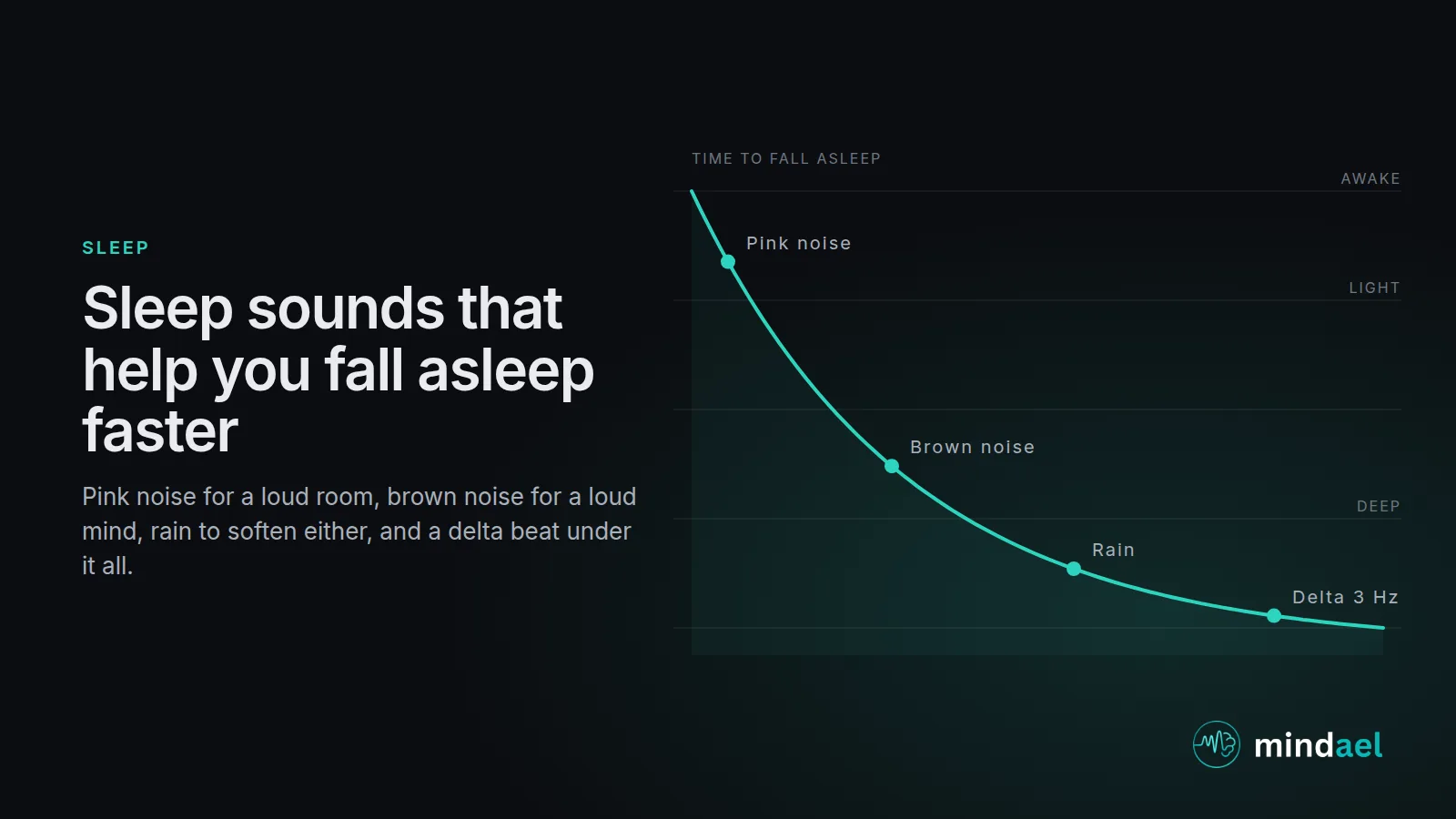
If the room is noisy, start with pink or white noise. If the room is quiet and your head is not, start with brown noise or a delta binaural beat under rain. Keep it at the volume of a quiet conversation, set a 60 to 90 minute fade, and give any sound three nights before you judge it.
Sounds that work, and why
Pink noise
Softer than white noise, like steady rain. The color sleep labs have studied most, and the one we suggest first for a noisy bedroom.
Brown noise
Deep and warm, with the hiss rolled off. The best choice when the loud part is your own mind rather than the street.
Delta binaural beats
A 1 to 4 Hz pulse that matches the rhythm of deep sleep. Needs earbuds, so we layer it under rain for the first twenty minutes and let the timer take over.
Rain and ocean
Natural sounds with a pink-like spectrum. Less clinical than plain noise, which matters when you are sleeping with a partner who dislikes static.
Why a steady sound helps you sleep
Your hearing never switches off. All night, part of your brain keeps scanning for change: a door, a car, a partner turning over. Each spike pulls you a little closer to waking. A steady sound does not make the room quieter. It raises the floor, so those spikes have less contrast and stop registering as events. That is the whole trick, and it is why the volume can stay low.
The second effect is slower and, for many of our listeners, bigger. A sound you use every night becomes a cue. After a couple of weeks, pressing play tells your body what comes next, the same way a dimmed lamp or a closed book does. People who travel a lot tell us this is the part they value most: the hotel changes, the sound does not, and our naps, jet lag and shift sleep guide builds on exactly that. The other end of the night, the alarm and the groggy half hour after it, has its own page: the morning and alarm guide.
What the research shows
The cleanest result is also the oldest. In 1990, researchers in London played white noise to newborns in a hospital nursery: 80% fell asleep within five minutes, against 25% without it (Spencer et al., 1990). In adults, a 2017 study put healthy sleepers in a noisy environment designed to mimic a bad night and found that steady broadband sound cut the time to fall asleep by 38% (Messineo et al., 2017).
Pink noise has the most interesting sleep-lab work behind it. When soft pink noise pulses were timed to a sleeper’s slow brain waves, deep sleep got deeper and next-morning memory improved, first in young adults (Ngo et al., 2013) and then in older adults (Papalambros et al., 2017). Those experiments used brain monitoring to time the pulses; a steady pink noise track is a simpler thing, but it is the same sound, and the reason we suggest pink first for a noisy room.
For binaural beats, a 2018 study played a 3 Hz beat to sleepers for the whole night and found more time in deep sleep and less in light sleep (Jirakittayakorn and Wongsawat, 2018). The beat only exists with earbuds, which is why we treat it as a falling-asleep tool rather than an all-night one.
The one caution in the literature is about volume, not sound. A 2014 study measured infant sleep machines and found several could exceed safe levels at maximum volume (Hugh et al., 2014). Every recommendation on this page assumes you keep it quiet, and for a baby’s room the limits are stricter; our white noise for babies guide has them.
Picking the sound for the night you are having
The street is loud. Pink noise first, white noise if pink is not enough. Both put energy where traffic and voices sit. Rain is the natural-sounding version of the same idea.
The room is quiet but your head is not. Brown noise. It is deep enough to feel physical, which gives a busy mind something steady to rest on, and it has no hiss to get sharp over hours. Many people add a little rain on top for texture.
You wake at 3 a.m. and cannot get back down. Keep the sound running all night at a low level rather than using a timer, so the room does not change halfway through the night. Brown noise or ocean works well here.
You sleep next to someone who hates static. Rain or ocean on a speaker, or a delta beat under rain in one earbud for the first twenty minutes.
If you want the full comparison of the three noise colors, with the research for each, we wrote it up in brown noise vs white noise vs pink noise.
How to set it up tonight
- Pick one sound, not fiveStart with pink noise if your room is loud, brown noise or rain if it is quiet. Add a second layer only after a week.
- Set the volume to a quiet conversationAround 40 to 50 dB. You should still hear someone speak to you. Louder does not mask better, it just tires your ears.
- Use a speaker across the roomNothing pressing on your ears all night, and you can turn freely. Earbuds only if you are using a binaural beat, and then with a timer.
- Set a 60 to 90 minute fadeThat carries you through the first sleep cycle. A fade rather than a hard stop, so the sudden silence does not wake you.
- Give it three nightsThe first night feels odd. By the third, most people stop hearing the sound and only notice when it is missing.
Tonight's sound is already waiting.
You know which color to start with and how loud it should be. Mindael has pink, brown and white noise made in our studio and measured before release, rain and ocean recorded in-house, and a sleep timer that fades out on its own. Download it, set 60 minutes, and let the room go quiet.
- Pink, brown and white noise, each measured to spec
- Rain, ocean and delta beats to layer under them
- Sleep timer with a gentle fade, works offline
 Free · No account needed · Works offline
 Frequently asked questions
What is the best sound for sleeping?
There is no single winner, but pink noise is the most studied and the easiest to live with. White noise masks a noisy room better, brown noise is calmer when the room is already quiet. Try each for a night and keep the one you forget is playing.
Is it bad to sleep with sound on all night?
Not at a low volume. Keep it around 40 to 50 dB, place the speaker away from the bed, and use a timer if you only need help falling asleep. The one real risk is volume: a 2014 Pediatrics study found infant sleep machines can exceed safe levels at maximum, so keep it quiet, especially for children.
Do binaural beats work for sleep?
In a 2018 sleep-lab study, a 3 Hz binaural beat played during sleep increased time in deep sleep. They only work with earbuds, so we suggest a short session under rain while you fall asleep rather than all night.
Should I use headphones or a speaker?
A speaker for anything except binaural beats. It is kinder to your ears over eight hours and nothing falls out when you turn over.
How loud should sleep sounds be?
Quieter than you think. The masking effect works at low levels because it reduces the contrast between silence and sudden sounds, not because it drowns everything out.
Sources
- Spencer JA, Moran DJ, Lee A, Talbert D. White noise and sleep induction. Archives of Disease in Childhood, 1990.
- Messineo L, et al. Broadband sound administration improves sleep onset latency in healthy subjects in a model of transient insomnia. Frontiers in Neurology, 2017.
- Ngo HV, Martinetz T, Born J, Mölle M. Auditory closed-loop stimulation of the sleep slow oscillation enhances memory. Neuron, 2013.
- Papalambros NA, et al. Acoustic enhancement of sleep slow oscillations and concomitant memory improvement in older adults. Frontiers in Human Neuroscience, 2017.
- Jirakittayakorn N, Wongsawat Y. A novel insight of effects of a 3-Hz binaural beat on sleep stages during sleep. Frontiers in Human Neuroscience, 2018.
- Hugh SC, et al. Infant sleep machines and hazardous sound pressure levels. Pediatrics, 2014.
This page is for general information and is not medical advice. If you have ongoing sleep problems, talk to a doctor.