

The Best Sleep App for iPhone: What It Needs and How to Choose
Search for a sleep app and you get three kinds: trackers that tell you how badly you slept, meditation libraries that ask for a subscription on the first screen, and sound apps with twenty loops. The app that actually helps you fall asleep does a handful of specific things, and you can check for each one in a minute. Mindael was built around that list and is free on the App Store. Here is what to look for.
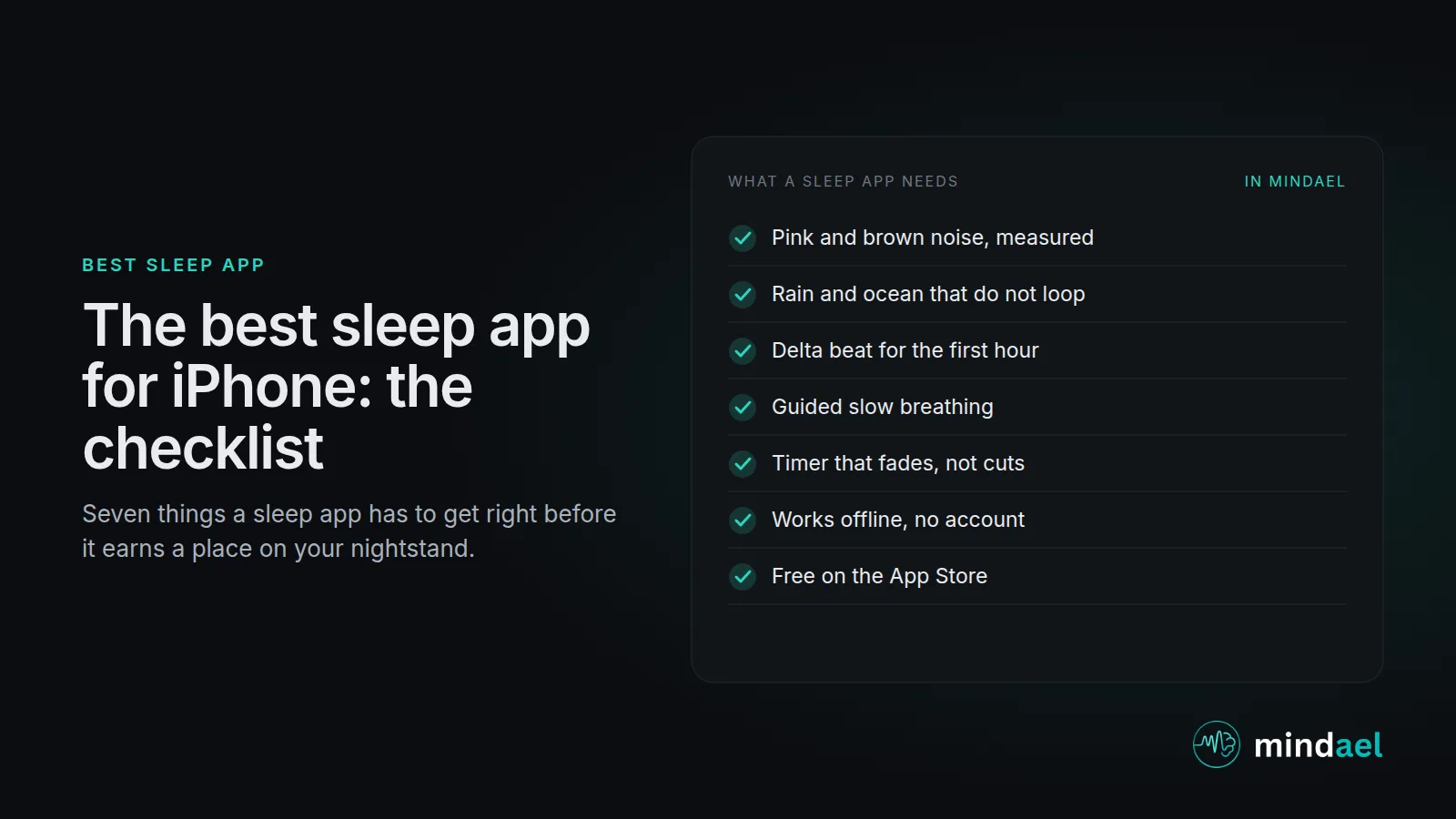
The best sleep app gets you to sleep rather than measuring you: steady sounds with research behind them (pink and brown noise, long nature recordings), a delta binaural beat for the nights when noise is not enough, a guided breathing pattern for the racing mind, a timer that fades instead of stopping, mixing, offline playback and no account. Mindael has every item on that list, free on iPhone.
What to look for, and how Mindael covers it
| What you need | In Mindael |
|---|---|
| Sounds that help you fall asleep | Pink and brown noise measured to spec, rain and ocean recorded for the whole night |
| Something for a racing mind | Delta binaural beats at 1 to 3.5 Hz, the band of deep sleep |
| A way to slow your breathing | Guided 4-7-8 and slow breathing, on screen, over any sound |
| A timer that fades | Fades out gently after the time you set instead of cutting to silence |
| Mixing | Rain over brown noise, a delta beat under ocean, at the balance you choose |
| Works offline and in the background | Every sound is on the phone; plays with the screen locked |
| No account, no tracking | Open the app and press play; nothing to sign up for |
| Price | Free to download and use on the App Store |
Three kinds of sleep app, one that helps
Sleep trackers tell you what happened after the fact. They are interesting for a week and then they become one more number to worry about at 11 p.m. Meditation libraries can be excellent, but most put the subscription screen between you and the first sound, and a narrated story is not what a tired brain wants at 2 a.m. The third kind, the sound app, is the one with the research behind it, and it is also where the quality gap is widest: a twenty-second loop with an audible seam is worse than silence.
So the first thing to check is what the app is for. If its home screen is a graph, it is a tracker. If it is a paywall, it is a library. If it is a play button, you are in the right place. Our sleep sounds guide explains what to play once you are there.
The sounds, and the evidence for them
Steady broadband sound works because it raises the floor of the room, so the door, the car and the partner turning over stop registering as events. In a 2017 study that put healthy sleepers in a deliberately noisy setting, broadband sound cut the time to fall asleep by about 38 percent (Messineo et al., 2017). Pink noise is the color the sleep labs have used most; brown noise is the one our listeners choose when the room is quiet and the mind is not. The differences are explained in our noise colors comparison.
For the nights when noise is not enough, a delta binaural beat adds a slow pulse in the 1 to 4 Hz band of deep sleep. In a 2018 sleep-lab study, a 3 Hz beat played during sleep increased time in deep sleep (Jirakittayakorn and Wongsawat, 2018). It needs earbuds, so the right way to use it is twenty minutes under rain while you fall asleep, then let the timer take over. Every sound in Mindael is made or recorded in our own studio and measured before release, and you can hear each one on its page in the sound library.
The part most sleep apps skip: breathing
If your body is tired and your mind is not, a sound alone can take a while. What shortens the wait is slowing your breathing, and specifically making the exhale longer than the inhale, which engages the brake on the stress response. A 2018 systematic review found that slow breathing at around six breaths a minute raises heart rate variability and lowers reported anxiety across the studies reviewed (Zaccaro et al., 2018).
The best sleep app therefore has a guided breathing pattern that runs over the sound, not instead of it. Mindael’s guided 4-7-8 screen counts the pattern for you while rain or brown noise plays underneath; by the fourth round most people have stopped following the count and started following the sound. Our breathing exercises guide explains the patterns and when to use each.
The small features that decide whether you keep it
A timer that fades. A hard stop at 60 minutes is a sudden change in the room, and sudden change is exactly what wakes you. The timer should fade over the last minute or two.
Mixing. Rain over brown noise fills the gaps that either leaves alone. A delta beat under ocean hides the beat’s clinical edge. The app should let you set the balance, not just stack two loops at full volume.
Volume guidance. A 2014 study found some sleep machines exceeded safe levels at full volume (Hugh et al., 2014). Keep it below 50 dB at the pillow, the level of a quiet conversation, and use a speaker across the room rather than earbuds all night.
Offline and background play. Hotel Wi-Fi, flight mode, a locked screen. The sounds need to be on the phone and keep playing when the screen goes dark.
No account. Between you and sleep there should be one tap. Nothing to sign up for, nothing to sync.
What Mindael leaves out, on purpose
No sleep score in the morning, because a number does not help you sleep and checking it adds a worry. No narrated stories, because the research supports steady sound and slow breathing, and a voice gives a restless mind something new to follow. No pop-ups when you open it at night. What is there is the list above: sounds measured to spec, a delta beat, guided breathing, a fading timer, mixing, offline play, and a play button on the first screen, free on the App Store.
How to switch in five minutes
- Download Mindael and open SleepFree on the App Store, no account. The Sleep screen puts the sounds for tonight in one place.
- Match the sound to the problemLoud room: pink noise or rain. Loud mind: brown noise, or a delta beat with earbuds for the first twenty minutes.
- Breathe for the first five minutesStart the guided 4-7-8 pattern over the sound. By the fourth round most people have stopped counting.
- Set a 45 to 60 minute fadeLong enough to be asleep, short enough that nothing is playing at 4 a.m. A fade, not a stop.
- Keep the same sound for a weekYour brain learns it as the cue for sleep. Switching nightly resets that learning.
Tonight's app is already free.
Mindael has the sounds the sleep research used, a delta beat for the racing mind, guided breathing for the first five minutes, and a timer that fades on its own. No account, nothing to track. Download it, pick one sound, set 45 minutes, and let the room go quiet.
- Pink, brown and white noise, measured; rain and ocean, no loops
- Delta beats and guided 4-7-8 breathing
- Fading timer, offline, no account
 Free · No account needed · Works offline
 Frequently asked questions
What is the best sleep app?
The one that helps you fall asleep, which means sounds with research behind them, a breathing guide for the nights your mind will not stop, a fading timer, and no sign-up between you and the play button. Mindael covers all of that and is free on iPhone.
Do sleep apps actually work?
The sound part does, with evidence: a 2017 study found steady broadband sound cut the time to fall asleep by about 38 percent, and a 2018 sleep-lab study found a 3 Hz binaural beat increased deep sleep. Trackers measure sleep; they do not change it.
Is there a free sleep app?
Yes. Mindael is free to download on the App Store, with sleep sounds, delta beats, a breathing guide and a timer, and it needs no account.
Do I need a sleep tracker?
Only if you are curious. Knowing you slept badly does not help you sleep better, and checking the score adds a small anxiety of its own. A sound and a breathing pattern you use every night does more.
Should the app play all night?
For most people, no. A 45 to 60 minute fade covers the first sleep cycle, which is when you need help. If you wake often, a low volume all night is the exception, below 50 dB at the pillow.
Sources
- Messineo L, et al. Broadband sound administration improves sleep onset latency in healthy subjects in a model of transient insomnia. Frontiers in Neurology, 2017.
- Jirakittayakorn N, Wongsawat Y. A novel insight of effects of a 3-Hz binaural beat on sleep stages during sleep. Frontiers in Human Neuroscience, 2018.
- Zaccaro A, et al. How breath-control can change your life: a systematic review on psycho-physiological correlates of slow breathing. Frontiers in Human Neuroscience, 2018.
- Hugh SC, et al. Infant sleep machines and hazardous sound pressure levels. Pediatrics, 2014.