

Delta Binaural Beats (1 to 4 Hz): The Deep-Sleep Rhythm, With a Sample
Binaural beat, 1 to 4 Hz difference (1, 2 and 3.5 Hz in the app)
15 second sample of the Delta 2 Hz binaural beat in Mindael. Use earbuds; on a speaker the beat does not exist.
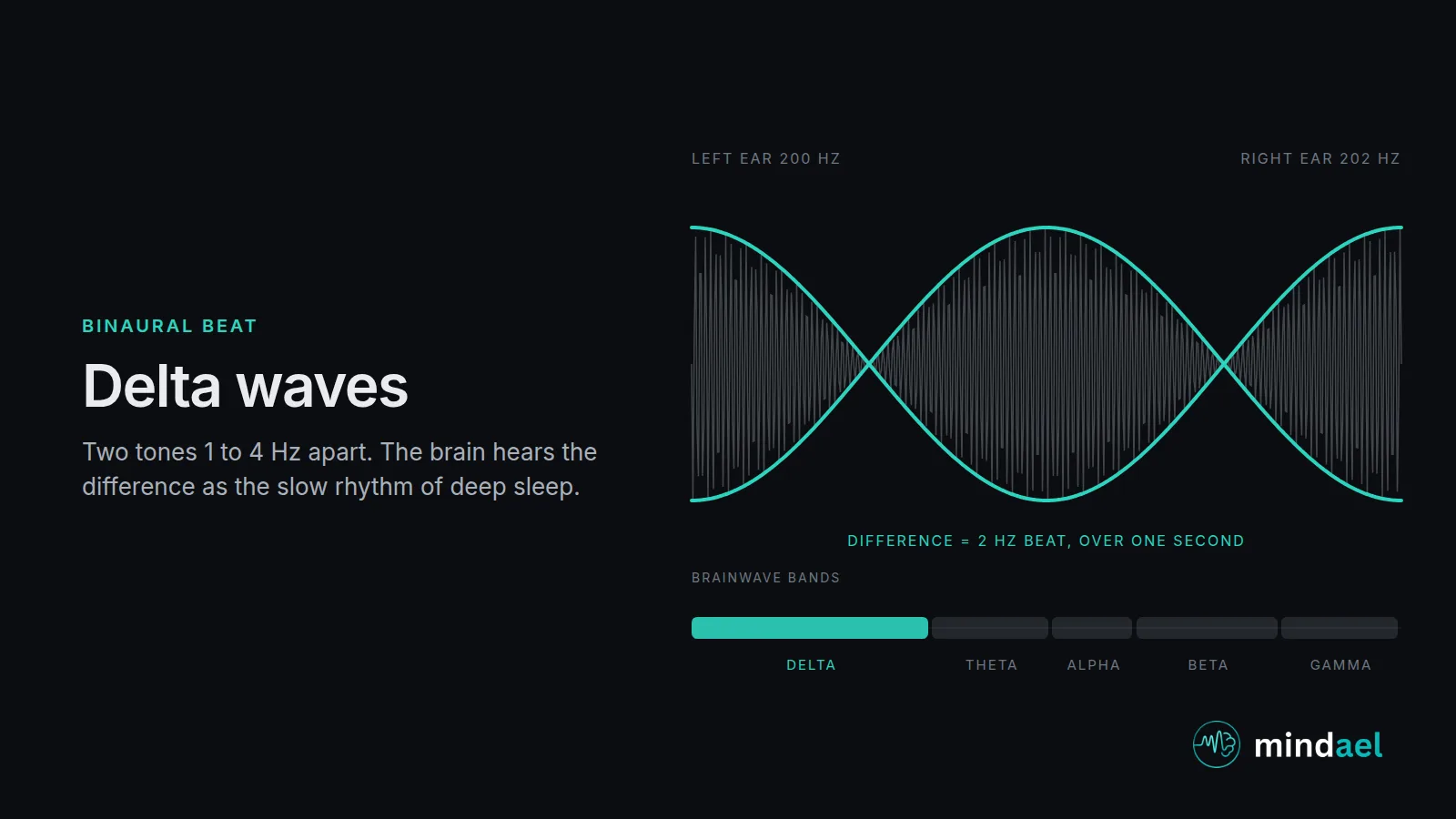
Delta is the slowest brainwave band, 1 to 4 Hz, the rhythm of deep, dreamless sleep. A delta binaural beat plays two tones a few hertz apart, one per ear, and the brain hears the slow difference as a pulse. It is the beat with the clearest sleep research, and the one to use under rain for the first twenty minutes of the night.
Choosing an app? See what the best binaural beats app needs, or browse the full sound library.
What a delta beat is
Play a 200 Hz tone in the left ear and 202 Hz in the right and the brain hears something neither ear is receiving: a slow 2 Hz pulse. That pulse is a binaural beat, and when its rate falls in the 1 to 4 Hz delta band it matches the rhythm of slow-wave sleep, the deepest stage of the night. The beats in Mindael use a clean carrier tone at the stated difference: 1, 2 or 3.5 Hz.
What the research shows
Delta is the binaural band with the most direct sleep evidence. In a 2018 sleep-lab study, a 3 Hz beat played throughout the night increased time in deep sleep and reduced time in light sleep (Jirakittayakorn and Wongsawat, 2018). In a study of young elite footballers, eight weeks of binaural beats during sleep improved perceived sleep quality and how they felt on waking (Abeln et al., 2014). Across 22 studies of binaural beats, a 2019 meta-analysis found reliable effects, larger with longer sessions (Garcia-Argibay et al., 2019).
How to listen
Earbuds, or there is no beat. Put gentle rain or brown noise over the beat at about twice its volume so the raw tone is not the thing you hear. Fifteen to thirty minutes with a timer is the usual pattern; most people take the earbuds out as they drift and let rain on a speaker carry the rest of the night. Our sleep sounds page has the full setup.
What each band does, with the research for all five, is in our guide to binaural beats.
The beat the sleep labs used, under rain, in two taps.
Delta 1, 2 and 3.5 Hz are all in Mindael, generated with a clean carrier tone, with rain and brown noise to put over them and a timer that fades everything out once you are under. Earbuds in, twenty minutes, done. Download it and try it tonight.
- Delta 1, 2 and 3.5 Hz beats with a clean carrier
- Layer the beat under rain or brown noise
- Sleep timer with a gentle fade, works offline
 Free · No account needed · Works offline
 Frequently asked questions
Do delta binaural beats help you sleep?
In a 2018 sleep-lab study, a 3 Hz binaural beat played during sleep increased time in deep sleep and reduced light sleep. An earlier study of elite athletes found eight weeks of binaural beats during sleep improved perceived sleep quality. Earbuds are required for the beat to exist.
Which delta frequency should I use?
Start with 2 Hz. It is the middle of the band and the one in our sample. 1 Hz is slower and some people find it heavy; 3.5 Hz is closer to the theta edge and suits people who want a slightly lighter rest.
Do I need headphones for delta waves?
Yes. The beat only exists when each ear receives its own tone. Through a speaker the two tones mix in the air and the effect disappears. Any stereo earbuds will do.
How long should I listen?
Fifteen to thirty minutes while falling asleep, with the beat under rain and a timer. Sleeping all night in earbuds is uncomfortable for most people, so we treat delta as a falling-asleep tool.
Sources
- Jirakittayakorn N, Wongsawat Y. A novel insight of effects of a 3-Hz binaural beat on sleep stages during sleep. Frontiers in Human Neuroscience, 2018.
- Abeln V, Kleinert J, Strüder HK, Schneider S. Brainwave entrainment for better sleep and post-sleep state of young elite soccer players. European Journal of Sport Science, 2014.
- Garcia-Argibay M, Santed MA, Reales JM. Efficacy of binaural auditory beats in cognition, anxiety, and pain perception: a meta-analysis. Psychological Research, 2019.
This page is for general information and is not medical advice.