

How Long Should a Nap Be? Naps, Jet Lag and Shift Sleep, with the Sounds That Help
The length of a nap decides what you get from it, and the wrong length leaves you worse than no nap at all. A 10 to 20 minute nap wakes you sharper within minutes; a 90 minute nap gives you a full sleep cycle; anything in between lands you in deep sleep and a groggy half hour after. This page covers the research on each length, when to nap, how to fall asleep fast enough for a short nap to count, and how the rules change for jet lag and shift work. The sounds that make a nap in a bright, noisy room possible are in Mindael, free to download on the App Store, and they play offline, so they work on a plane as well as a sofa.
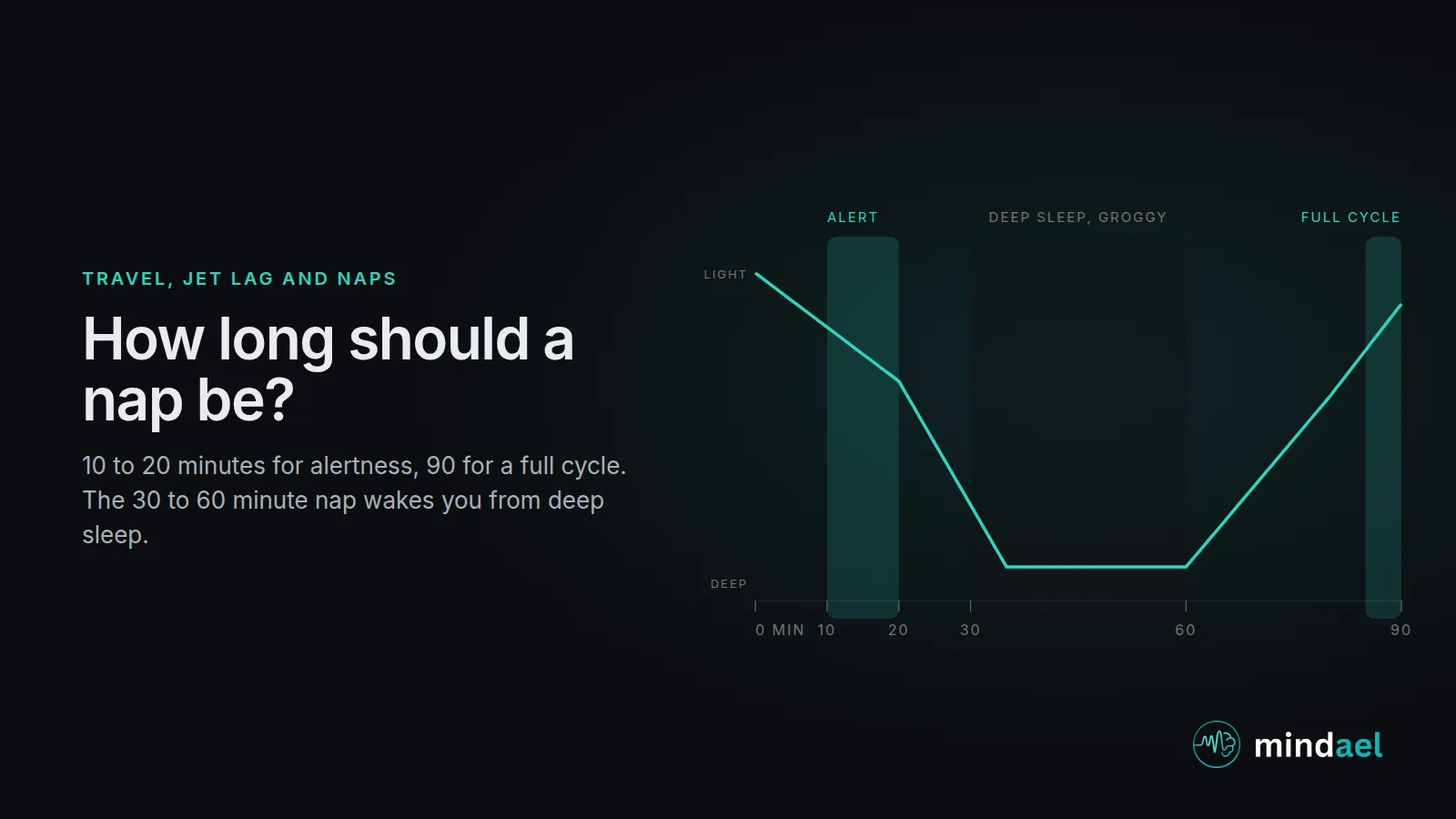
A nap should be either 10 to 20 minutes or about 90 minutes. The short nap stays in light sleep and improves alertness and performance for two to three hours with no grogginess. The 90 minute nap runs through deep and dream sleep and helps memory, but needs a quiet, dark hour and a half. A 30 to 60 minute nap wakes you from deep sleep, with sleep inertia that can last half an hour. Nap in the early afternoon, before 3 p.m., in the dark, with a steady sound to cover the room and a timer that fades at the length you chose. After a long flight, keep the first nap short and go to bed at local time; before a night shift, take the long one.
Sounds that work, and why
Brown noise
The deepest, most featureless sound we make. It covers a daytime house, an office nap room or an aircraft cabin without drawing attention to itself, and it is the sound most of our listeners nap to.
Rain
A sound with texture but no words, for people who find pure noise too flat. Used at the same volume every time, it becomes the cue that a nap is starting, which shortens the time to fall asleep.
Pink noise
Softer than white, brighter than brown, and the color used in the research on sound and sleep onset. A good first choice if you have never napped to sound before.
Delta waves
A slow binaural beat, with earbuds, for the 90 minute nap or a pre-shift sleep in the afternoon, when the body is not expecting to sleep and needs more help going deep.
Why the length decides everything
Sleep runs in stages, and a nap is a slice of that sequence. In the first 10 to 20 minutes you are in light sleep, which is easy to wake from and already restorative. Somewhere between 20 and 30 minutes most people drop into deep, slow-wave sleep, which is the hardest stage to wake from. After about 60 to 70 minutes the first dream period begins, and a full cycle closes at roughly 90 minutes, by which time you are back near the surface. So a nap’s length is really a choice of which stage you want to be woken from.
Being woken from deep sleep has a name, sleep inertia: the heavy, slow, slightly stupid feeling that can last from a few minutes to half an hour, with reaction times and judgement measurably worse during it (Tassi and Muzet, 2000). It is why a 40 minute nap on the sofa can leave you feeling as if you have been hit, while a 15 minute one leaves you fresh.
The four nap lengths
10 minutes. The surprise of the research. In a 2006 study, 24 adults were restricted to five hours of sleep and then given a 5, 10, 20 or 30 minute afternoon nap, or none. The 10 minute nap produced immediate improvements in alertness, fatigue and performance that lasted up to about two and a half hours, with no grogginess. The 5 minute nap did little (Brooks and Lack, 2006).
20 minutes. The classic power nap, and the length we recommend for most afternoons. In the same study the 20 minute nap produced benefits that lasted as long, though they took a few minutes to appear after waking. A Japanese study found that a 20 minute nap that reached stage 2 sleep improved performance and alertness through the afternoon, while a nap kept in stage 1 did not (Hayashi et al., 2005). Twenty minutes is long enough to get there and short enough to stay out of deep sleep.
30 to 60 minutes. The length to avoid on an ordinary day. The 30 minute nap in the 2006 study caused a period of impaired alertness on waking before its benefits arrived, which is sleep inertia doing exactly what it does. An hour is worse, because you are likely to be in the deepest part of the cycle.
90 minutes. A full cycle: light sleep, deep sleep, dream sleep and back up. In a 2003 experiment, people who took a 60 to 90 minute nap containing both slow-wave and dream sleep improved on a visual learning task by as much as people who slept a full night (Mednick et al., 2003). This is the nap for a short night, a pre-shift sleep or a study afternoon, and it needs a real bed, darkness and a steady sound for the whole 90 minutes.
When to nap
The body has a dip in alertness in the early afternoon, roughly 1 to 3 p.m., which is why falling asleep then is easy and why the research naps are scheduled there. A nap in that window takes very little pressure off the night. One after about 3 p.m., and especially a long one, does, and the cost shows up at bedtime. If you have an evening that matters, nap early and short.
If you cannot nap at all, do not force it. Ten minutes lying in the dark with a steady sound and slow breathing is restful even without sleep; our breathing guide has the four-in, six-out pattern that suits it.
Falling asleep fast enough for a short nap
The weakness of the 20 minute nap is that it only works if you fall asleep in the first five. Three things make that reliable. Darkness: an eye mask is enough. A steady sound: broadband noise shortened the time to fall asleep by about 38 percent in a 2017 study of adults trying to sleep in a disrupted environment (Messineo et al., 2017), and a daytime house, office or cabin is the definition of a disrupted environment. Brown noise or rain at the level of a quiet conversation, the same one every nap, so that the sound starting becomes the cue. And a timer that fades rather than rings, set for the nap length plus five minutes. The sleep sounds guide has the full version of these settings for night sleep.
The caffeine nap. Caffeine takes about 20 minutes to reach the brain. In a 1997 driving-simulator study, sleepy drivers who drank 200 mg of caffeine and then napped for 15 minutes had fewer lane drifts over the following two hours than with coffee or the nap alone (Reyner and Horne, 1997). Coffee, then the sound, then the nap, and the caffeine arrives as you wake. It is the one combination that works before a long drive.
Jet lag: the rules change
Jet lag is a mismatch between the body clock and the local clock, and the clock moves about an hour a day on its own. Light is what moves it faster. After a flight east, morning light at the destination advances the clock; after a flight west, evening light delays it; light at the wrong time pushes it the wrong way (Eastman and Burgess, 2009). Flying east is harder because advancing the clock is harder than delaying it.
Naps fit around that. On arrival day, keep any nap to 20 minutes, in the dark with the sound on, and then stay awake until local bedtime, even if it is early. A long afternoon nap on arrival is the most common way to be wide awake at 3 a.m. for the next three nights. On the flight itself, sleep when it is night at the destination; our guide to how to sleep on an airplane covers the seat, the cabin noise and the timing.
Shift work
A night shift puts sleep in the daytime, against the clock, in a bright, noisy world. Sleep after a night shift is typically one to four hours shorter than normal sleep and lighter (Åkerstedt, 2003), so the missing hours have to be found elsewhere. The best place is a 90 minute nap in the late afternoon before the shift, in a dark room with brown noise covering the house. During the shift, a 20 minute nap on the break with earbuds and an eye mask, if the work allows it, is the next best. After the shift, the day sleep itself needs the same treatment as a night: blackout, a steady sound at a low level, and the phone across the room.
For the daytime sleep, the sleep sounds guide and the brown noise guide have the settings. The main difference from night is volume: a daytime house is louder, so the sound may need a notch more, and it should run for the whole sleep rather than fading.
Choosing the sound and the app
For naps, the sound has one job: to cover the room so reliably that you stop listening. Brown noise does that best; rain does it with more character; pink noise is the gentlest start. For the 90 minute nap, a delta beat in earbuds helps a body that is not expecting to sleep. The app has to play offline, because planes, trains and basement break rooms have no signal, and it has to have a timer that fades. Our best sleep app checklist goes through the rest.
How to set it up tonight
- Pick the length before you lie downSharper for the afternoon: 10 to 20 minutes. Recovering a short night or sleeping before a night shift: 90 minutes. Nothing in between. Set the timer for the length plus about five minutes to fall asleep.
- Nap in the early afternoonBetween about 1 and 3 p.m. for a normal day. The afternoon dip makes falling asleep easy, and a nap this early does not take pressure off the night. Later than 3 p.m., skip it or keep it to 10 minutes.
- Make it dark and cover the soundAn eye mask or a dark room, and a steady sound at the level of a quiet conversation. Brown noise or rain, the same one every time. The sound masks the room; the repetition makes it a cue.
- Set a fade, not an alarmA sound that fades at 20 minutes brings you up through light sleep gently; an alarm yanks you out. For a 90 minute nap the fade matters more, because you may be coming out of a dream.
- Try a caffeine nap for driving or a long afternoonA coffee right before a 15 to 20 minute nap: the caffeine takes about 20 minutes to act, so it arrives as you wake. Tested on sleepy drivers, it beat either on its own.
- Change the rules for travel and shiftsAfter a long flight east, a short nap only, then local bedtime. Before a night shift, a 90 minute nap in the late afternoon. During the shift, 20 minutes if you can get it, with the sound in earbuds.
A nap room in your pocket.
Mindael has brown noise, pink noise and rain made in our studio, a delta beat for the long nap, and a timer that fades at the length you chose. Everything is on the phone, so it plays on a plane in flight mode or in a break room with no signal. Free to download, no account.
- Brown noise, pink noise, rain and delta waves, studio-made
- Timer that fades at 20 or 90 minutes
- Free to download, no account, works offline
 Free · No account needed · Works offline
 Frequently asked questions
How long should a nap be?
Either 10 to 20 minutes or about 90 minutes. In a 2006 study, a 10 minute nap improved alertness and performance immediately and for up to two and a half hours, while 20 and 30 minute naps caused grogginess on waking before their benefits appeared. Ninety minutes covers a whole sleep cycle and helps memory, with less inertia because you tend to wake from light sleep.
How long is a power nap?
Ten to twenty minutes. That keeps you in the lighter stages of sleep, which is why you wake up clear-headed instead of groggy. Set a fading timer for the nap length plus a few minutes to fall asleep.
Is a 30 minute nap good?
It is the awkward length. By 30 minutes most people have entered deep sleep, and waking from it brings sleep inertia that can last up to 30 minutes, so you can feel worse for a while before the benefit shows. Either stop at 20 or go through to 90.
Is a 2 hour nap too long?
For a normal day, yes: it takes pressure off the night and usually ends in deep sleep. It can make sense if you are recovering from a very short night, sleeping before a night shift, or seriously jet-lagged, and in those cases it is really a split sleep rather than a nap.
What is the best time to nap?
The early afternoon, roughly 1 to 3 p.m., when alertness dips naturally and the night is still far enough away. Napping after about 3 p.m. makes it harder to fall asleep at bedtime for most people.
Do naps ruin night sleep?
Short early naps do not for most people. Long or late naps can, because they use up some of the sleep pressure that builds through the day. If you have insomnia, your sleep clinician may ask you to skip naps entirely while you rebuild night sleep.
How do I nap on a night shift?
Take the long nap before the shift, about 90 minutes in the late afternoon, and a short one during the shift if the work allows, 20 minutes with brown noise in earbuds and an eye mask. Research on shift workers finds that sleep after a night shift is one to four hours shorter than normal, so the pre-shift nap is where the hours come from.
How long does jet lag last?
Roughly one day per time zone crossed, and longer flying east than west, because the body clock finds it easier to delay than to advance. Morning light at the destination after an eastward flight and evening light after a westward one shift the clock faster. Keep arrival-day naps short so you can sleep at local bedtime.
Sources
- Brooks A, Lack L. A brief afternoon nap following nocturnal sleep restriction: which nap duration is most recuperative? Sleep, 2006.
- Hayashi M, Motoyoshi N, Hori T. Recuperative power of a short daytime nap with or without stage 2 sleep. Sleep, 2005.
- Mednick S, Nakayama K, Stickgold R. Sleep-dependent learning: a nap is as good as a night. Nature Neuroscience, 2003.
- Tassi P, Muzet A. Sleep inertia. Sleep Medicine Reviews, 2000.
- Reyner LA, Horne JA. Suppression of sleepiness in drivers: combination of caffeine with a short nap. Psychophysiology, 1997.
- Eastman CI, Burgess HJ. How to travel the world without jet lag. Sleep Medicine Clinics, 2009.
- Åkerstedt T. Shift work and disturbed sleep/wakefulness. Occupational Medicine, 2003.
- Messineo L, et al. Broadband sound administration improves sleep onset latency in healthy subjects in a model of transient insomnia. Frontiers in Neurology, 2017.
This page is for general information and is not medical advice. If you need naps to get through every day, or sleepiness affects your driving or work, please talk to a doctor.