

How to Sleep on an Airplane: The Seat, the Sound and the Timing That Work
To sleep on an airplane, book a window seat away from the galley and toilets, cover the cabin noise with earplugs or in-ear headphones playing brown noise, wear an eye mask, recline as far as you are allowed and support the neck, skip alcohol and late caffeine, and time the sleep to the night at your destination rather than the one you left. Everything you play has to be on the phone, because flight mode has no streaming.
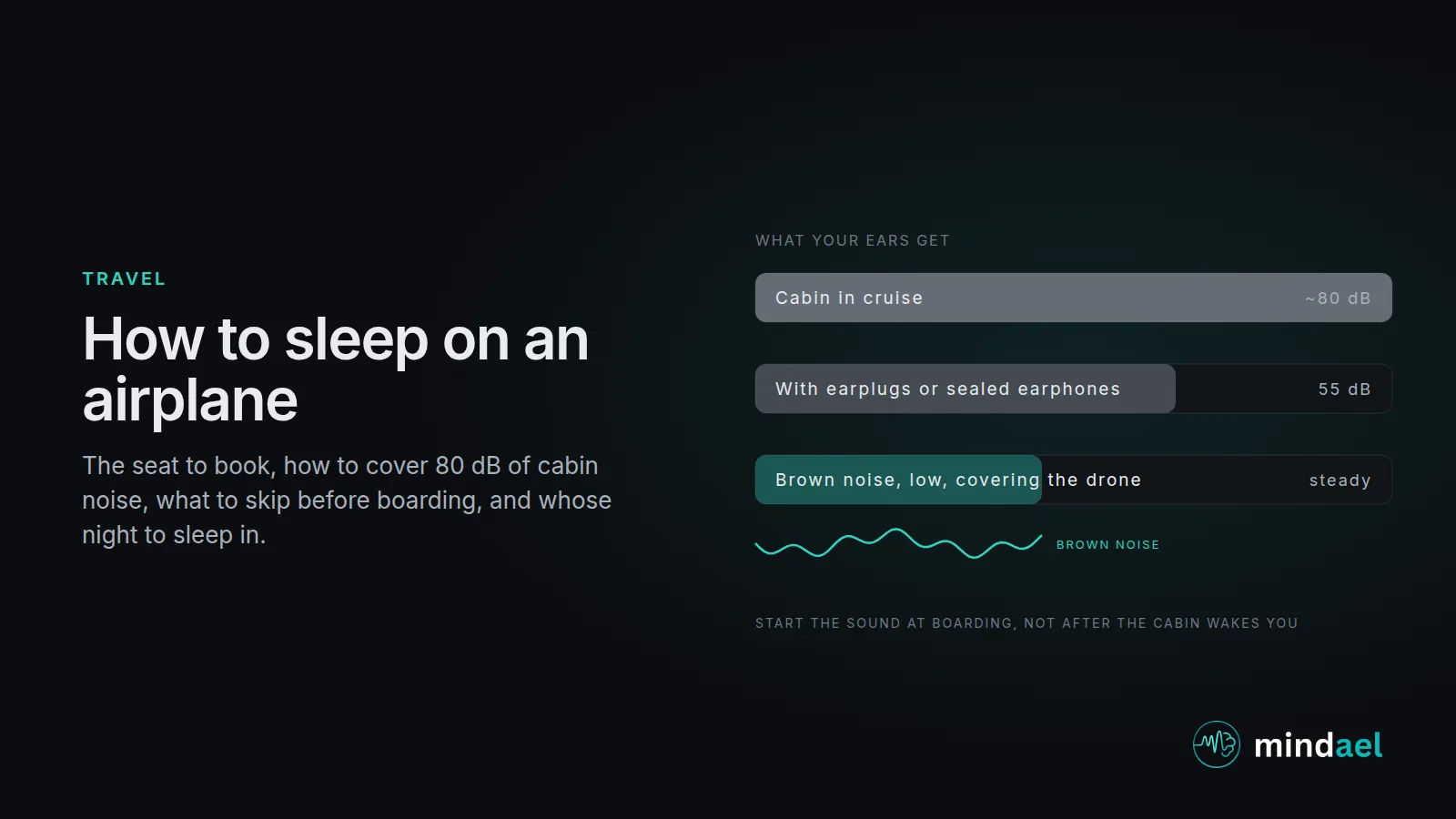
How to sleep on an airplane, or on any plane where the seat does not lie flat, is mostly a question of what you do before the seatbelt sign goes off: which seat you booked, what you drank, what you brought to put in your ears and over your eyes, and whose night you decided to sleep in. The cabin is loud, bright, dry and upright, and nothing about it wants you asleep. This article goes through each of those, with the research where it exists, and then the sound side, which is what we built Mindael for: every sound is on the phone, free to download, and plays in flight mode. If the real question is how long to nap once you land, our naps and jet lag guide is the companion to this one.
Why planes are hard to sleep on
Four things, and they stack. Noise. A study that measured 200 flights found cabin noise in cruise averaging around 80 dB, with peaks over 100 dB during take-off and climb (Zevitas et al., 2018). Eighty decibels is a busy restaurant, and noise at that level does not just make sleep harder to find; it makes the sleep you get lighter and more broken (Basner et al., 2014). Light. Cabin lights, screens, a neighbour’s window. Posture. A head that is not supported falls, and every fall is a micro-wake. The air. Cabin pressure is set to roughly 2,000 metres of altitude and the humidity is desert-dry, which is why you wake with a headache and a throat like paper.
Each has a fix, and learning to sleep on a plane is mostly learning the four fixes in order. Taken together they turn a flight from six hours of dozing into four hours of real sleep, which is the difference between arriving and arriving wrecked.
Book the seat before you think about anything else
A window seat, so you have a wall to lean on and no one climbs over you. Forward of the engines if you can, because the noise is lower there, and away from the galleys and lavatories, which are lit all night and have a queue. Avoid the last row, where the recline is often blocked, and the bulkhead, where the armrests do not lift and the bassinets are. On an overnight flight, this choice is worth more than any other on this page, and it costs nothing but booking early.
Cover the noise
You cannot make a cabin quiet. You can change what your ears are listening to. Foam earplugs or sealed in-ear headphones take off 20 to 30 dB on their own, which brings the cabin down from a restaurant to a quiet office. The second step is what plays through the headphones.
The engine drone is mostly low-frequency, a deep rumble that rises and falls as the aircraft climbs and turns. Brown noise lives in the same low frequencies, so at a modest volume it covers the drone with a sound that is steady, unchanging and has nothing in it to listen for. That is the whole trick: a steady broadband sound shortened the time it took adults to fall asleep in a noisy environment by about 38 percent in a 2017 study (Messineo et al., 2017), and a cabin is the noisy environment. Keep the volume low, around the level at which you could still hear a cabin announcement if you concentrated; the sealed earphones do the blocking, the sound only has to cover what gets through. Pink noise or rain are the choices for people who find brown too deep, and our noise colors guide explains the difference.
Two practical points. Start the sound before you want to sleep, at boarding, so the cabin never gets to wake you in the first place. And make sure the sound is on the phone, not streamed: flight mode and in-flight Wi-Fi are not where you want to find out your app needs a connection. Everything in Mindael plays offline with the screen locked, for that reason.
Light and posture
An eye mask, a proper one that does not press on the eyes. Recline as far as the seat allows the moment the meal service is over, and if you have a neck pillow, try it with the thick part under the chin rather than behind the neck; it stops the head falling forward, which is the fall that wakes you. Feet on your bag if you are short, shoes loosened, a layer for the cold hour over the ocean. Seatbelt fastened over the blanket, so no one wakes you to check.
What to skip before boarding
Alcohol. It brings sleep on faster and then takes it apart: the second half of the night is more fragmented, with less dream sleep (Ebrahim et al., 2013). At altitude, in dry air, the dehydration on top makes the landing worse still. Water instead, more than feels necessary.
Caffeine within six hours. A dose of caffeine taken even six hours before bed cut measured sleep by about an hour in a 2013 study, and the people did not notice the loss (Drake et al., 2013). Last coffee at the airport only if the flight’s sleep window is far off.
The big meal. The airline will serve one whatever time your body thinks it is. If you are planning to sleep straight after take-off, eat before boarding and wave the tray away.
Sleep in the destination’s night
This is the part that decides whether the flight helps or hurts the days after. Set your watch to destination time as you board and treat the flight as a night or a day according to that clock. Flying east, the destination’s night usually starts soon after take-off, so sleep early in the flight and stay awake once it is morning there. Flying west, stay up, sleep late, and wake near the destination’s morning. Light does the rest: after an eastward flight, get morning light at the destination; after a westward one, evening light; and avoid light at the wrong time, which pushes the clock the wrong way (Eastman and Burgess, 2009).
If you cannot fall asleep in the window, do not fight it with alcohol or a sleeping tablet you have not tried before. Mask on, sound on, slow breathing from our breathing guide, four in and six out, and lie still. Resting in the dark for two hours is worth more than it feels, and it keeps the clock pointed the right way. On arrival, keep any nap to 20 minutes and go to bed at local bedtime; the naps and jet lag guide has the lengths and the reasons.
The short version
Window seat, forward, away from the galley. Earplugs or sealed earphones, brown noise at a low level, started at boarding. Eye mask, recline, chin supported. Water, no alcohol, no late coffee. Sleep in the destination’s night, and get the right light when you land. The sound setup for night sleep at home is in our sleep sounds guide, and the best sleep app checklist covers what an app needs to do at 11,000 metres, which starts with working offline.
Sound that flies with you.
Every sound in Mindael is on the phone, so brown noise, rain and a delta beat play in flight mode at 11,000 metres with no signal. Made in our studio, with a timer that fades at the length you set. Free to download, no account, and it works where nothing else does.
- Brown noise, pink noise, rain and delta waves, studio-made
- Plays offline, in flight mode, with the screen locked
- Free to download, no account
 Free · No account needed · Works offline
 Frequently asked questions
What is the best way to sleep on an airplane?
Window seat away from the galley and toilets, eye mask, earplugs or in-ear headphones with brown noise at a low level, a neck pillow that holds the chin up, no alcohol, and sleep timed to the destination's night. Start the sound before you want to sleep, not after the cabin wakes you.
How do you sleep on a plane if you never can?
Build the conditions instead of waiting for sleep: book the window, start brown noise at a low level at boarding, mask on, chin supported, no alcohol, and breathe four seconds in and six out with your eyes closed. Most people who 'cannot sleep on a plane' are fighting noise and light they never covered. Resting in the dark still counts if sleep does not come.
Which seat is best for sleeping on a plane?
A window seat: you have the wall to lean on and nobody climbs over you. Choose a row forward of the engines and away from the galley and lavatories, which are the noisiest and brightest parts of the cabin. Avoid the last rows, where seats often recline less.
How loud is an airplane cabin?
Around 80 dB on average in cruise, measured across hundreds of flights, with peaks above 100 dB on take-off. That is loud enough to make sleep lighter and, over long exposure, is treated as a health exposure in its own right. Earplugs or sealed in-ear headphones take off 20 to 30 dB.
What sounds help you sleep on a plane?
Brown noise is the natural fit: it sits in the same low frequencies as the engine drone, so it covers it rather than fighting it, and at a low volume it is far more restful than the engine itself. Pink noise or rain work for people who find brown too deep. Play them from the phone in flight mode.
Should I drink alcohol to sleep on a flight?
No. Alcohol makes falling asleep faster but fragments the second half of sleep and reduces dream sleep, and a cabin's low humidity and pressure make the dehydration worse. Water, then the sound.
When should I sleep on a long flight?
During the night at your destination. Flying east, that usually means sleeping early in the flight; flying west, staying awake longer and sleeping late. Set your watch to local time at boarding and follow it. On arrival, keep any nap to 20 minutes and go to bed at local bedtime.
Sources
- Zevitas CD, et al. Assessment of noise in the airplane cabin environment. Journal of Exposure Science and Environmental Epidemiology, 2018.
- Basner M, et al. Auditory and non-auditory effects of noise on health. The Lancet, 2014.
- Messineo L, et al. Broadband sound administration improves sleep onset latency in healthy subjects in a model of transient insomnia. Frontiers in Neurology, 2017.
- Ebrahim IO, et al. Alcohol and sleep I: effects on normal sleep. Alcoholism: Clinical and Experimental Research, 2013.
- Drake C, et al. Caffeine effects on sleep taken 0, 3, or 6 hours before going to bed. Journal of Clinical Sleep Medicine, 2013.
- Eastman CI, Burgess HJ. How to travel the world without jet lag. Sleep Medicine Clinics, 2009.
This article is for general information and is not medical advice. If you have a sleep disorder, a heart or lung condition, or take medication that affects sleep, please ask your doctor before changing your routine for travel.
This article is part of our travel, jet lag and naps guide. Hear the sounds in this article in the Mindael sound library, or see our app comparison checklists.