

Alarm on My Phone: How to Set One That Wakes You Up Well, and Why the Usual One Leaves You Groggy
The alarm on your phone is the loudest thing that happens to your brain all day, and it goes off at the moment the brain is least able to deal with it. This page covers the practical part, how to set and check an alarm on an iPhone or an Android phone so it actually fires, and the part nobody explains: why you wake up groggy, which alarm sounds the research says cut that grogginess, what snoozing does, and the three changes that make mornings easier within a week. The sleep sounds and the morning sounds here are in Mindael, free to download on the App Store.
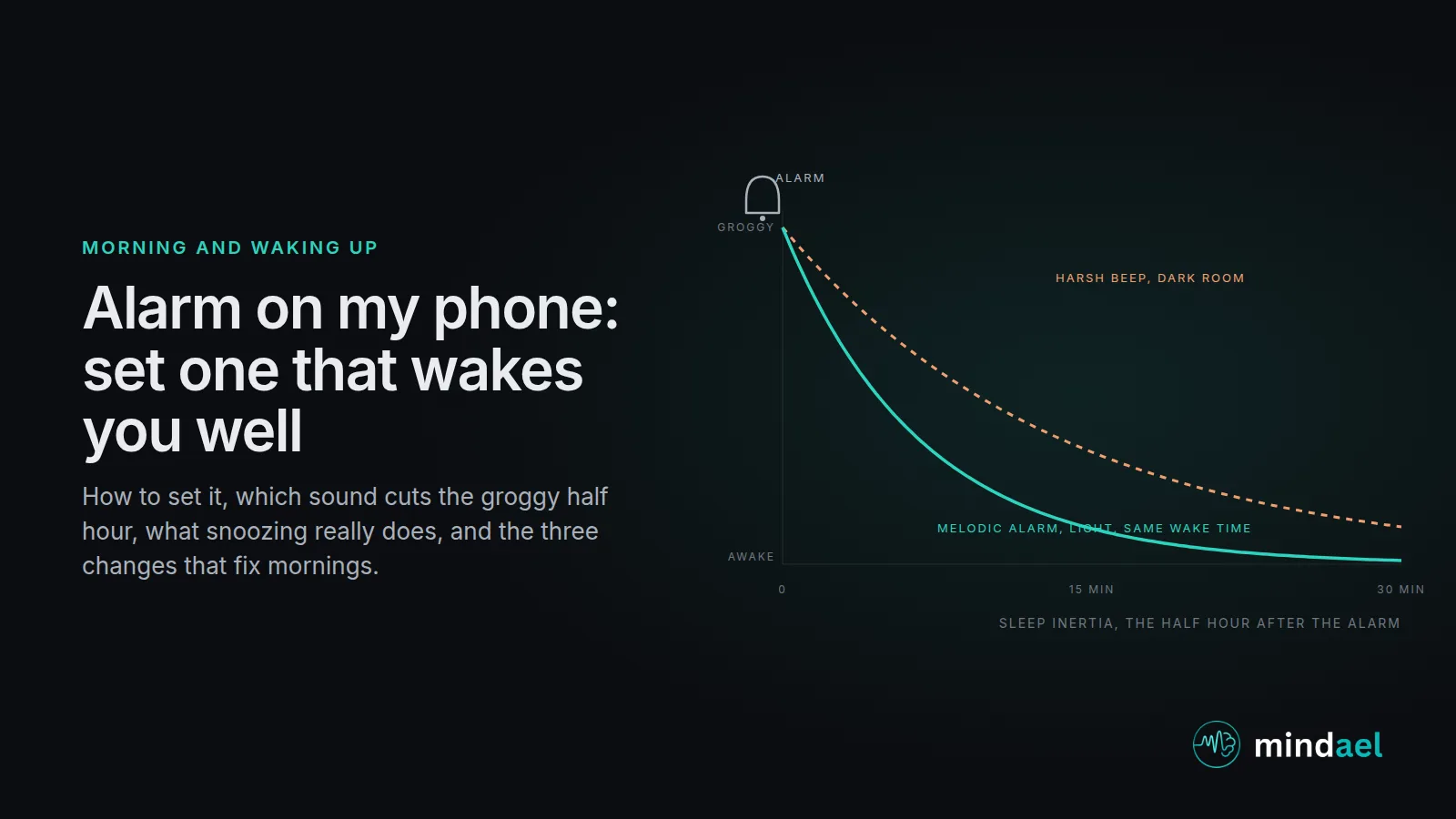
To set an alarm on your phone: Clock app, Alarm tab, plus, pick the time, choose a sound, decide on snooze, save, and check the ringer volume and that Do Not Disturb or Focus allows alarms (it does by default). To wake up well: a melodic alarm rather than a harsh beep, because a 2020 study found melodic alarms were linked to less sleep inertia; the same wake time every day, including weekends, which does more than any sound; light within minutes of waking; and a sleep setup that gets you enough hours, since grogginess is mostly a sign of short or interrupted sleep. Snoozing for up to 30 minutes did not harm sleep or cognition in a 2023 trial, so one snooze is fine; six is a symptom.
Sounds that work, and why
Delta waves
A slow binaural beat, with earbuds, for the first hour of the night. The best alarm setup starts with enough deep sleep; grogginess is mostly a shortage of it.
Brown noise
The all-night floor. It covers the noises that fragment sleep before the alarm, which is where a lot of morning grogginess actually comes from.
Rain
For the wind-down and for falling back asleep after an early wake. Soft enough to leave on under a fading timer.
Alpha waves
A 10 Hz beat for the first half hour after waking, with coffee and light: relaxed but awake, the state sleep inertia is slow to reach on its own.
Beta waves
Once you are at the desk, a faster beat for the first task of the day. Keep it for work, not for breakfast.
Why the alarm leaves you groggy
The fifteen to thirty minutes after an alarm have a name, sleep inertia, and a literature. In that window reaction time, memory and judgement are measurably worse than at any other point in the day, including the end of a long shift, and the brain’s blood flow and electrical activity are still part-way between sleep and waking (Hilditch & McHill, 2019). It is worse when the alarm lands in deep sleep, worse after short sleep, and worse in the body clock’s night, which for most people stretches until a couple of hours after dawn. Some people have it badly enough that it has its own clinical name, sleep drunkenness, and it runs in families (Trotti, 2017).
So the groggy feeling is not weakness and not fixed by a louder alarm. It is shortened by three things: enough sleep so the alarm is not cutting deep sleep short, light and movement immediately after waking, and, the evidence suggests, the kind of sound that wakes you. The night half of that lives in our sleep sounds guide; the morning half is below.
Which alarm sound to use
In a 2020 study, researchers asked people what sound woke them and how groggy they felt afterwards. The people who woke to melodic alarms, sounds with a tune, reported less sleep inertia than the people woken by harsh, beeping ones, and the authors suggested that a melody gives the waking brain something to organise around, where a beep is just an interruption (McFarlane et al., 2020). It is self-report, not a lab trial, but it is consistent with what most people notice: a radar siren at 6 am feels like an attack, a tune feels like a cue.
Practically: choose one of the melodic alarms your phone already has, a mid-pitch sound rather than a shrill one, and a volume that starts low and rises if the phone allows it. Change the sound every month or two, because any alarm sound becomes hated, and hated sounds wake you with a spike of stress rather than a gentle one. A steady sound at night, brown noise or rain, makes the alarm’s job easier too, because sleep that was not fragmented by the neighbours ends more cleanly; the noise colours article explains which to pick.
Wake time, light and the body clock
The single most effective change for mornings has nothing to do with the alarm. It is waking at the same time every day. The body clock sets tomorrow’s sleepiness partly from when you woke today, and a weekend lie-in of two hours shifts it as if you had flown two time zones west, which is why Monday mornings are the worst of the week; researchers call it social jetlag (Wittmann et al., 2006). Pick the earliest wake time your week needs, keep it seven days, and move bedtime to match.
Then light. In a 2013 study, a week of camping with no electric light moved people’s internal clocks about two hours earlier and lined up their melatonin rhythm with sunrise and sunset (Wright et al., 2013). You do not need the tent: bright light in the first ten minutes after the alarm, from a window, a walk or the brightest lamps in the house, tells the clock the day has started, shortens sleep inertia, and makes falling asleep easier the next night. The naps and jet lag guide covers what to do when the clock has been moved on purpose.
Snoozing, honestly
The usual advice is that snoozing is a disaster. The research is kinder. In a 2023 study, habitual snoozers who were allowed 30 minutes of snoozing did not have worse sleep, higher cortisol or lower mood than when they had to get up at the first alarm, and they did slightly better on cognitive tests just after rising, probably because the extra minutes of light sleep eased the transition (Sundelin et al., 2023). A single snooze, then, costs nothing worth worrying about.
What snoozing six times tells you is that the alarm is set earlier than your sleep allows. Fix that from the other end: earlier bedtime, a steady sound to protect the hours you have, and the alarm becomes a formality. If the first task of the day is one you have to think for, a 10 Hz alpha beat with coffee and light for the first half hour, then a faster beat at the desk, is how we would run it; the focus guide has the rest.
When mornings need more than an alarm
If you are groggy for more than an hour most days despite seven or more hours in bed, if you fall asleep in the afternoon without meaning to, or if someone has heard you snore and stop breathing, the alarm is not the problem. Those are worth a conversation with a doctor, because untreated sleep apnoea and some sleep disorders look exactly like “bad at mornings”. The same is true of a wake time that leaves you with five hours of sleep: no sound fixes that, and the sleep sounds guide is where to start on the night instead.
How to set it up tonight
- Set it in the Clock app, and check three thingsOn an iPhone: Clock, Alarm, plus, set the time, choose Sound, decide whether Snooze is on, Save. On Android: Clock, Alarm, plus, time, sound, save. Then check the ringer volume (alarms use it, not the media volume, on most phones), that the alarm shows as enabled in the list, and that Do Not Disturb or a Focus mode is not silencing it; by default both let alarms through, but check once.
- Choose a melodic sound, not a beepPick an alarm with a tune, in the middle of the pitch range, that rises rather than slams: most phones ship several. In a 2020 study of self-reported waking experiences, people who woke to melodic alarms reported less grogginess than those woken by harsh beeping, and the authors suggest the melody helps the brain make the transition. Set the volume to start low and rise if your phone offers it.
- Same wake time, seven days a weekThis is the change that does the most. A regular wake time anchors the body clock; a weekend lie-in of two hours is a small jet lag every Monday. Pick the earliest time you need in the week and keep it, and let bedtime move instead.
- Light in the first ten minutesOpen the blinds, go outside, or turn on the brightest lights you have. Morning light is the strongest signal the body clock gets, it shortens sleep inertia, and it moves tomorrow's sleepiness earlier so the next night is easier.
- One snooze, then feet on the floorA 2023 trial found that people who snoozed for 30 minutes were not worse off in sleep quality, cortisol or cognitive tests than those who got up at once, and some were slightly sharper. So a single snooze is fine. Serial snoozing is a sign the alarm is set earlier than your sleep allows; fix the night rather than the morning.
- Fix the night that makes the morningGrogginess that lasts past half an hour is almost always short or broken sleep. Same bedtime, a steady sound to cover the house, screens off, and enough hours that the alarm is a formality. The sleep sounds guide has the full setup.
The night that makes the morning.
Mindael has brown noise, rain and delta beats made in our studio for the night, alpha beats for the first half hour of the day, and a timer that fades the sound out while you fall asleep. Free to download, no account, works offline. Set the phone alarm, set the sound, and let the night do the work.
- Brown noise, rain, delta and alpha beats, studio-made
- A timer that fades the sound out at night
- Free to download, no account, works offline
 Free · No account needed · Works offline
 Frequently asked questions
How do I set the alarm on my phone?
Open the Clock app, go to the Alarm tab, tap the plus, set the time, choose a sound, switch snooze on or off, and save. Make sure the alarm is toggled on in the list and the ringer volume is up. On iPhone you can also ask Siri 'set an alarm for 6:30'; on Android, Google Assistant does the same.
Why did my alarm not go off?
The usual causes: the alarm was set for PM instead of AM, it was set for one day only, the phone was on silent with alarm volume low (on some Android phones alarm volume is separate from the ringer), the phone was off or had died overnight, or a Do Not Disturb schedule was customised to block alarms. Check the alarm list, the volume sliders in Settings, and charge the phone at the bed.
Will my alarm go off on Do Not Disturb or in a Focus mode?
Yes, by default. Both iPhone Focus modes and Android Do Not Disturb let alarms sound even though calls and notifications are silenced. If someone has customised the mode to block alarms, it will not, so test it once with an alarm two minutes ahead.
Will my alarm go off if my phone is on silent?
On an iPhone, yes: the silent switch mutes calls and notifications but not alarms. On most Android phones, yes too, because alarms have their own volume; check the alarm volume slider under Sound settings, since if it is at zero the alarm will vibrate but not ring.
What is the best alarm sound to wake up to?
A melodic one, with a tune you can hum, at a moderate pitch, that starts quiet and gets louder. In a 2020 study, melodic alarms were associated with less sleep inertia than harsh, beeping ones. The classic radar and siren sounds are the ones to avoid. If you can, wake to a sound you like: you will hate anything within a month, so change it occasionally.
Why do I feel so groggy when my alarm goes off?
Sleep inertia: for the first 15 to 30 minutes after waking, the brain is not fully switched on, reaction time and judgement are poor, and it is worse if the alarm fires during deep sleep or after too little sleep. Light, movement, a drink of water and a melodic alarm shorten it. Grogginess that regularly lasts past an hour is worth mentioning to a doctor.
Is it bad to snooze your alarm?
Not as bad as the advice suggests. A 2023 study of habitual snoozers found that 30 minutes of snoozing did not worsen sleep quality, cortisol or mood and slightly improved performance on cognitive tests compared with getting up at the first alarm. The real problem is the pattern behind heavy snoozing: an alarm set earlier than your sleep allows.
Should I wake up at the end of a sleep cycle?
Only loosely. Sleep cycles average about 90 minutes but vary from person to person and across the night, so no app can reliably time your alarm to the end of one. What works is a fixed wake time and enough sleep, so the alarm usually lands in lighter sleep by itself.
Sources
- Hilditch CJ, McHill AW. Sleep inertia: current insights. Nature and Science of Sleep, 2019.
- Trotti LM. Waking up is the hardest thing I do all day: sleep inertia and sleep drunkenness. Sleep Medicine Reviews, 2017.
- McFarlane SJ, et al. Alarm tones, music and their elements: analysis of reported waking sounds to counteract sleep inertia. PLOS ONE, 2020.
- Sundelin T, et al. Is snoozing losing? Why intermittent morning alarms are used and how they affect sleep, cognition, cortisol, and mood. Journal of Sleep Research, 2023.
- Wright KP, et al. Entrainment of the human circadian clock to the natural light-dark cycle. Current Biology, 2013.
- Wittmann M, et al. Social jetlag: misalignment of biological and social time. Chronobiology International, 2006.
This page is for general information and is not medical advice. Grogginess that lasts more than an hour most mornings, falling asleep during the day, or loud snoring with pauses in breathing are worth discussing with a doctor.