

Beta Binaural Beats (13 to 30 Hz): The Alert, Working Rhythm
Binaural beat, 13 to 30 Hz difference (15 and 20 Hz in the app)
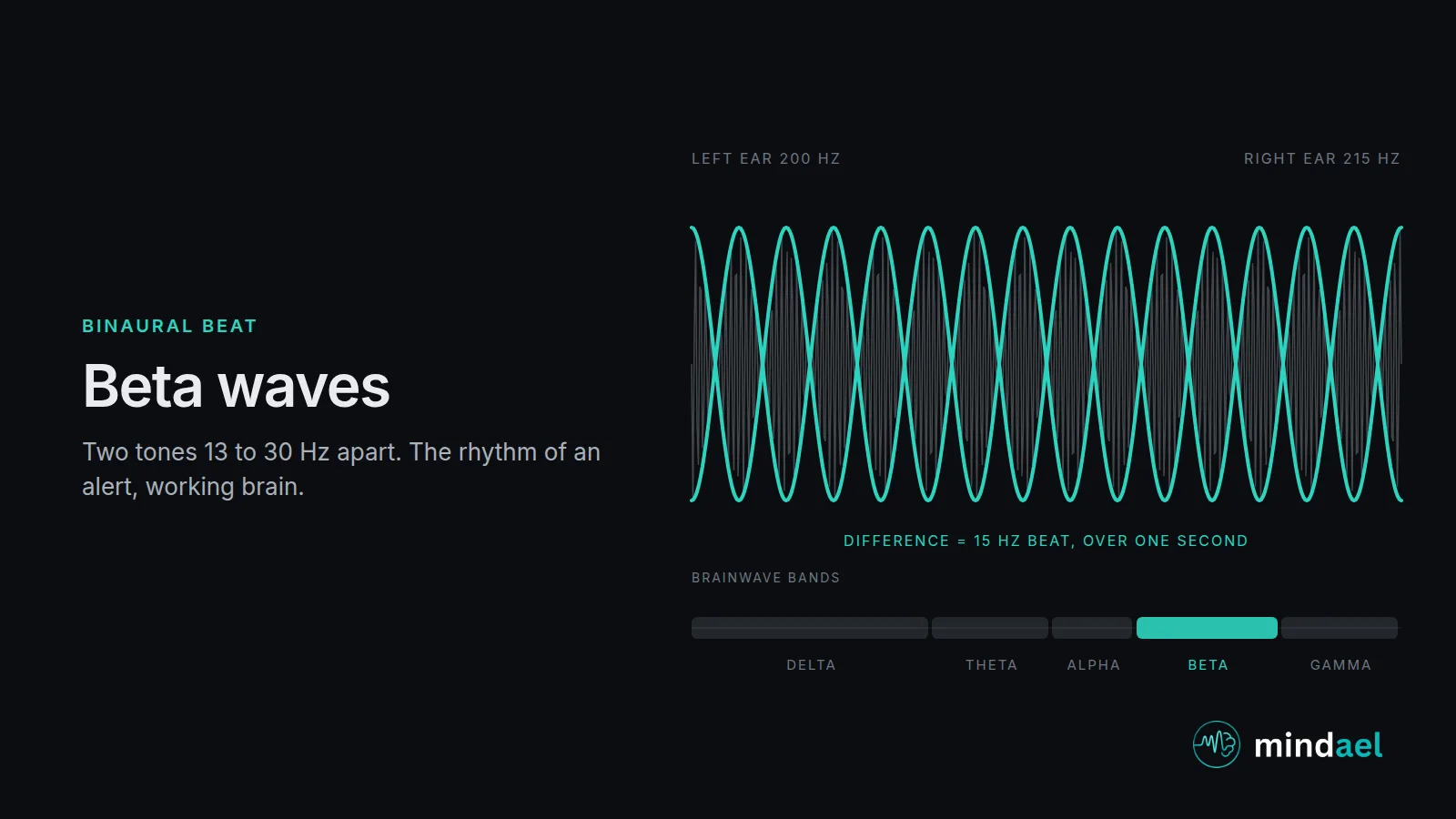
Beta is the 13 to 30 Hz band, the rhythm of a brain that is awake, alert and working. A beta binaural beat is the one with the clearest attention research: in a controlled study, beta beats improved target detection and mood during a 30 minute vigilance task compared with theta and delta. It is the beat for a deadline, under brown noise, in blocks.
Choosing an app? See what the best binaural beats app needs, or browse the full sound library.
What a beta beat is
Beta, 13 to 30 Hz, is the rhythm of an engaged, working brain: reading closely, checking numbers, solving. A beta binaural beat gives the brain that rate to follow, from two carrier tones 15 or 20 Hz apart, one per ear. In Mindael both are generated over a clean carrier so the pulse is the only thing you notice.
What the research shows
Beta is the band with the clearest attention evidence. In a 1998 controlled study, participants performed a 30 minute vigilance task while listening to binaural beats hidden in pink noise. With beta beats they detected more targets and missed fewer than with theta or delta beats, and they reported better mood (Lane et al., 1998). Pooling 22 studies, a 2019 meta-analysis found a reliable medium-sized effect of binaural beats on attention and memory, larger with longer sessions (Garcia-Argibay et al., 2019).
How to listen
Earbuds, 15 Hz, brown noise over it at about twice its volume so the tone sits in the background. Twenty-five to forty-five minutes, then off; the break with the sound off makes the next block’s start signal stronger. For the one hour that needs fast recall or hard reasoning, step up to gamma 40 Hz. For everything long and steady, brown noise alone. Our focus sounds page matches each kind of work to a sound.
All five bands and what each is for are in our guide to binaural beats.
The deadline setting, under brown noise.
A beta beat under brown noise for one 25 minute block is the sharpest focus mix we know, and the one with research behind it. Mindael has beta at 15 and 20 Hz with a clean carrier, brown noise measured to spec, and a timer that ends the block for you. Earbuds in, press play, and go.
- Beta 15 and 20 Hz beats with a clean carrier
- Layer under studio-measured brown noise
- Timer for 25 minute blocks, works offline
 Free · No account needed · Works offline
 Frequently asked questions
Do beta binaural beats help with focus?
In a 1998 controlled study, participants doing a 30 minute vigilance task with beta beats hidden in pink noise detected more targets, missed fewer, and reported better mood than with theta or delta beats. A 2019 meta-analysis found a reliable effect of binaural beats on attention across 22 studies.
15 Hz or 20 Hz?
Start at 15 Hz. It is alert without being edgy. 20 Hz is for the hour that needs more drive, and some people find it tiring beyond 30 minutes.
How long should a beta session be?
Twenty-five to forty-five minutes, then off. Beta is a tool for a block, not a sound for the whole day; for long steady work, brown noise alone is easier to live with.
Do I need headphones?
Yes. Through a speaker the two tones mix in the air and there is no beat.
Sources
- Lane JD, Kasian SJ, Owens JE, Marsh GR. Binaural auditory beats affect vigilance performance and mood. Physiology & Behavior, 1998.
- Garcia-Argibay M, Santed MA, Reales JM. Efficacy of binaural auditory beats in cognition, anxiety, and pain perception: a meta-analysis. Psychological Research, 2019.
This page is for general information and is not medical advice.