

Calming Music for Anxiety: What to Play, How to Breathe and How to Come Down from a Spike
Anxiety is a body in gear with nowhere to go, and the fastest ways down work on the body rather than the thoughts: a steady sound in the ears, a slower breath, a few minutes of both. This page covers what the research actually shows about calming music and sound for anxiety, which sounds to choose for a spike, an anxious evening or a panic attack, and the breathing that turns the sound into a routine. Every sound here is in Mindael, free to download on the App Store, with guided breathing that runs on top of it.
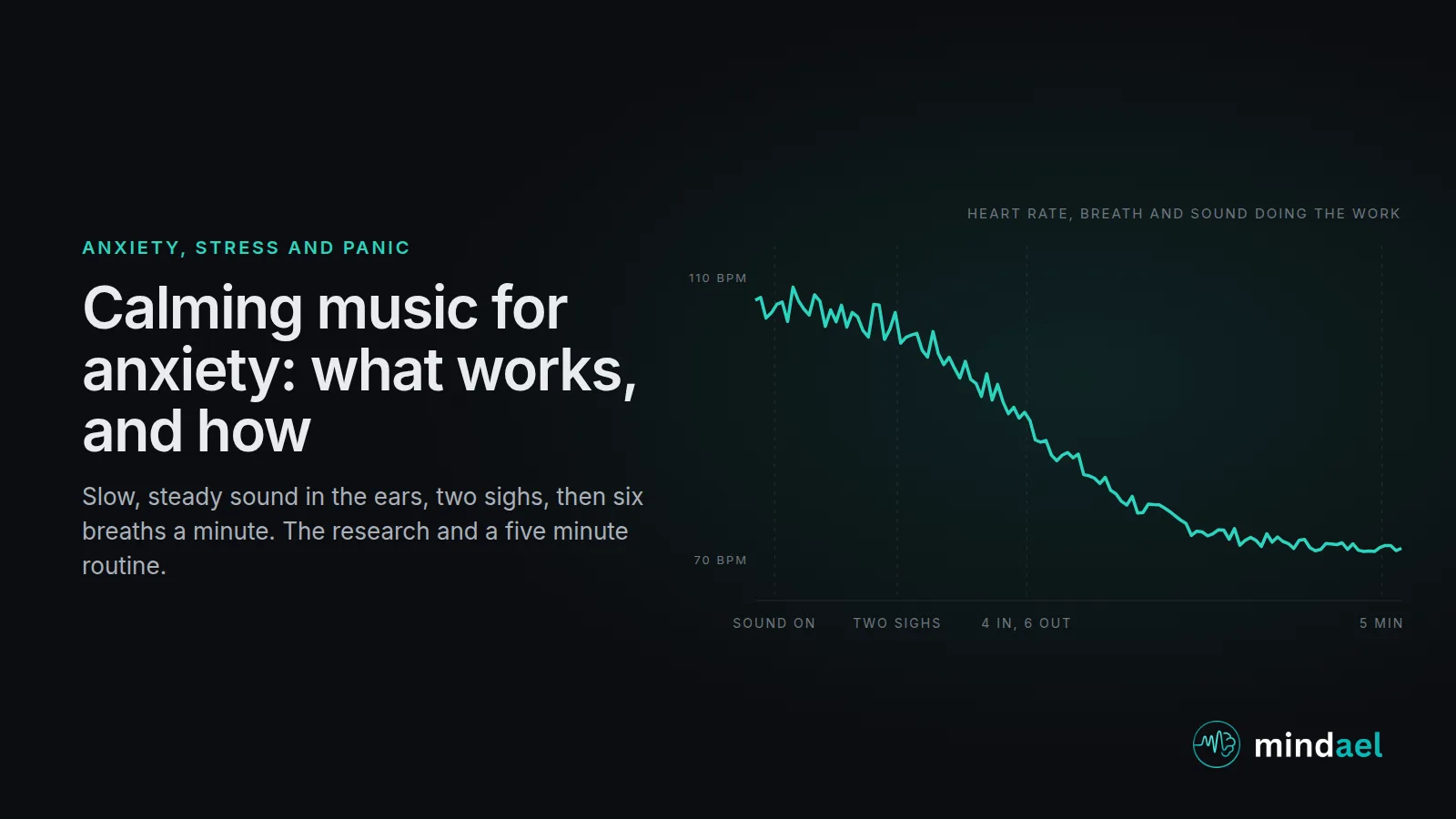
Calming music for anxiety works best when it is slow, steady and without words: around 60 beats a minute or no beat at all, low in the ears, and the same sound each time so it becomes a cue. The research finds music and steady sound lower cortisol, heart rate and reported anxiety, with the largest effects before stressful events such as surgery. For a spike, pair the sound with the physiological sigh and then four-in, six-out breathing for five minutes. For panic, the same breath, a steady sound, and a hand on something cold, with a doctor for anything that keeps coming back.
Sounds that work, and why
Rain
The sound most of our listeners reach for in a spike. Texture without words or rhythm, so there is nothing to follow and nothing to brace for. Recorded, not looped.
Brown noise
Deep, flat and featureless. It covers a loud room or a loud head and gives the ear nothing to track. The choice when even rain feels like too much happening.
Alpha waves
A 10 Hz binaural beat with earbuds, for the slow comedown after the spike has passed. The brain state it targets is calm, awake attention, which is where you want to land.
396 Hz
A low, steady tone for an anxious evening. We make no claims beyond what it is: a single pitch with nothing to anticipate, which some people find easier to breathe to than noise.
Ocean waves
Waves have a rhythm close to a slow breath, about six a minute at a calm beach. Breathe in on the draw and out on the break and the pacing takes care of itself.
What anxiety is doing to the body
Anxiety is the stress response running without a finish line. The heart speeds up, breathing goes shallow and high in the chest, muscles brace, attention narrows to threat, and because nothing arrives to use all that readiness, it sits there and hums. That is why advice to “think positive” fails in the moment: the thoughts are downstream of the body. The things that work fast work on the body, and sound and breath are the two you can change in seconds, anywhere, with no one noticing.
What the research says about music and anxiety
The evidence for music and sound against stress is broader than most people expect and more modest than the marketing. A 2020 systematic review pooled 104 studies and found that music interventions lowered stress-related outcomes with a medium-sized effect, both on physiological measures such as heart rate and cortisol and on self-reported stress and anxiety (de Witte et al., 2020). The clearest single setting is before surgery: a Cochrane review of 26 trials found that listening to music before an operation reduced anxiety reliably, by an amount comparable to a sedative in the trials that compared the two (Bradt et al., 2013).
Why it works is partly physiology. In a 2013 experiment, people who listened to relaxing music before a lab stress test showed a faster recovery of their stress response afterwards than people who sat in silence or listened to rippling water (Thoma et al., 2013). Music engages the same reward and arousal circuits that stress runs on, and slow, predictable sound pushes them the other way (Chanda and Levitin, 2013). Our relaxing sounds guide covers the research on sound and the stressed body in more depth.
Two things in that research matter for choosing what to play. The music that worked was slow, steady and predictable. And the effect was on recovery and on the run-up to stress more than on the peak itself, which is why the routine below puts sound on first and keeps it on after.
What to play
For a spike. Rain or brown noise, in earbuds, at the level of a quiet conversation. Nothing with words, nothing with a melody you will follow, nothing that changes. The point of the sound is to be a floor: steady enough that the ear stops checking it and the breath has something to lean on.
For an anxious evening. Rain or ocean at a low level for an hour, with the guided breathing for the first ten minutes and a timer that fades. Ocean has a bonus: calm waves break at roughly the rate of a slow breath, so breathing in on the draw and out on the break paces you without counting.
For the comedown. An alpha beat with earbuds once the spike has passed. A 2019 meta-analysis found a small overall effect of binaural beats on anxiety, larger with longer sessions (Garcia-Argibay et al., 2019). Not the first tool in a spike, but a good one for the twenty minutes after, and our binaural beats guide explains how to use them.
For a nervous system that will not stand down. Cold water on the face, a hum on the exhale, ocean to breathe with; the calm your nervous system article has the five-minute order.
For the headache that follows a tense day. Pink noise or rain, low, a dark room and water first; the stress headache guide has the rest.
For sleep on an anxious night. Brown noise or rain, the 4-7-8 pattern for four rounds, and the full setup in our sleep sounds guide.
What not to play: anything with lyrics, anything you love, anything fast. Songs you love pull attention toward the song, which is fine for a walk and wrong for a spike. “Calming music for anxiety” playlists full of slow piano can work, and many people like them; if the melody keeps your mind busy, switch to rain.
The five-minute routine
Sound on. Then two physiological sighs: a full breath in through the nose, a second short sip on top, and a long slow exhale through the mouth. In a 2023 randomised trial at Stanford, five minutes a day of this pattern produced the largest improvement in mood and the biggest drop in resting breathing rate of four practices, ahead of box breathing and mindfulness meditation (Balban et al., 2023). Then slow breathing for five minutes, four seconds in and six out through the nose, which lands near six breaths a minute; a 2018 systematic review found that rate consistently raises heart rate variability and lowers reported anxiety (Zaccaro et al., 2018). Our breathing guide teaches each pattern, and the abdominal breathing article explains why breathing low in the belly matters for all of them. The longer story of why a long exhale works, the vagus nerve and heart rate variability, is in our nervous system regulation guide.
While you breathe, cold on the hands or face, and one sentence that names the thing. The full set of in-the-moment tools, with the order to try them, is in our guide to how to calm down fast.
Panic attacks
A panic attack is the same response at full volume, arriving fast and peaking within about ten minutes. It feels like an emergency and is not one, and the single most useful thing to know is that it ends on its own whether or not you do anything. What helps it end sooner: slow the exhale rather than trying to get more air in, which is what the body is shouting for and the opposite of what it needs; a steady sound in the ears, which gives the senses one fixed thing; feet flat on the floor and a hand on something cold; and the sentence “this peaks and passes”. Do not run from the place you are in if you can help it, because leaving teaches the body that the place was the danger.
If panic attacks recur, talk to a doctor. Panic disorder is one of the most treatable conditions there is, and the breathing and sound on this page become far more effective once the treatment has taken the edge off.
Making it stick
The research on calming down in the long run points the same way as the research on calming down fast: practice when nothing is wrong. A 2010 meta-analysis of 39 studies found mindfulness-based therapy produced moderate, robust reductions in anxiety, and the practice at its core is the one in the routine above, attention on the breath, returning when it leaves (Hofmann et al., 2010). Ten minutes under the same sound every evening, with a fade, is enough to make the sound itself a cue. Our meditation guide has a sound-based version, and the sounds for ADHD guide covers the overlap between a racing mind and an anxious one. When nerves are about a specific event, an exam, an interview, a stage, our guide to how to calm nerves adds the tools that are specific to performance.
How to set it up tonight
- Start the sound before anything elseEarbuds in, rain or brown noise at the level of a quiet conversation. The sound is the floor you stand on for the next five minutes; it goes on first and stays on.
- Two sighsBreathe in through the nose, then a second shorter sip on top, then a long slow exhale through the mouth. Twice. This is the physiological sigh, and it is the fastest thing on this page.
- Four in, six out, for five minutesThrough the nose, no holds, about six breaths a minute. Let the sound carry the count. In Mindael the guided breathing runs on top of the sound you chose.
- Give your hands somethingCold water on the wrists, a cold glass, or a hand flat on a wall. Cold on the face or hands slows the heart through the dive reflex; a surface gives attention somewhere to go.
- Name it in one sentenceSay what you are anxious about in one plain sentence, out loud or on paper. Anxiety grows in the vague; one sentence makes it a size you can look at.
- Make it a routine, not a rescueThe same sound and breath every evening for ten minutes, under rain with a timer that fades. After two weeks the sound starting is itself the signal to come down.
A sound to stand on.
Mindael has rain and ocean recorded without loops, brown noise made in our studio, alpha beats and low tones, with guided breathing that runs on top of whichever sound you choose and a timer that fades. Free to download, no account, works offline. Put it on before the spike peaks.
- Rain, ocean, brown noise, alpha beats and low tones, studio-made
- Guided slow breathing and 4-7-8 on top of the sound
- Free to download, no account, works offline
 Free · No account needed · Works offline
 Frequently asked questions
What is the best calming music for anxiety?
Slow, steady, without lyrics and without surprises: around 60 beats a minute or, better, no beat at all. Research finds that music lowers cortisol and reported anxiety, and the most reliable effects come from steady sound you are not analysing: rain, brown noise, ocean, or a single low tone. The best sound is the one you can stop listening to.
Does music actually help with anxiety?
Yes, modestly and reliably. A 2020 review of 104 studies found music interventions lowered stress-related outcomes with a medium effect, and a Cochrane review of 26 trials found music before surgery reduced anxiety by about the same amount as a sedative in some comparisons. The effect is on the body first: heart rate, breathing and cortisol.
How do I calm down anxiety fast?
Sound on, two physiological sighs, then four-in, six-out breathing for five minutes with cold water on your wrists. The sigh produced the largest mood improvement of four five-minute practices in a 2023 randomised trial, and slow breathing near six a minute is the pattern with the most evidence behind it.
How do I calm down an anxiety attack or panic attack?
Do not fight the breath; slow it. Long exhales through the mouth, a steady sound in the ears, feet flat on the floor, cold on the hands, and the sentence 'this peaks in a few minutes and passes'. Panic attacks are frightening and not dangerous, and they end on their own. If they recur, a doctor can help; panic disorder responds well to treatment.
Is white noise or brown noise better for anxiety?
Brown noise, for most people. White noise is bright and can feel sharp when you are already on edge; brown noise is deep and flat. Rain sits between the two and is the sound most of our anxious listeners settle on. Our noise colors guide explains the difference.
Do binaural beats help with anxiety?
The evidence is modest but positive: a 2019 meta-analysis found a small overall effect of binaural beats on anxiety, with longer sessions working better. Use an alpha beat with earbuds for the comedown after a spike, not as the first thing in the spike itself.
Can calming music replace treatment for anxiety?
No. Sound and breathing are tools for the next ten minutes, and they work. Anxiety that is there most days, stops you doing things, or brings panic attacks is worth talking to a doctor about, and therapy for anxiety has strong evidence. Use the tools here alongside that, not instead of it.
Sources
- de Witte M, et al. Effects of music interventions on stress-related outcomes: a systematic review and two meta-analyses. Health Psychology Review, 2020.
- Bradt J, Dileo C, Shim M. Music interventions for preoperative anxiety. Cochrane Database of Systematic Reviews, 2013.
- Thoma MV, et al. The effect of music on the human stress response. PLoS ONE, 2013.
- Chanda ML, Levitin DJ. The neurochemistry of music. Trends in Cognitive Sciences, 2013.
- Balban MY, et al. Brief structured respiration practices enhance mood and reduce physiological arousal. Cell Reports Medicine, 2023.
- Zaccaro A, et al. How breath-control can change your life: a systematic review on psycho-physiological correlates of slow breathing. Frontiers in Human Neuroscience, 2018.
- Garcia-Argibay M, Santed MA, Reales JM. Efficacy of binaural auditory beats in cognition, anxiety, and pain perception: a meta-analysis. Psychological Research, 2019.
- Hofmann SG, et al. The effect of mindfulness-based therapy on anxiety and depression: a meta-analytic review. Journal of Consulting and Clinical Psychology, 2010.
This page is for general information and is not medical advice. Anxiety that is present most days, limits what you do, or brings panic attacks deserves a doctor's attention; the tools here work alongside treatment, not instead of it. If you have thoughts of harming yourself, contact emergency services or a crisis line now.