

How to Calm Your Nervous System: What Works in Minutes, What Works in Weeks, and Why
To calm an overactive nervous system quickly, work on the body, not the thoughts: two physiological sighs, then four seconds in and six out for five minutes, cold water on the face, a low hum on the exhale, and a steady sound with no words. Each of those leans on the vagus nerve, the brake on the stress response, and together they bring heart rate down within minutes. To calm it for good, repeat the slow breathing daily, protect sleep, move every day and keep a steady sound in the evening; the baseline moves over weeks, not hours.
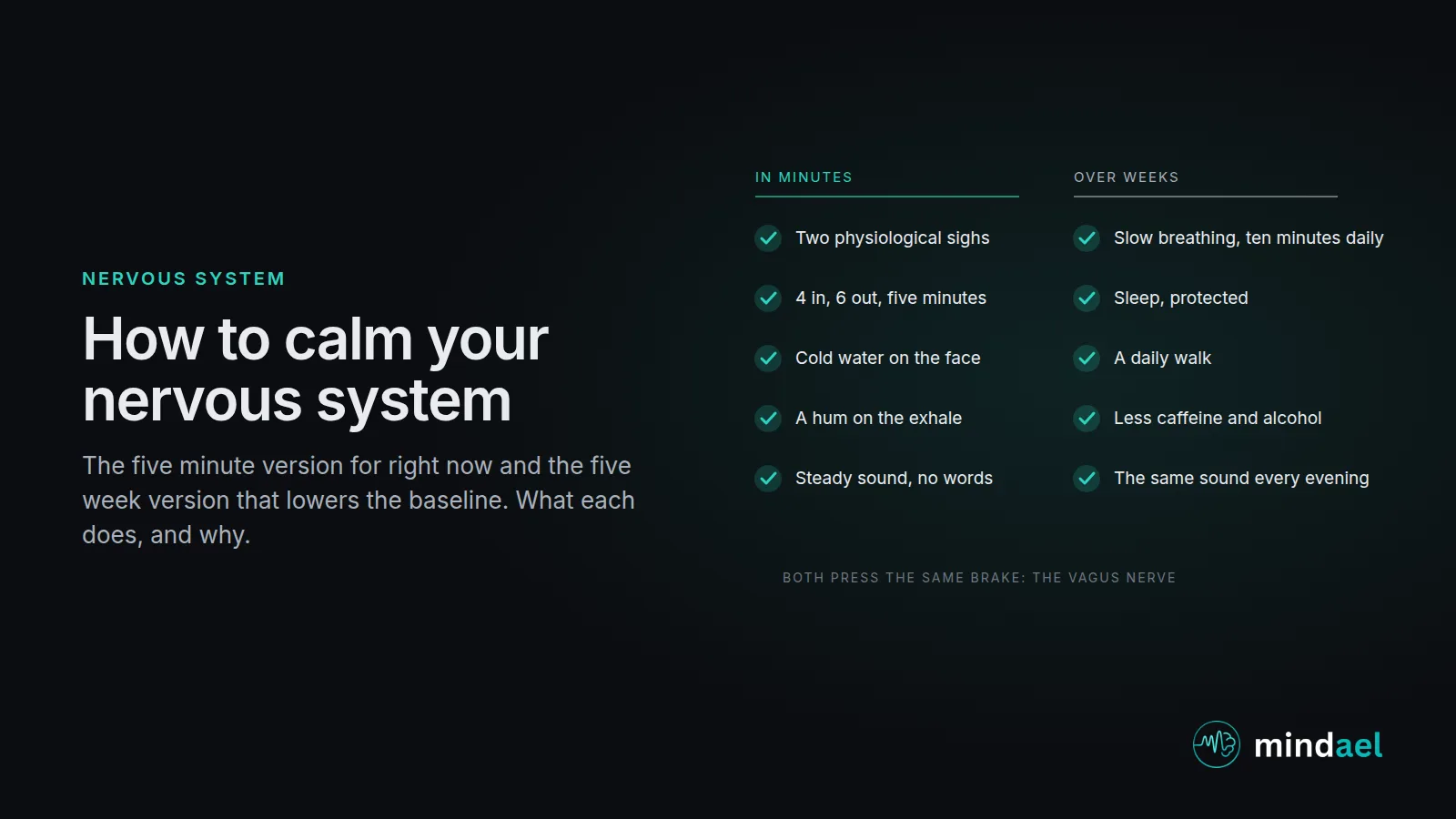
How to calm your nervous system has two answers, and most articles give only the first. There is the five-minute version, for the moment you notice your heart going, your breath high in the chest and your jaw set, and there is the five-week version, which lowers the level you return to so those moments come less often. Both work through the same piece of anatomy, the vagus nerve, which our nervous system regulation guide explains in full; this article is the practical half. The sounds and the guided breathing below are in Mindael, free to download on the App Store.
What “overactive” means
The autonomic nervous system has an accelerator, the sympathetic branch, and a brake, the parasympathetic branch, run largely by the vagus nerve. Both are always on; what changes is the balance. An “overactive sympathetic nervous system” is a system where the accelerator is held down for hours after the thing that pressed it is gone, and where the brake has got weak from not being used. You feel it as a heart that will not settle, breathing that stays shallow and quick, muscles braced, startle on a hair trigger, and sleep that will not come even when you are exhausted.
The brake can be measured, roughly, as heart rate variability: how much the gap between heartbeats changes with the breath. Higher variability means a stronger brake and a faster return to calm, and it tracks with better stress regulation in a large meta-analysis of brain imaging and heart studies (Thayer et al., 2012). Everything below is a way to press the brake harder in the moment, or to strengthen it over time.
Calming it in minutes
Two physiological sighs. A full breath in through the nose, a second short sip of air on top to open the lungs fully, then a long slow exhale through the mouth. Twice. In a 2023 randomised trial at Stanford, five minutes a day of this pattern lowered resting breathing rate and improved mood more than box breathing or mindfulness meditation (Balban et al., 2023). It is also the fastest thing on this list, because the double inhale reinflates collapsed air sacs and the long exhale slows the heart on the spot.
Four in, six out, for five minutes. Slow breathing at around six breaths a minute, with the exhale longer than the inhale, is the best-studied lever on the brake. A 2018 systematic review found it consistently raised heart rate variability and lowered reported anxiety (Zaccaro et al., 2018). Breathe into the belly, not the chest; the abdominal breathing article explains why that matters and how to feel it. Our breathing guide has the patterns.
Cold on the face. Splash cold water on the face, or hold a cold wet cloth over the eyes and cheeks for thirty seconds. In a randomised trial, cold applied to the face and neck increased markers of vagal activity within minutes (Jungmann et al., 2018). It is the dive reflex: the body slows the heart when the face meets cold water. Cold hands or a cold shower do less; it has to be the face.
A hum on the exhale. Lips closed, a low hum for the whole out-breath, so you feel it in the chest. The vagus runs through the larynx, and a sustained voiced exhale stimulates it from inside; in a small imaging study, “Om” chanting produced deactivation in the amygdala similar to what is seen with electrical vagus nerve stimulation, while an unvoiced “sss” did not (Kalyani et al., 2011). It is the exercise people feel silliest doing and the one they can feel working.
A steady sound, no words. Put on rain, ocean or brown noise at a quiet-conversation level and leave it on under everything above. In a 2020 meta-analysis of 104 studies, music lowered heart rate, blood pressure and cortisol as well as reported stress, and the sounds that did best were slow, steady and lyric-free (de Witte et al., 2020). A wired nervous system is scanning the room for the next thing; a steady sound tells it nothing new is coming. Ocean is the one we point to first here because it has a rhythm to breathe with: roughly six waves a minute, exhale on each.
Move, briefly. Five minutes of walking, or shaking out the arms and legs, burns off the adrenaline the accelerator already released. Then sit down and do the breathing. Movement first, stillness second, works better than stillness alone when you are very wired.
Put together, the five-minute routine is: sound on, two sighs, cold water on the face, five minutes of four in and six out with a hum on some of the exhales. If the trigger was anxiety specifically, the anxiety guide adds the steps for a spike or a panic attack; if the tension has settled into your head, the stress headache guide picks up from here.
Calming it for good
The fast tools press the brake. These make it stronger.
Daily slow breathing. Five to ten minutes a day at about six breaths a minute is the practice with the clearest evidence. Heart rate variability biofeedback, which is this breathing done with a monitor, raises resting variability and lowers anxiety and blood pressure over weeks of practice, and the review by Lehrer and Gevirtz explains the mechanism: breathing at the body’s resonance frequency trains the baroreflex, the loop that steadies the heart (Lehrer & Gevirtz, 2014). You do not need the monitor; you need the ten minutes.
Sleep, protected. Short sleep is the single most reliable way to lower heart rate variability the next day. Same bedtime, a steady sound to cover the house, a fading timer, screens off; our sleep sounds guide has the setup. An overactive nervous system that is also short of sleep is fighting with one hand.
Daily movement. Regular aerobic exercise raises resting heart rate variability over months and is one of the few things that strengthens the brake while you are not using it. A brisk daily walk counts.
Less of what presses the accelerator. Caffeine after noon, alcohol in the evening (it fragments the second half of the night and lowers variability), and a phone in the last hour. None of these need to go to zero; all of them matter more than people think when the system is already wired.
A slow evening. The longer, body-based version of all this, warm shower, muscle relaxation, weight and the same sound each night, is in the how to relax your nervous system article.
A sound in the evening, as a cue. The same sound at the same time every evening becomes a signal that the day is over. After two or three weeks, pressing play does part of the work by itself. That is conditioning, and it is the cheapest regulation tool there is.
The honest limits
None of this treats a medical condition. A heart that races with chest pain, breathlessness or fainting needs a doctor now. A nervous system that has been wired or flat for months, with poor sleep and low mood, overlaps with anxiety disorders, thyroid problems and depression, and deserves a proper look rather than a breathing routine. The tools here work alongside treatment, not instead of it.
The short version
Now: sound on, two sighs, cold water on the face, five minutes of four in and six out, hum on the exhale. Every day: ten minutes of the slow breathing, a walk, protected sleep, a steady sound in the evening. The brake gets stronger with use, and Mindael has the ocean, the brown noise and the guided breathing to use it with, free to download.
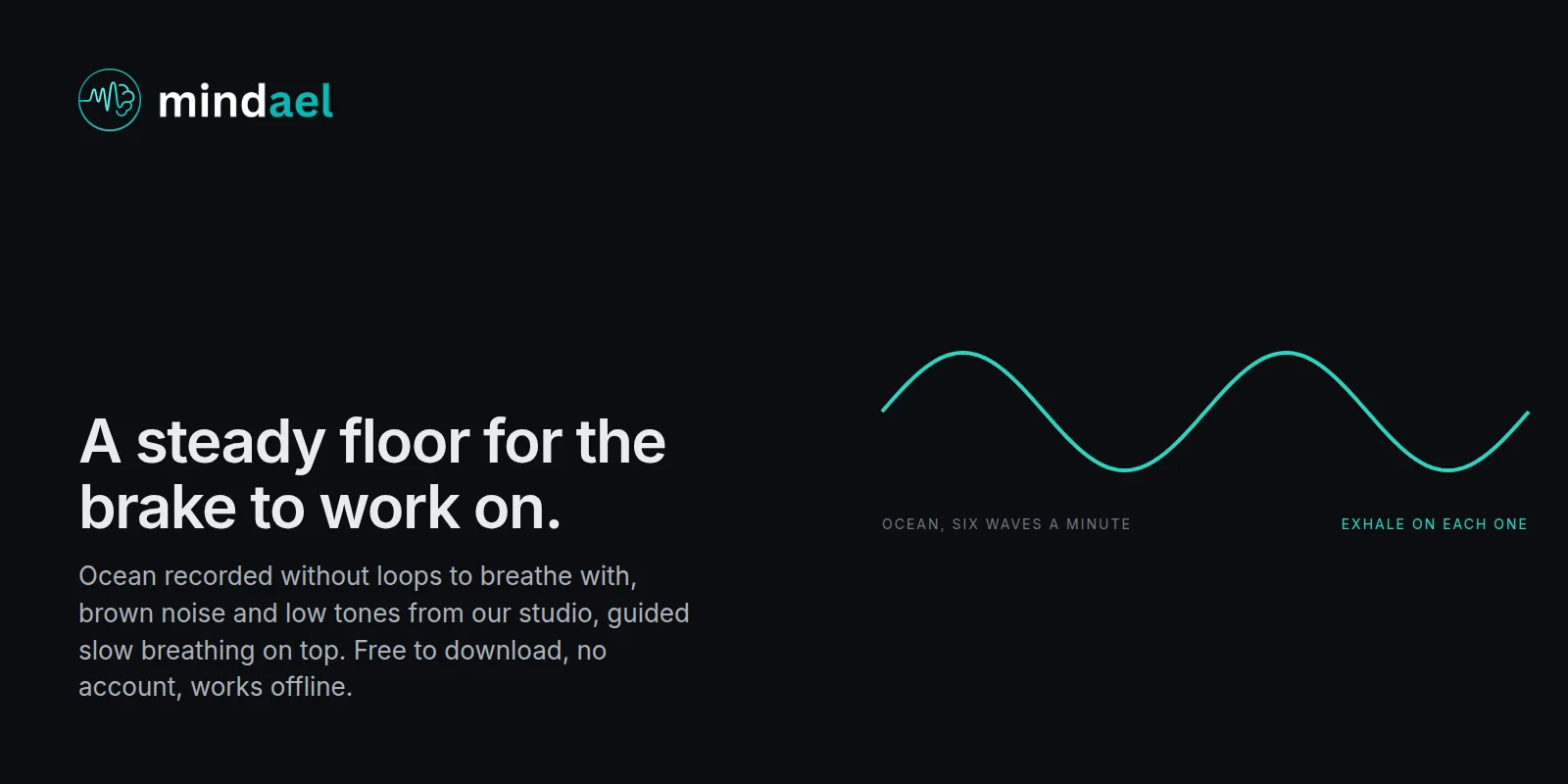
A steady floor for the brake to work on.
Mindael has ocean recorded without loops to breathe with, brown noise and low tones made in our studio, and guided slow breathing that runs on top of any sound and counts the long exhale for you. Free to download, no account, works offline. Five minutes now; ten minutes a day for the baseline.
- Ocean, rain, brown noise and low tones, studio-made
- Guided slow breathing over any sound
- Free to download, no account, works offline
 Free · No account needed · Works offline
 Frequently asked questions
How do I calm my nervous system quickly?
Two physiological sighs: a full breath in through the nose, a second short sip of air on top, then a long slow exhale through the mouth. Then breathe four seconds in and six out for five minutes with a steady sound playing low. Splash cold water on your face or hold a cold cloth over your eyes for thirty seconds. Most people feel the heart rate drop within two or three minutes.
How do I calm an overactive sympathetic nervous system?
Give the parasympathetic side, the brake, more to do. The brake runs mostly through the vagus nerve and responds to a long exhale, to cold on the face, to humming or chanting, to pressure and warmth, and to steady low sound. Do the fast versions when you are wired; do five to ten minutes of slow breathing daily so the brake gets stronger over time.
What are the signs of a dysregulated nervous system?
Common ones: feeling wired but tired, a heart that races for no reason, shallow fast breathing, startling easily, trouble falling asleep despite exhaustion, irritability, digestive upset, or the opposite, feeling flat, numb and unable to get going. Many are also signs of anxiety, poor sleep or illness, so if they persist, see a doctor.
How long does it take to calm the nervous system?
Minutes for the acute state: heart rate responds to slow breathing within one to two minutes and the feeling follows within five. Weeks for the baseline: studies of daily slow breathing or meditation show measurable changes in heart rate variability and reported stress after four to eight weeks of practice.
Does sound calm the nervous system?
Yes, measurably, as long as it is steady, slow and without words. A 2020 meta-analysis of 104 studies found music lowered heart rate, blood pressure and cortisol as well as reported stress. Rain, ocean and brown noise do the same job without a tempo and are easier to leave running under breathing.
Can you reset your nervous system in a day?
You can bring it down in a day, with a slow morning, slow breathing, a walk, no caffeine after noon, a steady sound in the evening and an early night. You cannot change the baseline in a day; that is what the daily ten minutes are for.
Sources
- Balban MY, et al. Brief structured respiration practices enhance mood and reduce physiological arousal. Cell Reports Medicine, 2023.
- Zaccaro A, et al. How breath-control can change your life: a systematic review on psycho-physiological correlates of slow breathing. Frontiers in Human Neuroscience, 2018.
- Jungmann M, et al. Effects of cold stimulation on cardiac-vagal activation in healthy participants: randomized controlled trial. JMIR Formative Research, 2018.
- Kalyani BG, et al. Neurohemodynamic correlates of 'OM' chanting: a pilot functional magnetic resonance imaging study. International Journal of Yoga, 2011.
- Lehrer PM, Gevirtz R. Heart rate variability biofeedback: how and why does it work? Frontiers in Psychology, 2014.
- Thayer JF, et al. A meta-analysis of heart rate variability and neuroimaging studies: implications for heart rate variability as a marker of stress and health. Neuroscience and Biobehavioral Reviews, 2012.
- de Witte M, et al. Effects of music interventions on stress-related outcomes: a systematic review and two meta-analyses. Health Psychology Review, 2020.
This article is for general information and is not medical advice. A racing heart, chest pain, fainting or breathlessness that come on suddenly need medical attention; persistent symptoms of a wired or flat nervous system are worth discussing with a doctor, since they overlap with anxiety, thyroid problems and poor sleep.
This article is part of our nervous system and vagus nerve guide. Hear the sounds in this article in the Mindael sound library, or see our app comparison checklists.