

How to Relax Your Nervous System: The Slow Evening Practices That Let the Body Stand Down
Relaxing the nervous system is slower work than calming it: not stopping a spike, but letting a body that has been braced all day stand down. The practices with evidence are progressive muscle relaxation (tense and release, top to bottom), a short yoga nidra or non-sleep deep rest recording, a warm bath or shower an hour or two before bed, steady natural sound such as rain or a stream, weight and warmth on the body, and ten minutes of slow breathing with a long exhale. Pick two, do them at the same time every evening for two weeks, and the evening starts doing the work by itself.
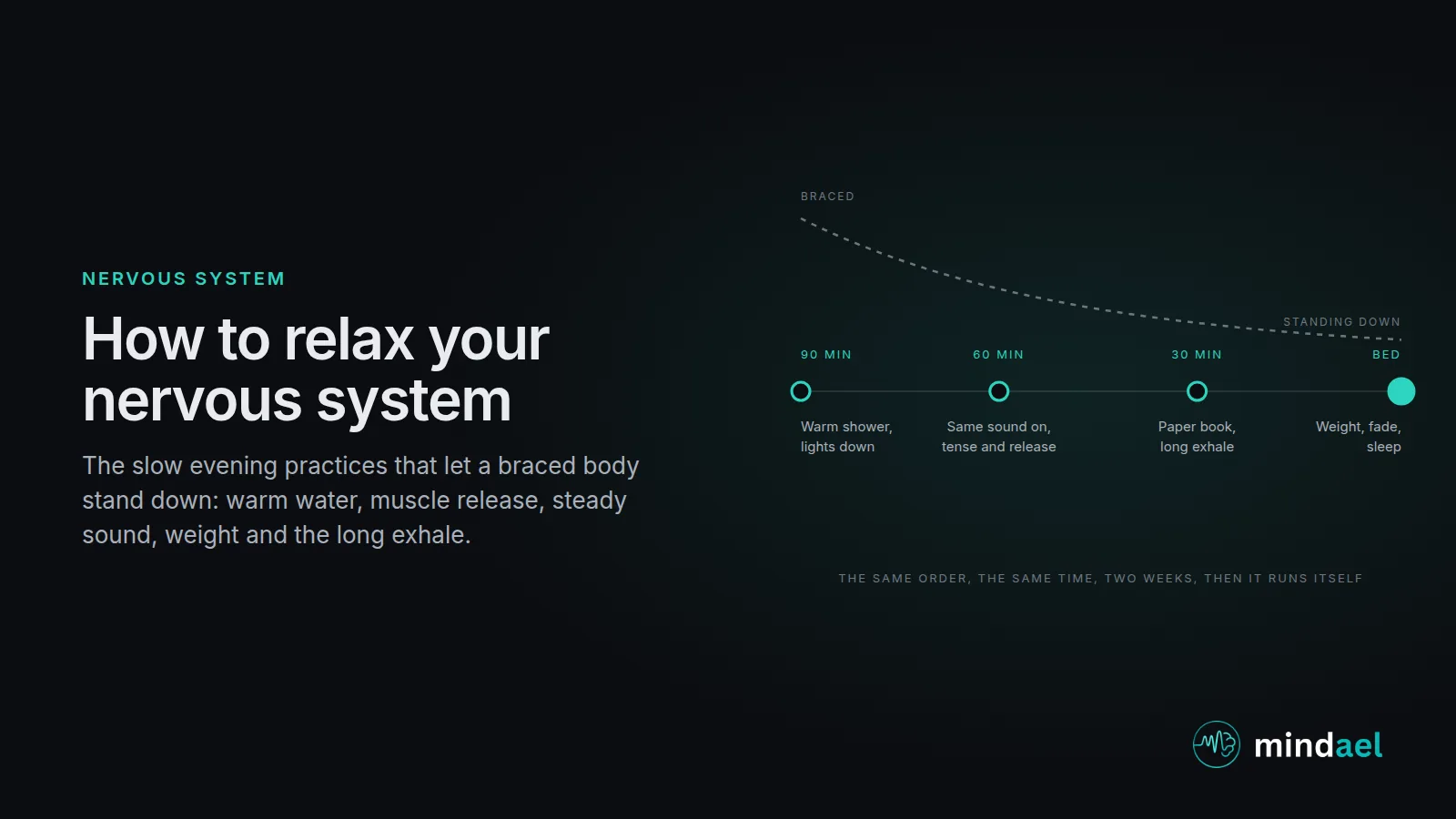
How to relax your nervous system is a different question from how to calm it, and the difference matters. Calming is for the spike: the heart going, the breath high, five minutes of sighs and cold water, which our calming article covers. Relaxing is for the baseline: a body that has been slightly braced since nine in the morning and needs twenty to forty minutes of the right signals before it will fully stand down. This article is about those signals, with the research behind each, and how to stack them into an evening that works by itself after a couple of weeks. The sounds and the breathing guide are in Mindael, free to download on the App Store, and the physiology underneath is in our nervous system regulation guide.
What “relaxed” means in the body
A relaxed nervous system is one where the brake, the parasympathetic branch run largely by the vagus nerve, has the upper hand: heart rate slow and variable, breathing low and slow, muscles long, digestion running, attention wide and unhurried. Most people reach it only in the last minutes before sleep, if then. The point of an evening practice is to reach it earlier and stay there longer, so that sleep starts from rest rather than from the day.
Two things get in the way. The first is novelty: every notification, new sound and bright screen is a small reason for the system to stay alert. The second is muscle: braced shoulders, a set jaw and a held belly send a continuous “not safe yet” message upward, and the system believes the body. The practices below work on both, by removing new input and by releasing the muscle.
The practices, with the evidence
Progressive muscle relaxation. Tense one muscle group hard for five seconds, release it fully, notice the difference, move on: feet, calves, thighs, buttocks, belly, hands, arms, shoulders, neck, jaw, forehead. Ten to fifteen minutes. It is the oldest of these methods and still the most reliable: in a 2021 trial comparing short sessions, it produced a stronger physiological relaxation response than deep breathing or guided imagery on its own (Toussaint et al., 2021). The reason it works where “just relax” fails is that most people cannot release a muscle they cannot feel; tensing it first makes it findable.
Yoga nidra, or non-sleep deep rest. Lie down, stay still and awake, and let a recorded voice move your attention slowly through the body for ten to thirty minutes. In a study of over 300 adults, eleven minutes a day for a month reduced stress and improved sleep quality and well-being, with effects still present six weeks later (Moszeik et al., 2020). Any free recording will do; play it over a low steady sound if the room is noisy.
A warm bath or shower, one to two hours before bed. Warmth draws blood to the skin, the core temperature then falls, and that fall is the signal the body uses to begin sleep. A 2019 systematic review and meta-analysis found that passive body heating in this window shortened the time to fall asleep by about ten minutes and improved sleep quality (Haghayegh et al., 2019). Ten minutes at a comfortable temperature is enough; it is the timing, not the heat, that matters.
Steady natural sound. Rain, a stream, waves, wind. A 2021 synthesis of studies on natural sound found it lowered stress and pain and improved mood, with water sounds the most consistently helpful (Buxton et al., 2021). Two things make it work for the nervous system specifically: it has no new information in it, so the threat detector goes quiet, and if it is the same sound every evening it becomes a cue, so after a couple of weeks pressing play does part of the job. Rain and ocean are the two we point to first; our relaxing sounds guide goes through the rest.
Weight and warmth. Pressure on the body is calming for many people, the way a hand on the shoulder is. In a randomised trial, a weighted blanket improved insomnia severity, daytime fatigue and anxiety symptoms in people with sleep problems compared with a light blanket (Ekholm et al., 2020). A heavy duvet, a warm towel across the shoulders or a hot water bottle on the belly give some of the same signal for free.
Slow breathing with a long exhale. The common thread through all of the above, and the thing to do during them: four seconds in through the nose, six out, breathing low into the belly. At around six breaths a minute heart rate variability rises and reported anxiety falls across many studies (Zaccaro et al., 2018). Our breathing guide teaches the patterns, and the abdominal breathing article explains why breathing low matters more than breathing slow.
Sound with a long tail. Singing bowls, gongs and sustained low tones, the sound-bath family. In an observational study, a singing bowl meditation lowered tension and anger and improved mood, most of all in people new to it (Goldsby et al., 2017). The mechanism is probably the same as natural sound, slow and without surprise, with the added anchor of a tone to follow as it fades.
An evening that stacks them
You do not need all seven. Two or three, in the same order at the same time, is what builds the cue. One version that our listeners use:
Ninety minutes before bed. Warm shower. Lights down afterwards; lamps, not ceiling lights. Phone charging in another room, or face down with the sound app running.
An hour before. Rain or ocean on, low. Ten minutes of progressive muscle relaxation lying on the floor or the bed, breathing four in and six out through it. Or a yoga nidra recording over the sound, if you would rather be guided.
Thirty minutes before. Something slow and unlit: a paper book, a stretch, a conversation. The sound stays on. If the jaw or shoulders have crept back up, one more round of tense and release for just those.
Bed. Heavy duvet, the same sound on a timer that fades, long exhale until you stop noticing. If sleep does not come, the sleep sounds guide has the night-time setup and the rules for what to do at 3 am.
Two weeks of that and the first step starts triggering the rest. That is the whole aim: not a nightly effort, but an evening the body recognises.
When relaxing is not enough
If the body will not stand down most evenings for more than a few weeks, if tension comes with chest pain, breathlessness, a racing heart at rest or a persistently low mood, or if you wake exhausted after a full night, those are signs of something a relaxation routine will not fix on its own: anxiety, a thyroid problem, sleep apnoea or depression among them. A doctor can tell them apart. The practices here work alongside treatment and make it easier; they do not replace it.
The short version
Relaxing the nervous system is slow work done at the same time every evening: a warm shower early, lights down, the same steady sound, ten minutes of tense and release or a yoga nidra recording, slow breathing with a long exhale, weight on the body in bed. Mindael has the rain, the low tones and the breathing guide, free to download; the evening is yours to build.
The same sound, every evening.
Mindael has rain, ocean and a stream recorded without loops, low tones and theta beats made in our studio, guided slow breathing on top, and a timer that fades the sound out after you are gone. Free to download, no account, works offline. Press play at the same time each night and let it become the cue.
- Rain, ocean, stream, low tones and theta beats, studio-made
- Guided slow breathing over any sound
- Free to download, no account, works offline
 Free · No account needed · Works offline
 Frequently asked questions
How do I relax my nervous system?
Give it a slow evening with the same cues each night: a warm shower or bath an hour or two before bed, dim light, a steady natural sound like rain at a low level, ten minutes of progressive muscle relaxation or a yoga nidra recording, and slow breathing with a longer exhale. The nervous system relaxes when nothing new arrives for a while and the body gets signals that it is safe to stand down.
What is the difference between calming and relaxing the nervous system?
Calming is fast and for a spike: sighs, cold on the face, a minute of slow breathing. Relaxing is slow and for a baseline: letting braced muscles release and the heart settle over twenty to forty minutes, usually in the evening. You need both; this article is about the slow one, and our calming article is about the fast one.
Does progressive muscle relaxation work?
Yes. Tensing each muscle group for a few seconds and releasing it, from feet to face, reliably lowers heart rate, blood pressure and reported anxiety in trials, and a 2021 study found it produced a stronger relaxation response than deep breathing or guided imagery alone over a short session. Ten to fifteen minutes is enough.
What is yoga nidra or NSDR?
A guided, lying-down practice of around ten to thirty minutes that moves attention slowly around the body while you stay still and awake. Non-sleep deep rest is the newer name for a short, secular version. In a 2020 study of over 300 adults, eleven minutes a day for a month reduced stress and improved sleep and well-being.
Does a warm bath help you relax?
Measurably, if it is timed right. A 2019 systematic review found that a warm bath or shower one to two hours before bed shortened the time to fall asleep by about ten minutes on average. The warmth draws blood to the skin and the core temperature then drops, which is the signal the body uses to start sleep.
What sounds relax the nervous system?
Steady, slow, natural ones: rain, a stream, waves, wind in trees. A 2021 synthesis of studies found water and bird sounds in particular lowered stress and improved mood. Keep it at a quiet-conversation level and the same every evening, so it becomes a cue in its own right.
Sources
- Toussaint L, et al. Effectiveness of progressive muscle relaxation, deep breathing, and guided imagery in promoting psychological and physiological states of relaxation. Evidence-Based Complementary and Alternative Medicine, 2021.
- Moszeik EN, et al. Effectiveness of a short yoga nidra meditation on stress, sleep, and well-being in a large and diverse sample. Current Psychology, 2020.
- Haghayegh S, et al. Before-bedtime passive body heating by warm shower or bath to improve sleep: a systematic review and meta-analysis. Sleep Medicine Reviews, 2019.
- Buxton RT, et al. A synthesis of health benefits of natural sounds and their distribution in national parks. PNAS, 2021.
- Ekholm B, et al. A randomized controlled study of weighted chain blankets for insomnia in psychiatric disorders. Journal of Clinical Sleep Medicine, 2020.
- Goldsby TL, et al. Effects of singing bowl sound meditation on mood, tension, and well-being: an observational study. Journal of Evidence-Based Complementary and Alternative Medicine, 2017.
- Zaccaro A, et al. How breath-control can change your life: a systematic review on psycho-physiological correlates of slow breathing. Frontiers in Human Neuroscience, 2018.
This article is for general information and is not medical advice. If you cannot relax or sleep most nights for more than a few weeks, or if tension comes with chest pain, breathlessness or low mood, please talk to a doctor.
This article is part of our nervous system and vagus nerve guide. Hear the sounds in this article in the Mindael sound library, or see our app comparison checklists.