

Relaxing Sounds for Anxiety and Stress: What to Play When You Need to Come Down
Stress does not leave on command. It leaves when the body gets a steady signal that nothing is happening, long enough to believe it. Sound is one of the few signals you can control in any room, and the ones on this page are the ones our listeners reach for after a hard day. All of them are in Mindael, free on the App Store, and the research behind each is cited below.
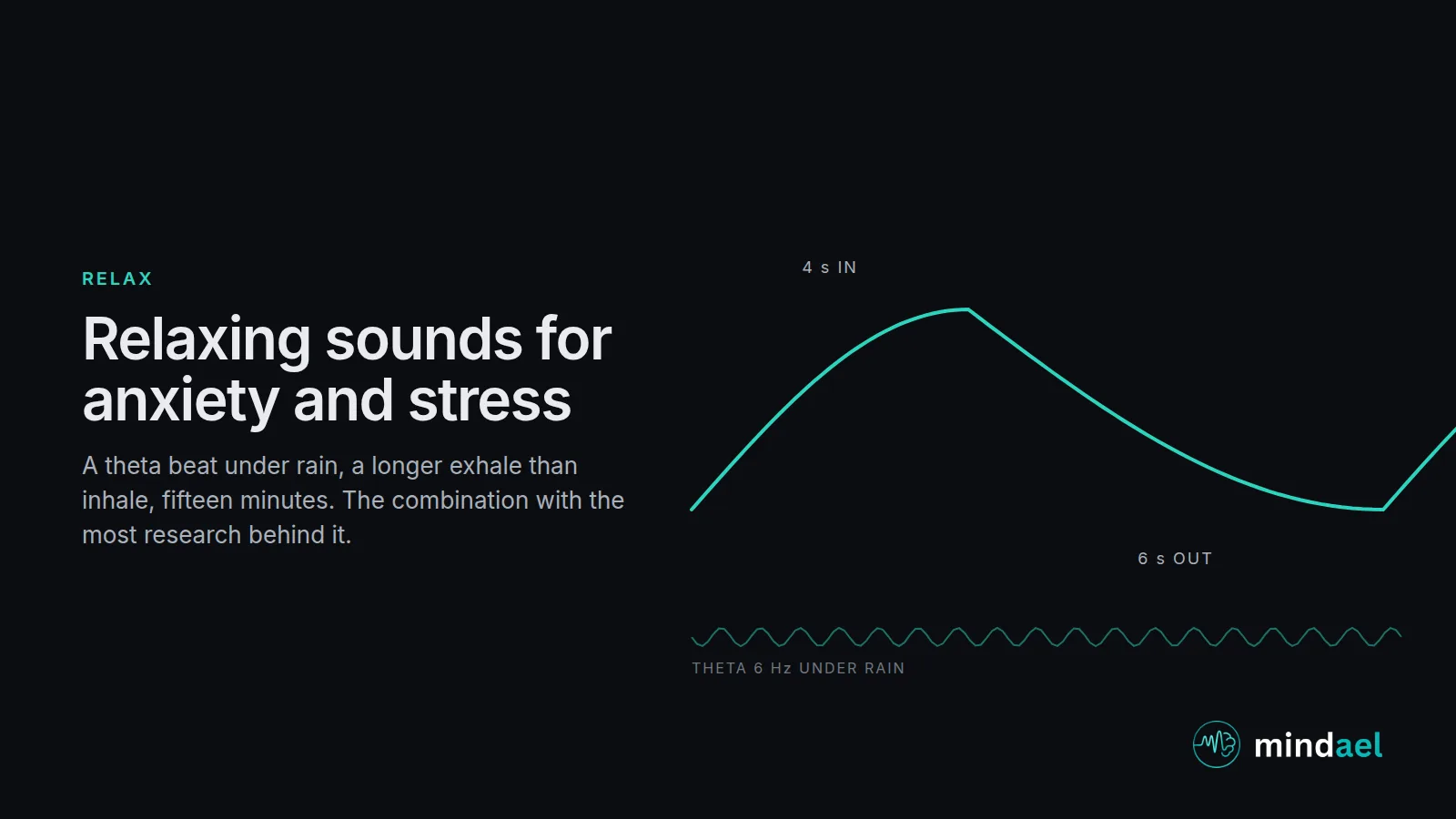
For an anxious evening, a theta or alpha binaural beat under rain for 15 to 20 minutes with earbuds is the combination with the most research behind it. For general stress without earbuds, rain, ocean or brown noise on a speaker at a low level. Pair the sound with slow breathing and the effect roughly doubles.
Sounds that work, and why
Theta and alpha binaural beats
A 4 to 13 Hz pulse that matches a calm, resting brain. The sound with the strongest anxiety research, including a surgical pre-op trial. Earbuds required.
Rain and ocean
Natural, steady, and familiar. The sounds people choose when they want calm without anything that feels like a technique.
Brown noise
Deep and physical. Gives a racing mind something steady to lean on, and covers the small sounds that keep you on alert.
528 Hz and 432 Hz tones
Pure tones and tunings with early studies on stress markers and heart rate. Soft, slow, and best under rain or a pad rather than alone.
Why sound calms a stressed body
Anxiety is a prediction problem. The body is braced for something, and every small sound, the fridge, a car door, a message tone, gets read as possible evidence. A steady sound removes that evidence stream. Nothing new arrives for fifteen minutes, and the nervous system, which was waiting for a reason to stand down, finally gets one. When the stress has a name, anxiety, panic, a spike that arrives from nowhere, our anxiety guide adds the breathing and the five minute routine that go with the sound. When stress has turned into a tight head, the stress headache guide covers what eases a tension headache and how low to keep the sound.
The second mechanism is breathing. Most people breathe faster and shallower under stress without noticing. A slow, rhythmic sound like rain or ocean gives the breath something to follow, and a longer exhale is the most reliable switch into the rest state the body has. Sound alone helps; sound with slow breathing is what our listeners describe as the moment it “clicks”.
What the research shows
The clearest trial took place in a hospital. Patients waiting for day surgery listened to binaural beats embedded in music, the same music without beats, or nothing. Anxiety fell by 26% in the binaural group, 11% in the music-only group, and barely moved without audio (Padmanabhan et al., 2005). In an emergency department, specially composed ambient sound reduced anxiety in waiting patients compared with usual care (Weiland et al., 2011). Pooling 22 studies, a 2019 meta-analysis found a reliable effect of binaural beats on anxiety, with longer sessions working better (Garcia-Argibay et al., 2019).
Tuning and tone studies are smaller but point the same way. Five minutes of music at 528 Hz lowered stress-related hormone levels compared with the same music at standard 440 Hz tuning in a 2018 pilot (Akimoto et al., 2018). Music tuned to 432 Hz was associated with a slight drop in heart rate compared with 440 Hz in a double-blind crossover (Calamassi and Pomponi, 2019). These are early results from small groups, which is why we treat solfeggio tones as a soft layer under rain rather than a sound to rely on alone.
For the longer version of the evening, with the warm shower, the muscle relaxation and the research behind each step, read the how to relax your nervous system article.
A fifteen minute routine for a hard evening
This is the routine we give to listeners who write to us after a bad day. It takes one song’s worth of effort to set up.
- Earbuds in. A theta beat at 6 Hz, rain over it at about half the beat’s volume, total volume low.
- Sit or lie down and lengthen the exhale. Four in, six out. Do not count precisely; let the rain carry the rhythm.
- Fifteen minutes. Set the timer and do nothing else. No phone, no planning. If a thought comes, let the sound be louder than it.
- When the timer ends, keep the rain. Switch off the beat and let the rain run on a speaker while you do whatever comes next.
If this becomes an evening habit, you will notice that the first ten seconds of rain start the wind-down on their own. That is conditioning, and it is the most useful thing a relaxing sound can do for you. When the evening ends in bed, our sleep sounds page picks up where this one leaves off.
How to set it up tonight
- Earbuds in, theta beat under rainSet the beat to 6 Hz and the rain to about half the beat's volume. Fifteen to twenty minutes is the window the studies used.
- Slow the breath to the soundFour seconds in, six seconds out. Longer exhale than inhale. Let the rain set the pace rather than counting hard.
- Keep the volume lowCalming sound should sit under your attention, not on top of it. If you can describe the sound while listening, it is too loud.
- Same time, same soundAfter a week, the sound alone starts the wind-down. That conditioning is the real payoff.
- No earbuds? Use a speakerRain, ocean or brown noise across the room works without them. Only the binaural beat needs earbuds.
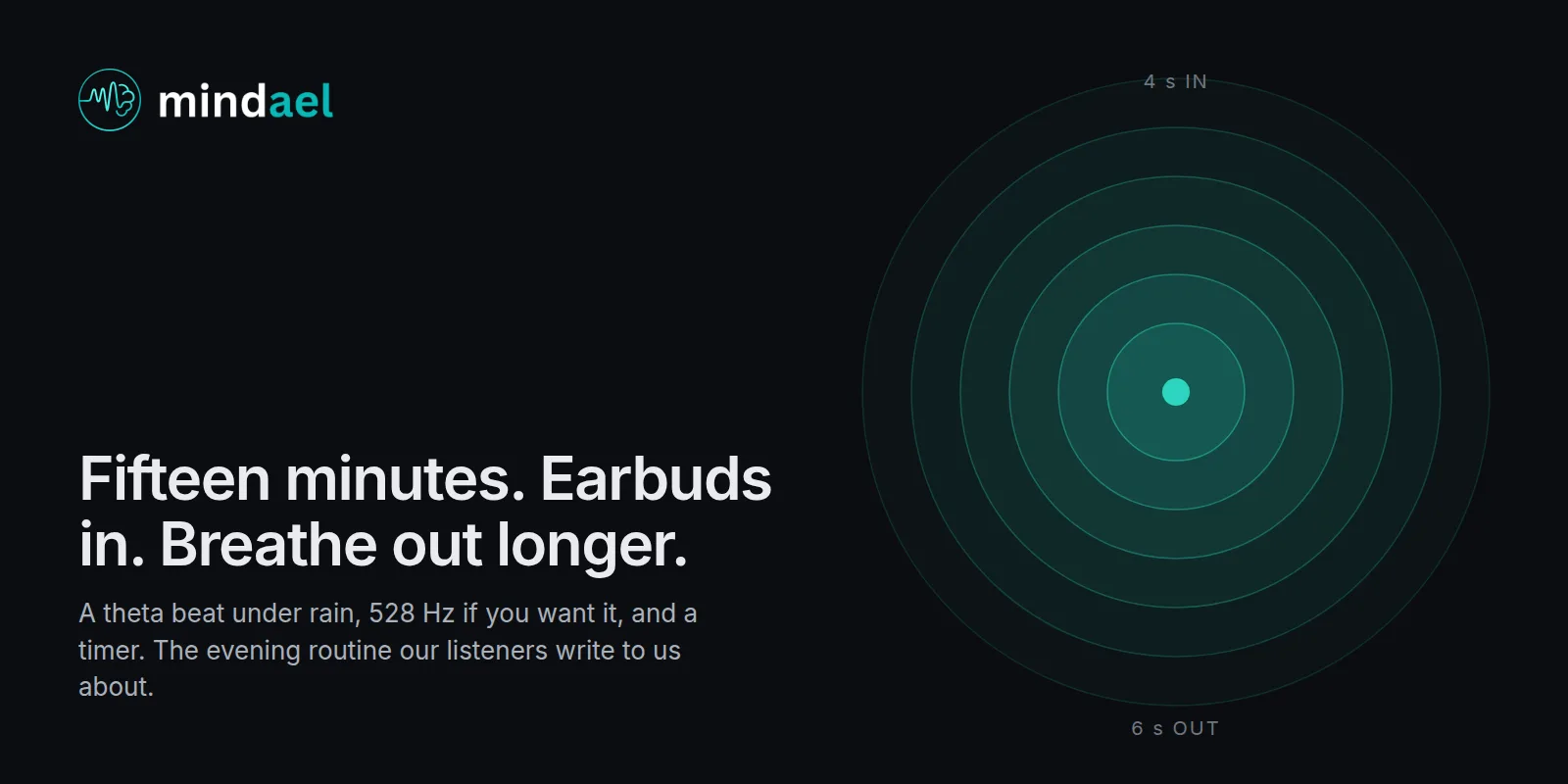
Give it fifteen minutes tonight.
You know the combination now: a theta beat under rain, slow breath, low volume. Mindael has every beat with a clean carrier tone, rain and ocean recorded in-house, and 528 Hz and 432 Hz tones made in our studio. Download it, set a 20 minute timer, and let the evening change pace.
- Theta, alpha and delta beats with a clean carrier
- Rain, ocean, brown noise and solfeggio tones to layer
- Short breathing guide and timer, works offline
 Free · No account needed · Works offline
 Frequently asked questions
What sounds help with anxiety?
The sounds with research behind them are binaural beats in the theta and alpha range, specially composed ambient sound, and steady natural sounds like rain. A 2005 trial found binaural beats cut pre-surgery anxiety by about a quarter, and a 2019 meta-analysis of 22 studies found a reliable effect on anxiety.
Do binaural beats reduce anxiety?
In the research so far, yes. Patients who listened to binaural beats before surgery reported a 26% drop in anxiety, compared with 11% for the same music without beats. Headphones are essential, and 15 to 30 minutes is the usual session.
What is 528 Hz used for?
It is the best known of the solfeggio frequencies and is associated with calm and stress relief. A small 2018 study found that five minutes of 528 Hz music lowered stress markers compared with the same music at standard tuning. We use it as a soft layer under rain rather than on its own.
How long does it take to feel calmer?
Most people notice a shift in five to ten minutes if they slow their breathing with the sound. The studies used 15 to 30 minute sessions, and that is what we suggest for a hard evening.
Can I use these sounds to fall asleep?
Yes. Run the same sound into a sleep timer, and move from a theta beat to a delta beat once you are in bed. Our sleep page covers the settings.
Sources
- Padmanabhan R, Hildreth AJ, Laws D. A prospective, randomised, controlled study examining binaural beat audio and pre-operative anxiety in patients undergoing general anaesthesia for day case surgery. Anaesthesia, 2005.
- Garcia-Argibay M, Santed MA, Reales JM. Efficacy of binaural auditory beats in cognition, anxiety, and pain perception: a meta-analysis. Psychological Research, 2019.
- Weiland TJ, et al. Original sound compositions reduce anxiety in emergency department patients: a randomised controlled trial. Medical Journal of Australia, 2011.
- Akimoto K, Hu A, Yamaguchi T, Kobayashi H. Effect of 528 Hz music on the endocrine system and autonomic nervous system. Health, 2018.
- Calamassi D, Pomponi GP. Music tuned to 440 Hz versus 432 Hz and the health effects: a double-blind cross-over pilot study. Explore, 2019.
This page is for general information and is not medical advice. If anxiety is affecting your daily life, talk to a doctor or therapist.