

Brown Noise vs White Noise vs Pink Noise: Which Is Best for Sleep?
White noise is the best masker for a noisy room, pink noise is the softer choice that sleep labs have studied most, and brown noise is the deepest and calmest of the three. Whichever you pick, keep it quiet and give it three nights.
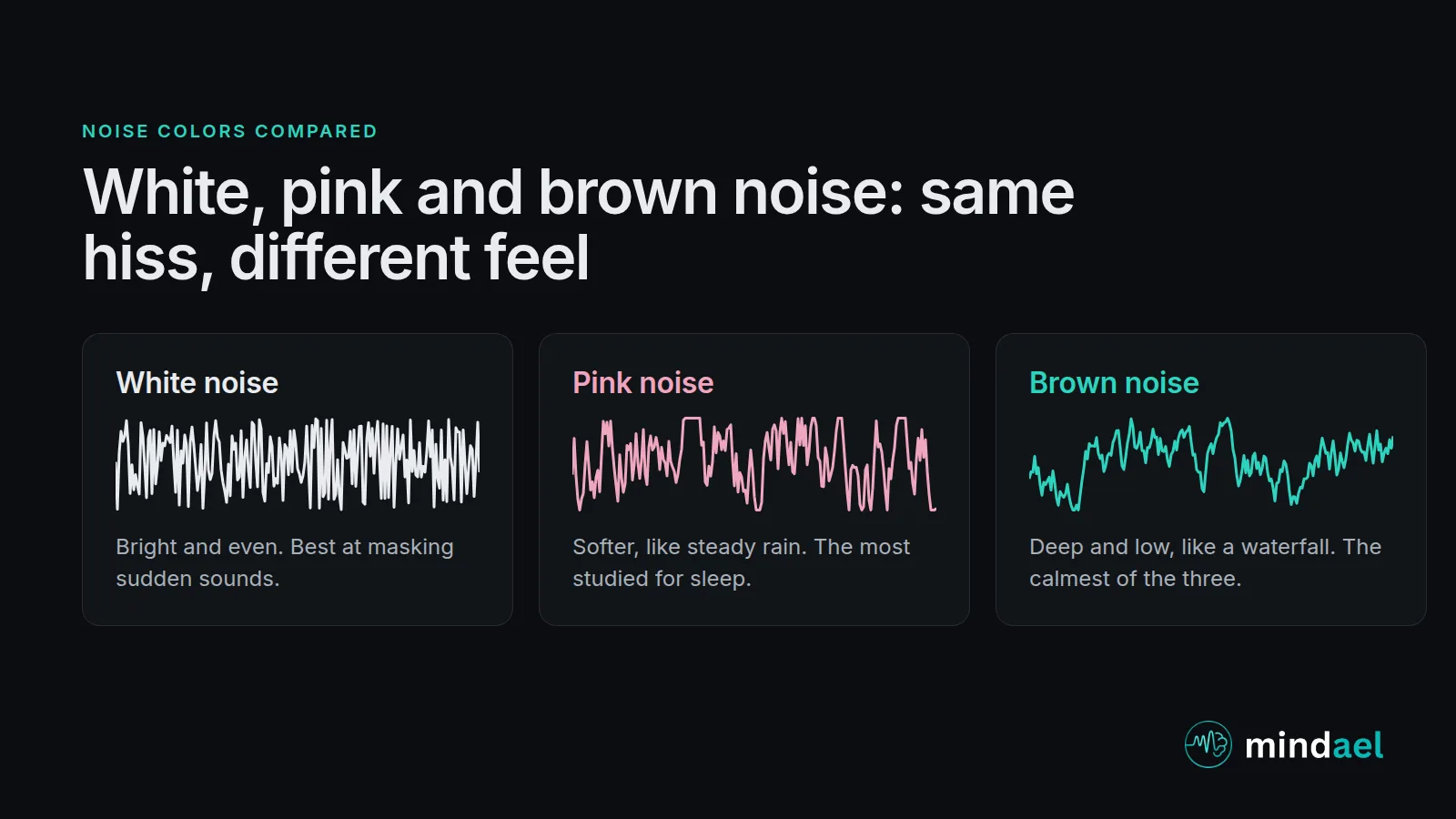
Brown noise vs white noise vs pink noise is the question we get asked more than any other, usually by someone who has tried one of them, liked it, and now wonders whether a different color would work better. You can hear all three side by side in Mindael, free on the App Store, and the answer is shorter than most guides make it.
The short answer
- White noise is best when the problem is noise around you: traffic, snoring, thin walls, a barking dog.
- Pink noise is the softer choice for long nights, and it is the color sleep scientists have studied most.
- Brown noise is the deepest and calmest, and many people reach for it when the loud part is their own mind.
- Whichever you choose, keep it quiet, about as loud as a shower running in the next room.
What “noise colors” actually mean
Every sound you hear is a mix of frequencies, from low rumbles to high hisses. A “noise” is a random signal that contains many of those frequencies at once. The color is just a label for how the energy is spread across that range.
The names are borrowed from light. White light contains every color in equal measure, so noise with equal energy at every frequency is called white. Tilt the balance toward the low end and the sound gets “warmer”, which is why the next two colors are pink and then brown.
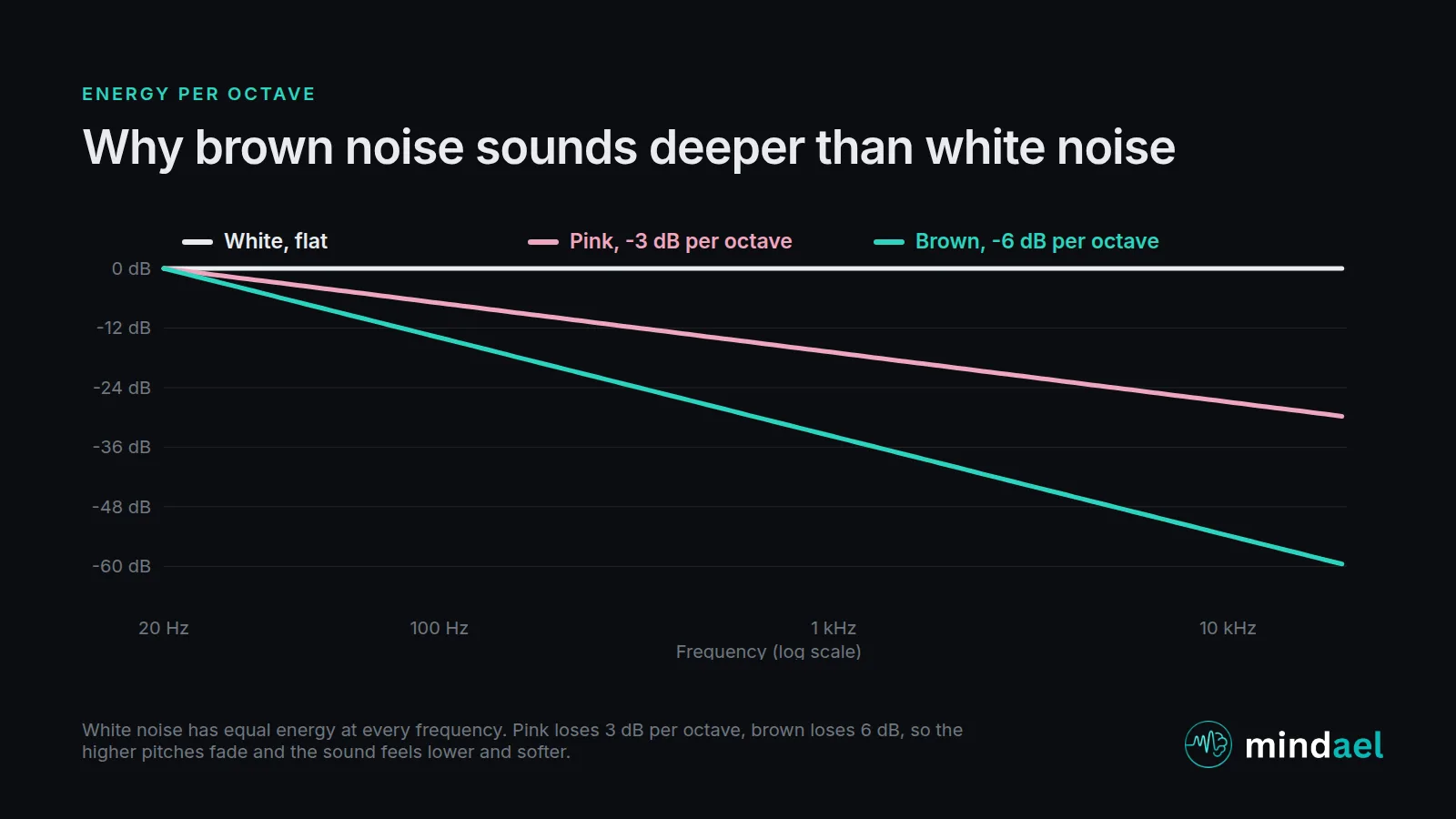
The practical takeaway is simple. The more energy a noise has in the high frequencies, the brighter and sharper it sounds. The more it leans toward the lows, the deeper and softer it sounds. That one idea explains almost everything below.
White noise: bright, even and great at masking
White noise spreads its energy evenly across all frequencies. Our ears are more sensitive to high frequencies, so white noise sounds bright and hissy: a fan on high, an air purifier, an old television between channels.
That brightness is exactly what makes it useful. Sudden sounds wake us because they stand out against a quiet background. White noise raises the background across the whole range, so a car door or a cough has less contrast and is less likely to pull you out of sleep.
It also has one of the best-known studies in this field. In 1990, a team at a London hospital played white noise to newborns: 80% fell asleep within five minutes, compared with 25% of the babies without it (Spencer et al., 1990). That one result is a big part of why white noise machines ended up in so many nurseries.
Good for: light sleepers in noisy places, shared rooms, travel, and nurseries at a low volume and a safe distance from the crib. Watch for: some people find it harsh over a whole night. If you wake up with a tired, “full” feeling in your ears, move one color down.
Pink noise: the one researchers study
Pink noise turns the energy down as the frequency goes up, by 3 dB per octave, so each octave carries the same amount of energy. To the ear that sounds balanced: steady rain, wind in trees, a distant shower.
Pink noise is also the color that sleep labs keep coming back to. In a 2013 study, researchers played short, gentle bursts of pink noise timed to the sleeper’s own slow brain waves during deep sleep. The slow waves got stronger and people remembered word pairs better the next morning (Ngo et al., 2013). A 2017 study repeated the idea in older adults with the same pattern of deeper sleep and better memory (Papalambros et al., 2017). And in a simpler setup, healthy adults placed in a noisy “transient insomnia” model fell asleep 38% faster with steady broadband noise playing (Messineo et al., 2017).
Those lab studies used timed pulses and brain monitoring, which is more precise than a track on a phone. What they tell us is that the sound itself is a good companion for sleep: it is gentle, it is easy to tolerate for eight hours, and the brain responds well to it.
Good for: people who find white noise too sharp, long nights, anyone who likes the sound of rain. Watch for: it covers high-pitched sounds a little less well than white noise.
Brown noise: deep, low and calm
Brown noise drops the high frequencies further still, by 6 dB per octave. What is left is a deep, rumbling sound: a waterfall heard from a distance, heavy surf, the cabin of an aircraft at cruising altitude.
The name has nothing to do with the color brown. It comes from Robert Brown, the botanist who described the random motion of pollen grains in water in 1827. The math behind that motion produces exactly this kind of noise, which is why you will sometimes see it called red noise or Brownian noise.
Brown noise has become a favorite among our listeners, and among many people with ADHD, for one reason: there is almost nothing in it for the ear to catch on. With so little high-frequency energy, it can run for hours without ever feeling sharp, and it leaves a steady floor under a busy mind.
Good for: overthinking at bedtime, focus sessions, people who are sensitive to bright sounds. Watch for: it covers high-pitched noises, like a phone notification or a squeaky door, less effectively than white noise.
Side by side comparison
| White noise | Pink noise | Brown noise | |
|---|---|---|---|
| Sounds like | Fan, TV static, air purifier | Steady rain, wind | Waterfall, aircraft cabin, surf |
| Energy | Even across all frequencies | Falls 3 dB per octave | Falls 6 dB per octave |
| Feels | Bright, sharp | Balanced, soft | Deep, warm |
| Best at | Masking sudden sounds | Comfortable long listening | Calming a busy mind |
| Research | Masking, infant sleep | Lab studies on deep sleep | Mostly listener reports |
Which one should you choose?
A simple rule works for most people, and it is the one we give friends who ask:
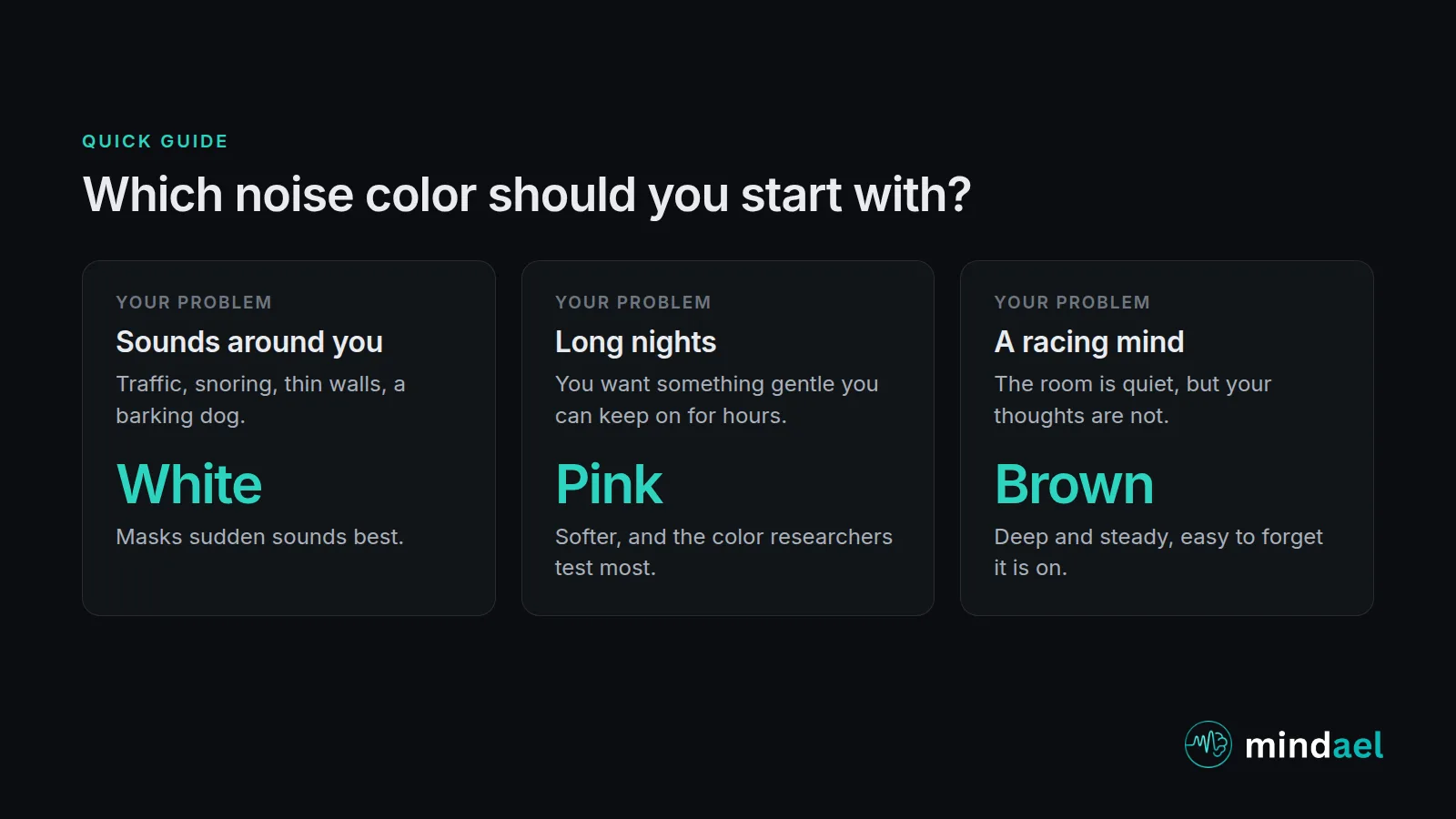
- If the noise is outside your head, start with white noise.
- If you want something softer for the whole night, try pink noise.
- If your mind is the loud part, try brown noise.
Then give it three nights. The first night with any new sound feels strange, the second is better, and by the third most people stop noticing it. The “best” noise is the one you forget is playing. If you are still unsure, run each color for three nights and keep the one after which you woke up least.
You can also layer sounds. Many of our users put brown noise under rain, or mix a little white noise into pink to cover one specific sound such as traffic. Layering is often the fastest way to find your own balance.
How loud should sleep noise be?
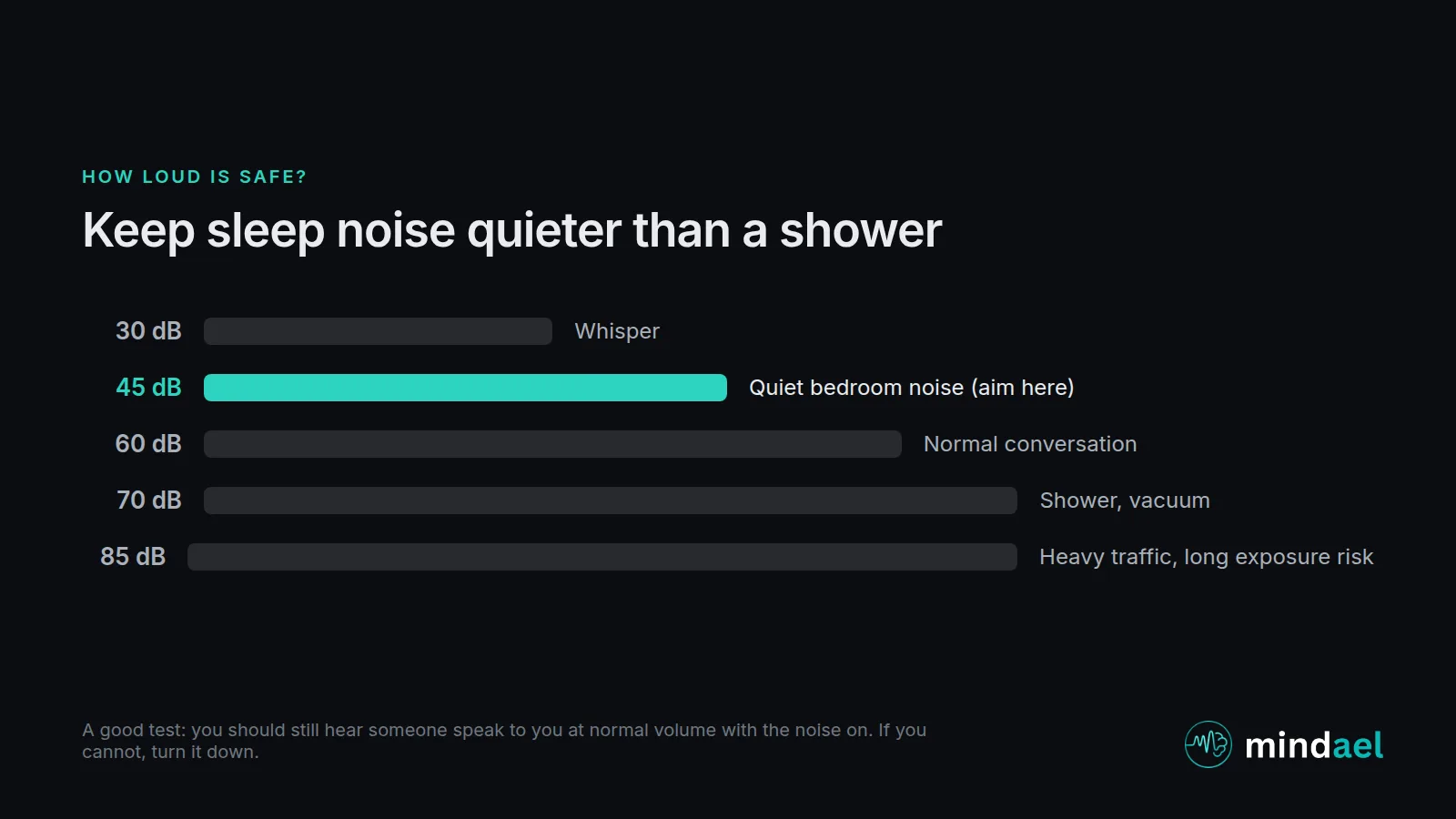
Lower than you think. Aim for a level where you could still hear someone speak to you softly in the room, roughly 45 dB, which is quieter than a normal conversation. Put the speaker across the room rather than next to the pillow, and use a timer if you do not want sound until morning.
For babies, keep machines well away from the crib and at a low setting. A 2014 study measured popular infant sleep machines and found that several could exceed recommended hospital nursery limits at maximum volume and close range (Hugh et al., 2014). Distance and a low volume fix that.
Why not every noise track is what it says
Search for “brown noise” online and you will find thousands of videos and playlists. Not all of them are what the title claims. Some are compressed so heavily that the low end disappears. Some are re-recorded or re-uploaded so many times that the balance drifts. Some are simply mislabeled: a track called brown noise may really be pink, or a loop with an audible seam every few minutes.
That matters, because the whole point of a noise color is its balance of frequencies. If the balance is wrong, you are not getting the sound you chose.
We produce every Mindael sound in our own studio and measure its spectrum before it goes into the app, so our white noise really is flat and our brown noise really falls 6 dB per octave. In Mindael you can play white, pink and brown noise, layer them with rain, ocean or binaural beats, and set a sleep timer that fades out gently. It is free on the App Store.
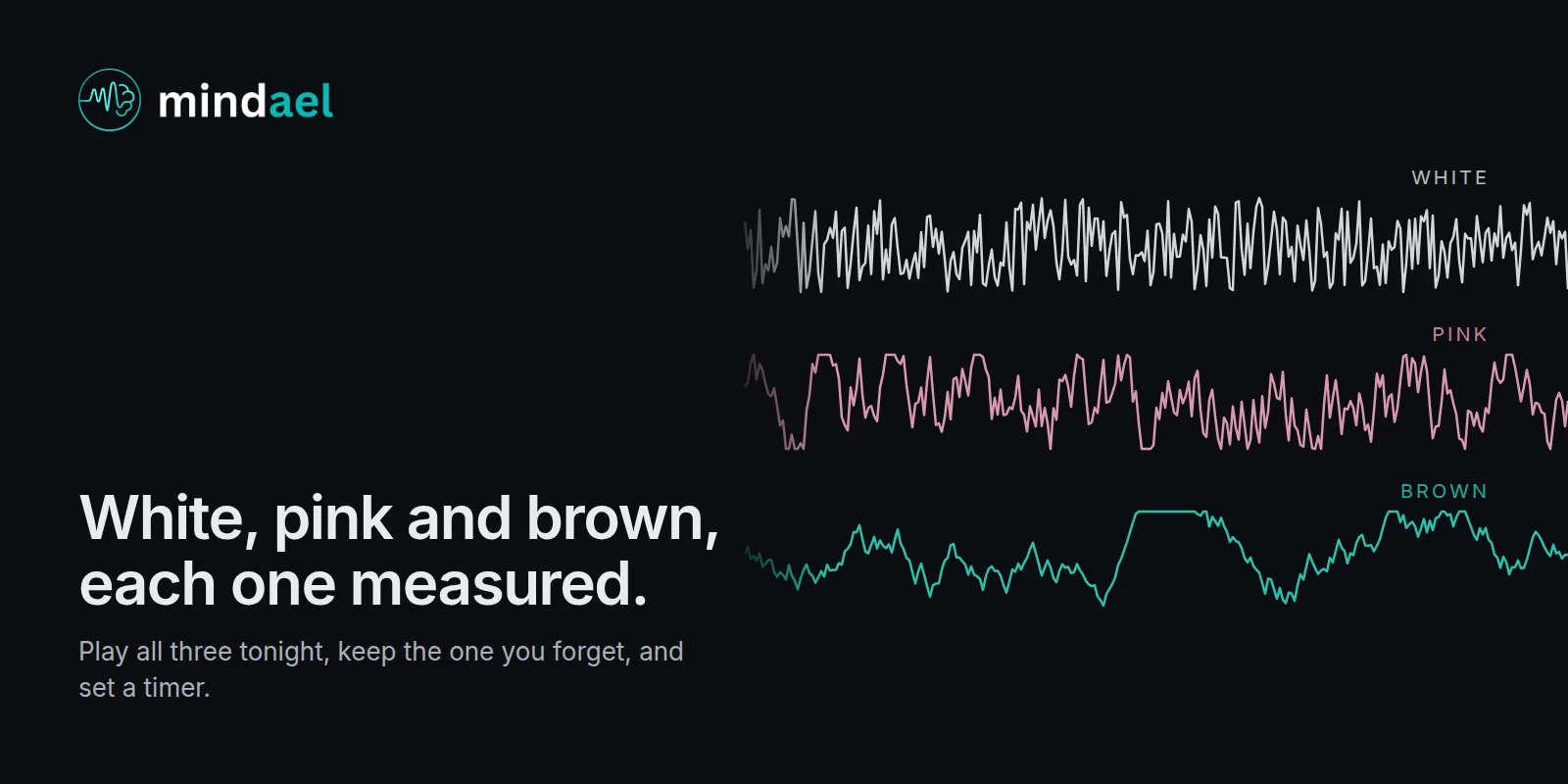
Try all three tonight and keep the one you forget.
The rule in this guide only works if the colors are real. Mindael's white, pink and brown noise are produced in our studio and measured before release, so a three-night test actually tells you something. Download it, play each color for a minute, and you will know which one is yours before you finish this sentence.
- White, pink and brown noise, each measured to spec
- Mix two colors, or add rain to cover one specific sound
- Timer, offline playback, no account needed
 Free · No account needed · Works offline
 Frequently asked questions
Is brown noise better than white noise for sleep?
It depends on what is keeping you awake. White noise is better at covering sudden sounds from outside. Brown noise is deeper and softer, and many people find it more relaxing when the room is already quiet. If your street is loud, start with white; if your thoughts are loud, start with brown.
What is the difference between pink noise and white noise?
White noise has equal energy at every frequency, so it sounds bright and hissy. Pink noise loses 3 dB of energy with every octave as the pitch rises, so it sounds softer and more balanced, like steady rain.
Is pink noise good for deep sleep?
Sleep labs have found that gentle pink noise pulses, timed to the sleeper's slow brain waves, strengthen deep sleep and improve next-morning memory. Those experiments used brain monitoring, and a steady pink noise track is a simpler thing, but pink noise remains one of the most comfortable sounds to sleep with.
Why is it called brown noise?
It is named after the botanist Robert Brown and the random Brownian motion he described in 1827, not after the color. Some people call it red noise for the same reason.
Is it okay to sleep with noise all night?
For most adults, yes, as long as the volume stays low and the speaker is not beside your head. A sleep timer that fades the sound out after an hour or two is a good middle ground.
Which noise color is best for focus?
Most of our listeners prefer brown or pink noise for work because they are less sharp than white noise over a long session. Try each for one work block and keep the one you forget is playing.
Sources
- Spencer JA, Moran DJ, Lee A, Talbert D. White noise and sleep induction. Archives of Disease in Childhood, 1990.
- Ngo HV, Martinetz T, Born J, Mölle M. Auditory closed-loop stimulation of the sleep slow oscillation enhances memory. Neuron, 2013.
- Papalambros NA, et al. Acoustic enhancement of sleep slow oscillations and concomitant memory improvement in older adults. Frontiers in Human Neuroscience, 2017.
- Messineo L, et al. Broadband sound administration improves sleep onset latency in healthy subjects in a model of transient insomnia. Frontiers in Neurology, 2017.
- Hugh SC, et al. Infant sleep machines and hazardous sound pressure levels. Pediatrics, 2014.
This article is for general information and is not medical advice. If you have ongoing sleep problems, talk to a doctor.
Hear the sounds in this article in the Mindael sound library, or see our app comparison checklists.