

Stress Headache Relief: Why Tension Headaches Happen and What Actually Eases Them
A stress headache is the body keeping a grip it forgot to let go of: jaw, neck, shoulders and scalp braced for hours, until the brace itself hurts. Painkillers blunt it; what ends it is undoing the grip, and most of that is physical and cheap. This page covers what a tension-type headache is and how it differs from migraine, what the research says eases it, the sounds that help a sore head rather than hurt it, and the signs that a headache needs a doctor rather than a dark room. The sounds and the guided breathing are in Mindael, free to download on the App Store.
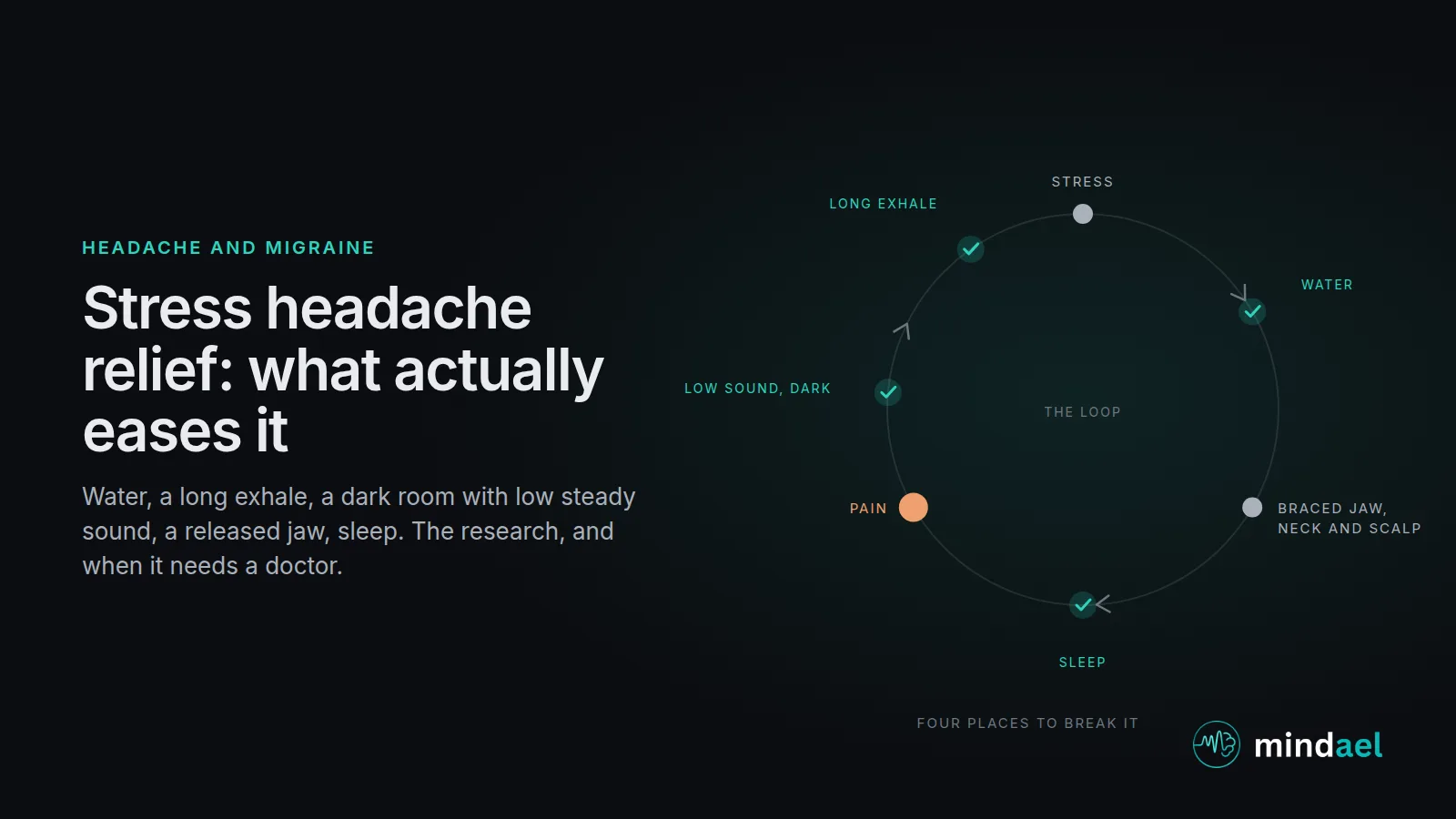
A stress headache is usually a tension-type headache: a dull, pressing, band-like ache on both sides, without nausea or light sensitivity, driven by stress, braced muscles, poor sleep, dehydration and screens. What eases it: a glass or two of water, ten minutes of slow breathing with the jaw and shoulders released, a dark quiet room with a low steady sound, heat on the neck, a walk, and a full night's sleep. Relaxation and biofeedback training reduce how often they come back. Keep sound low and soft, pink noise or rain, never loud; with migraine, go quieter still. A sudden severe headache, one with fever and a stiff neck, after a head injury, with weakness or confusion, or a new pattern after 50 needs a doctor now.
Sounds that work, and why
Pink noise
The gentlest of the noise colors, with none of white noise's hiss. At a very low level it covers a household without adding anything sharp, which is what a sore head needs.
Rain
Soft, textured and without a beat. Many of our listeners with tension headaches use it in a dark room for twenty minutes with the breathing guide, then sleep.
174 Hz
A single low tone, nothing to follow. We make no health claims for it beyond what it is; people who find any noise too much on a bad day often tolerate a low steady pitch.
Ocean waves
A slow rhythm to breathe to, roughly six waves a minute. Useful when the headache has a neck-and-shoulders component, because the exhale on each wave is where the shoulders drop.
Delta waves
A slow binaural beat, with earbuds, for the sleep that usually ends a stress headache. Keep the volume lower than you would on a normal night.
What a stress headache is
The headache most people mean by “stress headache” has a medical name, tension-type headache, and it is the most common headache there is. It presses rather than pulses, sits on both sides or in a band around the head, is mild to moderate, and does not get worse if you walk. There is usually no nausea and no strong aversion to light. It arrives in the afternoon of a hard day, after a long drive, at the end of an argument, or on the fourth night of short sleep.
Stress is its best-known trigger, and the mechanism is not only muscle. A 2010 review of the research found that stress makes the pain system itself more sensitive in people prone to these headaches, so the same braced neck that would be a stiff neck in someone else becomes a headache (Cathcart et al., 2010). That is why the fix has two halves: undo the brace, and turn down the stress that is amplifying it.
Stress headache or migraine?
It matters, because the sound advice is different. A migraine is usually one-sided and pulsing, moderate to severe, worse with movement, and comes with nausea or sensitivity to light and sound, sometimes with a visual aura before it. For most people with migraine, ordinary sound becomes painful during an attack: a 1998 study found sound discomfort thresholds dropped sharply during migraine compared with between attacks (Vingen et al., 1998). So with migraine, the room should be dark and nearly silent, and any sound you use should be barely audible. With a tension-type headache, a low steady sound helps more than it hurts. If you are not sure which you have, assume the quieter rule.
What eases it, in order
Water. Mild dehydration is a frequent and under-noticed trigger. In a randomised trial, people with recurrent headaches who were advised to drink an extra litre and a half of water a day reported fewer headache hours and better quality of life over three months (Spigt et al., 2012). Two glasses now, and give them twenty minutes.
Unclench. Tongue off the roof of the mouth, teeth apart, shoulders down, forehead smooth. Check them again in a minute; they creep back. Heat on the back of the neck, a warm shower, or a ten minute walk loosens the rest.
Slow breathing, lying down. Four in, six out through the nose, breathing into the belly so the shoulders are not involved, for ten minutes. Slow breathing near six a minute raises heart rate variability and lowers reported stress across the studies in a 2018 review (Zaccaro et al., 2018), and it is the half of the fix that turns down the amplifier. Our breathing guide has the patterns and the abdominal breathing article explains the mechanics.
A dark room and a low sound. Lights off, screen away. A steady sound at well below conversation level covers the household so you can rest. Across many pain conditions, music and sound reduce pain modestly, mainly through lowered stress and shifted attention (Lee, 2016); for headache the dose is the thing. Pink noise rather than white, rain rather than anything with a beat, and quieter than you would normally choose. The noise colors guide explains why pink is the softer choice.
Sleep. Short sleep is the most reliable everyday predictor of a headache the next day, and sleep is also what usually ends one. The sleep sounds guide has the evening routine; keep the volume lower than usual on a headache night.
A painkiller, early and rarely. A simple analgesic taken at the start works better than one taken an hour in. Taken more than two or three days a week, the same drugs cause rebound headaches, which is the most common way an occasional stress headache becomes a daily one.
Stopping them coming back
The research on prevention points at the stress half. Biofeedback training, which teaches people to lower muscle tension and slow their physiology on cue, reduced tension-type headache frequency with a medium-to-large effect across 53 studies, and the gains held for more than a year (Nestoriuc et al., 2008). In a landmark trial of chronic tension-type headache, stress management training was as effective as a daily antidepressant, and the two together did better than either (Holroyd et al., 2001). You do not need a clinic for the everyday version: ten minutes of slow breathing under a steady sound every evening, a fixed bedtime, water through the day, caffeine at the same time each day rather than more on bad days, and a screen break every hour with the shoulders dropped. Our guide to how to calm down fast covers the stress spike itself, and the anxiety guide covers the kind of stress that lives in the body for weeks.
When it is not a stress headache
See a doctor the same day for a headache that arrives suddenly and severely, like a blow; one with fever and a stiff neck; one after a head injury; one with weakness, numbness, confusion, trouble speaking or a drooping face; a new kind of headache after the age of 50; or one that gets steadily worse over days. See a doctor soon, not urgently, for headaches on 15 or more days a month, headaches that wake you from sleep, or any headache that is changing character. None of those is a stress headache until someone qualified says so.
How to set it up tonight
- Drink water, then wait twenty minutesTwo glasses. Mild dehydration is a common trigger and the one with the fastest fix. A trial found that drinking more water reduced headache hours in people with recurrent headaches.
- Unclench, from the top downLet the tongue drop from the roof of the mouth, part the teeth, let the shoulders fall, let the forehead go. Most people find three of the four were braced without knowing.
- Ten minutes of slow breathingFour seconds in through the nose, six out, lying down or sitting back, under a low sound. Breathe into the belly; our abdominal breathing article explains why. The shoulders drop on each exhale.
- A dark room, a low sound, no screenLights off or dimmed, phone face down, pink noise or rain at well below conversation level. Twenty minutes is usually enough to take the edge off; sleep, if it comes, finishes it.
- Heat on the neck, a short walkA warm towel or shower on the neck and shoulders loosens the muscles doing the gripping. A ten minute walk outside does the same from the inside and gets you off the screen.
- Fix the night, not just the afternoonShort sleep is the strongest everyday predictor of a headache tomorrow. Same bedtime, a steady sound, a fading timer; the sleep sounds guide has the routine.
Low, soft and steady, for a sore head.
Mindael's pink noise and rain are made for very low levels, with a volume control fine enough to set them barely there, guided slow breathing on top, and a timer that fades so the room goes quiet once you are asleep. Free to download, no account, works offline. Lights off, press play, breathe out.
- Pink noise, rain and a low 174 Hz tone, studio-made
- Guided slow breathing on top of the sound, timer that fades
- Free to download, no account, works offline
 Free · No account needed · Works offline
 Frequently asked questions
What does a stress headache feel like?
A dull, pressing or tightening pain on both sides of the head, often like a band across the forehead or at the back of the skull, mild to moderate, not pulsing, and not made worse by a walk. Usually no nausea and no strong light sensitivity. The medical name is tension-type headache, and stress is its most common trigger.
What is the difference between a stress headache and a migraine?
A migraine is usually one-sided, pulsing, moderate to severe, worse with activity, and comes with nausea or sensitivity to light and sound, sometimes with a visual aura first. A tension-type headache is two-sided, pressing, milder, and not made worse by moving. They can overlap, and stress triggers both.
How do I get rid of a stress headache fast?
Water, then unclench the jaw and shoulders, then ten minutes of slow breathing in a dark room with a low steady sound, then heat on the neck. Most tension headaches ease within an hour of that. A simple painkiller taken early helps too; taking them more than two or three days a week can cause rebound headaches.
Does white noise help a headache?
Low and soft, it can, by covering the household so you can rest; loud or bright, it hurts. Choose pink noise or rain rather than white, keep it well below conversation level, and if you have migraine, go quieter still or use silence, since sound sensitivity is part of migraine for most people.
Can music relieve headache pain?
Music reduces pain modestly across many conditions in meta-analyses, mostly by lowering stress and distracting from the pain. For headache, the rule is low and slow: no beat you will follow, no words, no volume. Steady sound under breathing is what we would use.
How long does a stress headache last?
From half an hour to a few days, with most easing in a few hours once the trigger is removed. If you have them 15 or more days a month for three months, that is chronic tension-type headache, and it is worth seeing a doctor, because preventive treatment works.
When should I worry about a headache?
See a doctor now for a sudden very severe headache, a headache with fever and a stiff neck, one after a head injury, one with weakness, numbness, confusion or trouble speaking, a new kind of headache after 50, or one that keeps getting worse over days. Those are not stress headaches until a doctor says so.
Sources
- Cathcart S, Petkov J, Winefield AH, Lushington K, Rolan P. Central mechanisms of stress-induced headache. Cephalalgia, 2010.
- Nestoriuc Y, Martin A, Rief W, Andrasik F. Biofeedback treatment for headache disorders: a comprehensive efficacy review. Applied Psychophysiology and Biofeedback, 2008.
- Holroyd KA, et al. Management of chronic tension-type headache with tricyclic antidepressant medication, stress management therapy, and their combination. JAMA, 2001.
- Spigt M, et al. A randomized trial on the effects of regular water intake in patients with recurrent headaches. Family Practice, 2012.
- Lee JH. The effects of music on pain: a meta-analysis. Journal of Music Therapy, 2016.
- Vingen JV, Pareja JA, Støren O, White LR, Stovner LJ. Phonophobia in migraine. Cephalalgia, 1998.
- Zaccaro A, et al. How breath-control can change your life: a systematic review on psycho-physiological correlates of slow breathing. Frontiers in Human Neuroscience, 2018.
This page is for general information and is not medical advice. A sudden severe headache, a headache with fever and stiff neck, after a head injury, with weakness, numbness or confusion, or a new pattern after 50 needs urgent medical attention. Frequent headaches deserve a doctor's assessment.