

How to Focus Better: 8 Changes That Work, Ranked by Evidence
To focus better, remove the things that pull attention before you try to push it: phone in another room, one task written down, notifications off. Then work in timed blocks with a short break, run a steady sound to mask the room, and protect sleep and daily movement, because tired brains cannot focus however good the method. Each of these has measured effects; together they are the difference between a day of effort and a day of work.
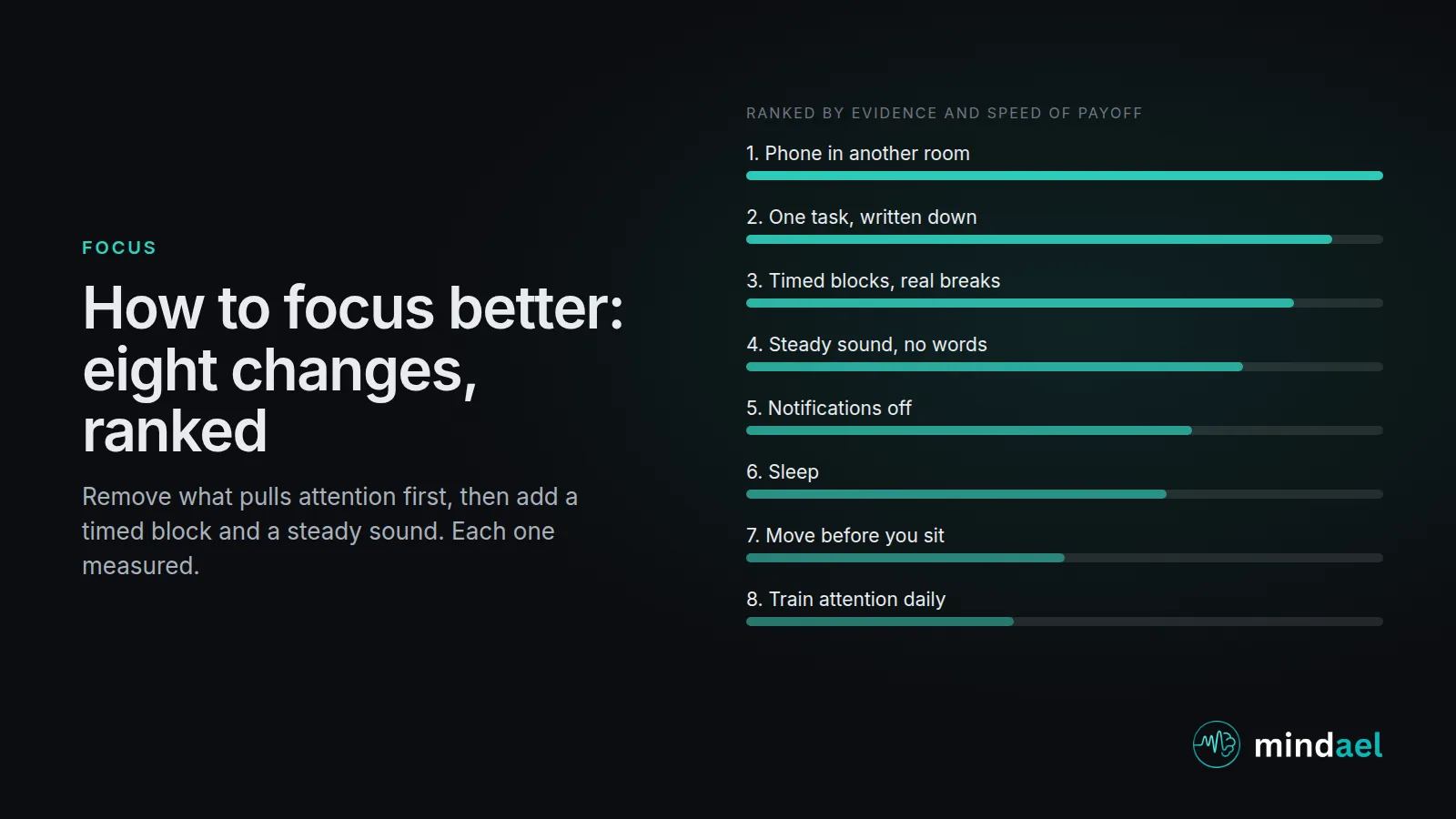
How to focus better is a question we get from students, developers, and people who have just realised a whole afternoon went somewhere. The honest answer is that focus is mostly about what you remove, and only then about what you add. We built the focus side of Mindael, free on the App Store, around the two things worth adding: a steady sound and a timed block. The list below is ranked by how much evidence sits behind each change and how fast it pays off. Do the first three today.
1. Put the phone in another room
Not face down. Not in a pocket. In a different room. In a 2017 series of experiments, people did worse on attention and working-memory tests when their own phone was on the desk than when it was in their bag, and worse in the bag than in another room, even though it was silent and they never touched it (Ward et al., 2017). Part of your attention stays on the phone as long as it is reachable. This is the cheapest gain on the list and the one most people skip.
2. Write down the one task
Vague tasks do not start. “Work on the report” is a feeling; “write the methods section” is a task. Before you begin, write the one thing in a line, by hand. It also stops the second problem: switching. A 2009 study found that when people move from one task to another, part of their attention stays with the first, especially if it was unfinished, and performance on the second task suffers (Leroy, 2009). One task, finished or parked deliberately, then the next.
3. Work in timed blocks with real breaks
Attention on one task fades after 20 to 40 minutes whatever you do, and the fix is a short break, not more effort. In a 2011 experiment, people on a 50 minute vigilance task declined steadily unless they got two brief breaks, in which case they held level to the end (Ariga and Lleras, 2011). The Pomodoro technique, 25 minutes on and five off, is the simplest way to build that in. The break has to be away from the screen; five minutes of messages is another task, not a rest.
4. Mask the room with a steady sound
An open office, a shared flat, a café: the problem is not volume but variety. Speech in particular pulls attention because the brain cannot help decoding it. A steady sound without words covers it. Brown noise is what most of our listeners use; rain for reading; a beta or gamma binaural beat with earbuds for the hardest block of the day. For people who find focus hard in general, the evidence is stronger still: steady noise improved cognitive performance in children with ADHD in a 2007 study, where it hindered those without (Söderlund et al., 2007). Our focus sounds guide has the settings. Keep the level at a quiet conversation.
5. Turn off the interruptions you can
Notifications, the email tab, the chat window. A 2008 study found interrupted workers still finished the task, but faster and with more stress, frustration and effort, because they compressed the work to make up the time (Mark et al., 2008). For a 25 minute block, everything that can ping is off. If someone genuinely needs you, they can wait 25 minutes; if they cannot, your job is not the kind this article is about.
6. Sleep, because nothing below works without it
This is the one people try to skip with coffee. A 2010 meta-analysis of 70 studies found short-term sleep loss hits sustained attention hardest of all cognitive functions (Lim and Dinges, 2010). A tired brain cannot hold a task however good the method. If focus has been poor for weeks, look at sleep before looking at techniques; our sleep sounds guide is where we would start.
7. Move before you sit
A 2012 meta-analysis of 79 studies found a single bout of moderate exercise improves cognitive performance, with the clearest gains in the hour after (Chang et al., 2012). A brisk ten minute walk before a block of hard work is not a luxury; it is preparation. Use the long Pomodoro break for the same thing.
8. Train attention a few minutes a day
Focus is a skill, and it trains quickly. In a 2010 study, four sessions of 20 minute mindfulness training improved sustained attention and working memory compared with a control group that listened to a book (Zeidan et al., 2010). Our meditation sounds guide has a simple way in. Slow breathing before a block does a smaller version of the same job; the patterns are in our breathing guide.
Focusing better in class
The same list, adapted. Phone in the bag, zipped. Sit where the screen or the teacher is the only thing in view. Write notes by hand; typing invites the browser. Five minutes of slow breathing before class settles attention, and a walk afterwards helps what you heard stick. If a lecture runs 90 minutes, a quiet stretch at the halfway mark is your break.
The two-minute version
Phone in the other room. One task on paper. Timer for 25 minutes. Brown noise, low. Begin. That is four of the eight, it takes two minutes to set up, and it is what we would want you to do before reading anything else about focus.

The sound and the timer are already in your pocket.
Most of this list is about removing things. The two things worth adding, a steady sound and a timed block, are what Mindael is built for: brown noise and binaural beats made in our studio, a Pomodoro timer that fades instead of ringing, offline and with no account. Download it, put the phone in the other room, and start the first block.
- Brown noise, beta and gamma beats, rain, studio-made
- Pomodoro timer with a fade at the end of each block
- Free to download, no account, works offline
 Free · No account needed · Works offline
 Frequently asked questions
How can I focus better right now?
Put the phone in another room, write the one task you are doing on paper, set a 25 minute timer and start a steady sound like brown noise at a low volume. Those four take two minutes and remove most of what is pulling at you.
How do I focus better in class?
Sit near the front, phone in the bag not the pocket, and write by hand rather than typing. Before class, five minutes of slow breathing settles attention. Afterwards, a ten minute walk helps what you heard stick.
Why can't I focus?
Usually one of three things: a phone within reach, too little sleep, or a task that is too vague to start. Fix those in that order before assuming something is wrong with you. If focus has been hard for months across every setting, that is worth raising with a doctor.
Does music help you focus?
Music with words competes with reading and writing. Steady sound without words, such as brown noise or rain, masks the room and has measurable effects on attention, especially for people who find focus hard. Keep it at the level of a quiet conversation.
How long can a person really focus?
Attention on one continuous task starts to fade within 20 to 40 minutes. The fix is not to try harder but to break briefly and return: a 2011 study found two short breaks kept performance flat across 50 minutes where a no-break group declined.
Does coffee help focus?
Caffeine improves alertness, which is not the same as focus, and it does nothing about a phone on the desk. It helps most in the morning on a reasonable night's sleep and least as a substitute for sleep.
Sources
- Ward AF, et al. Brain drain: the mere presence of one's own smartphone reduces available cognitive capacity. Journal of the Association for Consumer Research, 2017.
- Leroy S. Why is it so hard to do my work? The challenge of attention residue when switching between work tasks. Organizational Behavior and Human Decision Processes, 2009.
- Ariga A, Lleras A. Brief and rare mental "breaks" keep you focused. Cognition, 2011.
- Mark G, Gudith D, Klocke U. The cost of interrupted work: more speed and stress. CHI 2008.
- Söderlund G, Sikström S, Smart A. Listen to the noise: noise is beneficial for cognitive performance in ADHD. Journal of Child Psychology and Psychiatry, 2007.
- Lim J, Dinges DF. A meta-analysis of the impact of short-term sleep deprivation on cognitive variables. Psychological Bulletin, 2010.
- Chang YK, et al. The effects of acute exercise on cognitive performance: a meta-analysis. Brain Research, 2012.
- Zeidan F, et al. Mindfulness meditation improves cognition: evidence of brief mental training. Consciousness and Cognition, 2010.
This article is for general information and is not medical advice. If trouble focusing is persistent and affects your work or studies across settings, please talk to a doctor.
This article is part of our focus guide. Hear the sounds in this article in the Mindael sound library, or see our app comparison checklists.