

Sound Therapy for Tinnitus: What the Research Says, the Mixing Point, and the Sounds That Make Ringing Easier to Live With
Sound therapy for tinnitus means playing a steady, low background sound so the ringing stands out less, in a quiet bedroom above all. It does not cure tinnitus, and nothing sold online does, but many people find it makes the ringing easier to ignore and sleep easier to reach, and clinical guidelines list it as an option. This page explains what the research and the guidelines say, the one rule that matters most, the mixing point just below the ringing, and the sounds our listeners with tinnitus use, which are in Mindael, free to download on the App Store. New tinnitus, ringing in one ear, a pulsing sound or any sudden hearing change needs a doctor first.
Tinnitus, hearing a ringing, hissing or buzzing with no outside source, affects roughly one adult in seven, and for most it is a nuisance that is worst in silence. Sound therapy adds a steady, low background sound, broadband noise or natural sound, so the contrast between the tinnitus and the room drops and the brain has less reason to attend to it. Systematic reviews find the evidence is limited and of low quality, with no clear advantage of sound devices over counselling alone, and the US clinical guideline lists sound therapy as an option rather than a recommendation; cognitive behavioural therapy has the strongest evidence for reducing distress. In practice: set the sound just below the tinnitus, at the mixing point where you hear both, rather than covering it; use it at night and in quiet rooms; choose a sound you find neutral or pleasant, often pink noise, rain or a stream; keep it at a safe level; and see a doctor for new, one-sided, pulsing or sudden tinnitus.
Sounds that work, and why
Pink noise
The usual first choice: broadband like the noise generators audiologists use, softer than white, and easy to set just below the ringing in a quiet bedroom.
Rain
For people who find steady noise irritating: broadband with natural variation, recorded without loops, and the sound many tinnitus listeners settle on for the night.
Ocean waves
A slow swell that rises and falls, so the ear has something gently changing to follow. Good for the hour before sleep.
White noise
The closest match to a high, hissing tinnitus, at a very low level. Too sharp for some people; try pink first.
Brown noise
For a low, rumbling tinnitus or for people who find hiss unbearable. Deep and soft, but it does less against high-pitched ringing.
What tinnitus is, and why silence makes it worse
Tinnitus is hearing a sound, ringing, hissing, buzzing or humming, that has no source outside the head. It is common: a 2022 meta-analysis put it at around 14 percent of adults worldwide, with about 2 percent severely affected (Jarach et al., 2022). Most often it comes with some hearing loss, from age or noise, and the leading explanation is that the brain turns up its own gain to make up for missing input, and the ringing is that gain made audible.
That explains the most common complaint: tinnitus is worst in silence. In a busy street it disappears; in a quiet bedroom at midnight it is all there is. The contrast is the problem. A steady background sound lowers the contrast, gives the hearing system real input to work with, and makes the ringing one sound among several instead of the only one. That is sound therapy, in one paragraph.
What the research and guidelines say
We want to be precise here, because this is a niche full of cure claims. A 2018 Cochrane review of sound therapy using hearing aids and sound generators found the evidence limited and of low quality, with no clear difference between sound devices and education or counselling alone (Sereda et al., 2018). An earlier Cochrane review of masking reached a similar conclusion (Hobson et al., 2012). The US clinical practice guideline lists sound therapy as an option clinicians may offer for persistent, bothersome tinnitus, recommends hearing aids where there is hearing loss, recommends cognitive behavioural therapy, and recommends against supplements and several other treatments sold for tinnitus (Tunkel et al., 2014).
The strongest evidence for reducing how much tinnitus bothers people belongs to cognitive behavioural therapy, which a 2020 Cochrane review found reduced the impact of tinnitus on quality of life, though not its loudness (Fuller et al., 2020). The honest summary: sound therapy is a sensible, low-risk way to make tinnitus easier to live with, especially at night, and it works best alongside the rest of the picture, not as a cure.
The mixing point
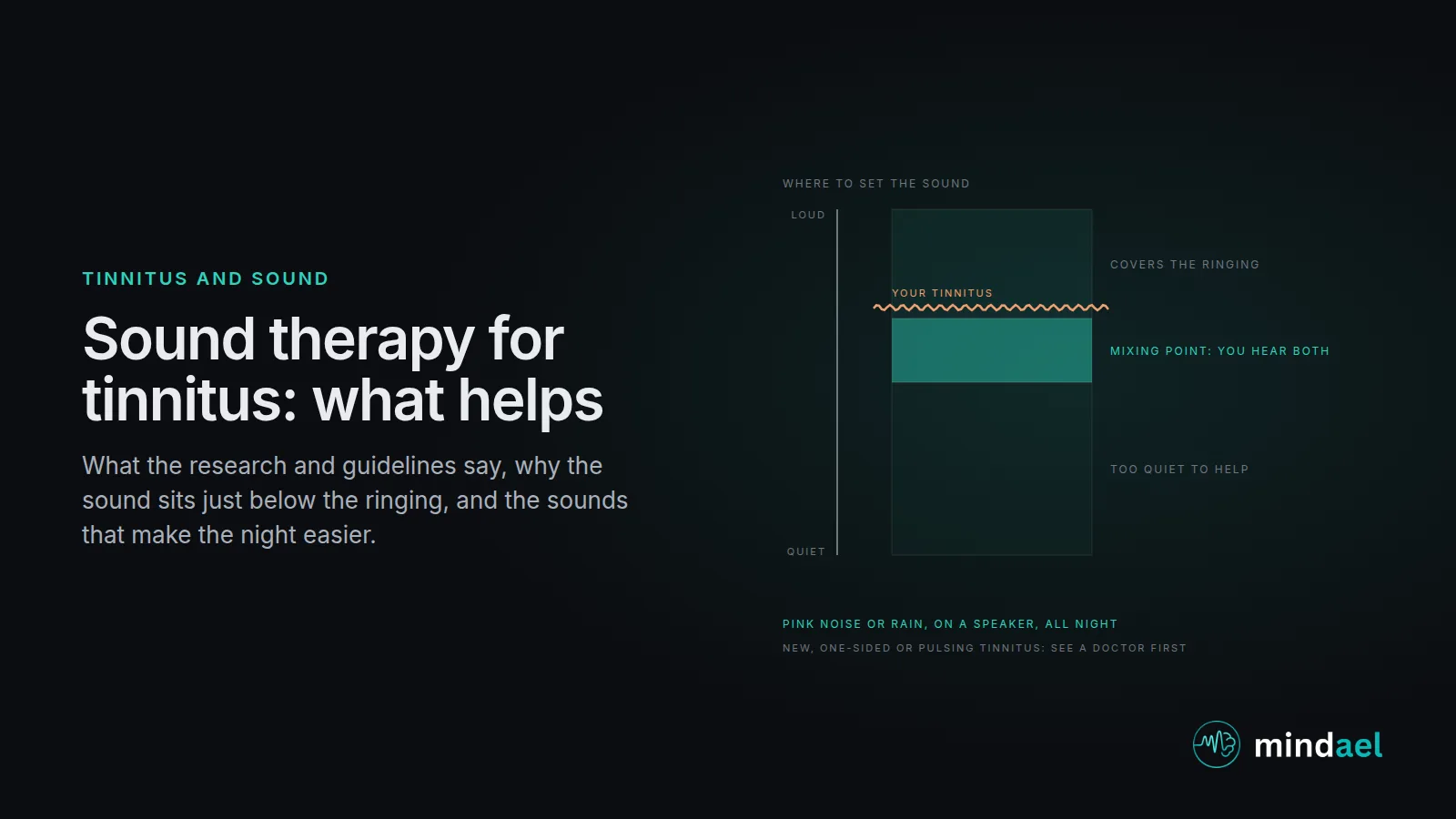
The single most useful rule is about level. Most sound therapy programmes set the background sound just below or at the tinnitus, at the point where you can hear both blended together, rather than loud enough to cover it. Partly that is about safety: a sound loud enough to mask tinnitus completely, all night, is more than tired ears need. Partly it is the aim: the brain gets used to sounds it hears as part of the background, and the tinnitus can only become background if it is still faintly there.
In practice: in the quiet room where it bothers you, start the sound at zero and raise it slowly until it begins to merge with the ringing. Stop there. If you can still pick out the tinnitus by listening for it, that is fine; the test is whether you stop noticing it when you are not listening.
Which sound
Choose a sound you find neutral or pleasant and can forget: a sound you dislike makes tinnitus feel worse. Pink noise is the closest to the broadband sound generators audiologists use and the usual first choice. Rain or a stream is the most popular with our listeners for the night, because natural variation is easier to ignore over hours than a steady hiss. White noise at a very low level suits a high, hissing tinnitus; brown noise suits a low hum, or people who cannot stand hiss, and our noise colours comparison explains the difference. Ocean waves rise and fall, which gives the ear something gently changing to follow before sleep. Avoid music with a melody, which pulls attention, and be sceptical of anything sold as a frequency that heals tinnitus; our best frequency for healing article explains why.
At night
Tinnitus is a sleep problem for many people more than a daytime one, because night is when the room goes quiet. Run the sound on a speaker by the bed, at the mixing point, all night rather than on a timer, so the room does not go silent when you surface between sleep cycles. The rest of the sleep sounds guide applies, and our noise masking for sleep guide covers the difference between masking a noise in the room and living with one in the ear. If the ringing makes your mind race at night, the slow breathing and evening routine in our how to relax your nervous system article work on the part that keeps you awake, and the breathing guide runs the patterns over any of these sounds.
When to see a doctor
New tinnitus deserves a check before sound therapy, and some kinds deserve one promptly: tinnitus in one ear only, a pulsing sound in time with your heartbeat, tinnitus with sudden hearing loss, dizziness or ear pain. Sudden hearing loss is treated as an emergency because early treatment matters. If tinnitus is affecting your sleep or mood, an audiologist can test your hearing, since hearing aids help many people with both, and a doctor can refer you for cognitive behavioural therapy, which has the best evidence for the distress that makes tinnitus hard. A steady sound at the mixing point is the part you can start tonight, alongside all of that.
How to set it up tonight
- See a doctor first if it is newNew tinnitus, ringing in one ear only, a pulsing sound in time with your heartbeat, or any sudden change in hearing should be checked before anything else. Sudden hearing loss is treated as urgent. Sound therapy is for tinnitus that has been looked at.
- Find the mixing pointIn a quiet room, start the sound at zero and raise it slowly until it begins to blend with the ringing, so you hear both. Stop there, or just below. That is the level most sound therapy programmes use: the aim is to make the tinnitus less noticeable, not to cover it.
- Choose a neutral soundThe sound should be one you can forget: pink noise, rain or a stream for most people, white noise for a high hiss, brown for a low hum. Avoid anything with a melody you will follow, and anything you find irritating, which makes the tinnitus feel worse.
- Use it where silence isTinnitus is loudest against silence: the bedroom, a quiet office, the first minutes after waking. Run the sound there. A speaker is better than earbuds at night, both for comfort and because it fills the room rather than the ear.
- All night, at a safe levelKeep the sound running until morning so the room does not go silent at 3 a.m. Keep it well below a conversation; sound loud enough to mask tinnitus completely is loud enough to tire the ears over hours.
- Work on the distress tooWhat makes tinnitus hard is often not the sound but the worry and attention around it. Cognitive behavioural therapy has the strongest evidence for reducing that, and slow breathing and a steady evening routine help with the part that keeps you awake.
Just below the ringing, all night.
Mindael has pink, white and brown noise generated to spec, rain and ocean recorded without loops, mixed two at a time with fine volume control and all-night play. Free to download, no account, works offline. Set it to the mixing point, put the phone down, and let the room stop being silent.
- Pink, white and brown noise to spec, rain and ocean without loops
- Fine volume control for the mixing point, all-night play
- Free to download, no account, works offline
 Free · No account needed · Works offline
Frequently asked questions
Does sound therapy work for tinnitus?
It helps many people live with tinnitus, especially at night, by making the ringing less noticeable. Systematic reviews find the evidence is limited and low quality, with no clear advantage of sound devices over counselling, so it is listed in clinical guidelines as an option rather than a firm recommendation. It does not cure tinnitus or change its loudness long term.
What is the best sound for tinnitus?
The best sound is a steady, broadband one you find neutral or pleasant. Pink noise and rain suit most people; white noise suits a high hissing tinnitus at a very low level; brown noise suits a low hum or people who dislike hiss. Natural sound with gentle variation is easier to listen to for hours than a pure tone.
Should white noise be louder than tinnitus?
No. Most sound therapy approaches set the sound just below or at the level of the tinnitus, at the mixing point where you hear both, so the brain gets used to the ringing as part of the background. Covering it completely means a louder sound, which tires the ears over a night and does not help the brain stop attending to it.
Can you sleep with tinnitus sounds on all night?
Yes, at a low level. Running the sound all night stops the room going silent when you surface between sleep cycles, which is when tinnitus is most noticeable. Use a speaker rather than earbuds where you can, and keep the level well below a conversation.
Is there a sound that cures tinnitus?
No. No sound, frequency or video, including the ten-hour 'tinnitus healing' recordings, has been shown to cure tinnitus. Sound therapy makes it easier to live with. Claims of a cure are marketing.
When should I see a doctor about tinnitus?
When it is new, in one ear only, pulsing in time with your heartbeat, comes with sudden hearing loss, dizziness or ear pain, or is affecting your sleep or mood. Sudden hearing loss is treated as urgent. An audiologist can also test your hearing, since hearing aids help many people with both hearing loss and tinnitus.
Sources
- Tunkel DE, et al. Clinical practice guideline: tinnitus. Otolaryngology, Head and Neck Surgery, 2014.
- Sereda M, et al. Sound therapy (using amplification devices and/or sound generators) for tinnitus. Cochrane Database of Systematic Reviews, 2018.
- Hobson J, Chisholm E, El Refaie A. Sound therapy (masking) in the management of tinnitus in adults. Cochrane Database of Systematic Reviews, 2012.
- Fuller T, et al. Cognitive behavioural therapy for tinnitus. Cochrane Database of Systematic Reviews, 2020.
- Jarach CM, et al. Global prevalence and incidence of tinnitus: a systematic review and meta-analysis. JAMA Neurology, 2022.
This page is for general information and is not medical advice. Sound therapy does not cure tinnitus. New tinnitus, tinnitus in one ear, pulsing tinnitus, or tinnitus with sudden hearing loss, dizziness or ear pain should be checked by a doctor promptly; sudden hearing loss is treated as urgent. Keep any sound at a safe, low level.