

Highly Sensitive People: What the Trait Is, What the Research Found, and How to Use Sound to Turn the World Down
Highly sensitive people, around a third of us by the best estimates, process everything more deeply: sound, light, other people's moods, their own. It is a trait, not a disorder, with a research literature behind it going back to 1997, and the thing it most reliably comes with is being more easily overstimulated, especially by noise. This page explains the trait as the research describes it, why a loud world costs sensitive people more, and the part we can actually help with: steady sound that lowers the room's contrast, quiet routines that give the nervous system a predictable floor, and the sounds our sensitive listeners use. They are in Mindael, free to download on the App Store.
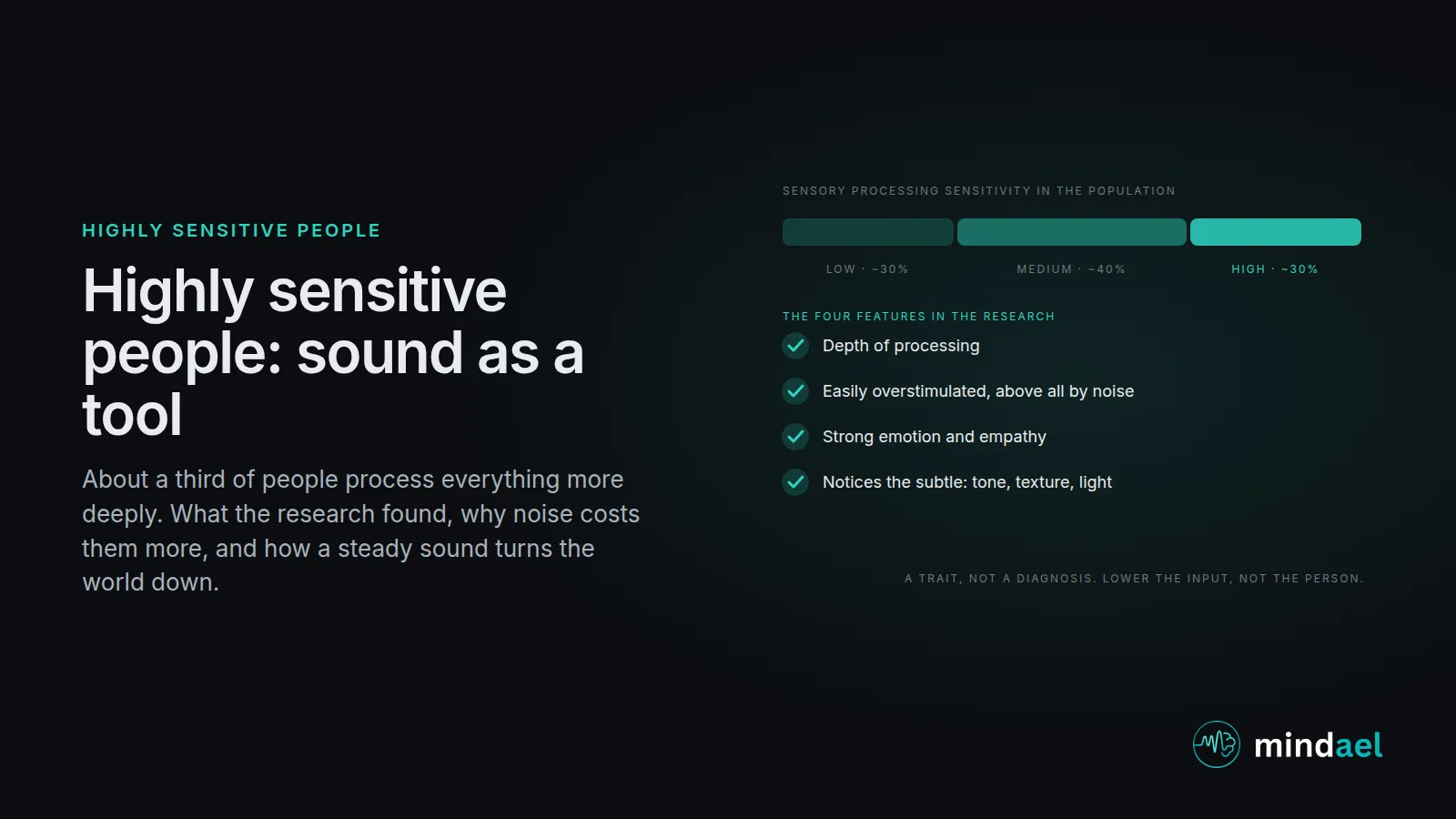
Sensory processing sensitivity, the research name for being a highly sensitive person, is a stable trait found in roughly 20 to 35 percent of people: deeper processing of experience, stronger emotional and empathic responses, awareness of subtle detail, and easier overstimulation. Brain imaging shows sensitive people's attention and empathy regions respond more strongly to other people's expressions. The trait is not a diagnosis and is not autism or ADHD, though sensory overload overlaps with both. What helps, in the research and in our listeners' experience, is lowering input rather than toughening up: a steady, low sound that masks sudden noise, predictable routines, real breaks after stimulating hours, slow breathing to come down, and the same sound at the same time each evening so the body learns when the day ends.
Sounds that work, and why
Brown noise
The masking sound for a sensitive ear: deep, soft, no hiss, it raises the floor so doors, voices and traffic lose their edge. Low volume, in headphones in a loud place.
Green noise
For people who find brown too heavy and white too sharp: the mid band, closest to a natural soundscape, and the least fatiguing over a long day.
Rain
The evening sound. Recorded without loops, natural variation, nothing to analyse. A 2021 synthesis found water sounds the most consistently calming of natural sounds.
174 Hz
The lowest solfeggio tone, under rain, for a lying-down rest after an overstimulating day. Felt more than heard.
Theta waves
The 6 Hz beat, in earbuds, for the deliberate come-down: twenty minutes of settling with research behind it.
What the trait is
The research name is sensory processing sensitivity, and the scale that measures it was published in 1997 by Elaine and Arthur Aron, who found a cluster of people, about a fifth of their samples, who reported being easily overwhelmed by sensory input, deeply affected by art and other people’s moods, aware of subtleties, and in need of downtime after busy days; the trait overlapped with introversion but was not the same thing, since about a third of the high-sensitivity group were extraverts (Aron and Aron, 1997). Later work settled the proportions: across large samples, roughly 30 percent of people fall in the high-sensitivity group, 40 percent medium and 30 percent low, the “orchids, tulips and dandelions” of a 2018 paper (Lionetti et al., 2018).
The four features the research uses are depth of processing, ease of overstimulation, emotional reactivity with high empathy, and sensitivity to subtle stimuli. In everyday terms: you think things over, you tire in loud or busy places, you feel strongly and catch other people’s moods, and you notice the hum of the fridge, the scratch of a label, the change in someone’s tone. A 2019 review placed the trait in the broader idea of environmental sensitivity: sensitive people are more affected by their surroundings in both directions, which means a good environment helps them more than average, not just that a bad one hurts more (Greven et al., 2019).
It is a trait, not a disorder, and not a diagnosis anyone can give you. The overlap that matters is with sensory overload in autism and ADHD, which can look similar from the outside and sometimes co-occur; if sensitivity comes with social-communication difficulties or attention problems that disrupt life, an assessment is worth having, because the right support differs. Our ADHD sounds guide covers the attention side.
What the research found in the brain
In a 2014 fMRI study, people high in the trait showed stronger activation in regions for attention, empathy and action planning when looking at photographs of their partners’ and strangers’ happy and sad faces, and the effect was strongest for their partners’ expressions (Acevedo et al., 2014). That is the “deeper processing” feature made visible: more of the brain engaging with the same input. It is also why sensitive people are often the ones in a room who noticed first, and the ones who are tired first.
What this means for noise is simple and worth stating plainly. Every input gets processed more fully, so a loud or unpredictable environment costs a sensitive person more per hour than it costs someone else. Willpower does not change that; arranging the input does.
Why sound, and which
The thing that overstimulates is rarely volume. It is contrast and unpredictability: a quiet office with sudden laughter, a flat with a slammed door, a café where every conversation arrives separately. A steady, low, broadband sound raises the floor of the room, so those spikes have less contrast and stop registering as events. Nothing gets quieter; less of it gets through. That is what brown noise does, and why it is the sound our sensitive listeners reach for in headphones on the commute and in the open office. Green noise is the version for people who find brown too heavy and white too sharp, and our noise colours comparison explains the difference.
For recovery, rather than masking, natural sound. A 2021 synthesis of studies found natural soundscapes lowered stress and pain and improved mood, with water sounds the most consistently helpful (Buxton et al., 2021). Rain at a low level, with nothing to analyse in it, is the evening sound; the lowest solfeggio tone, 174 Hz, under it for a lying-down rest. And for a deliberate come-down after a hard stretch, slow breathing at around six breaths a minute, four in and six out, lowers arousal across many studies (Zaccaro et al., 2018); our breathing guide runs it over any of these sounds.
Volume lower than you think. For a sensitive ear, a masking sound at normal volume is just one more input; at a quiet-conversation level or below, it is a floor you forget.
A day arranged for the trait
Morning: the first twenty minutes without a screen, the same sound, a slow start; the morning guide has the alarm and light side of it. Commute and open office: headphones, brown or green noise, low. After anything stimulating, a meeting, a crowd, a hard conversation: twenty minutes somewhere dim with rain on and eyes closed before the next thing, not the phone, which is more input dressed as rest. Evening: lights down early, the same sound at the same time, the slow routine in our how to relax your nervous system article, which was written for a braced body and fits a sensitive one exactly. Night: a low constant sound all night, brown or rain, so the room does not change at 3 a.m.; the sleep sounds guide has the setup. When the day has tipped into a spike rather than a slow overload, the anxiety guide has the five-minute routine, and the how to calm your nervous system article the fast levers.
None of this makes a person less sensitive, and that is not the aim. The trait that makes a loud room expensive is the trait that makes sensitive people notice, care, and make things. The research on orchids is clear that in the right conditions they do better than average. The conditions are the project, and sound is the part of them that is cheapest to change.
How to set it up tonight
- Lower the input before you need toA sensitive nervous system runs out of room by mid-afternoon on a loud day. Headphones with brown or green noise on the commute and in the open office are not avoidance; they are keeping the budget for the hours that matter.
- One steady sound instead of many sudden onesThe problem is rarely volume; it is contrast. A sudden voice in a quiet room costs more than a constant hum. A low steady sound raises the floor so the spikes stop registering as events.
- A real break after a stimulating stretchTwenty minutes somewhere dim and quiet after a meeting, a crowd or a difficult conversation, before the next thing. Not the phone. Rain on, eyes closed, four in and six out.
- The same evening, every eveningLights down, the same sound at the same time, a slow routine the body recognises. Sensitive people benefit more than most from predictability, because novelty is the thing that costs them.
- Sleep as the resetOverstimulation accumulates and sleep is where it clears. A low constant sound all night, brown or rain, so the room does not change at 3 a.m., and the night-time setup in our sleep guide.
- Keep the trait, drop the apologyDepth of processing is the same trait that makes sensitive people notice, care and create. The aim is a life arranged so the trait costs less, not a less sensitive person.
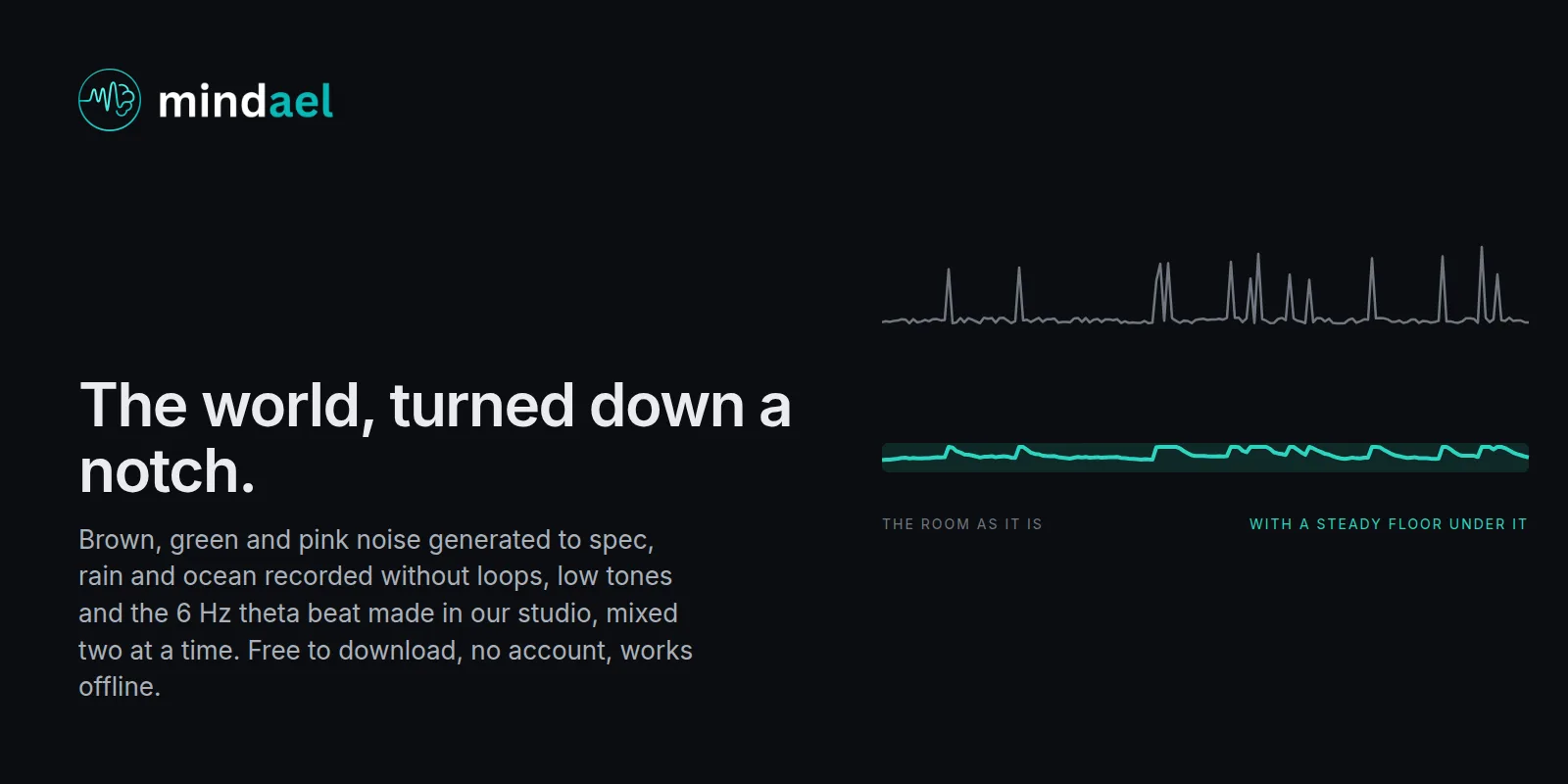
The world, turned down a notch.
Mindael has brown, green and pink noise generated to spec, rain and ocean recorded without loops, low tones and the 6 Hz theta beat made in our studio, mixed two at a time, with a timer that fades. Free to download, no account, works offline. A steady floor for the loud hours and the same sound for the quiet ones.
- Brown, green and pink noise, rain, low tones and theta beats, studio-made
- Two sounds at once, a timer that fades, all-night play
- Free to download, no account, works offline
 Free · No account needed · Works offline
Frequently asked questions
What is a highly sensitive person?
Someone high in sensory processing sensitivity, a stable trait first described in the research in 1997: deeper processing of experience, strong emotional and empathic responses, awareness of subtleties, and easier overstimulation. Around 20 to 35 percent of people fall in the high group. It is a temperament, not a disorder or a diagnosis.
What are the traits of highly sensitive people?
The four the research uses: depth of processing (thinking things over, noticing implications), overstimulation (tiring faster in loud, busy or bright settings), emotional reactivity and empathy (feeling things strongly, including other people's moods), and sensitivity to subtleties (small changes in a room, a tone of voice, a texture). Needing time alone after social events, being moved by music and art, and being bothered by noise, scratchy fabric and strong smells are the everyday versions.
Is being highly sensitive the same as autism or ADHD?
No. Sensory overload overlaps with both, and some people have more than one of these, but sensory processing sensitivity is a temperament trait across the general population, not a neurodevelopmental condition. If sensitivity comes with difficulty in social communication, or with attention problems that disrupt work or school, an assessment is worth having, because the right support is different.
Why does noise affect sensitive people so much?
Deeper processing means more of every input is handled, and the brain's response to sudden sound is stronger. The cost is not the volume but the contrast and the unpredictability: a quiet room with occasional sharp sounds is harder than a steady hum. That is why a low constant sound helps: it raises the floor and the spikes stop being events.
What sounds help highly sensitive people?
Steady, low, broadband sound for masking, brown or green noise, and natural sound with gentle variation for recovery, rain or a stream. Nothing sharp, nothing with lyrics, nothing that changes suddenly. Volume lower than you think, at a quiet-conversation level or below.
Is being highly sensitive a bad thing?
The research says the opposite in the right environment. Sensitive people respond more to good conditions as well as bad ones: the 'orchid' pattern, where a supportive setting produces better outcomes than average. The task is arranging the environment, including the sound in it, so the trait costs less and gives more.
Sources
- Aron EN, Aron A. Sensory-processing sensitivity and its relation to introversion and emotionality. Journal of Personality and Social Psychology, 1997.
- Lionetti F, et al. Dandelions, tulips and orchids: evidence for the existence of low-sensitive, medium-sensitive and high-sensitive individuals. Translational Psychiatry, 2018.
- Acevedo BP, et al. The highly sensitive brain: an fMRI study of sensory processing sensitivity and response to others' emotions. Brain and Behavior, 2014.
- Greven CU, et al. Sensory processing sensitivity in the context of environmental sensitivity: a critical review and development of research agenda. Neuroscience & Biobehavioral Reviews, 2019.
- Buxton RT, et al. A synthesis of health benefits of natural sounds and their distribution in national parks. PNAS, 2021.
- Zaccaro A, et al. How breath-control can change your life: a systematic review on psycho-physiological correlates of slow breathing. Frontiers in Human Neuroscience, 2018.
This page is for general information and is not medical advice. High sensitivity is a temperament trait, not a diagnosis. If sensory overload, anxiety or exhaustion is disrupting work, relationships or sleep, or if it comes with difficulties in attention or social communication, please talk to a doctor or psychologist.