
Law of Attraction: Is It Real? What the Research Supports, What It Does Not, and a Practice That Works
"Is the law of attraction real?" is searched half a million times a month, and most answers are either a sales page or a sneer. Here is the honest version. The claim that thoughts emit a frequency the universe matches has no evidence and no mechanism, and we will not pretend otherwise. But inside the practice people call manifesting, there are habits that psychology has tested and found to work: writing goals down, picturing the steps rather than the prize, planning for the obstacle, and a daily minute of gratitude. This page separates the two, keeps what works, and gives you a ten-minute morning practice with a sound under it. The sounds are in Mindael, free to download on the App Store.
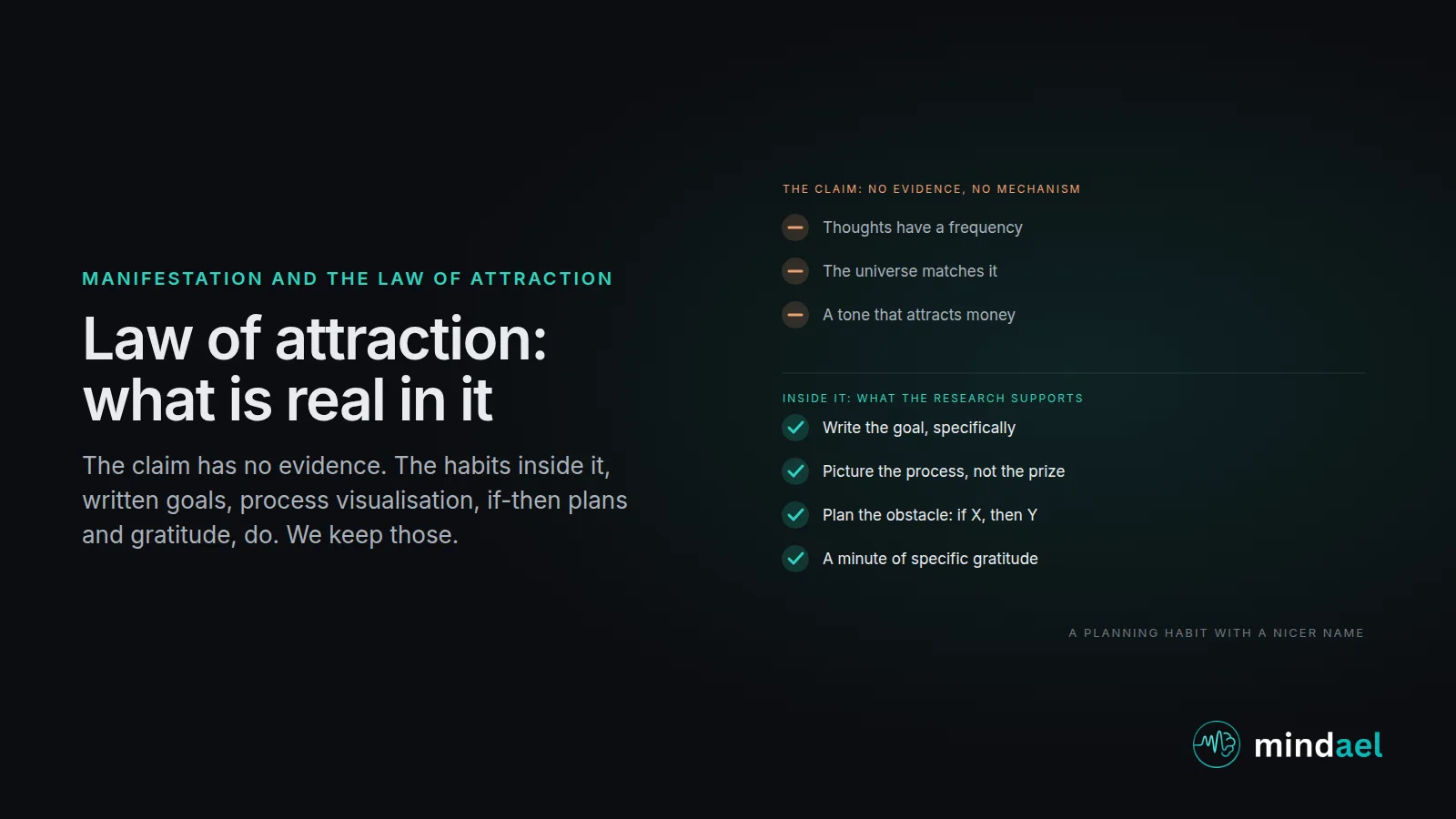
The law of attraction says like attracts like: hold a thought or feeling and the matching outcome arrives. As a physical claim it is not real; no study supports it and nothing in physics describes it. What is real is smaller and more useful. Writing specific goals and if-then plans roughly doubles follow-through across hundreds of studies. Visualising the process, the steps you will take, improves performance, while visualising only the outcome can reduce effort, because the brain partly cashes in the success early. Regular gratitude practice measurably lifts mood and optimism. Daily affirmations help people who already believe them and backfire for people who do not. A ten-minute morning practice built from those, with a steady sound to hold attention, is what we recommend; the universe is not required.
Sounds that work, and why
Theta waves
The 6 Hz beat, in earbuds, for the visualisation part of the practice: it is the sound with brain research behind it for a settled, inward state.
528 Hz
The tone the manifestation tradition calls the love frequency. We present that as a tradition, not a fact; it is a pleasant, precise tone to hold attention on for ten minutes.
Alpha waves
A 10 Hz beat for the writing part: relaxed and awake, the state in which planning goes best.
Rain
For people who want no beat and no tone, a steady natural sound that covers the room and cues the practice at the same time each morning.
852 Hz
The high, thin tone many of our listeners use for the gratitude minute at the end; low volume, eyes closed.
The claim, stated fairly
The law of attraction, in the form popularised in the mid-2000s, says that thoughts and feelings have a frequency, that the universe returns experiences of the same frequency, and that holding the feeling of already having something brings it about. Variants add rituals: writing a wish a set number of times a day, scripting a diary entry from the future, a vision board, a frequency to play.
As a claim about how the world works, it is not supported by anything. Thoughts do not broadcast, matter does not respond to mood, and the words “vibration” and “frequency” are borrowed from physics without any of the physics attached. We say this plainly because our whole site is built on telling people what a sound does and does not do, and we are not going to make an exception here. If you came for a frequency that attracts money, there is not one, in our app or anywhere.
What is interesting is that the practice survives anyway, and partly for good reasons. Strip out the metaphysics and what people are doing each morning is writing a goal down, imagining it, and feeling grateful. Those have been studied, and the results are specific enough to tell you which bits to keep.
What the research actually supports
Writing specific goals and if-then plans. Across 94 studies, forming an implementation intention, a sentence of the form “if situation X arises, I will do Y”, had a medium-to-large effect on whether people actually did the thing (Gollwitzer and Sheeran, 2006). Nothing in the manifesting toolkit comes close to this, and it takes one line.
Picturing the process, not the outcome. Students who spent five minutes a day imagining themselves studying for an exam, where, when, how, started earlier, studied longer and scored higher than those who imagined getting the grade (Pham and Taylor, 1999). The outcome group did no better than the control. This is the single most useful correction to the standard advice, which tells you to picture the prize.
Why pure positive fantasy backfires. Across four experiments, people who indulged in a vivid positive fantasy about a desired future showed lower energy, measured as blood pressure, and achieved less in the weeks after, than people who imagined it more soberly (Kappes and Oettingen, 2011). The brain partly cashes the success in early and relaxes. The fix from the same research programme is mental contrasting: picture the wish, then the obstacle, then the plan.
Gratitude. Keeping a weekly or daily list of things you are grateful for improved mood, optimism and, in one of the studies, hours of sleep and exercise, compared with listing hassles or neutral events (Emmons and McCullough, 2003). The effect is modest and reliable, and it is the part of manifesting that most people feel working, because it is.
Affirmations, with a warning. Repeating “I am a lovable person” made people with high self-esteem feel slightly better and people with low self-esteem feel worse (Wood et al., 2009). The gap between the statement and the belief is what gets noticed. Say things you believe, in your own words, or skip this part.
The sound. A 6 Hz theta beat raised the brain’s theta rhythm, the one associated with a settled, inward state, within ten minutes in a 2017 EEG study (Jirakittayakorn and Wongsawat, 2017). That is useful for the visualisation minutes. It attracts nothing. The 528 Hz tone the tradition calls the love frequency is a real, precise tone that is pleasant to hold attention on; our solfeggio frequencies article explains where the tradition came from and what it is not.
The ten-minute practice
Same time each morning, before the phone, with the same sound: the theta beat in earbuds or rain on a speaker, low. One line, written: the goal, concrete and dated. Three minutes, eyes closed, picturing the next steps, not the finish. One sentence naming this week’s obstacle and the if-then for it. One minute of three specific things from yesterday you were glad of. Then the first step, today, before the practice is allowed to count. The steps above have the sequence, and the meditation sounds guide covers the plain sit for the days you want the quiet without the planning. If the practice is something you would rather do in the evening, the morning guide explains why we put it at the start of the day anyway: the plan is for the hours that follow.
What we leave out, and why
Vision boards and scripting are harmless and some people find them motivating; they are repeated goal-setting in a nicer format, and if the format gets you to write the goal, keep it. The 369 method is the same. What we leave out entirely is the corollary that the common version carries: that illness, loss or hardship came to you because of your thoughts. It is false, it is unkind, and for someone in a hard year it is a weight they do not deserve. Use the habits above because they work, enjoy the ritual if it suits you, and if the framework ever starts telling you that a bad thing was your fault, that is the moment to put it down. For the sounds themselves and what they do, the chakra meditation guide takes the same honest line through a neighbouring tradition.
How to set it up tonight
- Same time, same sound, ten minutesMorning, before the phone. Theta beat in earbuds or rain on a speaker, low. The sound becomes the cue, which is most of why a practice sticks.
- Write the goal, specificallyOne line, concrete and dated: not 'abundance' but 'a signed contract with a second client by March'. Written goals are the part of manifesting with the strongest evidence.
- Picture the process, not the podiumThree minutes, eyes closed. See yourself doing the next steps: the email, the practice session, the hard conversation. Picturing only the finished outcome feels good and lowers effort; picturing the work raises it.
- Name the obstacle and the if-thenWhat will get in the way this week? 'If it is 6 pm and I have not sent it, then I send the draft as it is.' This one sentence is where most of the research effect comes from.
- One minute of gratitude, specificThree things from the last day, concrete. Not 'my health' but 'the walk at lunch'. Regular, specific gratitude measurably lifts mood and optimism over weeks.
- Then act, todayThe practice ends when the first step is done, not when the sound fades. Manifesting that works is a planning habit with a nicer name.
Ten minutes, the same sound, then act.
Mindael has the 6 Hz theta beat, alpha beats, the solfeggio tones and rain made in our studio, mixed two at a time, with a timer that fades. Free to download, no account, works offline. Press play at the same time each morning and let the sound become the cue for the practice.
- Theta and alpha beats, solfeggio tones, rain, studio-made
- Two sounds at once, a timer that fades
- Free to download, no account, works offline
 Free · No account needed · Works offline
Frequently asked questions
Is the law of attraction real?
As a law of nature, no. There is no evidence that thoughts attract matching events and no mechanism by which they could; the 'vibration' and 'frequency' language borrows words from physics without the physics. As a bundle of habits, parts of it are real: writing goals, planning for obstacles, picturing the steps and practising gratitude all have decent research behind them. This page keeps those and drops the rest.
Does manifesting work?
The parts that are planning work, and the parts that are wishing can backfire. In studies, people who vividly imagined a positive outcome put in less effort and achieved less than people who imagined the obstacles alongside it, because the brain partly treats the fantasy as done. People who wrote a specific goal and an if-then plan followed through far more often. Manifest the steps, not the prize.
What is the 369 method or scripting?
Writing a wish three times in the morning, six in the afternoon and nine at night, or writing a diary entry as if the wish had happened. Neither has been tested. What they contain is repeated goal-writing, which does help, wrapped in a ritual that may or may not suit you. If you enjoy the ritual, keep it, and add the obstacle and the if-then plan, which is what the research says is missing.
Do affirmations work?
It depends on whether you believe them. In a 2009 study, repeating 'I am a lovable person' lifted the mood of people with high self-esteem and made people with low self-esteem feel worse, because the gap between the statement and the belief was the thing they noticed. Affirmations about values you already hold, in your own words, help; aspirational ones you do not believe tend not to.
What frequency is for manifesting?
The tradition names 528 Hz as the love or miracle frequency and theta as the manifesting state. There is no measurement behind the first claim; the tone is real and precise and pleasant to hold attention on, which is why we include it. The 6 Hz theta beat does have research for producing a settled, inward state within minutes, which is useful for the visualisation part. Neither attracts anything.
Is there any harm in the law of attraction?
The common version has a cruel corollary: if bad things happen, you attracted them. That is false and, for someone who is ill, grieving or struggling, it is harmful. We leave that part out entirely. Use the planning habits, enjoy the ritual if it suits you, and never let the framework tell you a hard thing was your thoughts' fault.
Sources
- Gollwitzer PM, Sheeran P. Implementation intentions and goal achievement: a meta-analysis of effects and processes. Advances in Experimental Social Psychology, 2006.
- Pham LB, Taylor SE. From thought to action: effects of process- versus outcome-based mental simulations on performance. Personality and Social Psychology Bulletin, 1999.
- Kappes HB, Oettingen G. Positive fantasies about idealized futures sap energy. Journal of Experimental Social Psychology, 2011.
- Emmons RA, McCullough ME. Counting blessings versus burdens: an experimental investigation of gratitude and subjective well-being in daily life. Journal of Personality and Social Psychology, 2003.
- Wood JV, Perunovic WQE, Lee JW. Positive self-statements: power for some, peril for others. Psychological Science, 2009.
- Jirakittayakorn N, Wongsawat Y. Brain responses to a 6-Hz binaural beat: effects on general theta rhythm and frontal midline theta activity. Frontiers in Neuroscience, 2017.
This page is for general information. Manifestation and law of attraction practices are not a treatment for anything, and no illness, loss or hardship is caused by a person's thoughts. If low mood, anxiety or a sense of hopelessness is persistent, please talk to a doctor or therapist.