
Chakra Meditation: The Seven Centres, a Tone for Each, and What Is Actually Known
"Chakra meditation" is searched fifty thousand times a month, and most pages either promise that a frequency will unblock your heart or dismiss the whole thing. We do neither. The chakras are a map of attention from a thousand-year-old tradition: seven places in the body to rest awareness in turn, from the base of the spine to the crown. Meditating that way, slowly, with a tone for each centre, is a real and often calming practice. What the tones cannot do is anything measurable to an energy centre, because no instrument has ever found one, and we say so on this page. The nine solfeggio tones, the theta beat and the drones are in Mindael, free to download on the App Store.
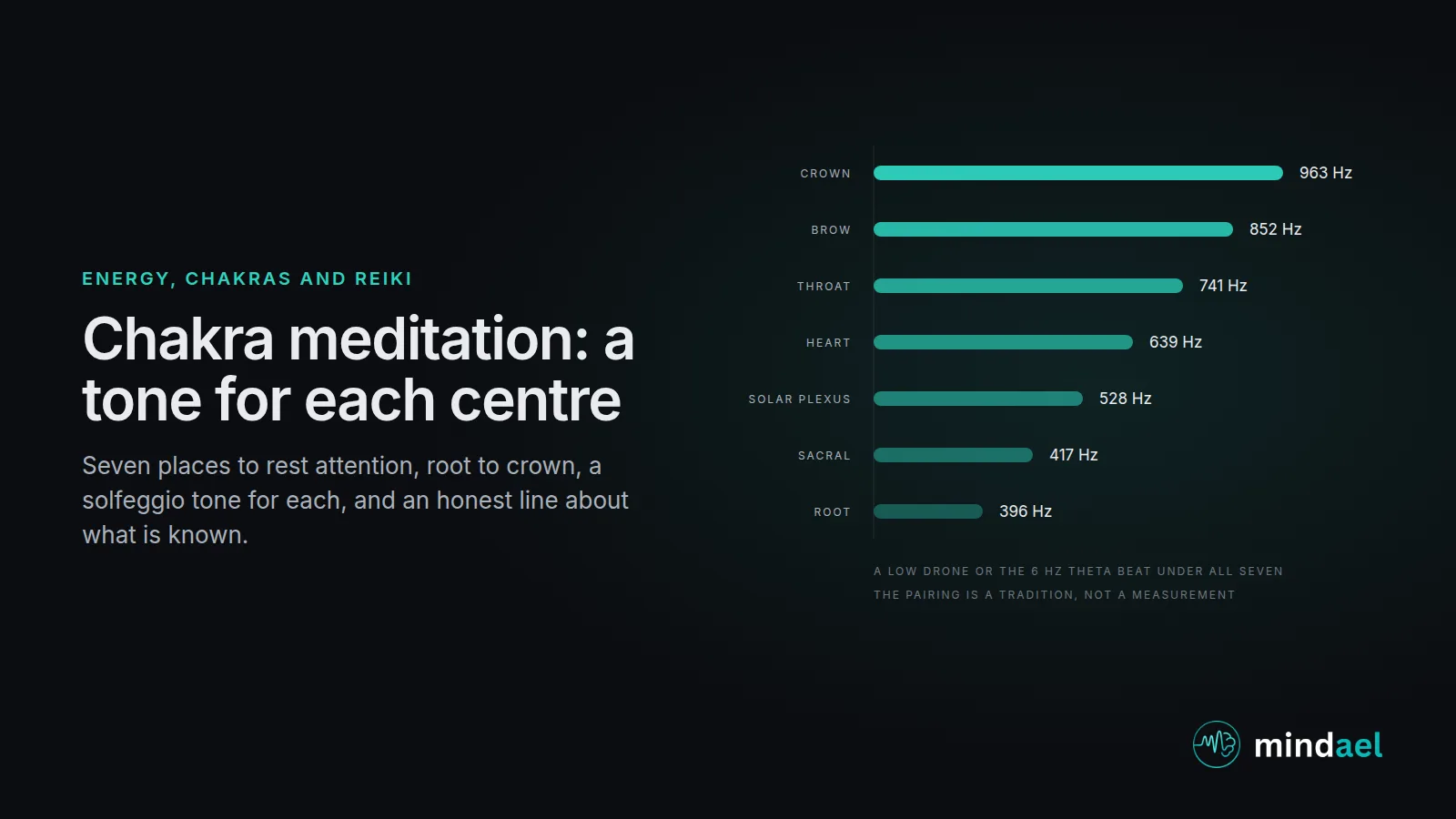
Chakra meditation moves attention through seven points in the body, root to crown, usually with a colour, a sound or a breath for each. In the tradition it balances energy centres; in the research, what is being measured is a body-scan meditation with slow breathing and sustained sound, and those have evidence: meditation programmes improve anxiety and mood, slow breathing lowers arousal, chanting and singing bowls lower tension and quieten the brain's self-referential network. We pair each centre with one of the solfeggio frequencies by the usual tradition, 396 Hz at the root up to 963 Hz at the crown, and present that pairing as a tradition, not a measurement. A fifteen-minute version is on this page; a low drone or the 6 Hz theta beat underneath works for all seven.
Sounds that work, and why
396 Hz
The tone paired with the root centre in the tradition: the lowest of the seven, under a drone, for the grounding stage at the start of the practice.
528 Hz
Paired with the solar plexus. The most listened-to solfeggio tone and a comfortable pitch to hold attention on for several minutes.
639 Hz
Paired with the heart centre. A warm mid tone, good under ocean waves for the middle of the practice.
852 Hz
Paired with the brow centre. Bright and thin; keep it low. Many listeners use it alone for the seated part of the practice.
963 Hz
Paired with the crown, the highest of the nine. Barely there at low volume, which is the point for the last two minutes.
Theta waves
The 6 Hz beat under all seven tones, in earbuds: the one sound on this page with brain research behind it for meditation.
What chakra meditation is
The word chakra means wheel. In the Tantric yoga texts of medieval India, the body was mapped with a column of centres along the spine, and meditation meant placing attention at each in turn, often with a syllable, a colour and a number of petals to picture. The seven-centre version most people know today, root, sacral, solar plexus, heart, throat, brow and crown, was fixed in the early twentieth century and spread through yoga and the New Age from there. Different lineages count five, six, nine or more.
Strip away the imagery and what remains is a structured body scan: attention moves slowly up the body, rests at places where sensation is easy to find, and is given something to hold at each stop. That structure is why many people who struggle with open “just watch the breath” meditation find chakra meditation easier. There is always a next place to go. Our meditation sounds guide covers the plainer kinds of sit; this page is the structured one.
What is actually known
We should be plain about the two layers. No study has measured a chakra, because there is nothing at the base of the spine or the crown of the head that an instrument can read as an energy centre. Claims that a frequency “activates”, “opens” or “balances” one are not measurements, and we do not make them.
What has been measured is the practice. Meditation programmes in general improve anxiety, depression and pain by moderate amounts across 47 trials (Goyal et al., 2014). The slow breathing that runs through a chakra practice, four in and six out, raises heart rate variability and lowers arousal across many studies (Zaccaro et al., 2018). Chanting a long “om”, which traditionally belongs at the throat and heart centres, quietened the brain’s self-referential network in a small fMRI study, in a way the same researchers compared to vagus nerve stimulation (Kalyani et al., 2011). A singing bowl meditation, the sound-bath cousin of this practice, lowered tension and anger and improved mood in an observational study (Goldsby et al., 2017). And a 6 Hz theta beat raised the brain’s theta rhythm, the one associated with settled meditation, within ten minutes (Jirakittayakorn and Wongsawat, 2017).
So the calm people report after a chakra meditation is real and has ordinary causes: attention held on the body, slow breathing, a sustained sound, fifteen minutes of not doing anything else. That is enough for us to recommend it, and it is all we claim for it.
The seven centres and the tone paired with each
The pairing of solfeggio frequencies with chakras is a modern tradition, built on the nine-tone scale our solfeggio frequencies article explains. It is the one most of our listeners use, and it rises in pitch as attention rises in the body, which makes it a natural ladder for the practice.
| Centre | Where to rest attention | Tone, by tradition |
|---|---|---|
| Root | Base of the spine, the seat | 396 Hz |
| Sacral | Below the navel | 417 Hz |
| Solar plexus | Under the ribs | 528 Hz |
| Heart | Centre of the chest | 639 Hz |
| Throat | The throat | 741 Hz |
| Brow | Between the eyebrows | 852 Hz |
| Crown | Top of the head | 963 Hz |
The tones themselves are precise: a 528 Hz tone in Mindael is 528 Hz, not a nearby note, which matters if you are going to hold attention on it for two minutes. Under all of them a floor stays constant, a low drone, ocean waves or the 6 Hz theta beat in earbuds, so that the change from tone to tone is a step and not a jolt. If you prefer a single sound throughout, the theta beat alone is the choice with research behind it; the binaural beats article explains why it needs earbuds.
A fifteen-minute chakra meditation
Sit or lie down, drone on low, eyes closed. Two minutes at each centre, root to crown, with the matching tone over the drone and the breath at four in, six out. At the heart and throat, a long low “om” on each out-breath if you want it; the Gayatri mantra article has the longer chant some people use here. At the brow and crown, the tones go very quiet and the breath goes natural. Then one minute with the tones off and attention on the whole body, and open the eyes before moving. The steps above have the exact sequence. Done at the same time each day for two weeks, it becomes the kind of practice that starts itself, the same way the evening routine for relaxing the nervous system does.
Reiki, aura and energy music, honestly
The same search brings people looking for reiki music, aura cleansing tracks and 432 Hz “healing” playlists. Our answer is the same for all of them. A slow, steady, low sound lowers arousal and gives attention a place to rest, and that is valuable; a reiki session’s calm is real and comes from attention, touch and rest. A track does not carry energy, cannot clean anything and does not heal, and anyone selling it on those terms is selling the tradition’s words without its honesty. Use the sounds for what they do. If you are dealing with pain, low mood or anxiety that is not shifting, the nervous system regulation guide is the better page, and a doctor is the better next step.
How to set it up tonight
- Sit or lie down, and pick the floorA low drone, ocean or the 6 Hz theta beat in earbuds, quiet. This stays on for the whole fifteen minutes; the tones change over it.
- Root, two minutesAttention at the base of the spine, where you meet the chair or the floor. 396 Hz low under the drone. Breathe four in, six out, and feel the weight going down.
- Sacral and solar plexus, two minutes eachBelow the navel, then the soft spot under the ribs. 417 Hz then 528 Hz. Let the belly move with the breath; most people are holding it.
- Heart and throat, two minutes eachCentre of the chest, then the throat. 639 Hz then 741 Hz. If you chant, this is where a long low 'om' on the out-breath goes.
- Brow and crown, two minutes eachBetween the eyebrows, then the top of the head. 852 Hz then 963 Hz, both very low. Eyes stay closed; let the breath go natural.
- One minute of nothingTones off, drone fading, attention on the whole body at once. Then open your eyes before you move.
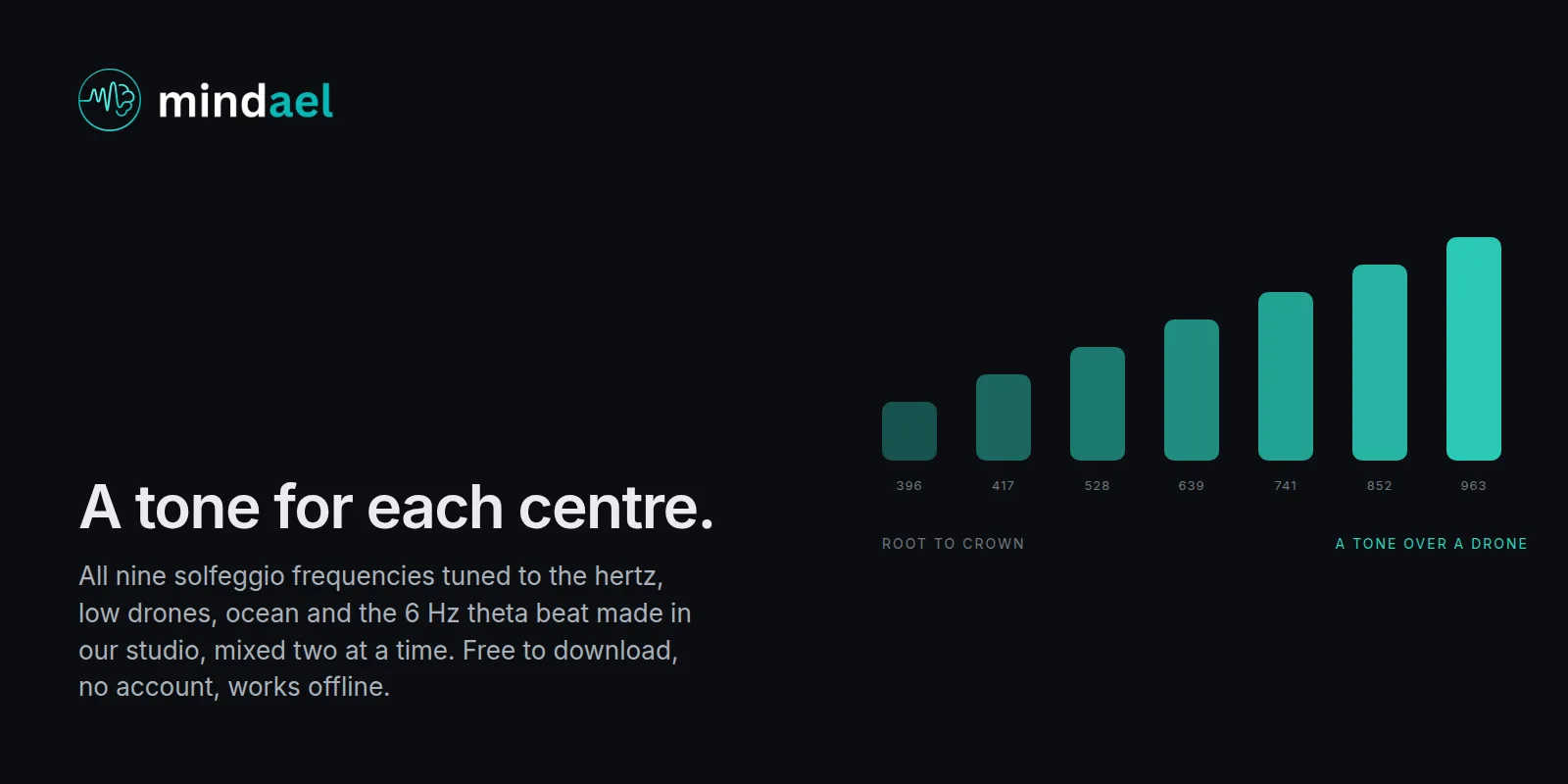
A tone for each centre, a floor under all seven.
Mindael has the nine solfeggio frequencies tuned to the hertz, low drones, ocean and the 6 Hz theta beat made in our studio, mixed two at a time. Free to download, no account, works offline. Set the drone, move the tone up as you move your attention up, and let it fade at the crown.
- All nine solfeggio tones, drones, ocean and theta beats, studio-made
- Two sounds at once: a tone over a drone
- Free to download, no account, works offline
 Free · No account needed · Works offline
Frequently asked questions
What is chakra meditation?
A meditation that moves attention through seven points in the body in turn, from the base of the spine to the top of the head, usually resting a minute or two at each with a breath, a colour, a sound or a word. It comes from the Tantric yoga traditions of medieval India. In practice it is a slow body scan with a structure, which is why many people find it easier to hold than open awareness.
Are chakras real?
As a map of where attention and sensation sit in the body, yes, and people across cultures report the same places: gut, chest, throat, head. As physical energy centres that can be measured, blocked or unblocked, no evidence has ever found them. We use the map and leave the metaphysics to you.
Which frequency is for which chakra?
The common pairing runs 396 Hz root, 417 Hz sacral, 528 Hz solar plexus, 639 Hz heart, 741 Hz throat, 852 Hz brow and 963 Hz crown. That assignment is a modern tradition, not a measurement; there is no instrument reading of a chakra at any frequency. The tones are real, precise and pleasant to hold attention on, which is their job here.
What is the best chakra meditation music?
Something steady, low and without lyrics or a melody to follow: a drone, ocean waves or a theta beat, with a single clean tone layered over it that you change as you move up the body. Loud, busy or vocal tracks pull attention away from the body, which is where the practice lives.
How long should a chakra meditation take?
Fifteen minutes is enough: two minutes a centre and a minute of stillness at the end. Longer versions exist, but the benefit in the research on meditation comes from regular short sessions, not occasional long ones.
Does reiki or energy healing music do anything?
The music does what any slow, steady sound does: lowers arousal and gives attention a place to rest, which is worth having. Claims that a track carries energy or heals are not supported by evidence, and we do not make them. If you enjoy a reiki session, the calm you feel is real; the mechanism is relaxation, touch and attention.
Sources
- Goyal M, et al. Meditation programs for psychological stress and well-being: a systematic review and meta-analysis. JAMA Internal Medicine, 2014.
- Zaccaro A, et al. How breath-control can change your life: a systematic review on psycho-physiological correlates of slow breathing. Frontiers in Human Neuroscience, 2018.
- Kalyani BG, et al. Neurohemodynamic correlates of 'OM' chanting: a pilot functional magnetic resonance imaging study. International Journal of Yoga, 2011.
- Goldsby TL, et al. Effects of singing bowl sound meditation on mood, tension, and well-being: an observational study. Journal of Evidence-Based Complementary and Alternative Medicine, 2017.
- Jirakittayakorn N, Wongsawat Y. Brain responses to a 6-Hz binaural beat: effects on general theta rhythm and frontal midline theta activity. Frontiers in Neuroscience, 2017.
This page is for general information and is not medical advice. Chakra, reiki and energy practices are complementary; they do not treat illness and are not a substitute for seeing a doctor about a physical or mental health problem.