

Free Meditation Apps: What to Look For, What Most Free Tiers Leave Out, and What Mindael Gives You
Most "free meditation apps" are free to download and then not free to use: a handful of sessions, a timer behind a paywall, a reminder every third screen. Mindael is a different kind of app. It is a sound app, not a library of guided talks, and the sounds that hold a meditation together, a 6 Hz theta beat, low drones, singing bowl tones and rain, are the ones you can start listening to the minute you download it, free, with no account. This page is the checklist we would use to judge any free meditation app, and how we measure up.
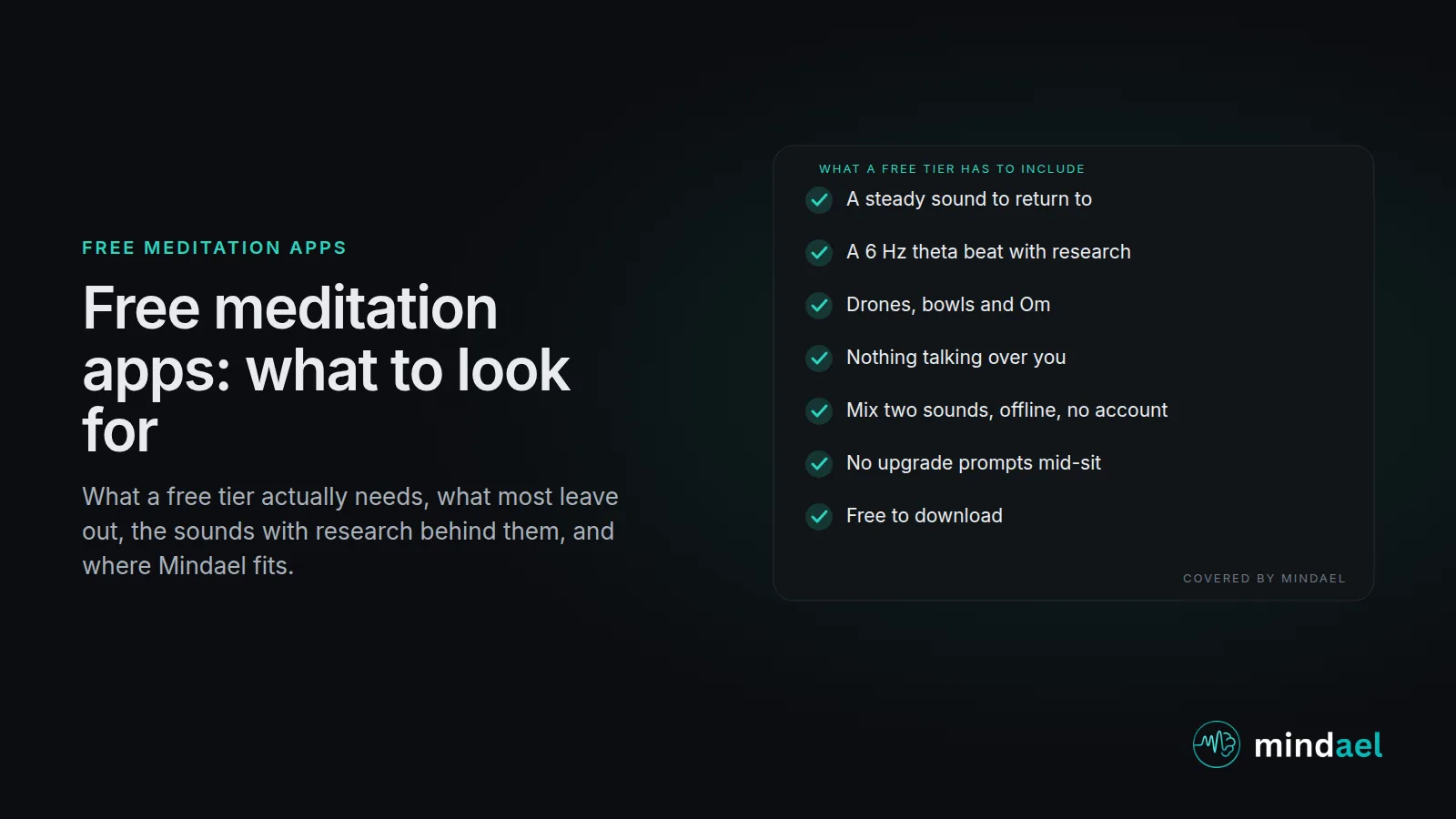
A free meditation app is worth having if its free tier includes what a session actually needs: a steady sound to return to, a theta beat or drone with research behind it, no voice talking over you unless you want one, offline play, no account, and nothing nagging you to upgrade mid-sit. Mindael covers the sound side of that list free to download: theta beats, drones, bowl tones, rain and ocean recorded without loops, two-sound mixing, offline. It does not have guided talks or sleep stories; if you want a voice, pair it with a free guided recording and let Mindael be the floor underneath.
What to look for, and how Mindael covers it
| What you need | In Mindael |
|---|---|
| A steady sound to return to | Rain, ocean, brown noise and low drones, recorded or generated in our studio, with no loop to notice |
| A theta beat with research behind it | A 6 Hz theta binaural beat; a 2017 study found it raised theta activity within about ten minutes |
| Bowls, tones and Om for body-based sessions | Singing-bowl style tones, the nine solfeggio frequencies and sustained drones |
| Nothing talking over you | Mindael is a sound app. No narration, no voice unless you add your own recording on top |
| Mixing | Two sounds at once: a theta beat under rain, a drone under ocean |
| Works offline, no account | Every sound is on the phone; nothing to sign up for before the first sit |
| No upgrade prompts mid-session | Press play, close your eyes; nothing interrupts the sound |
| Price | Free to download on the App Store |
What a free tier has to include
A meditation app earns its place by being opened every day, and a free tier earns it by not getting in the way. The test is simple: can you sit down, press play, close your eyes and have twenty minutes pass with nothing asking you for anything? Many free tiers fail that test on the first sit, with a timer behind a paywall or a prompt after the intro session. Whatever app you choose, open it once with that test in mind before you build a habit on it.
The second test is what the sound is for. The research on meditation itself is reasonably good: a 2014 systematic review of 47 trials found moderate evidence that mindfulness programmes improve anxiety, depression and pain (Goyal et al., 2014). The app does not do any of that; the practice does. What an app can do is make the practice easier to start and easier to stay in, and sound is the most direct way it does that.
The checklist, explained
A steady sound to return to. Beginners are told to return to the breath, and the breath is hard to find when the mind is loud. A steady tone or rain is an easier anchor for most people in the first months, and it masks the room. Mindael’s rain and ocean are long studio recordings with no loop to notice, and the brown noise is generated continuously, so there is no seam at minute fourteen.
A theta beat with research behind it. Binaural beats are oversold in general, and a 6 Hz theta beat is the one with a clear result: in a 2017 study, listening raised theta activity across the scalp and in the frontal midline, the rhythm associated with deep relaxation and early meditation, within about ten minutes (Jirakittayakorn & Wongsawat, 2017). It needs earbuds, because each ear gets a slightly different tone. Our theta waves page explains the rest, and the best binaural beats app checklist covers what a beat has to be to work at all.
Bowls, tones and Om. For sound-bath style and body-based sessions. An observational study of singing bowl meditation found lower tension and better mood afterwards, with the biggest change in people new to it (Goldsby et al., 2017). Mindael has sustained drones, bowl-like tones and the nine solfeggio frequencies as a soft harmonic layer.
Nothing talking over you, unless you want it. This is the honest limitation and the honest advantage. Mindael has no guided talks and no sleep stories. If you want a voice, play one from any free source on top; Mindael stays underneath as the steady floor, which is how many of our listeners use it. If you do not want a voice, nothing here will give you one.
Mixing, offline, no account. A theta beat under rain, a drone under ocean, two sounds at once. Everything on the phone, so it works on a plane or in a basement. No sign-up before the first sit.
Who this suits
People who want to meditate to sound rather than to a voice, people who already have a teacher or a free guided recording and want a better floor under it, people who found the guided apps noisy, and anyone who wants the evening sit and the night’s sleep handled by one app. Our meditation sounds guide has three sessions to run this week; the breathing guide has the patterns to run under them; if what you were really looking for was a replacement for a subscription sleep app, the Calm alternative page is the one to read; and if it was the timer-and-sounds half of a big meditation platform, the Insight Timer alternative page is the closer comparison.
It does not suit people who want guided courses, sleep stories or a community. There are good apps for that, some with workable free tiers, and no sound app replaces them.
How to switch in five minutes
- Download MindaelFree on the App Store, no account needed to listen.
- Open Relax mode and pick the floorRain or ocean for a first sit; the 6 Hz theta beat, with earbuds, once you want to go deeper. Mix the two if you like.
- Set the volume lowJust loud enough to blur the room. If you notice the sound during the sit, turn it down.
- Twenty minutes, eyes closedReturn to the sound, not the breath, when attention drifts; most beginners find the steady tone an easier anchor.
- Add a voice if you want onePlay a free guided recording from any source over the top. Mindael stays underneath as the steady floor.
The floor under the sit, free to download.
Theta beats, drones, bowl tones, rain and ocean made in our studio, two at a time if you want, offline, with no account and nothing interrupting the sound. Download Mindael and start the first sit today.
- Theta beats, drones, bowl tones, rain and ocean
- Mix two sounds, works offline, no account
- Free to download on the App Store
 Free · No account needed · Works offline
 Frequently asked questions
Are there any truly free meditation apps?
Free to download, many. Free to actually use for a daily sit, far fewer: check what the free tier includes before you commit a habit to it. Mindael is free to download, needs no account, and the sounds you meditate to, theta beats, drones, bowl tones, rain and ocean, are available from the first open.
Does Mindael have guided meditations?
No. Mindael is a sound app: nothing talks over the sound. If you want guidance, play a free guided recording on top, or follow the sessions in our meditation sounds guide, which gives you the structure without a voice.
What sound is best for meditation?
For a seated session, a 6 Hz theta binaural beat under a soft drone is the sound with the clearest brain research, and it takes about ten minutes to build. For body-based or sound-bath sessions, singing bowl tones and Om. For beginners, plain rain. Keep whatever you choose low.
Is a meditation app better than meditating in silence?
Silence is fine if the room is quiet and your attention has somewhere to go. A steady sound helps when the room is not quiet, when the mind cannot settle without a floor, and when you want the particular effect of a theta beat. Most people use sound for the first months and need it less later.
Do meditation apps actually work?
The practice works, modestly: a 2014 review in JAMA Internal Medicine found mindfulness meditation programmes improved anxiety, depression and pain with moderate evidence. The app is just the way you get to the practice. The best app is the one you open every day, which is why a free tier that does not nag matters.
Can I use Mindael for sleep as well as meditation?
Yes. The same rain, brown noise and delta beats run under a sleep routine, and the sleep sounds guide has the setup. One app for the evening sit and the night that follows.
Sources
- Goyal M, et al. Meditation programs for psychological stress and well-being: a systematic review and meta-analysis. JAMA Internal Medicine, 2014.
- Jirakittayakorn N, Wongsawat Y. Brain responses to a 6-Hz binaural beat: effects on general theta rhythm and frontal midline theta activity. Frontiers in Neuroscience, 2017.
- Goldsby TL, et al. Effects of singing bowl sound meditation on mood, tension, and well-being: an observational study. Journal of Evidence-Based Complementary and Alternative Medicine, 2017.
- de Witte M, et al. Effects of music interventions on stress-related outcomes: a systematic review and two meta-analyses. Health Psychology Review, 2020.