
Perimenopause and Sleep: Why Sleep Changes in the Menopause Transition, What the Research Says Helps, and a Night-Time Setup
Perimenopause and sleep is a pairing millions of women know from the inside: falling asleep is fine, but waking at 3 a.m., hot, and lying there for an hour is not. Sleep complaints rise sharply in the menopause transition, and the research is clear on the main reasons and on what helps most. This page explains why sleep changes, what the evidence supports, from cognitive behavioural therapy to keeping the bedroom cool, and the night-time setup with steady sound that our listeners use. The sounds are in Mindael, free to download on the App Store. Treatment decisions belong with your doctor.
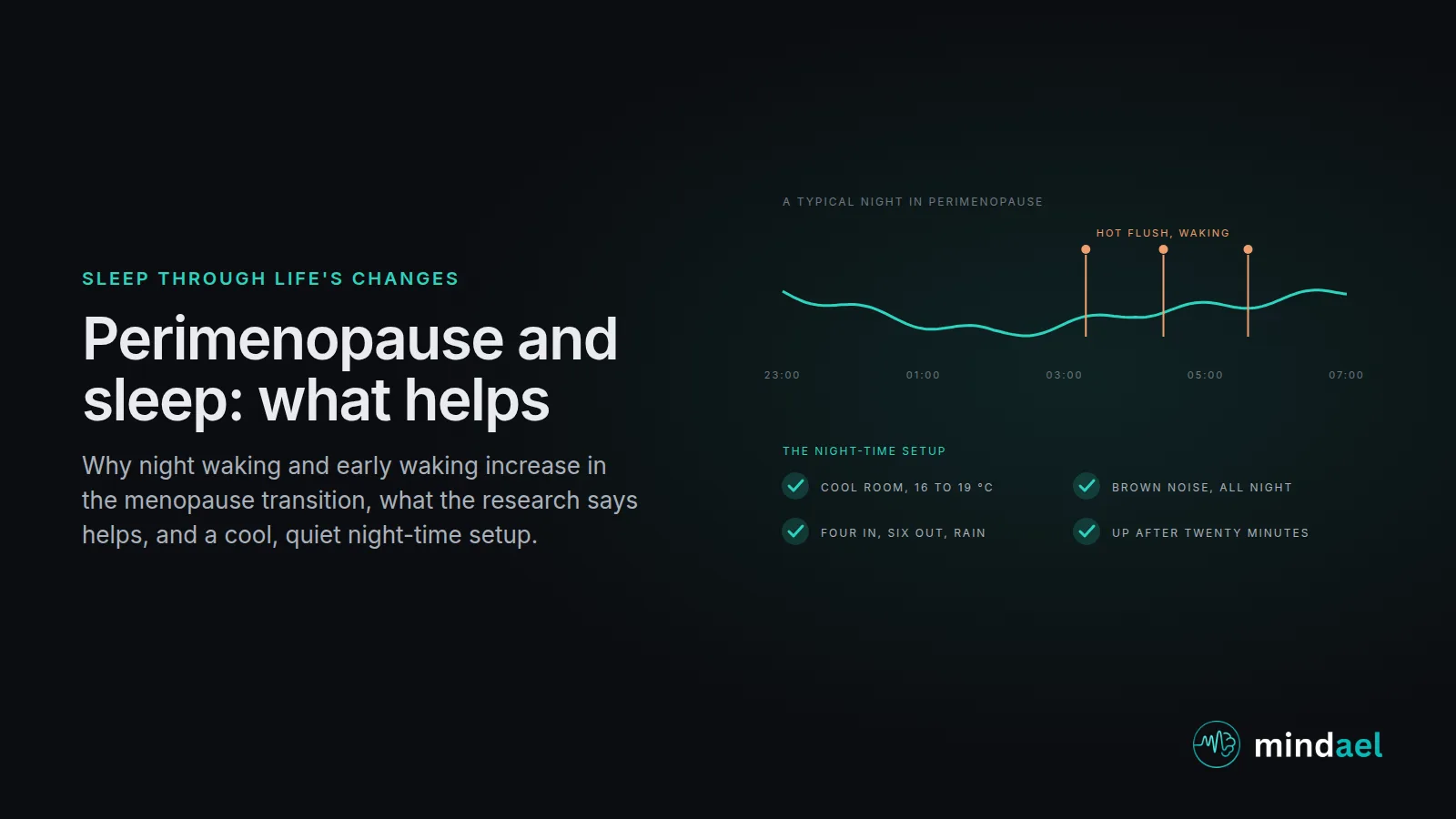
Sleep problems rise in the menopause transition: roughly 40 to 60 percent of women in perimenopause report poor sleep, most often waking during the night and waking too early rather than trouble falling asleep. The main drivers are hot flushes and night sweats, which wake women from sleep and fragment it, the hormonal changes themselves, mood and anxiety, and the conditions that become more common in midlife, such as sleep apnoea. Cognitive behavioural therapy for insomnia improves sleep in perimenopausal women, including those with hot flushes, and is the first-line non-drug treatment; hormone therapy and other medicines are options to discuss with a doctor. At home, the most useful changes are a cool bedroom and bedding that sheds heat, a steady low sound all night so the room does not change when you surface, a slow-breathing routine for the 3 a.m. waking, and getting up rather than lying awake.
Sounds that work, and why
Brown noise
Deep and soft, with no hiss to grow sharp over hours. The all-night floor that stops a creak or a car from finishing off a light second half of the night.
Rain
For the 3 a.m. waking: natural, recorded without loops, nothing to analyse, and the sound many listeners use to get back down.
Pink noise
If a partner snores or the street is loud: softer than white, with energy where voices and traffic sit.
Ocean waves
A slow swell to breathe with, in at the rise and out at the fall, for the slow-breathing routine in the night.
Delta waves
The 2 Hz beat in one earbud for the first twenty minutes, for women who like something under the rain on the way down.
Why sleep changes in the menopause transition
Perimenopause is the years before the last period, when hormone levels start to fluctuate and then fall, and it is when sleep complaints rise most sharply in a woman’s life. A review of the research puts poor sleep at roughly 40 to 60 percent of women in the transition, with the rate climbing from early to late perimenopause (Baker et al., 2018). The typical pattern is not trouble falling asleep. It is waking in the night, often more than once, and waking too early, with the second half of the night the hardest.
Several things stack up. Hot flushes and night sweats are the best known: in a lab study of perimenopausal women, most hot flushes at night were accompanied by a waking, and nights with more flushes had more time awake (de Zambotti et al., 2014). The hormonal changes themselves affect temperature control and sleep regulation even without a flush. Anxiety and low mood become more common in the transition, and a mind that starts working at 3 a.m. keeps you awake long after the flush has passed. And other sleep problems become more likely in midlife, sleep apnoea above all, which is easy to miss in women because it does not always come with loud snoring.
What helps most
Cognitive behavioural therapy for insomnia. The treatment with the best evidence for chronic insomnia in general also works here. In a randomised trial of perimenopausal and postmenopausal women with hot flushes, a short course of telephone-delivered CBT for insomnia improved insomnia severity and sleep quality compared with education alone, with the effect lasting at follow-up (McCurry et al., 2016). Its core pieces are a fixed wake time, getting up when you cannot sleep, cutting time in bed down to the time you actually sleep for a while, and changing the thoughts that keep you awake. A doctor can refer you, and digital programmes exist.
Medical options. Hormone therapy, and some non-hormonal medicines, reduce hot flushes and can improve sleep for some women. Whether they suit you depends on your health history; that is a conversation for your doctor, and we do not give advice on it.
A cool bedroom. Heat is what turns a flush into a full waking. Sleep is more fragile in a warm room, and the body’s ability to shed heat matters most in the hours when deep sleep should happen (Okamoto-Mizuno and Mizuno, 2012). Aim for around 16 to 19 °C, a fan or an open window, cotton or linen, and layers you can throw off without waking fully.
The night-time setup
A steady sound, all night. Sleep in the second half of the night is lighter, and at this stage of life a creak, a car or a partner’s breathing is often what finishes it. A low, steady sound raises the floor of the room so those changes stop registering; in a lab study, steady broadband sound shortened the time to fall asleep by about a third (Messineo et al., 2017). Brown noise from a speaker, all night rather than on a timer, is the setup most of our listeners settle on, with pink noise if a partner snores; our noise masking for sleep guide explains why. Keep it at a quiet-conversation level or lower.
The 3 a.m. routine. When you wake, do not check the time; the number only starts the arithmetic. Throw off a layer. Then breathe: four counts in through the nose, six out, low into the belly, with rain or ocean waves low. Slow breathing with a long exhale lowers arousal across many studies (Zaccaro et al., 2018), and our breathing guide has the patterns. Rest attention on the sound.
Get up if it has been about twenty minutes. Dim light, another room, something calm, back to bed when sleepy. It feels wrong and it is one of the most effective parts of CBT for insomnia, because lying awake for an hour teaches the bed that it is a place for being awake. Our how to fall asleep fast article has the rest of the evening routine, and the how to relax your nervous system article the slow evening wind-down.
Same time up. Every day, weekends included, with light within an hour of waking; the morning guide covers it. It is the single habit that most steadies a body clock under pressure.
When to see a doctor
If poor sleep has lasted more than a few weeks and is affecting your days; if you snore loudly, wake gasping, or a partner notices pauses in your breathing; if night sweats are drenching; or if low mood or anxiety are building. A doctor can discuss CBT for insomnia, hormone therapy and other treatments, and check for sleep apnoea, low iron or thyroid changes, which also become more common at this age. The setup on this page is the part you can start tonight, alongside all of that. Our sleep sounds guide has the rest of the sounds and setups for every kind of night.
How to set it up tonight
- Keep the bedroom coolAround 16 to 19 °C if you can, a fan, a window, breathable cotton or linen, and layers rather than one heavy duvet so you can throw one off without waking fully. Heat is the most common thing that turns a hot flush into a full waking.
- A steady sound, all nightSleep in the second half of the night is lighter in perimenopause, and small noises finish the job. A low brown noise or rain from a speaker, running until morning rather than on a timer, keeps the room the same when you surface.
- Same time up, every dayGetting up at the same time, weekends too, anchors the body clock and builds sleep pressure for the next night. Morning light within an hour of waking helps it hold.
- Breathe the 3 a.m. waking downWhen you wake, do not check the time. Four counts in, six out, low into the belly, with rain or ocean on low. Slow breathing lowers arousal, and paced breathing is also used in some hot-flush programmes.
- Get up after about twenty minutesIf you are still awake, get up, keep the light dim, sit somewhere else with something calm, and go back when sleepy. Lying awake for an hour teaches the bed that it is a place for being awake. This is a core part of CBT for insomnia.
- Talk to your doctorIf sleep has been poor for months, a doctor can discuss CBT for insomnia, hormone therapy and other options, and check for sleep apnoea, low iron or thyroid changes, which also become more common at this age.
The same room at 3 a.m. as at 11.
Mindael has brown and pink noise generated to spec, rain and ocean recorded without loops and the 2 Hz delta beat made in our studio, mixed two at a time with all-night play. Free to download, no account, works offline. A low floor all night, and rain to breathe with when you wake.
- Brown and pink noise, rain, ocean and delta beats, studio-made
- All-night play, two sounds at once, fine volume control
- Free to download, no account, works offline
 Free · No account needed · Works offline
Frequently asked questions
Why does perimenopause affect sleep?
Several reasons stack up. Hot flushes and night sweats wake women and fragment sleep, often in the second half of the night. Falling and fluctuating hormone levels affect sleep and temperature regulation directly. Anxiety and low mood become more common, and so does sleep apnoea. The result is usually waking in the night and too early, rather than trouble falling asleep.
How common are sleep problems in perimenopause?
Very common. Large surveys find that roughly 40 to 60 percent of women in the menopause transition report poor sleep, compared with fewer before it, and the rate rises from early to late perimenopause.
What helps perimenopause insomnia?
Cognitive behavioural therapy for insomnia has the best evidence of the non-drug treatments and helped perimenopausal women with hot flushes in a randomised trial. A cool bedroom, a consistent wake time, a steady sound to mask night noise, slow breathing on waking and getting up rather than lying awake all help. Hormone therapy and other medicines are options to discuss with your doctor.
Why do I wake up at 3 a.m. in perimenopause?
Hot flushes cluster in the second half of the night for many women, sleep there is lighter anyway, and a small rise in temperature or a noise is enough to wake you. Once awake, a mind that starts working keeps you there. Cooling the room, a steady background sound and a slow-breathing routine target each of those.
Can sound help perimenopause sleep?
Sound does not touch the hormonal side. What it does is mask the small noises that finish off light sleep in the second half of the night, and give a busy mind something steady to rest on when you wake. Steady broadband sound shortened the time to fall asleep in a lab study. Keep it low and running all night.
When should I see a doctor about sleep in perimenopause?
When poor sleep has lasted more than a few weeks and is affecting your days, if you snore loudly or someone notices pauses in your breathing, if night sweats are drenching, or if low mood or anxiety are building. A doctor can discuss treatment options and rule out other causes.
Sources
- Baker FC, de Zambotti M, Colrain IM, Bei B. Sleep problems during the menopausal transition: prevalence, impact, and management challenges. Nature and Science of Sleep, 2018.
- de Zambotti M, Colrain IM, Javitz HS, Baker FC. Magnitude of the impact of hot flashes on sleep in perimenopausal women. Fertility and Sterility, 2014.
- McCurry SM, et al. Telephone-based cognitive behavioral therapy for insomnia in perimenopausal and postmenopausal women with vasomotor symptoms: a MsFLASH randomized clinical trial. JAMA Internal Medicine, 2016.
- Okamoto-Mizuno K, Mizuno K. Effects of thermal environment on sleep and circadian rhythm. Journal of Physiological Anthropology, 2012.
- Messineo L, et al. Broadband sound administration improves sleep onset latency in healthy subjects in a model of transient insomnia. Frontiers in Neurology, 2017.
- Zaccaro A, et al. How breath-control can change your life: a systematic review on psycho-physiological correlates of slow breathing. Frontiers in Human Neuroscience, 2018.
This page is for general information and is not medical advice. Perimenopause symptoms vary widely, and treatment decisions, including hormone therapy, belong with your doctor. Please see a doctor if poor sleep lasts more than a few weeks, if you snore loudly or stop breathing in your sleep, or if low mood or anxiety are building.