
Noise Cancelling for Sleep: Why Headphones Cannot Cancel Snoring, What Masking Does Instead, and the Setup for Traffic, Neighbours and a Partner
Noise cancelling for sleep is the search, and the honest answer is that cancellation is the wrong tool for most of what wakes people. Active noise-cancelling headphones are built for steady low drones, an engine, an air conditioner; they do little against the sounds that actually pull you out of sleep, which are sudden and irregular: a snore, a door, a bus, a neighbour's chair. What works for those is masking, a steady sound that raises the floor of the room so the spikes stop registering as events. This page explains the difference, what the sleep research found, and the setup for each noise you are up against, with the sounds in Mindael, free to download on the App Store.
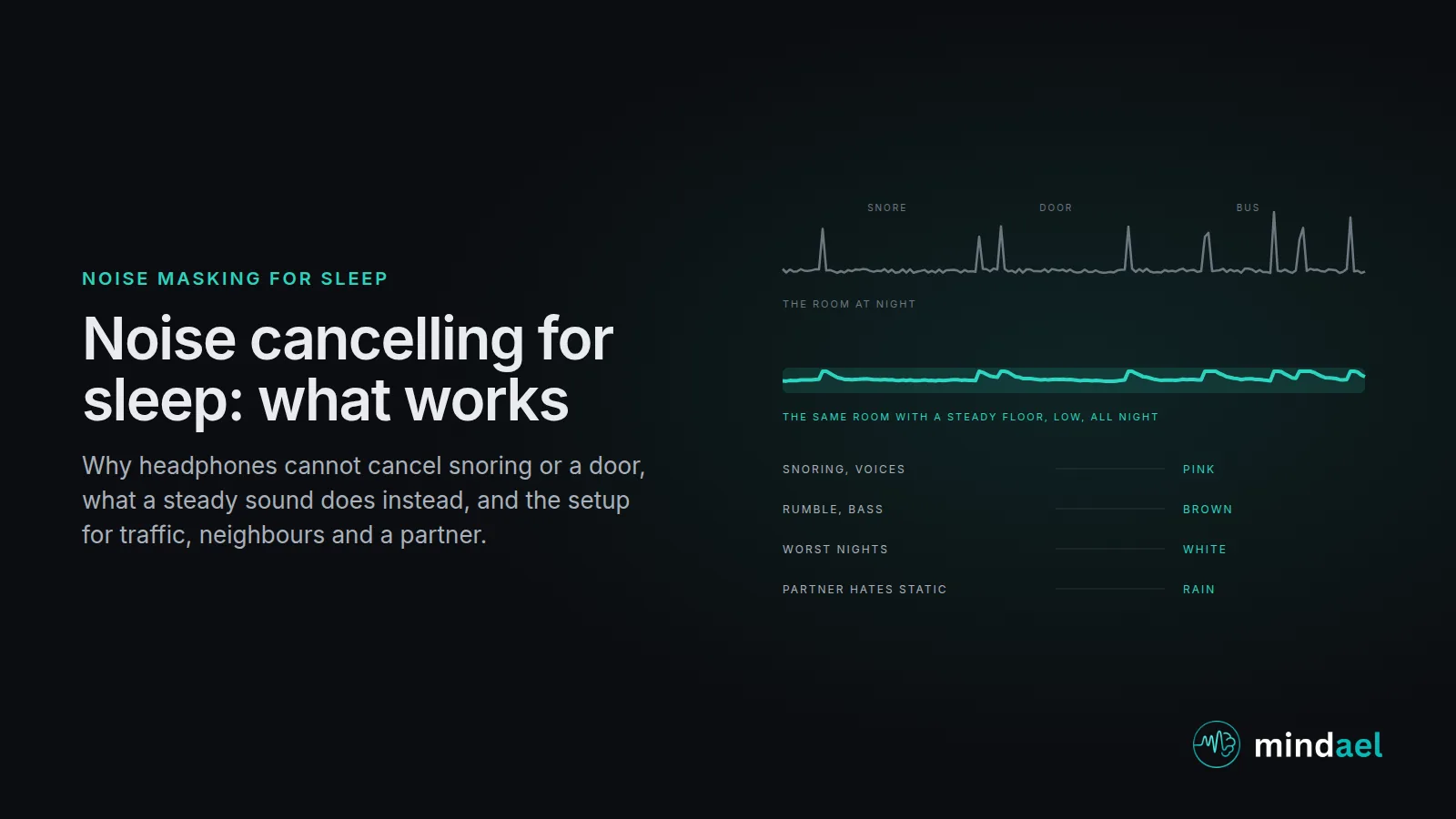
Active noise cancellation subtracts steady, low-frequency sound and is weak against sudden, irregular noise, which is what wakes sleepers; it also needs earbuds that most people cannot sleep in. Masking works the other way: a steady broadband sound, white, pink or brown noise, rain or ocean, played low all night, reduces the contrast between the room and the intrusion, so a snore or a door no longer stands out enough to trigger an arousal. Night-time noise fragments sleep even when you do not remember waking, and a steady masker reduced arousals and shortened the time to fall asleep in laboratory and city-bedroom studies, though the evidence is small and the reviews call for more. The rules: speaker rather than earbuds where you can, a quiet-conversation level or below, all night rather than on a timer, the colour matched to the noise, and fix the source where that is possible.
Sounds that work, and why
White noise
The strongest masker of the three colours and the one most sleep studies used: equal energy across the spectrum, so it covers voices, snoring and traffic at once. Harsher over hours; keep it low.
Pink noise
The first thing to try for a loud street or a snoring partner: softer than white, with energy where traffic and voices sit, and the colour sleep labs come back to.
Brown noise
For low rumbles, a motorway, a fridge, bass through a wall, and for anyone who finds hiss sharp. Deep, no top end, the easiest to sleep under all night.
Rain
The natural masker: broadband, with gentle variation that a partner who hates static will accept. Recorded without loops, so nothing repeats at 3 a.m.
Ocean waves
A slow swell for a room where the noise is occasional rather than constant, and for a second sound under rain to fill the low end.
Why cancellation is the wrong tool for most bedrooms
Active noise cancellation works by listening to the sound arriving at the ear and playing its inverse a fraction of a millisecond later. That works well when the sound is predictable: a low, steady drone such as an engine, a fan or a motorway heard through a wall. It works badly when the sound is sudden or irregular, because the system is always a little behind, and badly at higher frequencies, where a small timing error turns the cancellation into a smear. Snoring, a slammed door, voices through a wall, a bus that comes every eight minutes: these are exactly the sounds cancellation is worst at, and exactly the sounds that wake people. Add that earbuds have to stay in all night, on a side sleeper, and the search for noise cancelling for sleep usually ends in a drawer.
Masking is the other approach, and the one with the sleep research behind it. Instead of subtracting the noise, you add a steady, broadband sound at a low level. The noise is still there; what changes is the contrast between the room and the intrusion. The brain’s arousal system responds to change, not to level, and a snore over silence is a large change where a snore over pink noise is a small one. Nothing gets quieter. Less of it gets through.
What the research shows
Night-time noise fragments sleep even when the sleeper does not remember waking: brief arousals, shifts to lighter sleep and heart rate rises follow sounds well below the level that would wake you fully, and chronic exposure to traffic and aircraft noise is linked to worse sleep and to cardiovascular risk in a 2014 Lancet review (Basner et al., 2014). That is the problem masking is trying to solve, and it is a real one.
The masking evidence is smaller but consistent in direction. In a laboratory model of transient insomnia, healthy adults given broadband sound fell asleep 38 percent faster than on a quiet night (Messineo et al., 2017). In a real bedroom study, people living in a noisy part of New York City who had trouble sleeping fell asleep faster and spent less time awake during the night in the week they used a white noise device than in the week without it (Ebben et al., 2021). The oldest result is still the cleanest: 80 percent of newborns in a London hospital fell asleep within five minutes with white noise playing, against 25 percent without (Spencer et al., 1990). A 2021 systematic review of noise as a sleep aid found this general pattern across 38 studies and also said plainly that most were small and the quality was mixed, and that better trials are needed (Riedy et al., 2021). We would rather you knew that than took the result as settled; the practical case for masking is that it is cheap, reversible and works for most people on the first night.
The one caution in the literature is about level. Several infant sleep machines could exceed recommended nursery limits at maximum volume and close range (Hugh et al., 2014). For adults, a quiet-conversation level at the pillow; for babies, lower and further away, with the rules in our baby white noise guide.
The setup for each noise
A snoring partner. Pink noise from a small speaker on your side of the bed, at a level you forget within a minute, because snoring sits in the low and mid range where pink has its energy. White noise if the snoring is loud and sharp. Rain if your partner objects to static; it masks nearly as well and sounds like weather. If a speaker is not enough, one sleep earbud in the ear facing them. And loud, regular snoring with pauses is worth a doctor’s look, for their sake more than yours.
Traffic and a loud street. Pink first, white if the street is high and bright, brown noise if what reaches you is the low rumble of lorries and buses. Our noise colours comparison explains why the colour matters. Heavy curtains take several decibels off before the sound has to do anything.
Neighbours: voices, footsteps, a television, bass. Voices and a television: pink or rain. Footsteps and bass through a wall or ceiling: brown, which fills the low end those sounds live in, with ocean under it if you want texture. Move the bed off the shared wall if you can.
A hotel corridor, a hostel, a plane. The plane is the one place cancellation genuinely helps, and our sleep in the airplane article covers it with the rest of the cabin setup. For a corridor or a dormitory, rain on the phone speaker low, or one earbud with pink noise, and foam earplugs under either if the night is bad; the naps and travel guide has the short-sleep version.
A quiet room where the problem is you. If the room is quiet and it is your head that is loud, the issue is not masking, and brown noise plus the routine in our how to fall asleep fast article is the better page. The sleep sounds guide matches the sound to the kind of night you are having.
The rules in one place
Speaker before earbuds. A quiet-conversation level or lower, set once and then turned down. All night, not on a timer, so the room does not change at 3 a.m. The colour matched to the noise: pink for voices and snoring, brown for rumble, white for the worst nights, rain for a partner who hates static. And fix the source where you can: a door sweep, a rug, curtains, a conversation with the snorer. Masking is the floor you put under all of that, and it is the part you can do tonight.
How to set it up tonight
- Decide whether it is a drone or a spikeA constant hum, an air conditioner, a motorway at a distance, a plane cabin, is the one case where active cancellation shines, and a steady masker works too. Everything irregular, snoring, doors, voices, a bus every eight minutes, needs masking, not cancellation.
- Match the colour to the noiseVoices and snoring: pink first, white if pink is not enough. Low rumble and bass: brown. Mixed and unpredictable: rain, which covers the whole range with a natural texture. Try one at a time; most people settle on one within three nights.
- Speaker before earbudsA small speaker on the bedside table at a quiet-conversation level masks the room for both of you and nothing is in your ear. Sleep earbuds are for the cases a speaker cannot solve: a partner who refuses any sound, or a hostel. One earbud, low, is often enough.
- Set the level once, then lower itLoud enough that the intrusion stops being an event, not loud enough to be one itself. For an adult that is around 50 dB at the pillow, the volume of a quiet conversation; after a minute you should have forgotten it is on. Louder masking does not sleep better and the only caution in the research is about level.
- All night, not on a timerThe noise you are masking does not stop at 2 a.m., and a room that changes halfway through the night is itself a wake-up. Run the sound until morning at the same low level, and let the alarm, not the silence, be the first change.
- Fix what can be fixedMasking is a floor, not a cure. A snoring partner may need a doctor's look, and loud regular snoring with pauses is worth a conversation about sleep apnoea. Heavy curtains, a door sweep, a rug and moving the bed off the shared wall each take a few decibels off before the sound has to do anything.
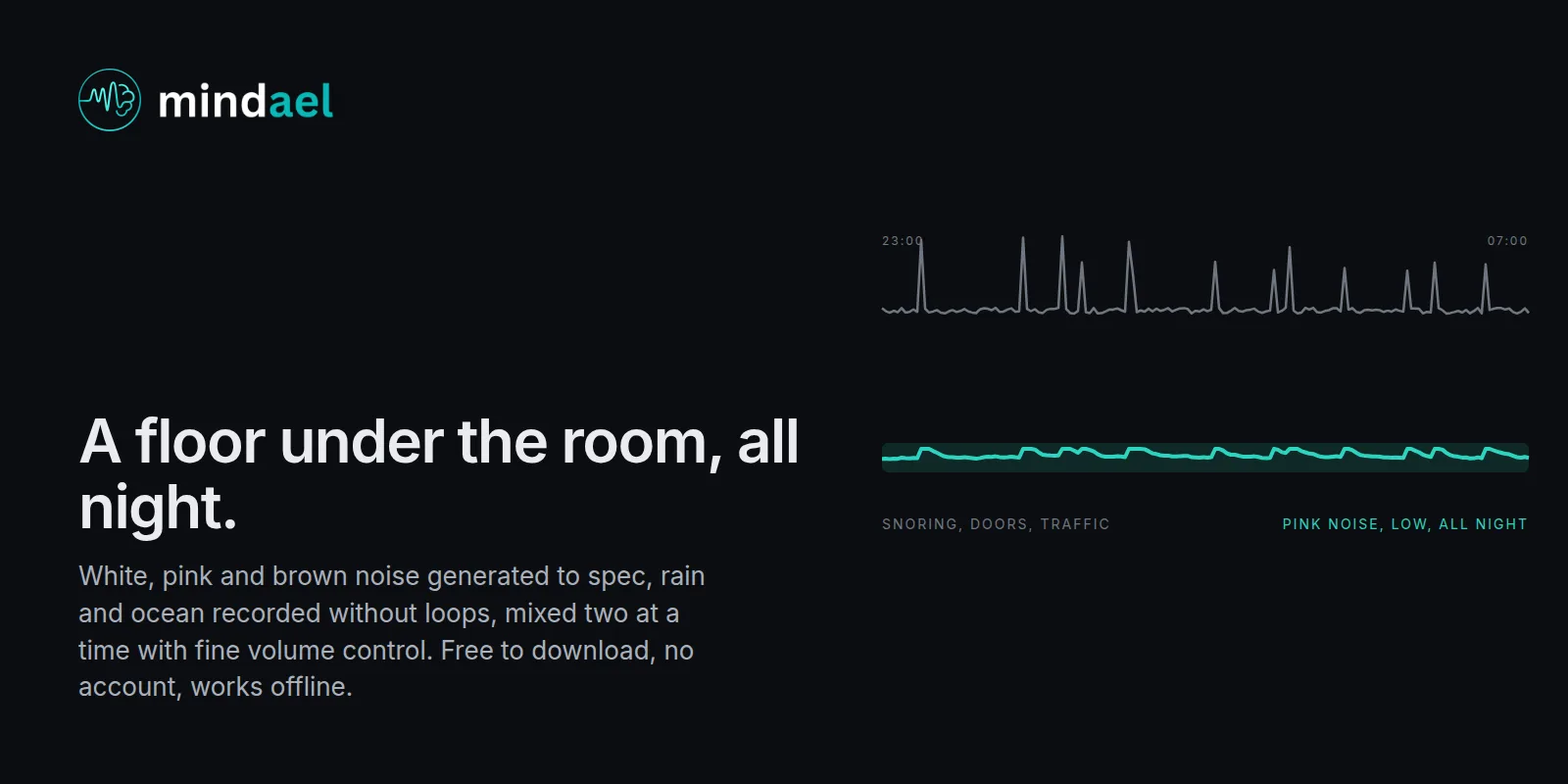
A floor under the room, all night.
Mindael has white, pink and brown noise generated to spec, rain and ocean recorded without loops, mixed two at a time, with a fine volume control and all-night play. Free to download, no account, works offline. Pink noise on the bedside speaker at a quiet-conversation level, and the bus stops being an event.
- White, pink and brown noise to spec, rain and ocean without loops
- Two sounds at once, fine volume control, all-night play
- Free to download, no account, works offline
 Free · No account needed · Works offline
Frequently asked questions
Do noise cancelling headphones work for sleeping?
For steady low sound, an engine or an air conditioner, yes, and some people sleep well in them on a plane. For the things that usually wake people at home, snoring, doors, traffic that comes and goes, voices, they do little: active cancellation works on predictable low-frequency sound and lags sudden sound. They are also hard to sleep in on your side. Masking with a steady sound is what works for irregular noise.
What is the difference between noise cancelling and noise masking?
Cancellation subtracts: a microphone hears the sound and the headphone plays its inverse, which works on steady low drones. Masking adds: a steady broadband sound raises the floor of the room so that intrusions have less contrast and stop triggering an arousal. Cancellation needs earbuds and a predictable noise; masking works from a speaker and against anything irregular.
What is the best sound to block out snoring?
Pink noise first, from a speaker on your side of the bed at a quiet-conversation level, because snoring sits in the mid and low range where pink has its energy. White noise if the snoring is loud and high. Rain if your partner dislikes static. If it is still not enough, one sleep earbud with pink noise in the ear facing them. Loud snoring with pauses should also be looked at by a doctor.
How loud should white noise be for sleeping?
At a quiet-conversation level or below at the pillow, roughly 50 dB for adults, and lower for babies, with the machine well away from the cot. The test is that you forget it is on within a minute. Louder does not mask better; it becomes a noise of its own, and the one caution in the research is about level, not about the sound.
Is it bad to sleep with noise every night?
The research on steady, low-level sound for adults has found no harm and some benefit, fewer arousals and faster sleep onset, though the reviews note the evidence base is small. The two cautions: keep it low, and for babies keep it low and distant. If you no longer need it, stopping is easy; there is no dependence beyond the habit.
Do earplugs work for sleeping?
Foam earplugs cut around 20 to 30 dB when fitted well and are the cheapest option for a hostel or a loud street. Many people find them uncomfortable by morning and they muffle the alarm. A combination that works for many of our listeners is earplugs plus a speaker playing rain low, which masks what the plugs let through.
Sources
- Basner M, et al. Auditory and non-auditory effects of noise on health. The Lancet, 2014.
- Messineo L, et al. Broadband sound administration improves sleep onset latency in healthy subjects in a model of transient insomnia. Frontiers in Neurology, 2017.
- Ebben MR, Yan P, Krieger AC. The effects of white noise on sleep and duration in individuals living in a high noise environment in New York City. Sleep Medicine, 2021.
- Riedy SM, et al. Noise as a sleep aid: a systematic review. Sleep Medicine Reviews, 2021.
- Spencer JA, Moran DJ, Lee A, Talbert D. White noise and sleep induction. Archives of Disease in Childhood, 1990.
- Hugh SC, et al. Infant sleep machines and hazardous sound pressure levels. Pediatrics, 2014.
This page is for general information and is not medical advice. Loud, regular snoring with pauses in breathing, or daytime sleepiness despite enough hours in bed, can be signs of sleep apnoea and should be discussed with a doctor. Keep any sleep sound at a low level, and well away from a baby's cot.