
How to Fall Asleep Fast: What Shortens the Wait, What the Research Says, and What to Do at 3 a.m.
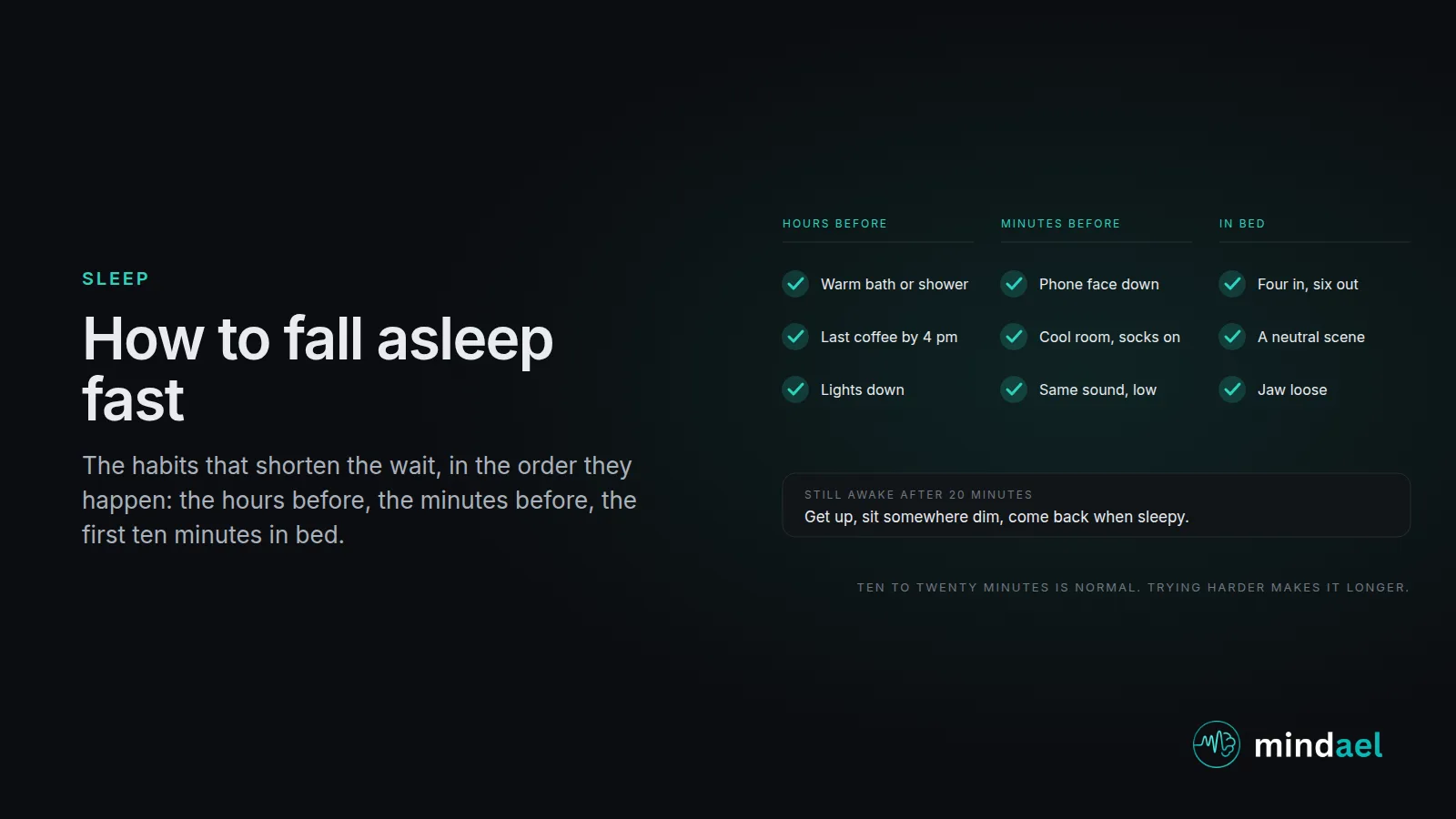
Falling asleep fast is mostly decided before you get into bed: a warm bath or shower one to two hours earlier, caffeine stopped by mid-afternoon, bright screens off, warm feet, a cool room. In bed, the things with evidence are a steady low sound, slow breathing with a long exhale, and giving the mind a neutral picture to hold instead of the day. If you are still awake after about twenty minutes, get up, do something dull in dim light and come back; staying in bed trying harder is the one thing that reliably makes it slower. The viral methods, the military method and 4-7-8 among them, are mostly repackaged slow breathing and distraction, which is why they half work.
How to fall asleep fast is searched half a million times a month, and most of the answers are either a two-minute trick that works for the person who wrote it or a list of forty tips with no sense of which ones matter. This article is the middle: the handful of things with trials behind them, in the order they happen in an evening, with the research for each. The sounds and the breathing guide are in Mindael, free to download on the App Store, and the night-long setup, the sound for a loud street and for a 3 a.m. waking, is in our sleep sounds guide.
Why “fast” is the wrong target, and what the right one is
A healthy adult takes ten to twenty minutes to fall asleep. Under five minutes usually means you are short of sleep, not good at it. So the goal is not instant: it is to be reliably asleep inside twenty minutes, without the hour of ceiling-staring that makes the next night worse.
The thing that most lengthens the wait is trying. Sleep is the one task that effort pushes further away, because effort is arousal and arousal is the opposite of sleep onset. Nearly everything below is a way of lowering arousal or taking your attention off the question of whether you are asleep yet.
Before bed: where most of the time is won
A warm bath or shower, one to two hours before. This is the single best-supported habit. A 2019 systematic review and meta-analysis found that warm water in that window shortened the time to fall asleep by about ten minutes on average and improved sleep quality (Haghayegh et al., 2019). The mechanism is the drop in core temperature after you get out, which is one of the body’s own signals for sleep.
Warm feet, cool room. The oldest paper on this list found that the warming of the hands and feet, which pushes heat out of the core, was the best predictor of how fast people fell asleep (Kräuchi et al., 1999). Socks in bed, a cool bedroom and a warm duvet are the practical version.
Caffeine stopped six hours out. A dose of caffeine taken six hours before bed still cut total sleep by about an hour in a 2013 study, and the sleepers did not notice (Drake et al., 2013). If bed is at eleven, the last coffee is at four at the latest; for many people it is lunchtime.
Lights and screens down for the last hour. Reading on a bright screen before bed delayed the melatonin rise, lengthened the time to fall asleep and left people less alert the next morning compared with a paper book (Chang et al., 2015). Dim lamps, a paper book, the phone face down with the sound app running.
The same evening every night. None of these are dramatic on their own; the ten minutes from the bath is the biggest single effect. What makes them add up is repetition. After two weeks of the same order, the first step starts telling the body what is coming. Our how to relax your nervous system article builds the full slow evening around that idea.
In bed: the first ten minutes
A steady low sound. Hearing stays on all night, and every change in the room is a small reason to stay alert. In a 2017 study that put healthy sleepers in a noisy environment, steady broadband sound cut the time to fall asleep by 38 percent (Messineo et al., 2017). Rain or brown noise at a quiet-conversation level, the same one every night. If you want the version with sleep-lab work behind it, a 3 Hz delta beat in earbuds increased deep sleep in a 2018 study (Jirakittayakorn and Wongsawat, 2018); use it for the first twenty minutes under rain, then let it fade.
Slow breathing, long exhale. Four seconds in through the nose, six out, low into the belly, for a few minutes. At around six breaths a minute heart rate variability rises and arousal falls across many studies (Zaccaro et al., 2018). This is the engine inside most of the named methods below. Our breathing guide has the patterns.
Something neutral to picture. Lying there with the day on replay is the commonest reason for a long wait. In a 2002 study of people with insomnia, those told to picture a pleasant, detailed, engaging scene fell asleep faster than those left to their own devices or told simply to distract themselves (Harvey and Payne, 2002). A walk you know well, a room you are building in your head, a slow descent through a landscape. Not a problem to solve.
Muscles, top to bottom. Jaw loose, tongue off the roof of the mouth, shoulders dropped, hands open. Most people are holding something, and the body reads held muscle as “not yet”.
The twenty-minute rule
If you are still clearly awake after about twenty minutes, get up. Sit somewhere dim, do something dull, no screen, and go back when you feel sleepy. This feels like giving up and is in fact one of the core parts of cognitive behavioural therapy for insomnia, which a 2015 meta-analysis found shortened time to fall asleep by about nineteen minutes and cut night waking, with effects that lasted (Trauer et al., 2015). The point is that the bed must stay the place you sleep, not the place you lie awake worrying about not sleeping. Keep the sound on while you are up and back in bed, so the room does not change.
The methods people search for, honestly
The military method. Relax the face, shoulders and arms, breathe out, relax the legs, then hold a still image or repeat “don’t think” for ten seconds; claimed to work in two minutes after six weeks of practice. It has never been tested in a trial. What it contains is progressive muscle relaxation and imagery distraction, both of which do have evidence, so it is worth trying as a routine. The two-minute figure is the part to drop.
4-7-8. Breathe in for four, hold for seven, out for eight. It is slow breathing with a long exhale, which works, in a wrapper that makes some people tense on the hold. If the seven feels like effort, four in and six out does the same job.
Cognitive shuffling. Pick a neutral word and think of unrelated words starting with each letter, picturing each. It is imagery distraction with a rule to keep the mind from drifting back to the day, and it is a reasonable way to do the Harvey and Payne idea if a single scene does not hold you.
Counting sheep. The one method with a study against it: in the same 2002 paper, counting sheep was no better than no instruction. Too boring to hold attention, so the worries come back.
When it is not about tonight
If it takes you more than thirty minutes to fall asleep on three or more nights a week, for three months, that is the definition of chronic insomnia, and the treatment with the best evidence is cognitive behavioural therapy for insomnia rather than any list of tips. Loud snoring, pauses in breathing, or waking exhausted after a full night point to sleep apnoea, which a doctor can test for. The habits on this page still help in both cases; they are just not the whole answer.
The short version
Warm bath an hour or two before bed, caffeine stopped by mid-afternoon, lights down and the phone away for the last hour, socks on, room cool. In bed: rain or brown noise low, four in and six out for a few minutes, a neutral scene to walk through, jaw and shoulders loose. Twenty minutes and still awake, get up and come back. Mindael has the sound, the delta beat and the breathing guide, free to download; the evening is the part you build.
Press play, breathe out, let it fade.
Mindael has rain, brown and pink noise, a 3 Hz delta beat and guided slow breathing made in our studio, with a timer that fades the sound after you are gone. Free to download, no account, works offline. The same sound every night becomes the cue that you are about to sleep.
- Rain, brown and pink noise, delta beats, studio-made
- Guided slow breathing over any sound, a fading timer
- Free to download, no account, works offline
 Free · No account needed · Works offline
Frequently asked questions
How can I fall asleep fast?
Set it up earlier: a warm bath or shower one to two hours before bed, no caffeine after early afternoon, lights and screens down for the last hour, a cool room and warm feet. In bed, a steady low sound such as rain or brown noise, four seconds in and six out, and a neutral scene to picture. If twenty minutes pass, get up and come back when you are sleepy. There is no trick that works in two minutes for everyone, and the ones that claim to are mostly slow breathing.
What is the military method for sleep?
A routine from a 1981 book: relax the face, drop the shoulders and arms, breathe out and relax the legs, then clear the mind with a still image or by repeating 'don't think' for ten seconds. It has never been tested in a trial. What it contains is progressive muscle relaxation and imagery distraction, both of which have evidence, so it is reasonable to try; the two-minute promise is the part to ignore.
Does the 4-7-8 breathing method work?
It is slow breathing with a long exhale, and slow breathing at around six breaths a minute reliably lowers arousal in studies. The exact counts are not magic and holding for seven can feel like effort; four in and six out, breathing low, does the same job. Expect calmer, not unconscious.
Why can't I fall asleep even though I'm tired?
Tired and sleepy are different states. You can be exhausted with a nervous system still in daytime mode because of caffeine, a late bright screen, a hot room, an argument or the habit of worrying in bed. Most of the fixes on this page are about lowering arousal rather than adding tiredness.
Should I stay in bed if I can't sleep?
Not for long. After roughly twenty minutes awake, get up, sit somewhere dim and do something dull until you feel sleepy, then go back. It feels wrong, but it is one of the core parts of cognitive behavioural therapy for insomnia, the treatment with the strongest evidence, because it stops the bed from becoming the place you lie awake.
What sound helps you fall asleep fastest?
A steady, low, broadband one: rain, brown noise or pink noise, at a quiet-conversation level. In a 2017 study, steady sound cut the time to fall asleep by 38 percent in a noisy environment. A 3 Hz delta beat in one earbud for the first twenty minutes is the version with brain-wave research behind it.
Sources
- Haghayegh S, et al. Before-bedtime passive body heating by warm shower or bath to improve sleep: a systematic review and meta-analysis. Sleep Medicine Reviews, 2019.
- Kräuchi K, et al. Warm feet promote the rapid onset of sleep. Nature, 1999.
- Drake C, et al. Caffeine effects on sleep taken 0, 3, or 6 hours before going to bed. Journal of Clinical Sleep Medicine, 2013.
- Chang AM, et al. Evening use of light-emitting eReaders negatively affects sleep, circadian timing, and next-morning alertness. PNAS, 2015.
- Messineo L, et al. Broadband sound administration improves sleep onset latency in healthy subjects in a model of transient insomnia. Frontiers in Neurology, 2017.
- Zaccaro A, et al. How breath-control can change your life: a systematic review on psycho-physiological correlates of slow breathing. Frontiers in Human Neuroscience, 2018.
- Harvey AG, Payne S. The management of unwanted pre-sleep thoughts in insomnia: distraction with imagery versus general distraction. Behaviour Research and Therapy, 2002.
- Jirakittayakorn N, Wongsawat Y. A novel insight of effects of a 3-Hz binaural beat on sleep stages during sleep. Frontiers in Human Neuroscience, 2018.
- Trauer JM, et al. Cognitive behavioral therapy for chronic insomnia: a systematic review and meta-analysis. Annals of Internal Medicine, 2015.
This article is for general information and is not medical advice. If it takes you more than half an hour to fall asleep on three or more nights a week for three months, or if you snore heavily, stop breathing in your sleep or feel exhausted after a full night, please talk to a doctor.
This article is part of our sleep guide. Hear the sounds in this article in the Mindael sound library, or see our app comparison checklists.