
Best Frequency for Healing: What 528, 432, 174 Hz and the Others Have Actually Been Tested For, What the Studies Found, and How to Choose a Tone
There is no best frequency for healing, because no frequency heals: no tone repairs tissue, clears a disease or 'repairs DNA', and the studies that exist do not claim it. What the studies do show is smaller and real: music tuned to 432 Hz lowered heart rate and anxiety slightly compared with 440 Hz in two small trials; a 528 Hz piece lowered a stress marker in a nine-person study; singing bowls lowered tension and mood scores in an observational study; binaural beats have a modest pooled effect on anxiety; slow breathing and natural sound lower arousal across many studies. The useful question is which tone helps you rest, and the honest answer is the low ones, 174 or 396 Hz, under rain or a drone, at a volume you forget, with a slow exhale. This article goes through each frequency people search for and says exactly what has been measured.
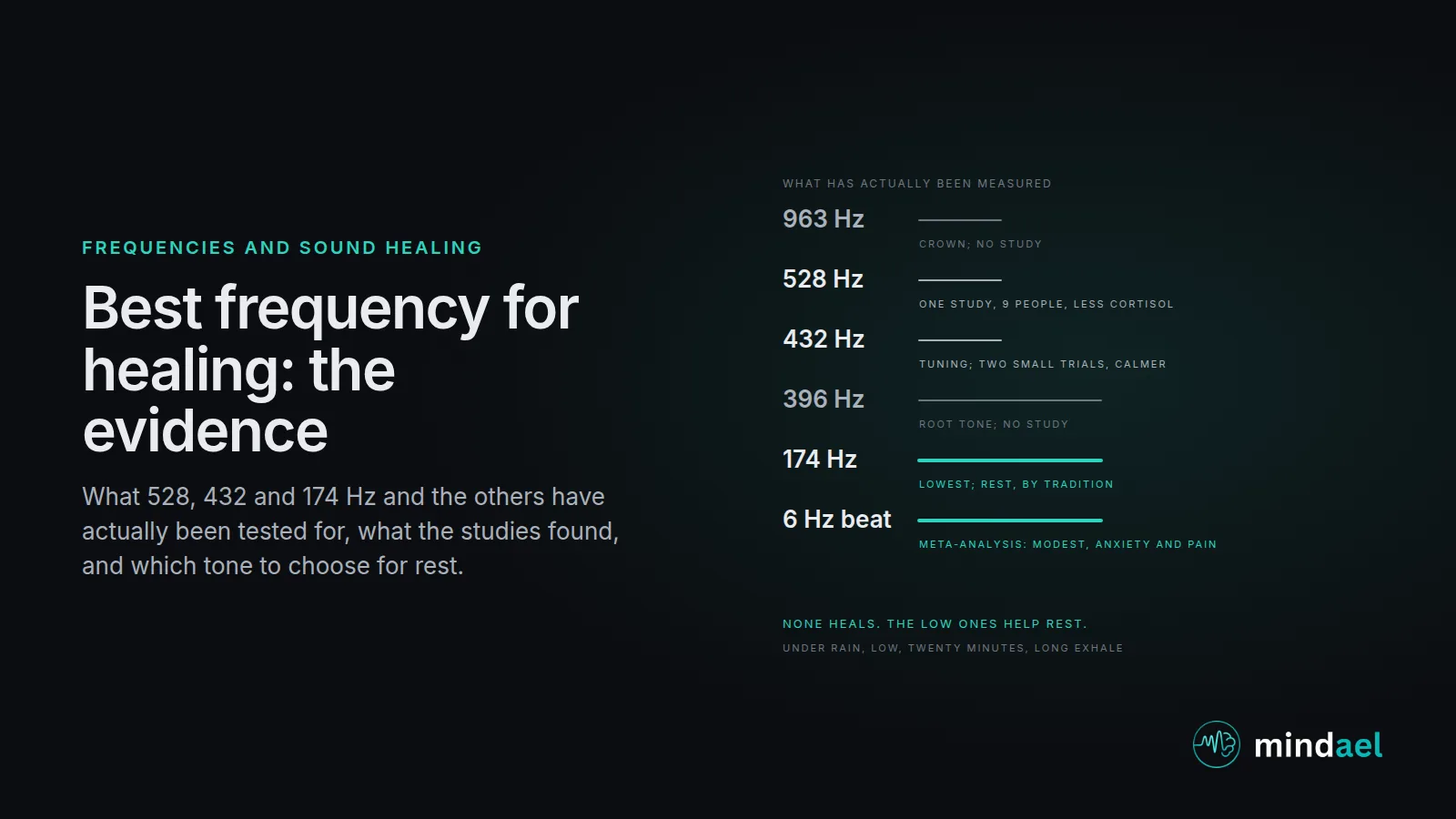
Best frequency for healing is a search with a thousand confident answers and no honest one, so here is ours: no frequency heals. No tone repairs tissue, clears an infection, shrinks anything or “repairs DNA”, and the handful of real studies on these frequencies do not claim it. What the studies do show is modest and worth knowing, because it tells you which tone helps a body rest and why. This article takes each frequency people search for, says what has actually been measured, and ends with how to choose and listen. All of them, tuned to the hertz, are in Mindael, free to download on the App Store, and the background on where the numbers come from is in our solfeggio frequencies article.
First, what “healing” can mean here
Three things get mixed up in the phrase. The first is medical healing, tissue and disease, and for that the evidence for any audio frequency is nil, and we will not pretend otherwise. The second is the body’s stress response: heart rate, cortisol, anxiety scores, muscle tension. That is measurable, and sound in general, not any particular hertz, moves it a little. The third is the feeling of rest, which is real and is the thing people are mostly after when they type the search. The rest of this article is about the second and third.
The practices around the tones carry most of the measurable effect. Slow breathing at around six breaths a minute lowers arousal and raises heart rate variability across many studies (Zaccaro et al., 2018). Natural sound, water above all, lowered stress and pain and lifted mood in a 2021 synthesis (Buxton et al., 2021). Twenty minutes lying still with a sound to attend to is, functionally, a meditation. Whatever tone sits under that gets the credit.
The frequencies people search for, one by one
528 Hz, “the love frequency” or “the DNA repair frequency”. The DNA claim comes from a 2000s book and has no study behind it; DNA does not resonate at 528 Hz and the claim is not testable as stated. The one published study played a short piece of music at 528 Hz and at 440 Hz to nine people and found lower salivary cortisol and anxiety scores after the 528 Hz version (Akimoto et al., 2018). Nine people, one piece, one session: a small result about relaxation that nobody has replicated, and nothing about DNA. Our 528 Hz page has the tone and the honest version of its story.
432 Hz, “the natural tuning”. This is a tuning standard, not a solfeggio tone: the same music with A set to 432 instead of the modern 440 Hz. Patients listening to 432 Hz music during root canal treatment reported lower anxiety and had lower salivary cortisol than a group with no music, in a 2016 trial, though the study did not compare 432 with 440 directly (Di Nasso et al., 2016). A 2019 double-blind cross-over pilot did compare them in 33 people and found a slightly lower heart rate and slightly better self-reported outcomes with 432 Hz (Calamassi and Pomponi, 2019). Small differences, small samples, and the plainest explanation is that a slightly lower tuning sounds a little warmer to most people. Nothing about healing; something about preference.
174 Hz, “the pain relief frequency”. No study. It is the lowest of the nine solfeggio tones, which is why it feels physical, in the chest and the seat, and why listeners reach for it on an aching evening under rain. We put it on our 174 Hz page as the lying-down tone, because that is what it is good for. The “pain relief” label is a tradition.
396 Hz, “releasing fear”. No study. In the chakra tradition it is paired with the root centre, and our root chakra article says what that pairing is and is not. As a tone it is low and steady, good under a drone for a grounding two minutes.
963 Hz and 852 Hz, “the crown” and “the third eye”. No studies. High, thin tones that most people find hard to listen to for long; in a chakra meditation they are the last two stops and the quietest, and the chakra meditation guide places them. Not a tone for rest on its own.
Singing bowls, often sold as “healing frequencies”. The one observational study measured 62 people before and after an hour-long singing bowl meditation and found lower tension, anger, fatigue and depressed mood scores, with the biggest change in people who had never done it before (Goldsby et al., 2017). No control group, so the hour of lying still is as likely the cause as the bowls. A pleasant result, honestly reported by its authors.
Binaural beats, “healing frequencies” of a different kind. These are not tones but a beat frequency the brain produces from two slightly different tones, one per ear. They are the only item on this list with a meta-analysis: across 22 studies, binaural beats had a modest pooled effect on anxiety and on pain perception, with the effect larger for longer exposure (Garcia-Argibay et al., 2019). Our binaural beats article covers what that does and does not mean; for rest, the 2 Hz delta and 6 Hz theta beats are the ones listeners use.
“The frequency of the human body”, 62 to 72 MHz. This traces to a device sold in the 1990s that was never validated, and the number means nothing: tissues have mechanical resonances, the heart beats at about one hertz, brain rhythms run from under one to over forty, and no single frequency is “the body’s”. Any product that quotes the figure is quoting marketing.
So which one?
If the question is which tone helps you rest, we can answer it from what our listeners use and from the small evidence above. Low tones, because they are felt as much as heard and give a busy mind something physical to rest on: 174 Hz lying down, 396 Hz seated. Under something natural, rain or ocean, because water sound is the one with the broadest evidence for lowering stress. On a speaker rather than in the ear, so the tone sits in the room. At a volume you stop noticing within a minute. For twenty minutes, with the exhale longer than the inhale. If you want a beat rather than a tone, the 6 Hz theta beat in earbuds, with the meta-analysis behind it.
If the question is which frequency heals an illness, the answer is none, and the kind thing to say is that a tone can sit beside treatment, as a way to rest, and never in its place.
The short version
No frequency heals; the studies do not claim it and neither do we. 432 Hz tuning lowered heart rate and anxiety slightly in two small trials; 528 Hz lowered a stress marker in nine people once; singing bowls lowered tension scores in an uncontrolled study; binaural beats have a modest pooled effect on anxiety and pain. The breathing, the stillness and the water sound carry most of the effect. For rest: a low tone, 174 or 396 Hz, under rain, low, twenty minutes, long exhale.
Tuned to the hertz. Claiming only rest.
Mindael has all nine solfeggio tones and a 432 Hz drone tuned exactly, rain and ocean recorded without loops, and the 2 Hz delta and 6 Hz theta beats made in our studio, mixed two at a time with a timer that fades. Free to download, no account, works offline. A low tone under rain for twenty minutes is the whole prescription.
- Nine solfeggio tones and a 432 Hz drone, tuned to the hertz
- Rain, ocean, delta and theta beats, mixed two at a time
- Free to download, no account, works offline
 Free · No account needed · Works offline
Frequently asked questions
What is the best frequency for healing?
None heals, in the medical sense: no tone has been shown to repair tissue, clear an illness or change DNA, and the studies on these frequencies do not claim it. If the question is which tone helps the body rest, the low tones, 174 and 396 Hz, under rain or a low drone, at a quiet volume with slow breathing, are what our listeners and the small research base point to.
Does 528 Hz really heal DNA?
No. The claim comes from a 2000s book and has no study behind it; DNA is not a resonator at 528 Hz and nothing about the claim is testable as stated. The one published study on 528 Hz played a short piece of music to nine people and found a drop in a stress hormone and in anxiety scores compared with 440 Hz. That is an interesting small result about relaxation, not about DNA.
Is 432 Hz better than 440 Hz?
Two small trials found music tuned to 432 Hz lowered heart rate and anxiety slightly more than the same music at 440 Hz: a 2016 dental study and a 2019 cross-over pilot. The differences were small, the samples were small, and the better explanation is that most people find a slightly lower tuning a little warmer. Neither study found anything about healing.
What frequency is good for pain?
Binaural beats, not single tones, have the pooled evidence: a 2019 meta-analysis found a modest effect on pain perception and on anxiety across 22 studies. Natural sounds, water above all, lowered pain and stress in a 2021 synthesis. For a tone, 174 Hz is the one listeners use for an aching evening, under rain, but that is a tradition and a preference, not a measurement.
What is the frequency of the human body?
There is no single one. Different tissues resonate at different mechanical frequencies, the heart beats at about 1 Hz, brain rhythms run from under 1 to over 40 Hz, and none of this corresponds to a note you could play. Claims of a 'healthy body frequency' of 62 to 72 MHz trace to a device that was never validated.
How should I listen to healing frequencies?
Low, for twenty minutes, lying down or seated, with the exhale longer than the inhale. A tone under rain or a drone on a speaker so it sits in the room rather than in the ear. The breathing and the stillness are where the measured benefit comes from; the tone is the thing that keeps you there.
Sources
- Calamassi D, Pomponi GP. Music tuned to 440 Hz versus 432 Hz and the health effects: a double-blind cross-over pilot study. Explore, 2019.
- Di Nasso L, Nizzardo A, Pace R, et al. Influences of 432 Hz music on the perception of anxiety during endodontic treatment: a randomized controlled clinical trial. Journal of Endodontics, 2016.
- Akimoto K, Hu A, Yamaguchi T, Kobayashi H. Effect of 528 Hz music on the endocrine system and autonomic nervous system. Health, 2018.
- Goldsby TL, et al. Effects of singing bowl sound meditation on mood, tension, and well-being: an observational study. Journal of Evidence-Based Complementary and Alternative Medicine, 2017.
- Garcia-Argibay M, Santed MA, Reales JM. Efficacy of binaural auditory beats in cognition, anxiety, and pain perception: a meta-analysis. Psychological Research, 2019.
- Buxton RT, et al. A synthesis of health benefits of natural sounds and their distribution in national parks. PNAS, 2021.
- Zaccaro A, et al. How breath-control can change your life: a systematic review on psycho-physiological correlates of slow breathing. Frontiers in Human Neuroscience, 2018.
This article is for general information and is not medical advice. No sound frequency treats, cures or prevents any disease. If you have pain, an illness or a mental health condition, please see a doctor; a tone can sit alongside treatment, never in place of it.
This article is part of our energy, chakras and reiki guide. Hear the sounds in this article in the Mindael sound library, or see our app comparison checklists.