

Root Chakra Meaning: What the First Centre Stands For, the Other Six in Brief, and What a Tone Can and Cannot Do
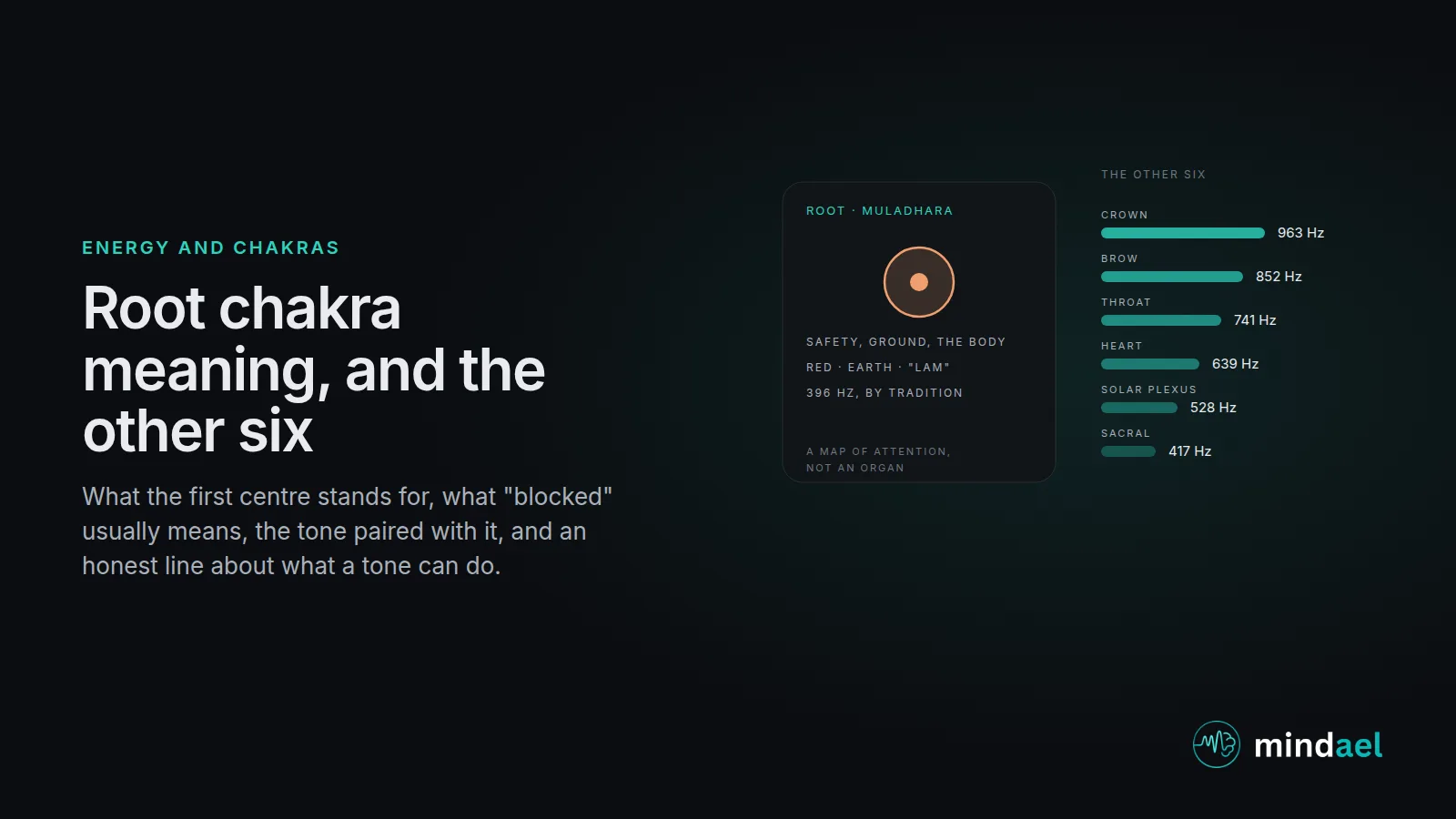
The root chakra, muladhara in Sanskrit, is the first of the seven centres in the Tantric yoga map of the body: located at the base of the spine, associated with the colour red, the element earth, the sound 'lam' and, in the modern tradition, the 396 Hz solfeggio tone. It stands for safety, grounding, the body's basic needs and the sense of having a place to stand. When people say their root chakra is 'blocked' they are usually describing anxiety about security, restlessness or feeling ungrounded, and the practices that help, slow breathing, attention at the base of the body, weight, steady low sound, help for ordinary reasons the research covers. No instrument has ever found a chakra; the map is a way of organising attention, and we present it as that. The other six, from sacral to crown, are summarised below with the tone paired with each.
Root chakra meaning is the first thing most people look up when they meet the chakra system, because the root is where every chakra meditation starts and because “blocked root chakra” is the phrase that turns up when someone feels unsafe without knowing why. This article explains what the root stands for in the tradition, what people actually mean when they say it is blocked, what a tone can and cannot do about it, and then runs briefly through the other six. The tones are in Mindael, free to download on the App Store, and the full fifteen-minute practice through all seven centres is in our chakra meditation guide.
What the root chakra is
Muladhara, “root support”, is the first of the seven centres in the Tantric yoga map, placed at the base of the spine, at the perineum, the point where the seated body meets the ground. In the tradition it is the centre of survival: safety, shelter, food, the body’s basic needs, belonging to a place and a family. Its colour is red, its element is earth, its lotus has four petals, its seed sound is “lam”, and in the modern practice that pairs solfeggio tones with centres it is given 396 Hz, the lowest of the seven.
We should say plainly what that is. The chakras are a map of attention, developed over centuries to give a meditator places to rest awareness in turn. They are not organs, and no instrument has found one. Everything the root “means” is a way of describing how it feels to have attention at the base of the body: heavy, still, supported, here. That feeling is real and useful. The anatomy is a metaphor, and we use it as one.
What “blocked” usually means
When people say their root chakra is blocked, they tend to describe some combination of: anxiety about money, housing or security; restlessness and an inability to settle; feeling disconnected from the body or “in the head”; trouble sleeping; a vague sense of not being safe when nothing is wrong. Those are ordinary experiences with an ordinary explanation. They are what a nervous system that has been slightly braced for a long time feels like from the inside, and our nervous system regulation guide describes the same state in physiological terms.
Nothing is physically blocked. But the tradition’s prescription for it is not bad, because it amounts to a grounding practice, and grounding practices do what they say for reasons the research covers. Slow breathing with a long exhale, at around six breaths a minute, raises heart rate variability and lowers arousal across many studies (Zaccaro et al., 2018). Attention held in the body, which is what any body-scan or seated meditation trains, is part of why meditation programmes improve anxiety and mood (Goyal et al., 2014). Weight on the body is calming for many people; a weighted blanket improved insomnia and anxiety symptoms in a randomised trial (Ekholm et al., 2020). And chanting a low sustained syllable, which is what “lam” or a long “om” at the root is, quietened the brain’s self-referential network in a small fMRI study (Kalyani et al., 2011). The tradition got the practice right and the explanation wrong, which is a fair description of a lot of old wisdom.
If the feeling of being unsafe is persistent, comes with panic, or is about a real threat, the root practice is a comfort and not a solution, and a doctor or therapist is the right next step; our anxiety guide has the five-minute routine for a spike in the meantime.
The root practice, two minutes
Sit on the floor or a firm chair, feet flat, or stand barefoot. Put attention at the base of the spine, at the point of contact with the ground, and let the weight go down into it. Breathe four in through the nose and six out, low into the belly. If you use sound, the 396 Hz tone low under a drone or ocean waves, in a speaker rather than earbuds so it feels like it is in the room. If you chant, a long low “lam” or “om” on each out-breath, feeling it in the seat rather than the throat. Two minutes. The point is not to open anything; it is to arrive in the body before you do anything else. In a full chakra meditation this is stop one of seven, and the other six build on the stillness it gives you. For the tone’s own page and what listeners pair it with, see 396 Hz; for a lying-down version with the lowest tone of all, 174 Hz under rain is the one many people use.
The other six, in brief
The same honesty applies to each: the meaning is a tradition, the tone pairing is a modern convention, and the practice at each stop is attention plus breath plus, if you like, a sound.
Sacral, svadhisthana. Below the navel. Pleasure, creativity, emotion, flow. Orange, water, “vam”, 417 Hz. The stop where you let the belly move with the breath.
Solar plexus, manipura. Under the ribs. Will, confidence, the capacity to act. Yellow, fire, “ram”, 528 Hz, the most listened-to tone of the nine, and the one our solfeggio frequencies article spends most time on.
Heart, anahata. Centre of the chest. Love, compassion, grief, connection. Green, air, “yam”, 639 Hz. The stop where a long “om” on the out-breath belongs if you chant, and the one most people find easiest to feel.
Throat, vishuddha. The throat. Expression, truth, saying the thing. Blue, space, “ham”, 741 Hz. Humming on the out-breath, which also has its own small research on calming, fits here.
Brow, ajna. Between the eyebrows. Perception, intuition, clarity. Indigo, “om”, 852 Hz. Eyes closed, tone very low; the stop where the breath goes natural.
Crown, sahasrara. Top of the head, the thousand-petalled lotus. Awareness, connection to something larger, the end of the self’s borders for a minute. Violet or white, silence, 963 Hz barely audible. The last stop, then one minute with the tones off and attention on the whole body at once.
A singing-bowl session often runs the same ladder with bowls instead of tones; in an observational study, singing bowl meditation lowered tension and anger and improved mood, most of all in people new to it (Goldsby et al., 2017), which is a fair description of what a seven-stop practice does for most beginners. The full sequence with timings, and the floor sound to keep under all seven, is in the chakra meditation guide.
The short version
The root chakra is the tradition’s name for attention at the base of the body: safety, weight, ground. “Blocked” means anxious or ungrounded, and the fix the tradition prescribes, slow breath, attention down, a low sound, weight, works for ordinary reasons. The 396 Hz tone is a real and precise pitch to rest on and attracts, opens and balances nothing. Mindael has it, with the other eight, the drones and the ocean, free to download; two minutes at the root is a good way to start any sit.
The lowest tone, under a drone.
Mindael has 396 Hz and the other eight solfeggio tones tuned to the hertz, low drones, ocean and the 6 Hz theta beat made in our studio, mixed two at a time. Free to download, no account, works offline. Put the root tone under a drone, sit, and breathe low for two minutes.
- All nine solfeggio tones, drones, ocean and theta beats, studio-made
- Two sounds at once: a tone over a drone
- Free to download, no account, works offline
 Free · No account needed · Works offline
Frequently asked questions
What does the root chakra mean?
In the Tantric yoga tradition it is the first of seven centres, at the base of the spine, standing for safety, stability, the body's basic needs and the sense of being grounded. Its Sanskrit name muladhara means 'root support'. It is paired with the colour red, the element earth, the seed sound 'lam' and, in modern practice, the 396 Hz tone. It is a map of attention, not an organ.
What are the signs of a blocked root chakra?
People use the phrase for feeling unsafe without a clear reason, restless, scattered, anxious about money or home, or disconnected from the body. Those are real experiences with ordinary explanations, usually a stressed nervous system, and the practices the tradition prescribes, grounding attention in the body, slow breathing, weight and steady sound, help with them. Nothing is physically blocked, and if the feelings are persistent, a doctor or therapist is the right next step.
How do you open or balance the root chakra?
The traditional practice is attention at the base of the spine, slow breathing, the sound 'lam' or a low tone, and contact with the ground: sitting, standing barefoot, walking. We would describe the result as feeling grounded rather than as a centre opening, because that is what can be observed. Two minutes at the root is the first step of the fifteen-minute practice in our chakra meditation guide.
What frequency is the root chakra?
The modern pairing is 396 Hz, the lowest of the solfeggio tones used for the seven centres. That assignment is a tradition from the last few decades, not a measurement; a chakra has no frequency because there is nothing to measure. The tone is real and precise and is a good low pitch to rest attention on.
What is the crown chakra meaning?
Sahasrara, the seventh centre at the top of the head, stands for awareness, connection and a sense of something larger than the self. It is paired with violet or white, silence rather than a seed sound, and in modern practice the 963 Hz tone. It is the last stop in a chakra meditation, where the breath goes natural and the tones go quiet.
What is the sacral chakra meaning?
Svadhisthana, the second centre, below the navel, stands for pleasure, creativity, emotion and flow. Orange, the element water, the seed sound 'vam' and the 417 Hz tone. In practice it is the stop where people are reminded to let the belly move with the breath, which most of us are holding.
Sources
- Goyal M, et al. Meditation programs for psychological stress and well-being: a systematic review and meta-analysis. JAMA Internal Medicine, 2014.
- Zaccaro A, et al. How breath-control can change your life: a systematic review on psycho-physiological correlates of slow breathing. Frontiers in Human Neuroscience, 2018.
- Kalyani BG, et al. Neurohemodynamic correlates of 'OM' chanting: a pilot functional magnetic resonance imaging study. International Journal of Yoga, 2011.
- Ekholm B, et al. A randomized controlled study of weighted chain blankets for insomnia in psychiatric disorders. Journal of Clinical Sleep Medicine, 2020.
- Goldsby TL, et al. Effects of singing bowl sound meditation on mood, tension, and well-being: an observational study. Journal of Evidence-Based Complementary and Alternative Medicine, 2017.
This article is for general information and is not medical advice. Chakra practices are a meditation tradition, not a treatment. Persistent anxiety, low mood or a feeling of being unsafe deserves a conversation with a doctor or therapist.
This article is part of our energy, chakras and reiki guide. Hear the sounds in this article in the Mindael sound library, or see our app comparison checklists.