

Calm Music for Sleep: What Sleep Music Has in Common, Why People Use It, and How to Build a Calm Playlist
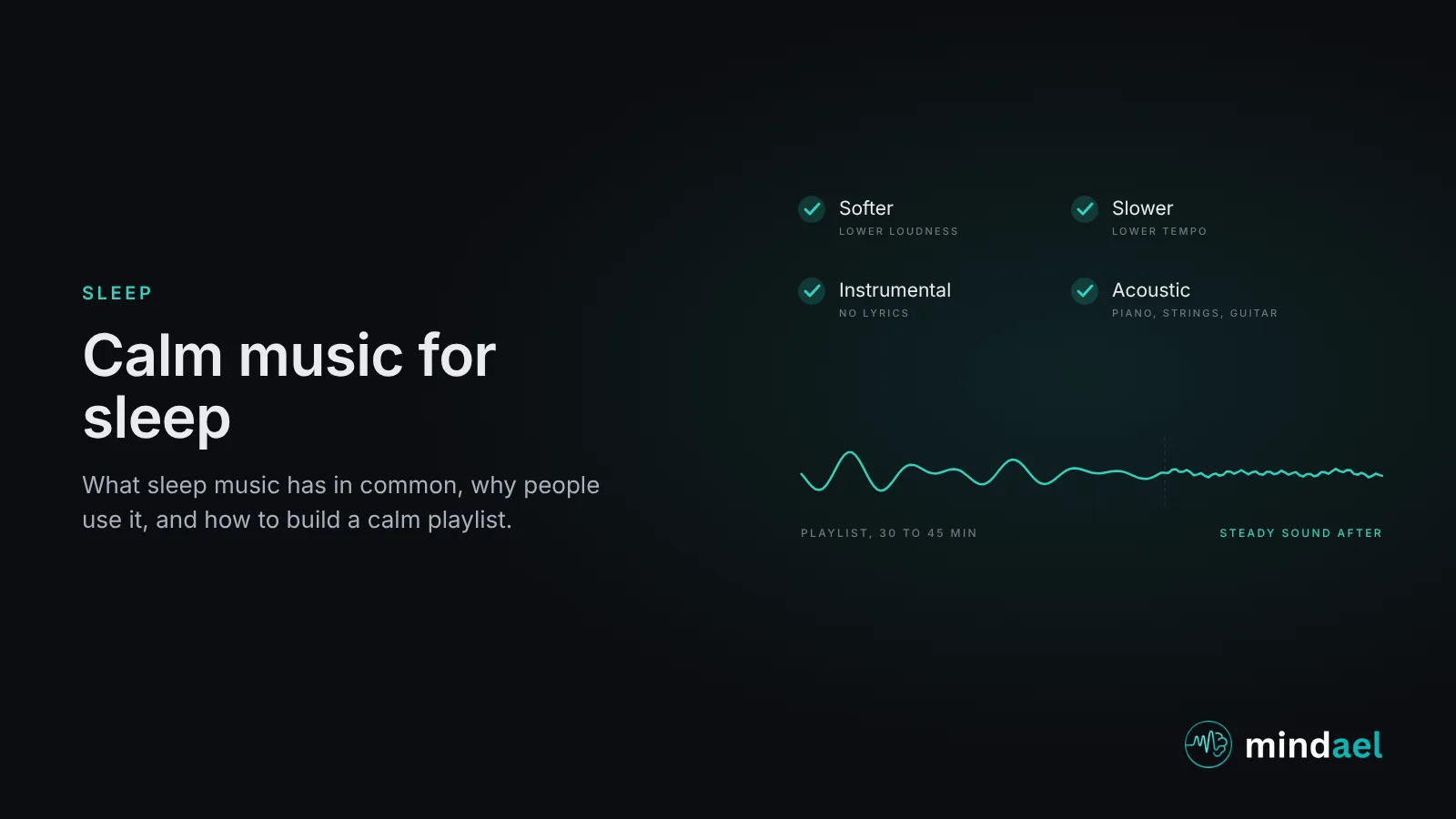
Calm music for sleep is less about a genre and more about a few features. An analysis of over 225,000 tracks on sleep playlists found that sleep music was, on average, softer and slower than other music, more often instrumental and more often played on acoustic instruments. In a survey, people who used music to fall asleep said it helped not only by relaxing them but by masking noise, giving the mind something to follow instead of worries, and becoming a bedtime habit. A Cochrane review of 13 trials found that music likely improves how adults with insomnia symptoms rate their sleep. So build a calm playlist around what you already find soothing: slow, soft and without words, 30 to 45 minutes long, the same every night, played quietly, and switch to a steady sound if you need sound all night.
Calm music for sleep is one of the most common bedtime habits there is: a quiet playlist, lights off, and somewhere in the second or third track you are gone. It works for many people, and research now shows what that music has in common and why people say it helps. This article covers both, and how to build a calm playlist of your own. We make Mindael, a sound app for sleep with calm, steady sounds, free to download on the App Store.
What sleep music has in common
Researchers analysed more than 225,000 tracks from almost a thousand sleep playlists on a streaming service. Compared with music in general, sleep music was softer and slower, more often instrumental, without lyrics, and more often played on acoustic instruments (Scarratt et al., 2023).
There was a surprise too: the tracks fell into six groups, and some of them were ordinary pop songs, faster and louder than you would expect. People also fall asleep to music they simply know and love. So “calm” is partly in the music and partly in you.
Why people say it works
In a survey of 651 people, 62 percent said they used music to help them sleep. Relaxation was only one of the reasons they gave. Others said music masked noise, gave their mind something to follow instead of worries, or had simply become part of going to bed (Trahan et al., 2018).
That fits with the trials. In a study of students with poor sleep, 45 minutes of relaxing music at bedtime for three weeks improved sleep quality, while an audiobook did not (Harmat et al., 2008). A Cochrane review of 13 trials found that music likely improves how adults with insomnia symptoms rate their sleep (Jespersen et al., 2022). Our relaxing sleep music article covers the trials in more detail.
Build a calm playlist
Slow and soft. Piano, ambient, soft strings, gentle acoustic guitar. If a track has a sudden loud moment, drop it.
No words, or only very familiar ones. Lyrics pull attention. A song you have heard a hundred times is the exception.
30 to 45 minutes. About the length most trials used. Put the calmest tracks at the end, so the playlist winds down with you.
The same playlist every night. Familiarity is part of the effect; it becomes a cue for sleep.
Quiet, and across the room. Just loud enough to hear. Avoid earbuds all night.
When the music ends
If the room is quiet, let the playlist end. If traffic, a partner or early-morning noise wakes you, switch to a low, steady sound for the rest of the night, such as rain or brown noise. A melody is good for drifting off; a steady sound is better for staying asleep because it does not change. Our sleep noise guide helps you choose.
If you still lie awake most nights, music is not the whole answer; our can’t sleep at night guide covers what to do.
The short version
Calm sleep music is slower, softer, instrumental and acoustic, and people use it to relax, cover noise and quiet their thoughts. Build a 30 to 45 minute playlist you already find soothing, play it quietly every night, and switch to a steady sound if you need one all night. For calm, steady sounds with a timer that fades, Mindael is free to download on the App Store, and our sleep sounds guide has the full night-time setup.
Calm first. Steady after.
Mindael has soft drones made in our studio, rain and ocean recorded without loops and brown noise generated to spec, two at a time, with a timer that fades. Free to download, no account, works offline. Something calm to fall asleep to, and something steady for the rest of the night.
- Soft drones, rain, ocean and brown noise
- Two sounds at once, a timer that fades
- Free to download, no account, works offline
 Free · No account needed · Works offline
Frequently asked questions
What kind of music is best for sleep?
Music you already find calm, that is slow, soft and without words. Across hundreds of thousands of sleep playlist tracks, sleep music was softer, slower and more often instrumental and acoustic than music in general. Piano, ambient, soft strings and gentle acoustic guitar are common choices.
Why does calm music help you sleep?
People who use it describe several reasons: it relaxes them, it covers noises in the room, it gives the mind something neutral to follow instead of worries, and it becomes a habit that tells the body it is bedtime. Trials find it improves how people rate their sleep.
Is it OK to fall asleep to music every night?
For most people, yes, if it is quiet and stops after you fall asleep. Use a playlist of 30 to 45 minutes or a timer that fades. Avoid earbuds at high volume all night.
Should sleep music have lyrics?
Usually not. Words pull attention, which is the opposite of what you want at bedtime. If a song with lyrics is deeply familiar and calming to you, it may still work, but instrumental music is the safer default.
How long should I play music to fall asleep?
About 30 to 45 minutes, the length most trials used. If you need sound for the whole night to cover traffic or a partner, switch to a low, steady sound such as rain or brown noise after the music ends.
Is calm music better than white noise for sleep?
They do different jobs. Music with a melody is good for winding down and falling asleep. A steady sound like brown noise or rain masks disturbing noises through the night without changing. Many people use music first and a steady sound after.
Sources
- Scarratt RJ, Heggli OA, Vuust P, Jespersen KV. The audio features of sleep music: universal and subgroup characteristics. PLOS ONE, 2023.
- Trahan T, Durrant SJ, Müllensiefen D, Williamson VJ. The music that helps people sleep and the reasons they believe it works: a mixed methods analysis of online survey reports. PLOS ONE, 2018.
- Jespersen KV, et al. Music for insomnia in adults. Cochrane Database of Systematic Reviews, 2022.
- Harmat L, Takács J, Bódizs R. Music improves sleep quality in students. Journal of Advanced Nursing, 2008.
This article is for general information and is not medical advice. If you struggle to sleep on three or more nights a week for three months, or if you snore heavily or feel exhausted after a full night, please talk to a doctor.
This article is part of our sleep guide. Hear the sounds in this article in the Mindael sound library, or see our app comparison checklists.