
Deep Sleep Music: What It Can and Cannot Do for Deep Sleep, What the Research Shows, and How to Use It
Deep sleep music helps most people fall asleep more calmly, and that is real: a Cochrane review of 13 trials found music likely improves how well adults with insomnia symptoms rate their sleep. What it cannot do is switch on deep sleep. The one sound method that boosted the slow waves of deep sleep in the lab played short clicks of pink noise timed to each person's own brain waves, which an ordinary track cannot do. Steady noise has mixed evidence: it masks disruptive sounds, but a systematic review found the research too weak to call it a proven sleep aid. So use deep sleep music for the first half hour, slow, quiet and without words, then switch to a low steady sound or silence, and protect deep sleep the proven way: a regular schedule, a cool dark room, and less alcohol late in the evening.
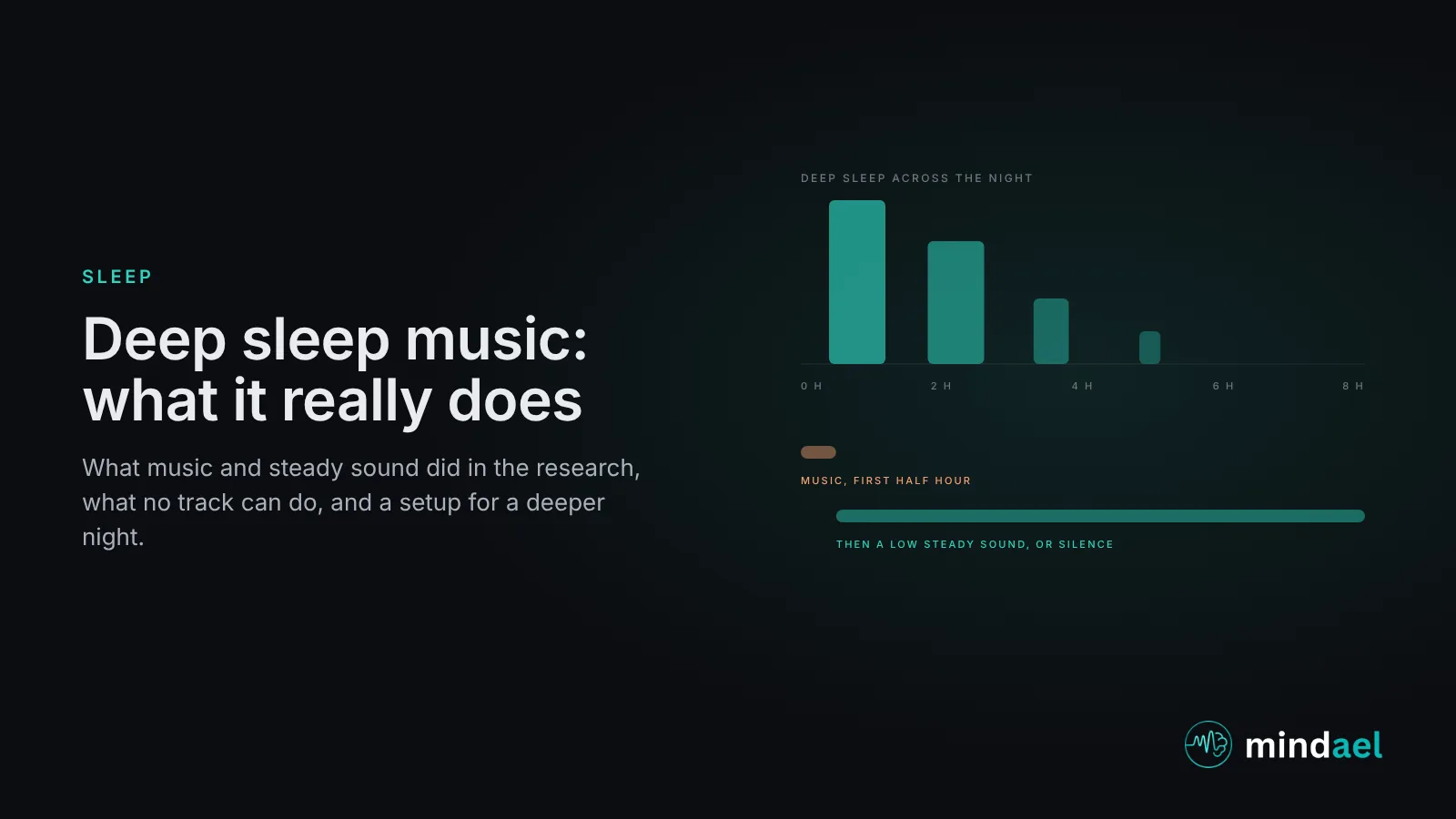
Deep sleep music is one of the most searched sleep sounds, and most of what is promised under that name goes further than the research. This article separates what music and steady sound can do for sleep from what no track can do, explains what deep sleep actually is, and gives a simple setup for a deeper night. The sounds we use are in Mindael, free to download on the App Store, and the wider guide to sleep sounds is our sleep sounds page.
What deep sleep is
Deep sleep, also called slow-wave sleep or N3, is the stage with the slowest, largest brain waves. It comes mostly in the first few hours of the night, and it is the stage linked with feeling physically restored. Its share of the night falls with age: a meta-analysis of sleep studies from childhood to old age found that the proportion of slow-wave sleep declines as people get older (Ohayon et al., 2004). So if you sleep less deeply at 45 than at 20, that is normal, not a fault to fix with a track.
What music can do
Music helps people fall asleep more calmly. A Cochrane review of 13 trials with about 1,000 adults with insomnia symptoms found that listening to music before sleep likely improves how people rate their sleep quality, with no reported side effects (Jespersen et al., 2022). The evidence that it changes measured sleep, such as time to fall asleep or total sleep, was much weaker. The music in these trials was typically slow and calm, played for 25 to 60 minutes at bedtime.
That fits how most people use it: as a way to stop the day’s thoughts and give the mind something slow to follow until sleep arrives.
What no track can do
The idea that a piece of music switches on deep sleep comes from real research, stretched. In a well-known lab study, short clicks of pink noise played in time with each sleeper’s own slow brain waves strengthened those waves and improved memory the next morning; clicks played out of time did nothing (Ngo et al., 2013). That needs a device reading your brain in real time. A recording, however it is labelled, cannot know when your slow waves are happening.
Steady noise is a separate question. It masks the traffic, the heating and the partner turning over, which can wake you out of deeper sleep. But a systematic review of continuous noise as a sleep aid found the studies mixed and the evidence too weak to promote it as proven (Riedy et al., 2021). We use it because it masks disruption, not because it deepens sleep on its own.
A setup for a deeper night
The first half hour. Slow, quiet, wordless sound: rain, ocean, a low drone or a delta beat under rain. Volume low, phone face down.
The rest of the night. Stop the music, or switch to a low, steady sound such as brown noise if your room has noises that wake you. Nothing that changes, nothing with words. Our white, pink and brown noise guide explains which to choose.
The day before. Deep sleep responds to things a track cannot replace: the same wake time every day, daylight and movement in the day, a cool, dark bedroom, and less alcohol in the evening. How to fall asleep fast covers the bedtime side.
The short version
Deep sleep music is a good way to fall asleep calmly, and the evidence supports it for that. It does not switch on deep sleep, and nothing you can download does. Play something slow and wordless for the first half hour, keep the night steady and quiet, and protect deep sleep with a regular schedule and a cool, dark room.
A calm first half hour. A steady night.
Mindael has rain and ocean recorded without loops, brown noise generated to spec and delta beats made in our studio, two at a time. Free to download, no account, works offline. A slow sound to fall asleep to, and a low steady one for the rest of the night.
- Rain, ocean, brown noise and delta beats, studio-made
- Two sounds at once, fine volume control
- Free to download, no account, works offline
 Free · No account needed · Works offline
Frequently asked questions
Does deep sleep music really work?
It helps you fall asleep and rate your sleep better: a Cochrane review found music likely improves sleep quality for adults with insomnia symptoms. There is no good evidence that an ordinary music track increases the amount of deep sleep itself. The lab method that did boost deep sleep timed sound clicks to each person's brain waves.
What is the best music for deep sleep?
Slow, quiet, steady and without words: around 60 to 80 beats per minute or no beat at all, with no sudden changes. Many people prefer a natural sound such as rain or ocean, or a low drone, to music with a melody to follow.
Should I play music all night?
Music with melody is best for the first half hour, then stop it or switch to something steadier, because changes in the music can disturb light sleep. A low, constant sound such as brown noise or rain can run all night if it helps mask noises in your room.
Do delta waves or binaural beats increase deep sleep?
Delta is the brain rhythm of deep sleep, and delta binaural beats are popular for that reason. The evidence that listening to them increases deep sleep is limited. Many people find them a calming sound to fall asleep to, which is how we describe them.
How much deep sleep do I need?
Deep sleep is a minority of the night, larger in childhood and smaller with age. There is no reliable number to chase, and home trackers estimate it roughly; feeling rested in the day matters more than a figure on a screen.
How can I get more deep sleep naturally?
Keep a regular sleep and wake time, be physically active during the day, keep the bedroom cool and dark, and avoid alcohol and heavy meals late in the evening. Deep sleep comes first in the night, so protecting the first few hours matters most.
Sources
- Jespersen KV, et al. Music for insomnia in adults. Cochrane Database of Systematic Reviews, 2022.
- Ngo HVV, Martinetz T, Born J, Mölle M. Auditory closed-loop stimulation of the sleep slow oscillation enhances memory. Neuron, 2013.
- Riedy SM, et al. Noise as a sleep aid: a systematic review. Sleep Medicine Reviews, 2021.
- Ohayon MM, et al. Meta-analysis of quantitative sleep parameters from childhood to old age in healthy individuals. Sleep, 2004.
This article is for general information and is not medical advice. If you sleep badly most nights for more than a few weeks, snore loudly, stop breathing in your sleep or feel very sleepy in the day, please see a doctor.
This article is part of our sleep guide. Hear the sounds in this article in the Mindael sound library, or see our app comparison checklists.