
Body Scan Meditation: How to Do One, Where NSDR and Yoga Nidra Fit, and What the Research Shows
A body scan is the simplest deep-rest practice there is: lie down, move attention slowly through the body from the feet to the head, and notice what is there without trying to change it. It is the first formal practice taught in mindfulness courses, and the core of what is now called NSDR, non-sleep deep rest, and of yoga nidra. This page gives the twenty-minute scan step by step, explains how those practices relate, what the research shows and what it does not, and the steady sound our listeners use underneath. The sounds are in Mindael, free to download on the App Store.
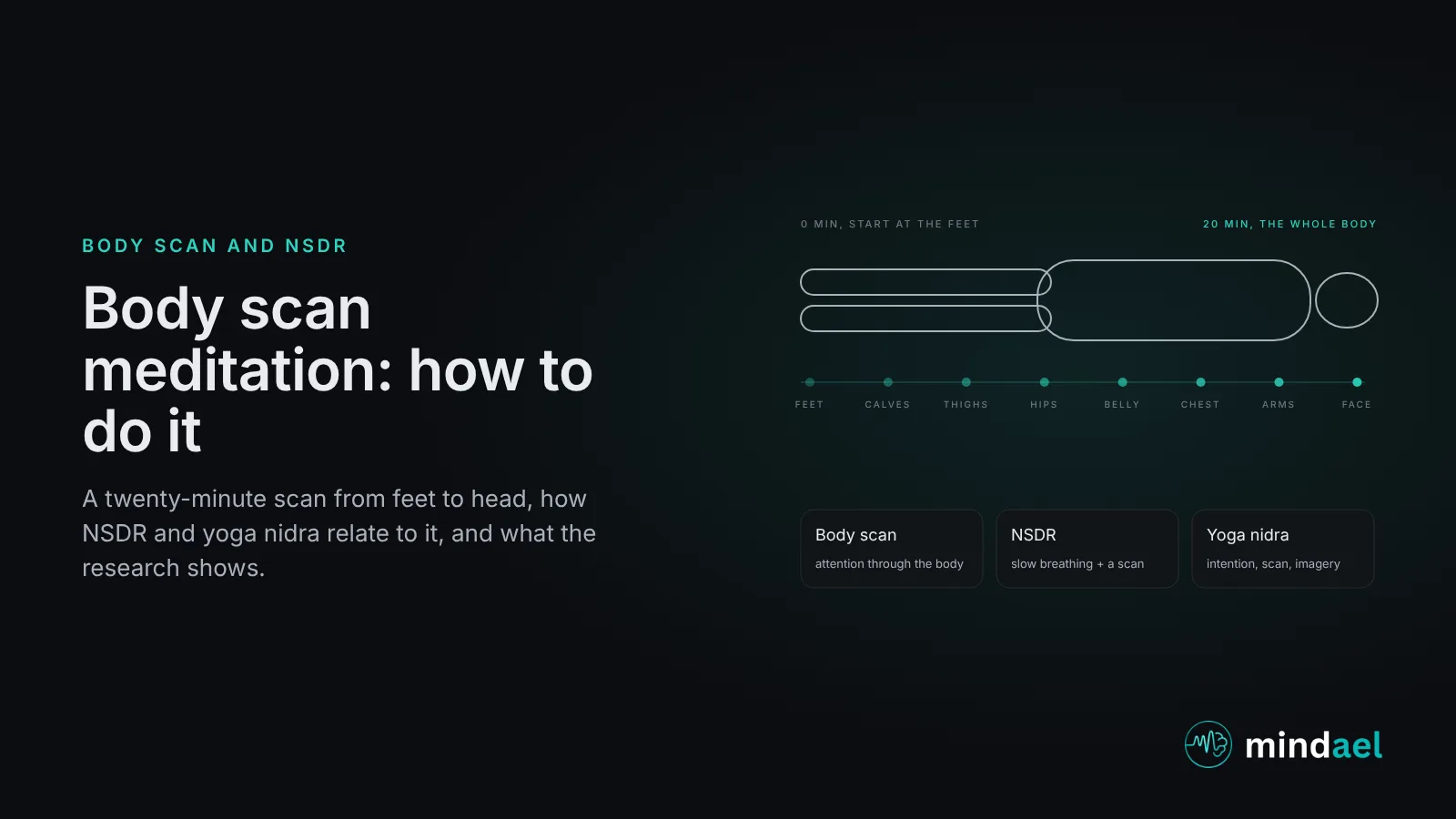
A body scan is lying down and moving attention slowly through the body, region by region, noticing sensation without changing it. It is the first formal practice in mindfulness-based stress reduction. NSDR, non-sleep deep rest, is a modern name for guided deep-rest practices built on the body scan and slow breathing; yoga nidra is the older yogic form, with an intention at the start and end. The evidence: in a small randomised study of people with chronic pain, ten minutes of body scan reduced pain-related distress straight away; a brain-imaging study found increased dopamine release during yoga nidra; reviews find reductions in stress and mild anxiety, with study quality still modest. Twenty minutes, lying down, with a steady low sound, at midday or before sleep.
Sounds that work, and why
Rain
The easiest background for a scan: steady, natural, nothing to follow, and it covers the room noises that pull attention out of the body.
Ocean waves
A slow swell for the breathing at the start, in on the rise and out on the fall, before attention moves to the feet.
Theta waves
The 6 Hz beat under rain in headphones, for a daytime NSDR session where you want to stay on the edge of sleep without crossing it.
Delta waves
The 2 Hz beat for a scan at bedtime, when the plan is to fall asleep at the end.
Brown noise
A deep, soft floor for a noisy flat or an open-plan office at lunchtime, with no hiss to notice.
What a body scan is
A body scan is attention moving slowly through the body. You lie down, start at the toes, and notice what is there in each region in turn: warmth, pressure, tingling, tightness, or nothing at all. You do not try to relax anything. Noticing is the whole practice, and relaxation tends to follow on its own.
It is the first formal practice in mindfulness-based stress reduction, often the first thing participants do at home, and clinicians describe it as the foundation the other practices build on (Dreeben et al., 2013). Its emphasis is on present awareness rather than on producing a change, which is what makes it different from most relaxation techniques.
Body scan, NSDR and yoga nidra
Body scan. The mindfulness version: attention through the body, notice, return when you drift. Ten to thirty minutes.
NSDR, non-sleep deep rest. A modern name for guided deep-rest sessions, usually slow breathing followed by a body scan, aimed at resting deeply while staying just awake. Popular as a midday reset. The name is new; the components are not.
Yoga nidra. The older practice from the yoga tradition, systematised in the 1960s: lying in the corpse pose, a personal intention at the start and end, breath awareness, a body scan and guided imagery, with the aim of deep relaxation while staying aware (Pandi-Perumal et al., 2022).
All three share the core of this page: lying still and moving attention through the body. If you can do a body scan, you can do the other two.
What the research shows
The evidence is promising but early. In a randomised study of 55 people with chronic pain, a ten-minute body scan reduced pain-related distress and pain’s interference with social life immediately afterwards, compared with a ten-minute audio about natural history (Ussher et al., 2014). In a small brain-imaging study, experienced teachers practising yoga nidra showed increased dopamine release in the striatum, alongside a reduced desire for action (Kjaer et al., 2002). Reviews of yoga nidra report reductions in stress and mild anxiety and depression, while noting that many studies are small (Pandi-Perumal et al., 2022).
The slow breathing at the start has the firmest ground: breathing around six times a minute with a longer out-breath shifts the body towards its resting state (Zaccaro et al., 2018).
When to do it
Midday, for a reset. Twenty minutes after lunch, with a theta beat under rain, set to end. Many people use it in place of a nap; our how to take a nap guide covers the other option.
At bedtime, to fall asleep. The same scan with a delta beat or rain, and no end: let the sound run and sleep when it comes. Our meditation for sleep guide has a shorter version for nights when the mind is louder than the body.
After stress. A ten-minute scan after a hard day is one of the easiest ways to come down. The how to relax your nervous system article covers the other tools, and the meditation sounds guide covers seated practice. If you are new to meditation altogether, how to meditate properly explains the loop of drifting and returning that a scan runs on.
How to set it up tonight
- Lie down and set the soundOn your back, arms by your sides, a pillow under the knees if the lower back complains. Rain or ocean, low. Eyes closed. Twenty minutes.
- Three slow breathsIn for four, out for six, letting the body get heavier on each out-breath. Then let the breath go at its own pace.
- Start at the feetToes, soles, heels, ankles. Notice what is there: warmth, pressure, tingling, nothing. No need to relax them; noticing is the practice.
- Move slowly upwardsCalves, knees, thighs, hips, belly, chest, back, hands, arms, shoulders, neck, face, scalp. About a minute or two per region.
- When attention wanders, returnNotice where it went, and come back to the last region you remember. Falling asleep in a daytime scan is common; it means you needed it.
- Finish with the whole bodyA minute of feeling the body as one shape, breathing. Then move fingers and toes, roll to one side, and sit up slowly.
Lie down. Rain on. Start at the feet.
Mindael has rain and ocean recorded without loops, brown noise generated to spec and theta and delta beats made in our studio, two at a time. Free to download, no account, works offline. A steady sound under twenty minutes of deep rest.
- Rain, ocean, brown noise, theta and delta beats, studio-made
- Two sounds at once, fine volume control
- Free to download, no account, works offline
 Free · No account needed · Works offline
Frequently asked questions
What is a body scan meditation?
A practice where you lie down and move attention slowly through the body, usually from the feet to the head, noticing sensations in each region without trying to change them. It is the first formal practice taught in mindfulness-based stress reduction courses and is often used for relaxation and before sleep.
What is NSDR?
NSDR stands for non-sleep deep rest: a guided practice, usually ten to thirty minutes lying down, combining slow breathing and a body scan, meant to rest deeply without falling asleep. It is a modern name rather than a new technique; the components come from yoga nidra and mindfulness practice.
Is yoga nidra the same as a body scan?
Related, not the same. Yoga nidra, yogic sleep, is a longer guided practice from the yoga tradition that includes a body scan, breath awareness, imagery and a personal intention, or sankalpa, at the start and end. A mindfulness body scan is simpler: attention through the body, noticing, returning.
What are the benefits of a body scan?
In a small randomised study, ten minutes of body scan reduced pain-related distress in people with chronic pain straight away. Reviews of yoga nidra report reductions in stress and mild anxiety and depression, though many studies are small. Most people use it to rest during the day and to fall asleep at night.
How long should a body scan be?
Ten minutes is enough to feel the effect; twenty to thirty is the usual length for a full scan or an NSDR session. At midday, set a timer so you do not oversleep; at night, let the sound run and sleep at the end.
Can a body scan replace sleep?
No. Deep rest is restful and can help on a day after a short night, but it does not do what sleep does. Use it alongside sleep, not instead.
Sources
- Dreeben SJ, Mamberg MH, Salmon P. The MBSR body scan in clinical practice. Mindfulness, 2013.
- Ussher M, et al. Immediate effects of a brief mindfulness-based body scan on patients with chronic pain. Journal of Behavioral Medicine, 2014.
- Kjaer TW, et al. Increased dopamine tone during meditation-induced change of consciousness. Cognitive Brain Research, 2002.
- Pandi-Perumal SR, et al. The origin and clinical relevance of yoga nidra. Sleep and Vigilance, 2022.
- Zaccaro A, et al. How breath-control can change your life: a systematic review on psycho-physiological correlates of slow breathing. Frontiers in Human Neuroscience, 2018.
This page is for general information and is not medical advice. A body scan is not a treatment for pain, insomnia or a mental health condition. If attending to the body brings up distress or traumatic memories, stop, open your eyes, and consider practising with a therapist.