
How to Meditate Properly: Posture, Anchor, the Four-Step Loop, and the Mistakes That Make It Harder
Meditating properly does not mean an empty mind. It means running one loop well: attention rests on an anchor, it wanders, you notice, you bring it back. Brain-imaging research describes exactly this cycle, and each return is the skill being trained. Sit upright but relaxed, eyes down or closed, and choose an anchor that is easy to find: a steady sound is easier than the breath for most people. Return gently, without commentary. Ten to twenty minutes daily beats an hour once a week. The common mistakes are trying to stop thoughts, judging the drift, chasing a special state and skipping days.
People who ask how to meditate properly usually suspect they are doing it wrong, because their mind will not go quiet. That is the first thing to correct: meditating properly does not mean an empty mind. It means running one simple loop, again and again, with a light touch. This guide covers that loop, the posture, the anchor, the mistakes that make it harder, and how long to sit. If you are brand new, our how to start meditation guide has the first ten days. The sounds we use as anchors are in Mindael, free to download on the App Store.
The loop is the practice
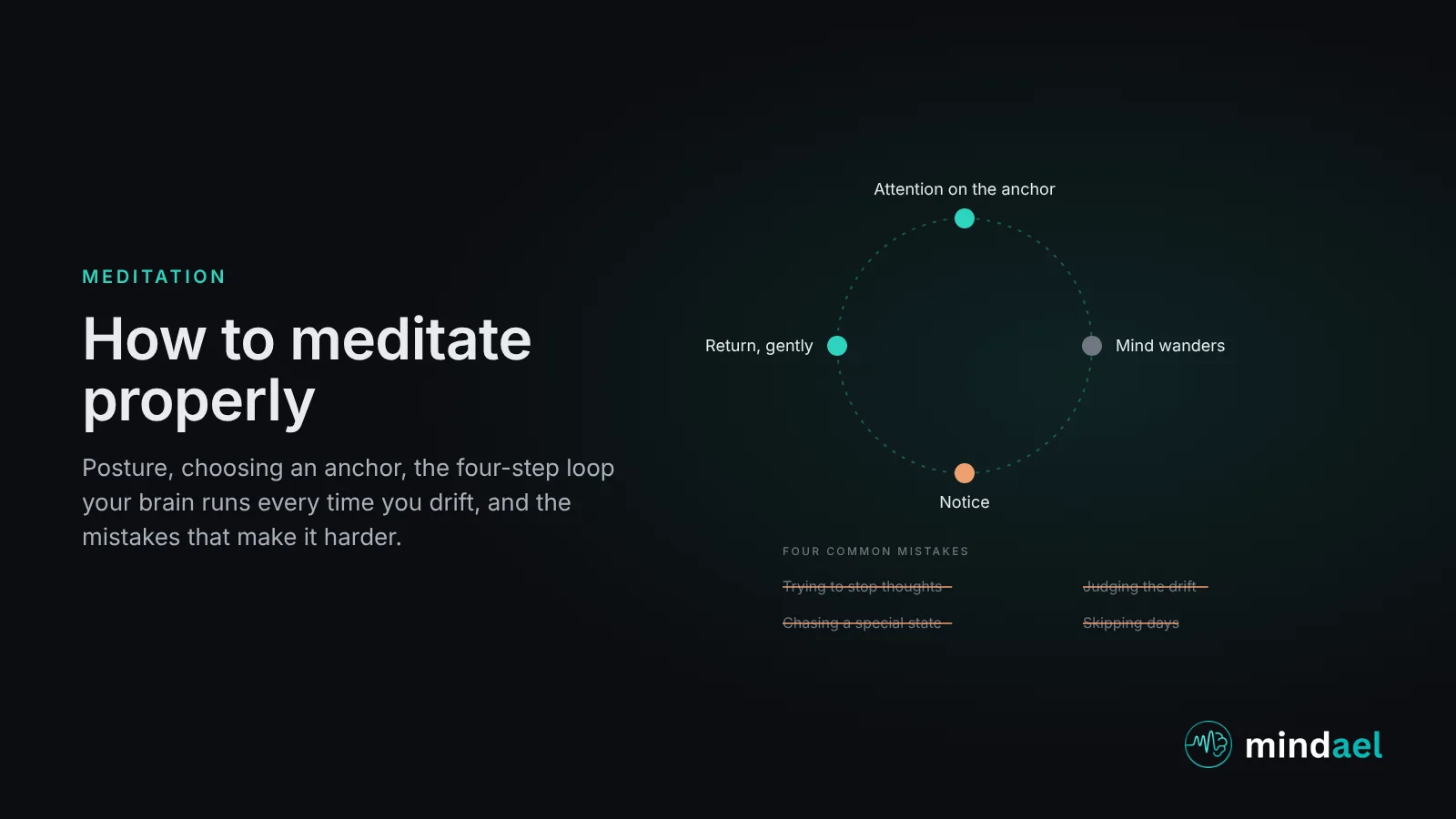
Every focused meditation runs the same cycle. Researchers who scanned meditators’ brains, asking them to press a button each time they caught their mind wandering, described it as four stages: attention on the anchor, mind wandering, noticing the wandering, and shifting attention back (Hasenkamp et al., 2012). Each stage involved different brain networks. The practice is not reaching the first stage and staying there. It is the whole circle, repeated.
That reframes what a good session is. Minds wander almost half the time in ordinary life, and people are less happy while they do (Killingsworth and Gilbert, 2010). Meditation trains the moment of noticing and the return. A session where you came back fifty times trained the skill fifty times.
Posture: upright, relaxed, still
Sit on a chair with feet flat, or on a cushion with knees lower than hips. Spine upright but not stiff, as if the top of your head were lightly lifted. Hands resting on the thighs. Shoulders dropped. Jaw loose. Eyes closed, or half open with a soft gaze on the floor ahead if you get sleepy.
The point of the posture is to be alert and comfortable at the same time. If something hurts, move. Lying down is fine for a body scan or a meditation for sleep, but for daytime practice it makes sleep the likely outcome.
Choosing an anchor
An anchor is the thing attention rests on and returns to. The breath is the classic choice, and for many beginners the hardest: it is subtle, and attending to it often turns into controlling it. A steady sound is easier. It is always present, it needs nothing from you, and it masks the noises that would otherwise pull you away.
Good anchors: rain, a low drone, ocean waves, or a theta beat under rain in headphones. Music with a melody or words is a poor anchor, because attention follows the tune. If you use the breath, rest on the feeling at the nostrils or the belly, and let it run at its own pace. A minute of slow breathing at the start, in for four, out for six, settles the body first (Zaccaro et al., 2018). Our meditation sounds guide covers which sound suits which kind of sit.
How to come back properly
When you notice you have drifted, three things matter.
Notice without commentary. A short mental note, “thinking”, “planning”, is enough. No “here I go again”.
Return gently. Bring attention back to the anchor the way you would guide a puppy back to its spot, without a jerk.
Begin again, completely. Each return is a fresh start. The previous drift does not count against this moment.
The loop runs faster with practice: the drift gets noticed sooner, and the return gets easier. That is the progress, not fewer thoughts.
The four common mistakes
Trying to stop thoughts. Thoughts are not the enemy. Trying to suppress them adds effort and frustration. Let them pass and return to the anchor.
Judging the drift. Criticising yourself for wandering is itself a wander, and an unpleasant one. The noticing is the good part.
Chasing a special state. Some sessions feel calm, some do not. A session that felt restless is not a failed session. Effects show up in daily life, not in how the sit felt.
Skipping days. Ten minutes daily beats an hour on Sunday. Habits form through repetition in a stable context, often over weeks to months (Lally et al., 2010). Same time, same place, same sound.
How long, and what to expect
Ten to twenty minutes a day. In one study, thirteen minutes a day for eight weeks improved attention, working memory, mood and emotional regulation in people who had never meditated (Basso et al., 2019). A review of 47 trials found meditation programmes produced moderate improvements in anxiety, depression and pain (Goyal et al., 2014). Most people notice they return from distraction faster within a couple of weeks, and feel the calmer days a little later.
Use a timer that ends softly. A sound fading out is better than an alarm, which undoes the last ten minutes in one second. Mindael is where we keep the anchors we use: rain, ocean, low drones and theta beats made in our studio, free to download.
An anchor that is always there.
Mindael has rain and ocean recorded without loops, low drones and the 6 Hz theta beat made in our studio, two at a time, with a fade at the end of the sit. Free to download, no account, works offline. Press play, sit, come back to the sound.
- Rain, ocean, drones and theta beats, studio-made
- Two sounds at once, a fade instead of a bell
- Free to download, no account, works offline
 Free · No account needed · Works offline
Frequently asked questions
What is the proper way to meditate?
Sit upright and relaxed, choose an anchor such as a steady sound or the breath, rest attention on it, and when you notice your mind has wandered, bring it back without judging the lapse. That loop, repeated, is the practice. Ten to twenty minutes a day, at the same time, is enough to start.
Am I meditating wrong if my mind keeps wandering?
No. Wandering is part of the practice, not a failure of it. People's minds wander almost half the time in daily life, and in meditation the skill being trained is noticing the drift and returning. A session with fifty returns is a good session.
Should I meditate with my eyes open or closed?
Either. Closed is easier for most beginners. If you get sleepy, open them halfway and rest your gaze on the floor a metre or so in front of you.
Is it okay to meditate lying down?
Yes, especially for a body scan or a practice before sleep, but you are more likely to fall asleep. For daytime practice, sitting upright on a chair or cushion keeps you alert. Comfort matters more than a particular posture.
How long should I meditate for it to work?
Ten to twenty minutes daily. Studies have found improvements in attention, memory and mood with thirteen minutes a day over eight weeks. Consistency matters more than length; five minutes on a hard day keeps the habit.
Do I need music to meditate?
No, but a steady sound makes a good anchor: it is always there, you cannot accidentally control it, and it masks distracting noise. Music with a melody or lyrics is harder, because attention follows the tune. Rain, a low drone or a theta beat work well.
Sources
- Hasenkamp W, Wilson-Mendenhall CD, Duncan E, Barsalou LW. Mind wandering and attention during focused meditation: a fine-grained temporal analysis of fluctuating cognitive states. NeuroImage, 2012.
- Killingsworth MA, Gilbert DT. A wandering mind is an unhappy mind. Science, 2010.
- Basso JC, et al. Brief, daily meditation enhances attention, memory, mood, and emotional regulation in non-experienced meditators. Behavioural Brain Research, 2019.
- Goyal M, et al. Meditation programs for psychological stress and well-being: a systematic review and meta-analysis. JAMA Internal Medicine, 2014.
- Lally P, et al. How are habits formed: modelling habit formation in the real world. European Journal of Social Psychology, 2010.
- Zaccaro A, et al. How breath-control can change your life: a systematic review on psycho-physiological correlates of slow breathing. Frontiers in Human Neuroscience, 2018.
This article is for general information and is not medical advice. Meditation is not a treatment for a mental health condition; if low mood or anxiety is persistent, or if sitting quietly makes distress or traumatic memories worse, please talk to a doctor or therapist.
This article is part of our meditation guide. Hear the sounds in this article in the Mindael sound library, or see our app comparison checklists.