

Music for Writing: What to Play While You Write, What the Research Says, and When to Switch to Steady Sound
Music for writing is one of the most personal choices a writer makes, and the research gives it a clear shape. Words in the music compete with the words you are writing. Fast, loud music hurts reading and editing. But a moderate hum, like a busy café, and upbeat music can both help when the job is coming up with ideas. This page sets out what to play for each stage of writing, from brainstorming to the final edit, and the steady sounds our writers use when music gets in the way. The sounds are in Mindael, free to download on the App Store.
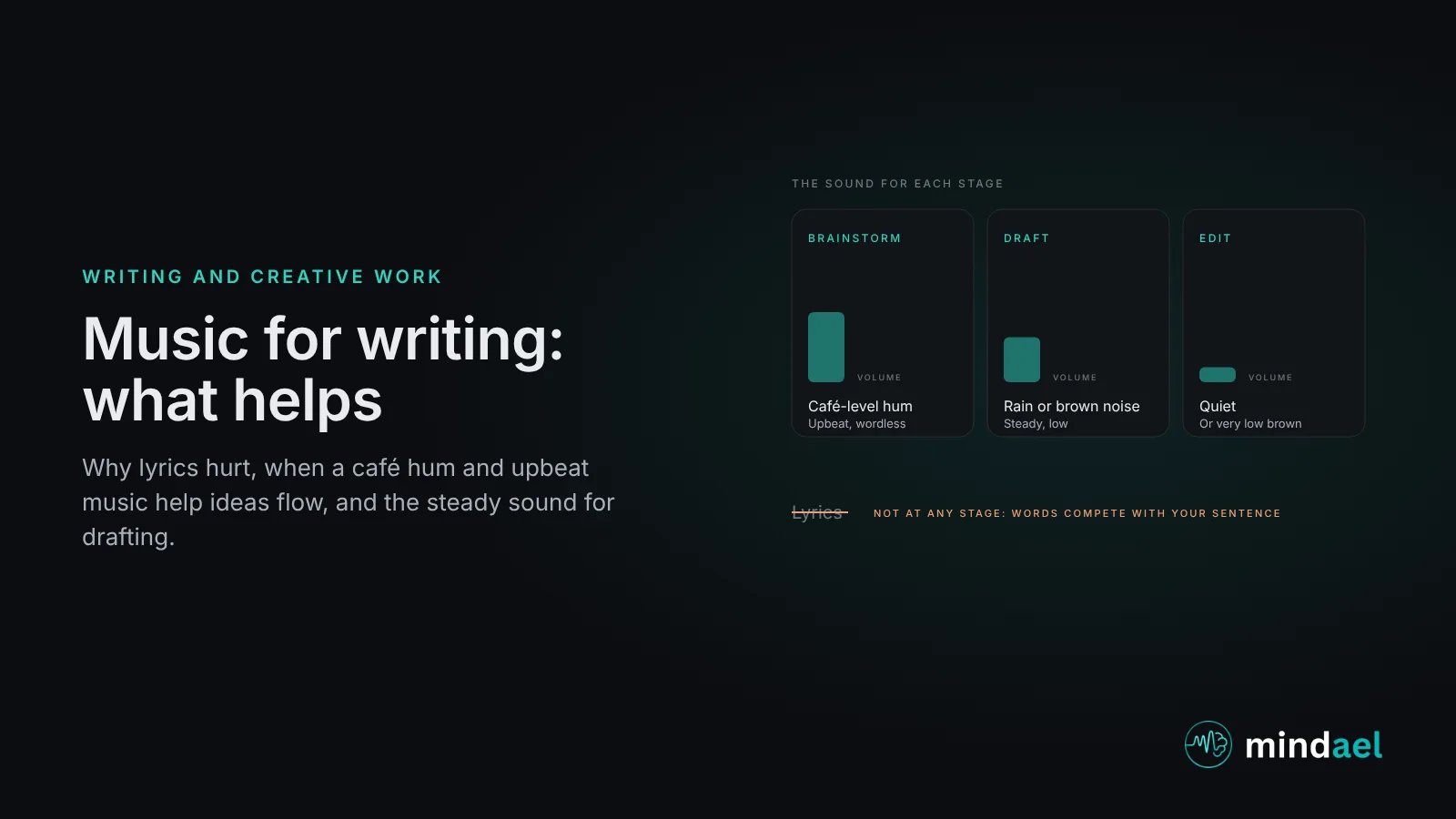
The best music for writing has no words: lyrics draw on the same verbal working memory as writing, and background music reduced writing fluency in a 2001 study. Match the sound to the stage. For brainstorming, a moderate background hum around café level, about 70 dB, improved creative performance in experiments, and upbeat instrumental music boosted divergent thinking. For drafting, a steady sound with nothing to follow, such as rain or brown noise, masks the room without competing with the sentence. For editing, quiet or very low steady sound, because fast and loud music hurt reading comprehension. Keep the volume moderate and the same sound for the same stage, so it becomes a cue.
Sounds that work, and why
Rain
The writer's default for drafting: steady, natural, nothing to follow, and loud enough to hide the flat or the café conversation next to you.
Brown noise
Deeper and softer than rain, for long drafting sessions in a noisy room, with no hiss to notice after an hour.
Pink noise
A little brighter, close to the hum of a busy room, for the brainstorming stage where a moderate background helps ideas come.
Alpha waves
The 10 Hz beat under rain in headphones, for relaxed, wide-open thinking at the start of a piece.
Ocean waves
A slow swell for the break between drafting blocks, to step away from the sentence without switching on something with words.
Why words in the music get in the way
Writing runs on verbal working memory, the short-term space where you hold the sentence you are building. Lyrics land in the same space whether you attend to them or not. In a 2001 experiment, students writing essays with background music wrote less fluently than in quiet, even though they were told to ignore the music (Ransdell and Gilroy, 2001). The effect was smaller for people with musical training and a large working memory, which is why some writers swear by music and others cannot bear it.
Speed and volume matter too. Reading comprehension fell below the level reached in silence only when background music was both fast and loud (Thompson et al., 2012). Slow or soft music did much less harm. Editing is close reading, so it is the stage where this matters most.
When sound helps
The picture flips for idea generation. In five experiments, a moderate level of background noise, about 70 dB, roughly a busy café, improved performance on creative tasks compared with a quiet 50 dB room, while a loud 85 dB background hurt it (Mehta et al., 2012). The authors suggest mild distraction nudges thinking to a more abstract level, which is where new connections come from.
Mood helps as well. In a 2017 study, people who listened to upbeat, positive instrumental music came up with more ideas on divergent thinking tasks than people working in silence; the other kinds of music tested did not show that advantage (Ritter and Ferguson, 2017). Notably, no music helped with convergent tasks, finding the one right answer, which is closer to what editing asks of you.
A sound for each stage of writing
Brainstorming. Café level, wordless. Pink noise or rain at a moderate volume, or an upbeat instrumental you know. Write everything down; judge nothing yet.
Drafting. A steady sound with nothing to follow. Rain is the writer’s default; brown noise for a noisier room. Lower than the brainstorm. The point is to hide the world, not to add to it.
Editing. Quiet, or low brown noise if the room is loud. This is reading, and reading is what fast, loud music hurts.
The same sound for the same stage becomes a cue: press play and the drafting brain arrives sooner. Our focus sounds guide covers the same principle for other kinds of work, the study sounds guide covers reading and revision, and how to concentrate better has the habits around the block.
Making a writing session work
Twenty-five to fifty minutes, then a real break away from the page. Write the next sentence’s first few words before you stop, so the next block starts mid-thought. Keep the phone in another room; the ADHD sounds guide has more on starting when starting is the hard part. Mindael is where we keep our drafting sounds: rain, ocean, brown and pink noise and alpha beats, made in our studio, free to download.
How to set it up tonight
- Brainstorm with a humPink noise or rain at café level, or an upbeat instrumental you like. Write every idea down, judge none. Twenty minutes.
- Draft with a steady soundSwitch to rain or brown noise, lower than the brainstorm. No lyrics, no new music. The sound should disappear after five minutes.
- Keep the same sound for the same stageThe same rain for every drafting session becomes a cue: you press play and the writing brain arrives faster.
- Edit in quietReading your own sentences closely is the stage most hurt by music. Silence, earplugs, or brown noise just loud enough to mask the room.
- Break every 25 to 50 minutesStand up, sound off or ocean on, no reading. The next block starts faster when the break is real.
Press play. Start the sentence.
Mindael has rain and ocean recorded without loops, brown and pink noise generated to spec and alpha beats made in our studio, two at a time. Free to download, no account, works offline. A steady sound for drafting that never asks to be listened to.
- Rain, ocean, brown and pink noise and alpha beats, studio-made
- Two sounds at once, fine volume control
- Free to download, no account, works offline
 Free · No account needed · Works offline
Frequently asked questions
What is the best music for writing?
Music without lyrics, at a moderate volume, that you know well enough not to follow. For drafting, many writers do better with a steady sound such as rain or brown noise than with music. For brainstorming, upbeat instrumentals or a café-level hum can help ideas flow.
Does listening to music while writing help?
It depends on the music and the stage. Background music reduced writing fluency in a study of students writing essays, and lyrics are the main problem because they compete for the same verbal memory as the sentence you are writing. Moderate, wordless background sound can help with idea generation and with masking a noisy room.
Is it bad to write with lyrics?
For most people, yes, during drafting and editing. Your brain processes words in the music whether you want it to or not, and that uses the same resources as writing. Save songs with lyrics for breaks or for routine tasks like formatting.
Why do some writers work in cafés?
A moderate level of background noise, around 70 dB, improved performance on creative tasks in a series of experiments, probably because slight distraction pushes thinking to a more abstract level. Louder noise, around 85 dB, hurt creativity. Pink noise or rain at a moderate volume gives the same effect at home.
What should I listen to while editing?
As little as possible. Fast and loud music reduced reading comprehension in experiments, and editing is close reading of your own work. Silence is best; low brown noise if the room is noisy.
Does music help with writer's block?
Upbeat music boosted divergent thinking, generating many ideas, in a 2017 study, which is the kind of thinking writer's block lacks. Try ten minutes of free writing to something upbeat and wordless, then switch to a steady sound to draft what came out.
Sources
- Ransdell SE, Gilroy L. The effects of background music on word processed writing. Computers in Human Behavior, 2001.
- Thompson WF, Schellenberg EG, Letnic AK. Fast and loud background music disrupts reading comprehension. Psychology of Music, 2012.
- Mehta R, Zhu R, Cheema A. Is noise always bad? Exploring the effects of ambient noise on creative cognition. Journal of Consumer Research, 2012.
- Ritter SM, Ferguson S. Happy creativity: listening to happy music facilitates divergent thinking. PLOS ONE, 2017.