
Best Study Noise: Which Colour of Noise Helps You Study, at What Volume, and When Silence Wins
The best study noise for most people is brown noise, low, in a room that is not quiet: it covers voices and traffic without adding anything the language parts of the brain want to process. Pink noise is the lighter version for long sessions, white noise the sharpest and the one most of the research used; it is best for short bursts in a loud place. The evidence is clearest for people with attention difficulties, where moderate noise improves memory and task performance, and mixed for everyone else, where quiet noise helps in a distracting room and adds little in a silent one. Keep it at a quiet-conversation level, under a timed block, off in the break. In a silent room with a calm mind, silence still wins for reading and memorising.
The best study noise is a more answerable question than “the best study music”, because noise has no lyrics, no melody and no surprises, which are the three things the research says cost you when you read. What is left to decide is which colour, how loud, and whether you need it at all in the room you are in. This article answers those three from the studies, with the honest caveat that the strongest results are in people with attention difficulties and the rest of us get a smaller effect. The noises are in Mindael, free to download on the App Store, and the wider question of music versus noise versus silence for each kind of study task is in our study sounds guide.
What “noise” does for studying
Two things. The first is masking: a steady broadband sound raises the floor of the room, so a door, a voice or a phone buzz has less contrast and stops registering as an event. That is the part everyone gets, and it is why noise helps most in a room that is not quiet. The second is subtler: moderate noise seems to raise arousal in a brain that is running a little low, which is the proposed reason it helps attention in some people and not others.
That second effect is the one with the clearest evidence, and it is mostly about ADHD. Children with attention problems remembered more words with white noise playing, while children without them did slightly worse (Söderlund et al., 2007), a result repeated in inattentive school children in 2010 (Söderlund et al., 2010). A 2024 systematic review and meta-analysis pooled the studies and found small but consistent improvements in attention and task performance for young people with ADHD or elevated attention problems (Nigg et al., 2024). If that is you, our ADHD sounds guide has the setup.
For everyone else the picture is mixed and honest reporting says so. In healthy adults, white noise during learning improved recall and raised activity in the midbrain’s reward regions in one study (Rausch et al., 2014) and improved new-word learning in another (Angwin et al., 2017), but it helped a perceptual task and not a memory task in a third (Herweg and Bunzeck, 2015). A 2022 study that varied the level found moderate white noise improved some cognitive scores while louder noise raised stress (Awada et al., 2022). The practical reading: in a distracting room, quiet noise is a net gain; in a silent room with a calm mind, it is roughly neutral, and silence is fine.
What is not mixed is music. Background music with lyrics or a familiar melody slightly harms reading and memory tasks across a 2011 meta-analysis (Kämpfe et al., 2011). Noise exists in this conversation because it is the sound that does the masking without the cost.
The three colours, for study
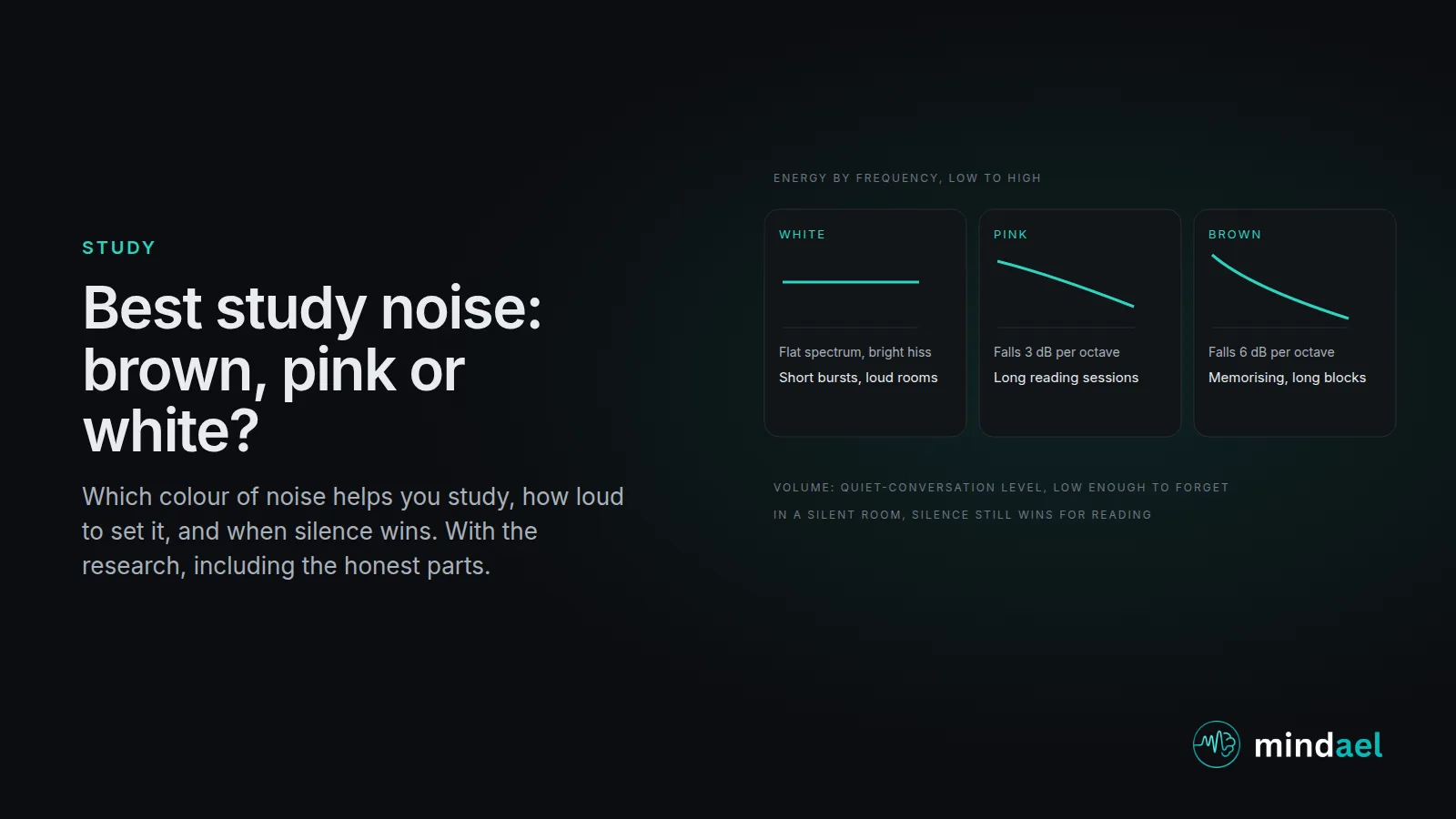
White noise. Equal energy at every frequency, which the ear hears as a bright hiss. It is the colour nearly all the research used, it masks voices and high sounds best, and it is the most tiring over a long session. Best for a short block in a loud place: twenty minutes of flashcards on a train. The white noise page has the detail.
Pink noise. Energy falls as frequency rises, so it sounds like steady rain or wind: softer than white, still bright enough to cover a room. It is the colour with the most sleep-lab research and a sensible default for long reading sessions when brown feels too heavy. The pink noise page covers it.
Brown noise. Energy falls faster still, so what is left is a deep, low rumble, more like a waterfall heard from a distance or a plane cabin. It is the colour most of our listeners choose for study: it masks the low hum of a building and the thud of footsteps, has no hiss to get sharp over hours, and is easy to forget. Best for reading, memorising and anything that runs for an hour or more. The brown noise article has the full case, and brown vs white vs pink compares them with the spectra.
Green noise, a band of pink centred on the middle frequencies, is the natural-sounding option between the two, and some readers find it the least fatiguing of all. Rain is the recorded version of the same idea, with a little variation for people who find pure noise clinical.
How loud
Quiet-conversation level, roughly 50 to 60 decibels at the ear, which in practice means: low enough that you stop noticing it within a minute, and low enough that someone speaking normally across the room still reaches you. The studies that found benefits used moderate levels; the 2022 study found louder noise raised stress and cost performance. If you can hear texture in the noise, it is too loud. Headphones in the library, a speaker at home, and the volume lower than you first set it.
When to use it, and when not to
Use it in a shared house, a library with whisperers, a café, an open office, a room next to a street, and for anyone with attention difficulties in almost any room. Run it under a timed block and turn it off in the break, which is what makes it keep working when it comes back on; the Pomodoro guide has the timing and the best study timer app checklist what to look for in the timer.
Skip it in a genuinely silent room when your mind is calm and the task is reading or memorising. There, silence is as good or better, and noise is just one more thing. Try it on yourself: a week of reading with brown noise, a week without, same kind of material, and compare what stayed.
Never swap it for lyrics, a podcast or a familiar playlist during verbal work. The one study in favour of ambient sound for thinking, a 2012 series on coffee-shop noise, found moderate ambient sound helped creative tasks (Mehta et al., 2012); it did not test reading, and the voices in a café compete with the words on the page in a way noise does not. For brainstorming, a busy café at moderate volume; for the textbook, brown noise or silence. The habits around the sound, the re-entry rule, one thing on the desk, are in our how to concentrate better article.
The short version
Brown noise, low, under a timed block, in any room that is not quiet. Pink if brown is too heavy, white for short bursts in a loud place. Louder is not better. If you have ADHD, noise is the sound with the clearest evidence for study; if you do not, it is a tool for a noisy room rather than a boost in a silent one. Mindael has all four colours generated to spec, free to download, with rain and beats to put underneath and a timer that fades.
The floor under the reading.
Mindael has brown, pink, white and green noise generated to spec, rain recorded without loops, and alpha and beta beats made in our studio, mixed two at a time under a timed block. Free to download, no account, works offline. Set it low, set the block, and forget it is there.
- Brown, pink, white and green noise, generated to spec
- Rain and beats to mix underneath, a block timer that fades
- Free to download, no account, works offline
 Free · No account needed · Works offline
Frequently asked questions
What is the best noise for studying?
Brown noise at a low level for most people in a room that is not quiet: it masks voices and traffic and has no hiss to tire you over a long session. Pink noise if brown feels too heavy, white noise for short bursts in a loud place. In a genuinely quiet room, for someone without attention difficulties, silence is usually as good or better for reading and memorising.
Is white noise or brown noise better for studying?
White noise is the one most studies used and it does the strongest masking, but its hiss gets sharp over hours. Brown noise puts the same energy low, where it feels like a hum rather than a hiss, and is easier to forget about. For a two-hour reading session, brown; for twenty minutes next to a building site, white.
Does background noise help you study?
It depends on who you are and where you are. In people with ADHD or attention difficulties, moderate white noise improved memory and attention in several studies and a 2024 meta-analysis. In people without, the effect is small and goes both ways: quiet noise helps in a distracting room and can hurt slightly in a silent one. Music with lyrics reliably hurts reading and memorising for everyone.
How loud should study noise be?
Quiet-conversation level, roughly 50 to 60 decibels at your ears, low enough that you stop noticing it within a minute. Studies that found benefits used moderate levels; higher levels raised stress and cost performance. If you can hear texture in the noise, turn it down.
Is pink noise good for studying?
Yes, as a gentler alternative to white noise for long sessions. It is the colour with the most sleep research, and for study it sits between white (sharp, strong masking) and brown (deep, calm). Many people use pink for reading and brown for late-evening work.
What about green noise or coffee shop sounds for studying?
Green noise is a band of pink centred on the middle frequencies, a softer, more natural-sounding option that some people prefer to brown. Coffee-shop ambience has one study behind it for creative work at moderate volume, and it works for the same reason as noise, by raising the floor, but the voices in it compete with reading. For verbal work, keep to noise.
Sources
- Söderlund G, Sikström S, Smart A. Listen to the noise: noise is beneficial for cognitive performance in ADHD. Journal of Child Psychology and Psychiatry, 2007.
- Söderlund GBW, et al. The effects of background white noise on memory performance in inattentive school children. Behavioral and Brain Functions, 2010.
- Nigg JT, et al. Systematic review and meta-analysis: do white noise or pink noise help with task performance in youth with ADHD or with elevated attention problems? Journal of the American Academy of Child & Adolescent Psychiatry, 2024.
- Rausch VH, Bauch EM, Bunzeck N. White noise improves learning by modulating activity in dopaminergic midbrain regions and right superior temporal sulcus. Journal of Cognitive Neuroscience, 2014.
- Angwin AJ, et al. White noise enhances new-word learning in healthy adults. Scientific Reports, 2017.
- Herweg NA, Bunzeck N. Differential effects of white noise in cognitive and perceptual tasks. Frontiers in Psychology, 2015.
- Awada M, et al. Cognitive performance, creativity and stress levels of neurotypical young adults under different white noise levels. Scientific Reports, 2022.
- Kämpfe J, Sedlmeier P, Renkewitz F. The impact of background music on adult listeners: a meta-analysis. Psychology of Music, 2011.
- Mehta R, Zhu R, Cheema A. Is noise always bad? Exploring the effects of ambient noise on creative cognition. Journal of Consumer Research, 2012.
This article is part of our study and learning guide. Hear the sounds in this article in the Mindael sound library, or see our app comparison checklists.